“Partnership for Action and Dignity” Indigenous Peoples Evaluating The
Total Page:16
File Type:pdf, Size:1020Kb
Load more
Recommended publications
-

The Mizoram Gazette EXTRA ORDINARY Published Byauthority Regn
The Mizoram Gazette EXTRA ORDINARY Published byAuthority Regn. No. NE-313(MZ) 2006-2008 Rs. 2/- per issue VOL - XXXVII Aizawl, Thursday 11.9.2008 Bhadra 20, S.E. 1930, Issue No. 367 NOTIFICATION No. B. 14016/30/07-LADNC, the 9th September, 2008. LushaiHills District (Administration ofJustice) Rules, 1953, Sec 2 (1) (i) in thuneihna a pek angin Mizoram Governor chuan a hnuaia J... tarian ViUage Council te tan A}·rNEXURE a tarlan ang hian an Boundary a siam a. Tunhma lama heng Village Council te tana boundary 10 siam tawh te chu a thiat nghal ani. It Amaherawh chu heng ramri te hi a tul anga enfiah theih a ni ang. 1 CHA\VILUNGVILLA.GE COUNCIL BOUNDARY 2. TLUNGVEL VILLAGE COUNCIL BOUNDARY 3. DARLAWNG VILLAGE COUNCIL BOUNDARY 4. PHULMAWI VILLAGE COUNCIL BOUNDARY 5. THINGSULTHLIAH, rtllNGSULTLANGNUAM LEHSELINGJOINTVILLAGE COUNCIL BOUNDARY 6. KEPRAN VILLAGE COUNCIL BOUNDARY 7. SAWLENG VILLAGE COUNCIL BOUNDARY 8. N. SERZAWLVILLAGE COUNCIL BOUNDARY 9. SATEEKVILLAGE COUNCIL BOUNDARY 10. MAUBUANG VILLAGE COUNCIL BOUNDARY 11. LENCHIM VILLAGE COUNCIL BOUNDARY 12. RUALLUNG LEH RULCHAWM VILLAGE COUNCIL BOUNDARY 13. DAIDO VILLAGE COUNCIL BOUNDARY 14. N.E.TLANGNUAM VILLAGE COUNCIL BOUNDARY 15. PHUAIBUANG VILLAGE COUNCIL BOUNDARY 16. KHAWLIAN VILLAGE COUNCIl BOUNDARY 17. MUALLUNGTHU VILLAGE COlJNCIL BOUNDARY 18. KELSIH VILLAGE COUNCIL BOUNDARY 19. MELRIATVILLAGE COUNCIL BOUNDARY 20. HUALNGOHMUN VILLAGE COUNCIL BOUNDARY Ex-367/2008 - 2 - 21. SAMTLANG VILLAGE COUNCIL BOUNDARY 22. FALKAWN VILLAGE COUNCIL BOUNDARY 23. N.KHAWLEK VILLAGE COUNCIL BOUNDARY 24. VANBAWNG VILLAGE COUNCIL BOUNDARY 25. LAMHERH VILLAGE COUNCIL BOUNDARY 26. ZAWNGIN VILLAGE COUNCIL BOUNDARY 27. SUANGPUILAWN VILLAGE COUNCIL BOUNDARY 28. SAILAM VILLAGE COUNCIL BOUNDARY 29. -
In the Court of Additional District Judge Aizawl Judicial District, Aizawl, Mizoram
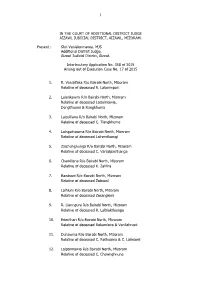
1 IN THE COURT OF ADDITIONAL DISTRICT JUDGE AIZAWL JUDICIAL DISTRICT, AIZAWL, MIZORAM. Present : Shri Vanlalenmawia, MJS Additional District Judge, Aizawl Judicial District, Aizawl. Interlocutory Application No. 358 of 2015 Arising out of Execution Case No. 17 of 2015 1. R. Vanlalfaka R/o Bairabi North, Mizoram Relative of deceased R. Lalawmpuii 2. Lalenkawmi R/o Bairabi North, Mizoram Relative of deceased Lalzuimawia, Dengthuami & Rangkhuma 3. Lalzuiliana R/o Bairabi North, Mizoram Relative of deceased C. Tlangkhuma 4. Lalngaihawma R/o Bairabi North, Mizoram Relative of deceased Lalremtluangi 5. Zaichungnunga R/o Bairabi North, Mizoram Relative of deceased C. Vanlalpanthanga 6. Chawiliana R/o Bairabi North, Mizoram Relative of deceased K. Zahlira 7. Bawbawi R/o Bairabi North, Mizoram Relative of deceased Zobuani 8. Lalhluni R/o Bairabi North, Mizoram Relative of deceased Zosangkimi 9. R. Lianngura R/o Bairabi North, Mizoram Relative of deceased R. Lalbiaktluanga 10. Edenthari R/o Bairabi North, Mizoram Relative of deceased Rokamlova & Vanllahruaii 11. Duhawma R/o Bairabi North, Mizoram Relative of deceased C. Rothuama & C. Lalmawii 12. Lalparmawia R/o Bairabi North, Mizoram Relative of deceased C. Chawnghnuna 2 13. Lalrohnuni R/o Bairabi North, Mizoram Relative of deceased Zodinpuii, Vanlalbani, Chanchinmawii & Rothangvungi 14. Lalduhawmi R/o Bairabi North, Mizoram Relative of deceased Lalngaihawmi 15. Kapmawii R/o Bairabi North, Mizoram Relative of deceased Rosangkima, Khuangliani, Chiluaia & Lalramthanga 16. Zakhumi Relative of deceased Vanlalnghaka R/o Bairabi North, Mizoram 17. Vanlalbuka R/o Bairabi North, Mizoram Relative of deceased Lalbiaknungi 18. Lalthlamuani R/o Bairabi North, Mizoram Relative of deceased Huapzauvi & Singha 19. -
Hydrological Observation Sites
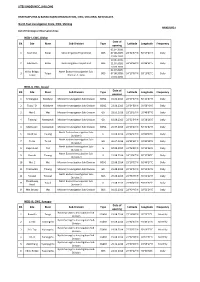
SITES UNDER NEIC, SHILLONG BRAHMAPUTRA & BARAK BASIN ORGANIZATION, CWC, SHILLONG, MEGHALAYA North‐East Investigation Circle, CWC, Shillong ANNEXURE‐I List of Hrdrological Observation Sites: NEID‐I, CWC, Silchar Date of SN. Site River Sub‐Division Type Latitude Longitude Frequency opening 02.07.2009, 1 Kashithal Sonai Sonai Irrigation Project Unit GDS 07.08.2009, 24°32'37''N 92°57'25''E Daily 01.05.2010 29.06.2009, 2 Kulicherra Rukni Rukni Irrigation Project Unit GDS 21.07.2009, 24°29'26''N 92°48'21''E Daily 01.05.2010 02.07.2009, Valley Bridge, North Eastern Investigation Sub‐ 3 Tuipui GDS 07.08.2009, 24°13'36''N 93°10'02''E Daily Tuipui Division‐5, Baite 01.05.2010 NEID‐II, CWC, Aizawl Date of SN. Site River Sub‐Division Type Latitude Longitude Frequency opening 1 Sihtlangpui Kolodyne Mizoram Investigation Sub‐Division GDSQ 01.01.2015 22°57'37''N 92°24'37''E Daily 2 Tuipui 'D' Kolodyne Mizoram Investigation Sub‐Division GDSQ 22.06.2013 22°54'50''N 93°56'40''E Daily 3 Mat‐1 Mat Mizoram Investigation Sub‐Division GD 23.09.2013 23°18'99''N 92°48'87''E Daily 4 Tlabung Karnaphuli Mizoram Investigation Sub‐Division GD 10.08.2013 22°53'54''N 92°28'26''E Daily 5 Mateswari Karnaphuli Mizoram Investigation Sub‐Division GDSQ 25.07.2013 22°56'25''N 92°31'32''E Daily North Eastern Investigation Sub‐ 6 Reiek Kai Tlawng G 07.08.2014 23°42'43''N 92°40'00''E Daily Division‐3 North Eastern Investigation Sub‐ 7 Turial Tuirial GD 30.07.2014 23°51'00''N 92°49'48''E Daily Division‐3 North Eastern Investigation Sub‐ 8 Dapchhuah Tut G 04.08.2014 23°46'09''N -

Schedule-Ii: Village Profile (Khaw Dinhmun Tlangpui)
SCHEDULE-II: VILLAGE PROFILE (KHAW DINHMUN TLANGPUI) Khuaa Moto Highe Chung h r Naupang r Middl Prima PHE kaw APL BPL Lo nei High Sub_ electric kawn District Code Mipa Hmeichhia kum 14 Colle Secon e ry Hosp tui lak zawng SI No District Village/Veng hming Name of Block APL zat BPL zat mihring mihring chhungkaw Scho UHC CHC PHC Centr ity a gin Code No awm zat awm zat hnuai lam ge dary Schoo Scho ital a awm zawng awm zat awm zat awm zat ol e awm khua awm zat Schoo l ol em awm tawh a l zat em pawh 1 2 3 4 5 6 7 8 9 10 11 12 13 14 15 16 17 18 19 20 21 22 23 24 25 26 27 28 1 Kolasib 02 Bairabi N 01 Bilkhawthlir 806 103 0 0 1 6 6 0 0 0 1 0 yes yes yes 909 2 Kolasib 02 Bairabi South Bilkhawthlir 355 11 0 0 1 2 2 0 0 0 0 1 yes yes yes 366 3 Kolasib 02 Bilkhawthlir N 02 Bilkhawthlir 411 79 0 0 0 1 2 0 0 0 0 1 yes yes yes 490 4 Kolasib 02 Bilkhawthlir South 03 Bilkhawthlir 503 61 2610 234 1401 1443 118 767 0 1 1 2 3 0 0 0 1 1 yes yes yes 564 5 Kolasib 02 Buhchangphai 18 Bilkhawthlir 184 27 450 523 200 0 0 1 1 2 0 0 0 0 1 yes yes yes 221 6 Kolasib 02 Bukvannei 21 Bilkhawthlir 76 32 342 158 234 266 30 50 0 0 0 1 1 0 0 0 0 0 yes yes yes 118 7 Kolasib 02 College Veng, Kolasib Bilkhawthlir 238 48 1308 203 730 771 64 127 0 0 1 1 1 0 0 1 1 1 Yes Yes Yes 286 8 Kolasib 02 Diakkawn, Kolasib 08 Bilkhawthlir 964 62 0 0 0 2 3 0 0 0 0 0 yes yes yes 1026 9 Kolasib 02 Electric Veng, Kolasib Bilkhawthlir 244 26 270 26 538 601 10 0 0 0 0 0 0 0 0 0 0 Yes Yes Yes 270 10 Kolasib 02 Hmarveng, Kolasib 09 Bilkhawthlir 726 40 2527 160 1329 1358 30 757 0 0 1 4 5 0 0 0 0 1 Yes Yes Yes 766 11 Kolasib 02 Khuangpuilam, Kolasib Bilkhawthlir 293 8 1500 31 796 735 150 435 0 0 0 2 1 0 0 0 0 0 Yes Yes Yes 301 12 Kolasib 02 Meidum 19 Bilkhawthlir 205 18 0 0 1 1 1 0 0 0 0 1 yes yes yes 223 13 Kolasib 02 N. -

Social Structure of Mizo Village: a Participatory Rural Appraisal
International Journal of Bio-resource and Stress Management 2019, 10(1):077-080 Research Article Doi: HTTPS://DOI.ORG/10.23910/IJBSM/2019.10.1.1899 Social Science Social Structure of Mizo Village: a Participatory Rural Appraisal Lalhmunmawia and Samares Kumar Das* Dept. of Veterinary & Animal Husbandry Extension, College of Veterinary Sciences & Animal Husbandry, Central Agricultural University, Selesih, Aizawl, Mizoram (796 015), India Corresponding Author Article History Samares Kumar Das Article ID: AR1899 e-mail: samcau.d1@gmail.com Received in 14th September, 2018 Received in revised form 21st February, 2019 Accepted in final form 27th February, 2019 Abstract Mizoram in india, the land of Mizo, is the fifth smallest state in India with the highest tribal population. However, there is a dearth of in depth study on social structure of Mizo village. This calls for a better understanding of social structure for planning and implementation of location specific research and development programs. Keeping this in view, a field study was carried out in a purposively selected village named Muthi in Aizawl district of Mizoram to study the social structure through Participatory Rural Appraisal (PRA) to help R&D professionals to plan and implement location specific development programs. Case study was done following the principles and methods of PRA. Data collected through PRA were analyzed and reported through the principles and methods of PRA. Established in 1910, Muthi was a village with three localities. Supply and services included road, path, stair steps, spring, cemetery, community hall, shop, post office, playing ground, and a number of institutions and organisations.Among institutions in the village, Church and Young Mizo Association were most important. -
Displaced Brus from Mizoram in Tripura: Time for Resolution
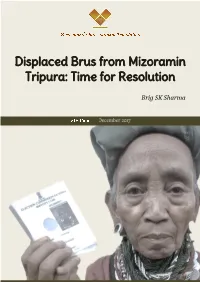
Displaced Brus from Mizoramin Tripura: Time for Resolution Brig SK Sharma Page 2 of 22 About The Author . Brigadier Sushil Kumar Sharma, YSM, PhD, commanded a Brigade in Manipur and served as the Deputy General Officer Commanding of a Mountain Division in Assam. He has served in two United Nation Mission assignments, besides attending two security related courses in the USA and Russia. He earned his Ph.D based on for his deep study on the North-East India. He is presently posted as Deputy Inspector General of Police, Central Reserve Police Force in Manipur. http://www.vifindia.org ©Vivekananda International Foundation Page 3 of 22 Displaced Brus from Mizoram in Tripura: Time for Resolution Abstract History has been witness to the conflict-induced internal displacement of people in different states of Northeast India from time to time. While the issues of such displacement have been resolved in most of the North-eastern States, the displacement of Brus from Mizoram has remained unresolved even over past two decades. Over 35,000 Brus have been living in six makeshift relief camps in North Tripura's Kanchanpur, areas adjoining Mizoram under inhuman conditions since October 1997. They had to flee from their homes due to ethnic violence in Mizoram. Ever since, they have been confined to their relief camps living on rations doled out by the state, without proper education and health facilities. Called Internally Displaced Persons (IDPs), some of the young Brus from these camps have joined militant outfits out of desperation. There have been several rounds of talks among the stakeholders without any conclusive and time-bound resolutions. -

Pseudolaguvia Virgulata, from Mizoram, India
http://sciencevision.info Sci Vis 10 (2), 73 Research Report April-June, 2010 ISSN 0975-6175 On the new catfish, Pseudolaguvia virgulata, from Mizoram, India Lalramliana Department of Zoology, Pachhunga University College, Mizoram University, Aizawl 796001, India A new species of catfish was recently identi- fied from some major rivers of Mizoram. Heok Hee Ng and Lalramliana named the new catfish Pseudolaguvia virgulata, after its distinctively striped colour pattern (virgulata = “striped” in Latin). Besides its distinctive colour pattern, which consists of pale stripes running along the entire length of the body, a pale y-shaped marking on the head and brown stripes running through the caudal fin lobes, the new catfish also differs from congeners in other characters. These in- clude: head width 21.2–24.4% standard length; pectoral-fin length 28.5–29.1% standard length; length of dorsal-fin base 17.2–19.9% standard length; dorsal-spine length 21.5–24.0% standard length; serrated anterior edge of dorsal spine; thoracic adhesive apparatus reaching beyond base of last pectoral-fin ray; body depth at anus 14.5–17.4% standard length; length of adipose- fin base 12.9–15.0% standard length; caudal peduncle length 18.2–20.2% standard length; caudal peduncle depth 7.8–9.7 % standard length; snout length 48.0–54.9% head length; interorbital distance 29.3–35.2% head length; 29 –30 vertebrae. Pseudolaguvia virgulata was collected from river system, one of the three rivers that form clear, shallow, moderately flowing streams with the Ganges Delta. a predominantly sandy bottom. -

The Mizoram Gazette Published by Author,Ity
Regd. No. NE 907 The Mizoram Gazette Published by Author,ity Vol XUI Aizawl Friday 2.11.1984 Kartika 11 S.B. 1906 Issue No. 44 , ;t)vernment of ,Mizoram PA!:tT I ,t.,;�"P8,;-,�,nents, Postings, Transfers, Powers, Leave and other F\;rsonal Notices and OrGers. ORDERS BY THE LT. GOV ERNOR (ADMINISTRATOR) NOTIFICATIONS , No.B. 20022j 1/84-EDN/3, the 29th October, 1984. The Lt. Governor of Mizoram is pleased to constitute a Co-ordination Committee of Archives with the following members and under the terms of reference shown below with immediate effect and until further order:- 1. 1) Chief Secretary Govt. of Mizoram. Chairman ...- 2) Deputy Commissioner Aizawl. Member 3) Education Secretary, Govt. of Mizoram. -do- Director of Education, Mizoram. -do- 54)) Dy Director Education. i/c Adult & Culture, Mizoram, Aizawl. -do- 6) President, District Council Court. -do- -7) Director of Agriculture, Mizoram. -do- '\. 8) Chief En,2ineer; P.W.D. Aizawl. - -do- 8) Su b-Diyisional Education Officer, Aizawl West.- ' -do- lO) Senior Executive Secretary, Mizoram Presbyterian Church. -do- l l) Representative of the Mizoram Baptist MIssion Church Lunglei -do-- 12) Representative of the Mizoram Roman Catholic Church, .Aizawl. --do- 13� Renresentative of the Mizoram Salvation Army, Aizawl. -do- 14) Superintendent of Archives -do- 15) Curator. J\1izoram· State Museum Mem ber Secretary. R-44/84 2 ' II. The function of the Co-ordi nation Committee of Archives is to implement the (i)main fWlctions of a Shte Record Office as follows:- To conccntrak in a single repos itory a]l the non current records, both , (a) Confidential and non-confidential of the State �ecretariat and the s ubor dingte t:1uthorities to it whether at the headqua'rters or elsewhere inc1udin£r District Divis'on' and coUectorate records and similar records I of the igh Court and othtr cou t; H r (b) To house th:m in a properly equipped building: (c) To arr.]I1.;e (IIld clarify them on Scientific principles; (d) To take such measures, as are required; for their preservation and reha- bilitation; . -

The State and Identities in NE India
1 Working Paper no.79 EXPLAINING MANIPUR’S BREAKDOWN AND MANIPUR’S PEACE: THE STATE AND IDENTITIES IN NORTH EAST INDIA M. Sajjad Hassan Development Studies Institute, LSE February 2006 Copyright © M.Sajjad Hassan, 2006 Although every effort is made to ensure the accuracy and reliability of material published in this Working Paper, the Development Research Centre and LSE accept no responsibility for the veracity of claims or accuracy of information provided by contributors. All rights reserved. No part of this publication may be reproduced, stored in a retrieval system or transmitted in any form or by any means without the prior permission in writing of the publisher nor be issued to the public or circulated in any form other than that in which it is published. Requests for permission to reproduce this Working Paper, of any part thereof, should be sent to: The Editor, Crisis States Programme, Development Research Centre, DESTIN, LSE, Houghton Street, London WC2A 2AE. 1 Crisis States Programme Explaining Manipur’s Breakdown and Mizoram’s Peace: the State and Identities in North East India M.Sajjad Hassan Development Studies Institute, LSE Abstract Material from North East India provides clues to explain both state breakdown as well as its avoidance. They point to the particular historical trajectory of interaction of state-making leaders and other social forces, and the divergent authority structure that took shape, as underpinning this difference. In Manipur, where social forces retained their authority, the state’s autonomy was compromised. This affected its capacity, including that to resolve group conflicts. Here powerful social forces politicized their narrow identities to capture state power, leading to competitive mobilisation and conflicts. -

Economic Development of Mizoram
IOSR Journal of Humanities And Social Science (IOSR-JHSS) Volume 25, Issue 8, Series 4 (August. 2020) 17-22 e-ISSN: 2279-0837, p-ISSN: 2279-0845. www.iosrjournals.org Anassessment of the Role of Political Partiesin the Socio- Economic Development of Mizoram F. LALRAMHLUNI Research Scholar, Department of Political Science Mizoram University (MZU) Abstract Political parties are essential to the functioning of democracy; they performed varied functions within and outside the realm of politics. Their role in political mobilization, governance, the formulation and implementation of economic and social policy, ethnic conflict and the working of democracy has been intensified and gained importance in the democratic set up. Their centrality arises from the fact that they are the key link between the individual and the state, the state and the society. Political parties provide crucial connection between social process and policy makers, and influence debate and policies affecting the interest of various social groups in the political system. Election is an important part of democratic process. Political parties issue their agendas, goals and objectives to the voters in the form of election manifesto. It is a statement by political party what it will do if they win the elections. Political parties are evaluated and examined their performances based on their election manifestos. This paper aims to analyse and seek the role of political parties in socio- economic development of Mizoram through their electoral performances and their policies since the attainment of statehood in 1986 till the last State Legislative Assembly Elections of 2018. ----------------------------------------------------------------------------------------------------------------------------- --------- Date of Submission: 25-07-2020 Date of Acceptance: 09-08-2020 ----------------------------------------------------------------------------------------------------------------------------- ---------- I. -

Ethnic History and Identity of the Zo Tribes in North East India
Journal of North East India Studies Vol. 5(1), Jan.-Jun. 2015, pp. 39-50. Ethnic History and Identity of the Zo Tribes in North East India H. Thangtungnung North East India is a hotspot of identity crisis and ethnic divisions. The Chin, Kuki, Zomi and Mizo tribes who are collectively known as Zo people are no exception. They have close cultural, lingual and religious affinities and a com- mon ancestor called Zo. Historically, they have different theories of origin and migration based on their folklores, folktales and songs narrated down from one generation to another. The different origin theories like the Khul/Chhinlung or Cave origin theory, Chin Hills origin theory and Lost tribe (Manmasi) theory are among the most significant theories so far which speak, to some extent, some- thing about their history and origin. Of late, the Lost Tribe theory has gained momentum which claims that the Zo tribes are among the ten lost tribes of Israel, particularly from the tribe of Manasseh. Israeli Chief Rabbi Shlomo Amar had recognised them as descendents of Israel in 2005, which was also approved by the Israeli government. Many have consequently immigrated to the ‘Holy Land’. In this backdrop, this paper is attempts to critically analyse and assess the ethnic origin of the Zo people with special reference to the lost tribe theory. Based on cultural and oral traditions, and Biblical sources, it also attempts to support that the Zo people are the ten lost tribe of Israel by substantiating various arguments to validate this origin theory. Keywords: Zo, Khul origin theory, Chin Hills theory, Lost tribe, Manmasi Introduction The Zo people are indigenous tribes of Manipur and Mizoram in Northeast India, Bangladesh and Chin State of Myanmar. -
Understanding the Breakdown in North East India: Explorations in State-Society Relations
Working Paper Series ISSN 1470-2320 2007 No.07-83 Understanding the breakdown in North East India: Explorations in state-society relations M. Sajjad Hassan Published: May 2007 Development Studies Institute London School of Economics and Political Science Houghton Street Tel: +44 (020) 7955 7425/6252 London Fax: +44 (020) 7955-6844 WC2A 2AE UK Email: d.daley@lse.ac.uk Web site: www.lse.ac.uk/depts/destin 1 Understanding the breakdown in North East India: Explorations in state-society relations M. Sajjad Hassan DESTIN, London School of Economics 1. Introduction Northeastern India – a compact region made up of seven sub-national states1- has historically seen high levels of violence, stemming mostly from ethnic and separatist conflicts. It was among the first of the regions, to demonstrate, on the attainment of Independence, signs of severe political crisis in the form of nationalist movements. This has translated into a string of armed separatist movements and inter-group ethnic conflicts that have become the enduring feature of its politics. Separatist rebellions broke out first in Naga Hills district of erstwhile Assam State, to be followed by similar armed movement in the Lushai Hills district of that State. Soon secessionism overtook Assam proper and in Tripura and Manipur. Of late Meghalaya and Arunachal Pradesh have joined the list of States that are characterised as unstable and violent. Despite the attempts of both the state and society, many of these violent movements have continued to this day with serious implications for the welfare of citizens (Table 1). Besides separatist violence, inter-group ethnic clashes have been frequent and have taken a heavy toll of life and property.2 Ethnic violence exists alongside inter-ethnic contestations, over resources and opportunities, in which the state finds itself pulled in different directions, with little ability to provide solutions.