I Served the King of England
Total Page:16
File Type:pdf, Size:1020Kb
Load more
Recommended publications
-

Copyrighted Material
Index Academy Awards (Oscars), 34, 57, Antares , 2 1 8 98, 103, 167, 184 Antonioni, Michelangelo, 80–90, Actors ’ Studio, 5 7 92–93, 118, 159, 170, 188, 193, Adaptation, 1, 3, 23–24, 69–70, 243, 255 98–100, 111, 121, 125, 145, 169, Ariel , 158–160 171, 178–179, 182, 184, 197–199, Aristotle, 2 4 , 80 201–204, 206, 273 Armstrong, Gillian, 121, 124, 129 A denauer, Konrad, 1 3 4 , 137 Armstrong, Louis, 180 A lbee, Edward, 113 L ’ Atalante, 63 Alexandra, 176 Atget, Eugène, 64 Aliyev, Arif, 175 Auteurism , 6 7 , 118, 142, 145, 147, All About Anna , 2 18 149, 175, 187, 195, 269 All My Sons , 52 Avant-gardism, 82 Amidei, Sergio, 36 L ’ A vventura ( The Adventure), 80–90, Anatomy of Hell, 2 18 243, 255, 270, 272, 274 And Life Goes On . , 186, 238 Anderson, Lindsay, 58 Baba, Masuru, 145 Andersson,COPYRIGHTED Karl, 27 Bach, MATERIAL Johann Sebastian, 92 Anne Pedersdotter , 2 3 , 25 Bagheri, Abdolhossein, 195 Ansah, Kwaw, 157 Baise-moi, 2 18 Film Analysis: A Casebook, First Edition. Bert Cardullo. © 2015 John Wiley & Sons, Inc. Published 2015 by John Wiley & Sons, Inc. 284 Index Bal Poussière , 157 Bodrov, Sergei Jr., 184 Balabanov, Aleksei, 176, 184 Bolshevism, 5 The Ballad of Narayama , 147, Boogie , 234 149–150 Braine, John, 69–70 Ballad of a Soldier , 174, 183–184 Bram Stoker ’ s Dracula , 1 Bancroft, Anne, 114 Brando, Marlon, 5 4 , 56–57, 59 Banks, Russell, 197–198, 201–204, Brandt, Willy, 137 206 BRD Trilogy (Fassbinder), see FRG Barbarosa, 129 Trilogy Barker, Philip, 207 Breaker Morant, 120, 129 Barrett, Ray, 128 Breathless , 60, 62, 67 Battle -

CZECH CINEMA: NEW WAVE and BEYOND Coordinators: Robert
CZECH CINEMA: NEW WAVE AND BEYOND Coordinators: Robert Gerace and Eva Vogel We survey films from the Czech cinema after WW II, beginning with the German and Soviet Occupations, continuing with the Czech New Wave and the Prague Spring of the 1960’s, and ending with more contemporary films of the modern era. Our materials on Czech and Slovak history and culture provide a framework and context for critical evaluation. We ask which policies and attitudes of the prevailing Soviet and German authorities are satirized in these films? How do the directors attempt to bypass strict censorship of this veiled government criticism? We come to understand the importance of the Czech film industry and how it reflected the historic struggles and aspirations of the citizens of Bohemia and Slovakia. Readings and other Required Materials: Subscription to Netflix is required. Class handouts and Web references will be provided. They include film reviews, director biographies and articles on Czech and Slovak history and culture. Robert has coordinated study groups on Greenwich Village Writers, Italian Neo Realism, and French New Wave Cinema. Eva is an enthusiast of Czech and Slovak films that reflect her family’s experience of the WWII German occupation and her own life during the Soviet occupations after 1968. * * * * * * * * Syllabus * * * * * * * * After viewing the films at home we consider assigned questions about theme, character development, cinematography and director’s style. We evaluate our answers as we view and discuss film clips of the highlights shown in class. Students are encouraged to submit their own questions for class discussion. Assigned background readings include: "Prague Spring: Russian tanks in the streets and a New Wave in the cinema," Peter Hames, The Manchester Guardian, 1999. -

Jiří Menzel Ostre Sledované Vlaky/ Closely Watched Trains 1966 93
October 16, 2007 (XV:8) Jií Menzel Ostre sledované vlaky/ Closely Watched Trains 1966 93 minutes Directed by Jií Menzel Written by Bohumil Hrabal (also novel), Jirí Menzel Produced by Zdenek Oves and Carlo Ponti Original Music by Jirí Sust Cinematography by Jaromír Sofr Film Editing by Jirina Lukesová Václav Neckár... Trainee Milos Hrma Josef Somr...Train dispatcher Hubicka Vlastimil Brodsk...Counselor Zednicek Vladimír Valenta...Stationmaster Max Alois Vachek...Novak Ferdinand Kruta... Masa's Uncle Noneman Jitka Bendová...Conducteress Masa Jitka Zelenohorská...Zdenka Nada Urbánková...Victoria Freie Libuse Havelková...Max's wife Kveta Fialová...The countess Pavla Marsálková...Mother Milada Jezková...Zdenka's mother Academy Award for Best Foreign Language Film JIÍ MENZEL (23 February 1938, Prague, Czechoslovakia) has directed 26 films and acted in many more. Some of the films he directed are Obsluhoval jsem anglického krále/ I Served the King of England (2006), Zebrácká opera/The Beggar’s Opera (1991), Konec starych casu/The End of Old Times (1989), Postriziny/Cutting it Short (1981), Promeny krajiny/Altered Landscapes (1974), Zlocin v dívcí skole/Crime at the Girls School (1965), and Domy z panelu/Prefabricated Houses (1960). from World Film Directors, Vol. II. Ed. John Wakeman. The H.W. Wilson Company NY 1988 Jií Menzel (February 12, 1938— ), Czech film and theatre director, scenarist, and actor, was born in Prague. He is the son of Josef Menzel, a journalist who became a children’s author and then turned to writing scripts for puppet -

The Altering Eye Contemporary International Cinema to Access Digital Resources Including: Blog Posts Videos Online Appendices
Robert Phillip Kolker The Altering Eye Contemporary International Cinema To access digital resources including: blog posts videos online appendices and to purchase copies of this book in: hardback paperback ebook editions Go to: https://www.openbookpublishers.com/product/8 Open Book Publishers is a non-profit independent initiative. We rely on sales and donations to continue publishing high-quality academic works. Robert Kolker is Emeritus Professor of English at the University of Maryland and Lecturer in Media Studies at the University of Virginia. His works include A Cinema of Loneliness: Penn, Stone, Kubrick, Scorsese, Spielberg Altman; Bernardo Bertolucci; Wim Wenders (with Peter Beicken); Film, Form and Culture; Media Studies: An Introduction; editor of Alfred Hitchcock’s Psycho: A Casebook; Stanley Kubrick’s 2001: A Space Odyssey: New Essays and The Oxford Handbook of Film and Media Studies. http://www.virginia.edu/mediastudies/people/adjunct.html Robert Phillip Kolker THE ALTERING EYE Contemporary International Cinema Revised edition with a new preface and an updated bibliography Cambridge 2009 Published by 40 Devonshire Road, Cambridge, CB1 2BL, United Kingdom http://www.openbookpublishers.com First edition published in 1983 by Oxford University Press. © 2009 Robert Phillip Kolker Some rights are reserved. This book is made available under the Cre- ative Commons Attribution-Non-Commercial 2.0 UK: England & Wales Licence. This licence allows for copying any part of the work for personal and non-commercial use, providing author -

1,000 Films to See Before You Die Published in the Guardian, June 2007
1,000 Films to See Before You Die Published in The Guardian, June 2007 http://film.guardian.co.uk/1000films/0,,2108487,00.html Ace in the Hole (Billy Wilder, 1951) Prescient satire on news manipulation, with Kirk Douglas as a washed-up hack making the most of a story that falls into his lap. One of Wilder's nastiest, most cynical efforts, who can say he wasn't actually soft-pedalling? He certainly thought it was the best film he'd ever made. Ace Ventura: Pet Detective (Tom Shadyac, 1994) A goofy detective turns town upside-down in search of a missing dolphin - any old plot would have done for oven-ready megastar Jim Carrey. A ski-jump hairdo, a zillion impersonations, making his bum "talk" - Ace Ventura showcases Jim Carrey's near-rapturous gifts for physical comedy long before he became encumbered by notions of serious acting. An Actor's Revenge (Kon Ichikawa, 1963) Prolific Japanese director Ichikawa scored a bulls-eye with this beautifully stylized potboiler that took its cues from traditional Kabuki theatre. It's all ballasted by a terrific double performance from Kazuo Hasegawa both as the female-impersonator who has sworn vengeance for the death of his parents, and the raucous thief who helps him. The Addiction (Abel Ferrara, 1995) Ferrara's comic-horror vision of modern urban vampires is an underrated masterpiece, full- throatedly bizarre and offensive. The vampire takes blood from the innocent mortal and creates another vampire, condemned to an eternity of addiction and despair. Ferrara's mob movie The Funeral, released at the same time, had a similar vision of violence and humiliation. -

Stony Brook University
SSStttooonnnyyy BBBrrrooooookkk UUUnnniiivvveeerrrsssiiitttyyy The official electronic file of this thesis or dissertation is maintained by the University Libraries on behalf of The Graduate School at Stony Brook University. ©©© AAAllllll RRRiiiggghhhtttsss RRReeessseeerrrvvveeeddd bbbyyy AAAuuuttthhhooorrr... Communism with Its Clothes Off: Eastern European Film Comedy and the Grotesque A Dissertation Presented by Lilla T!ke to The Graduate School in Partial Fulfillment of the Requirements for the Degree of Doctor of Philosophy in Comparative Literature Stony Brook University May 2010 Copyright by Lilla T!ke 2010 Stony Brook University The Graduate School Lilla T!ke We, the dissertation committee for the above candidate for the Doctor of Philosophy degree, hereby recommend acceptance of this dissertation. E. Ann Kaplan, Distinguished Professor, English and Comparative Literary and Cultural Studies, Dissertation Director Krin Gabbard, Professor, Comparative Literary and Cultural Studies, Chairperson of Defense Robert Harvey, Professor, Comparative Literary and Cultural Studies and European Languages Sandy Petrey, Professor, Comparative Literary and Cultural Studies and European Languages Katie Trumpener, Professor, Comparative Literature and English, Yale University Outside Reader This dissertation is accepted by the Graduate School Lawrence Martin Dean of the Graduate School ii Abstract of the Dissertation Communism with Its Clothes Off: Eastern European Film Comedy and the Grotesque by Lilla T!ke Doctor of Philosophy in Comparative Literature Stony Brook University 2010 The dissertation examines the legacies of grotesque comedy in the cinemas of Eastern Europe. The absolute non-seriousness that characterized grotesque realism became a successful and relatively safe way to talk about the absurdities and the failures of the communist system. This modality, however, was not exclusive to the communist era but stretched back to the Austro-Hungarian era and forward into the Postcommunist times. -
Surrealism in and out of the Czechoslovak New Wave
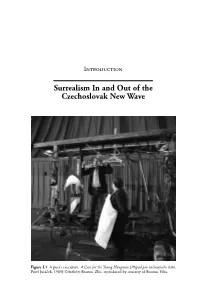
Introduction Surrealism In and Out of the Czechoslovak New Wave Figure I.1 A poet’s execution. A Case for the Young Hangman (Případ pro začínajícího kata, Pavel Juráček, 1969) ©Ateliéry Bonton Zlín, reproduced by courtesy of Bonton Film. 2 | Avant-Garde to New Wave The abrupt, rebellious flowering of cinematic accomplishment in the Czechoslovakia of the 1960s was described at the time as the ‘Czech film miracle’. If the term ‘miracle’ referred here to the very existence of that audacious new cinema, it could perhaps also be applied to much of its content: the miraculous and marvellous are integral to the revelations of Surrealism, a movement that claimed the attention of numerous 1960s filmmakers. As we shall see, Surrealism was by no means the only avant-garde tradition to make a significant impact on this cinema. But it did have the most pervasive influence. This is hardly surprising, as Surrealism has been the dominant mode of the Czech avant-garde during the twentieth century, even if at certain periods that avant-garde has not explicitly identified its work as Surrealist. Moreover, the very environment of the Czech capital of Prague has sometimes been considered one in which Surrealism was virtually predestined to take root. The official founder of the Surrealist movement, André Breton, lent his imprimatur to the founding of a Czech Surrealist group when he remarked on the sublimely conducive locality of the capital, which Breton describes as ‘one of those cities that electively pin down poetic thought’ and ‘the magic capital of old Europe’.1 Indeed, it would seem a given that Czech cinema should evince a strong Surrealist tendency, especially when we consider the Surrealists’ own long-standing passion for this most oneiric of art forms. -

Jiří Menzel's Closely Watched Trains
CHAPTER 11 TRAINSPOTTING: JIŘÍ MENZEL’S CLOSELY WATCHED TRAINS A 1963 graduate of his country’s film school (FAMU, or Faculty of the Academy of Dramatic Arts), the Czech Jiří Menzel spent the next two years working as an actor and assistant director. His first motion picture as a director was a contribution to an anthology film titled Pearls of the Deep (1965), based on five short stories by Bohumil Hrabal remarkable for their concentration on the destinies of little people on the edges of society. (Evald Schorm, Jan Němec, Věra Chytilová, and Jaromil Jireš were the other contributors, making Pearls of the Deep a kind of omnibus of the Czech New Wave, also known as the Czech Renaissance.) Menzel’s first feature, his masterpiece Closely Watched Trains (1966), is also his chief claim to a firm place in the history of Czech cinema. This picture, adapted from a Hrabal work as well, received an Academy Award for Best Foreign-Language Film and was also the biggest box-office success of all the New Wave works in Czechoslovakia. As the Hrabal adaptations suggest, Menzel was influenced by Czech fiction writers rather than Western filmmakers. Except for Crime in a Nightclub (1968), his reverential parody of American musical comedy, his films prior to the Soviet invasion of 1968 are adaptations of novels or short stories by Czech authors. These include Capricious Summer (1967), from a novella by Vladislav Vančura; Hrabal’s Closely Watched Trains, “The Death of Mr. Baltisberger” (segment from Pearls of the Deep), and Larks on a String (1969); and Josef Skvorecký’s Crime at a Girls’ School (1965). -

Community Exhibitor Survey Report 2013
Page 3 Key points 5 Executive summary 8 1 Introduction 8 1.1 Background 8 1.2 Aims 8 1.3 Timescale 8 1.4 Sector 9 2 Methods 9 2.1 Introduction 9 2.2 Responses 10 3 Results 10 3.1 Year of establishment 10 3.2 Membership 11 3.3 Admissions 13 3.4 Provision 15 3.5 Programming 16 3.6 Administration 18 3.7 The benefits of community exhibition 19 3.8 Using BFFS services and resources 20 3.9 Rating BFFS services and resources 22 Appendix 1: 2012/13 film list 27 Appendix 2: Feedback on BFFS Page 2 of 30 Community exhibition is more dynamic than ever, with greater opportunities for audiences to experience films on the big screen through community cinema events, film society activity and innovative pop-up screenings in non-traditional venues: Responding community exhibitors recorded around 213,000 admissions in 2012/13. Theatrical ticket sales on this scale would have generated box office revenues of £1.4 million. Nearly half of responding community exhibitors saw an increase in their annual admissions (46%), and 40% recorded roughly the same number as in the previous year. Three quarters (76%) of membership organisations saw their membership stay the same or increase over the last year, and average membership stood at 154. Responding community exhibitors hosted 4,175 screenings in 2012/13. Community exhibition is run for the benefit of communities, enhancing the quality of life locally, encouraging participation in cultural and communal activities and providing volunteering opportunities: The majority of responding organisations (89%) are run as not-for-profit, and 20% have charitable status. -

Organizer of the 54Th Karlovy Vary IFF 2019: Film Servis Festival Karlovy Vary, A.S
Organizer of the 54th Karlovy Vary IFF 2019: Film Servis Festival Karlovy Vary, a.s. Organizers of the 54th Karlovy Vary IFF thank to all partners which help to organize the festival. 54th Karlovy Vary IFF is supported by: Ministry of Culture Czech Republic Main partners: Vodafone Czech Republic a.s. innogy MALL.cz Accolade City of Karlovy Vary Karlovy Vary Region Partners: UniCredit Bank Czech Republic and Slovakia, a.s. UNIPETROL SAZKA Group the Europe’s largest lottery company DHL Express (Czech Republic), s.r.o. Philip Morris ČR, a.s. CZECH FUND – Czech investment funds Official car: BMW Official fashion partner: Pietro Filipi Official coffee: Nespresso Supported by: CZ - Česká zbrojovka a.s. Supported by: construction group EUROVIA CS Supported by: CZECHOSLOVAK GROUP Partner of the People Next Door section: Sirius Foundation Official non-profit partner: Patron dětí Film Servis Festival Karlovy Vary, Panská 1, 110 00 Praha 1, Czech Republic Tel. +420 221 411 011, 221 411 022 www.kviff.com Official beverage: Karlovarská Korunní Official beauty partner: Dermacol Official champagne: Moët & Chandon Official beer: Pilsner Urquell Official drink: Becherovka Main media partners: Czech Television Czech Radio Radiožurnál PRÁVO Novinky.cz REFLEX Media partners: BigBoard Praha PLC ELLE Magazine magazine TV Star Festival awards supplier: Moser Glassworks Software solutions: Microsoft Consumer electronics supplier: LG Electronics Partner of the festival Instagram: PROFIMED Main hotel partners: SPA HOTEL THERMAL Grandhotel Pupp Four Seasons Hotel Prague Partner of the No Barriers Project: innogy Energie Wine supplier: Víno Marcinčák Mikulov - organic winery GPS technology supplier: ECS Invention spol. s r.o. -

The Films of Věra Chytilová
DEFIANCE AND COMPASSION: THE FILMS OF VĚRA CHYTILOVÁ Tuesday 27 January 2015, London The late great avant-garde Czech film director Věra Chytilová will be celebrated with a season of films at BFI Southbank from 1 – 17 March 2015, marking a year since her death in March 2014. Aside from her experimental farce Daisies (1966), Chytilová’s work is relatively unknown in the UK and this season offers audiences a rare chance to celebrate the life and work of a true original and a pioneer of Czech cinema. Chiytilová’s early cinéma-vérité-style films A Bagful of Fleas (1962) and Ceiling (1962) introduced two main themes demonstrated across her almost 40 year career; the feminine point of view in a world dominated by men and a strong critique of contemporary society. A pioneer of women’s cinema, Chytilová thought it natural to use her female perspective and experience, although she didn’t see herself as a feminist. Never one to hesitate, she played on stereotypes associated with women, exploiting the fear of feminine hysterics and famously threatening to jump out of the window in front of state officials when she struggled to get her unorthodox films financed or released. Chytilová’s best known film Daisies (1966), in which two teenage girls embark on a series of destructive pranks, so shocked the Czechoslovak government that it withheld its release for a whole year. Strong social criticism and experimental form, together with Chytilová’s active criticism of the Soviet occupation led to a ban from studios for six years. Choosing to stay in Czechoslovakia, preferring to ‘battle the system from within its confines’, she returned to work in 1976 after making a personal appeal to the Czechoslovak president Gustáv Husák, who gave her the green light to make The Apple Game (1976). -

The Films of Věra Chytilová
SIT Graduate Institute/SIT Study Abroad SIT Digital Collections Independent Study Project (ISP) Collection SIT Study Abroad Fall 2004 Living With the Truth: The iF lms of Věra Chytilová Ethan White SIT Study Abroad Follow this and additional works at: https://digitalcollections.sit.edu/isp_collection Part of the Film and Media Studies Commons Recommended Citation White, Ethan, "Living With the Truth: The iF lms of Věra Chytilová" (2004). Independent Study Project (ISP) Collection. 515. https://digitalcollections.sit.edu/isp_collection/515 This Unpublished Paper is brought to you for free and open access by the SIT Study Abroad at SIT Digital Collections. It has been accepted for inclusion in Independent Study Project (ISP) Collection by an authorized administrator of SIT Digital Collections. For more information, please contact digitalcollections@sit.edu. LIVING WITH THE TRUTH: THE FILMS OF VĚRA CHYTILOVÁ // BY ETHAN WHITE // ADVISOR // PhDr. ZDENA ŠKAPOVÁ FALL 2004 CZECH REPUBLIC // ARTS AND SOCIAL CHANGE ACADEMIC DIRECTORS // EVA VALENTA AND LUKE BOUVIER White // 2 ABSTRACT // Despite a career spanning five decades and numerous different sociopolitical atmospheres, Věra Chytilová’s films present a remarkably consistent outlook on contemporary life. This paper traces the defining characteristics of Chytilová’s work: her strong moralistic criticisms of contemporary society, her motif of paradise, which establishes a potent symbolic basis for said moral criticisms, and her relentless pursuit of new forms and desire to experiment with film language. This final point is also inextricably linked to her moral stance, as the bulk of her work was produced under the authority of a Communist regime that frowned severely upon work of an avant-garde or experimental nature.