Lifeguarding Manual American Red Cross Lifeguarding MANUAL
Total Page:16
File Type:pdf, Size:1020Kb
Load more
Recommended publications
-
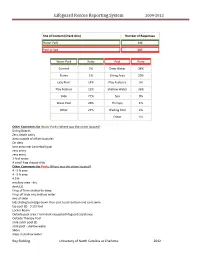
Lifeguard Rescue Reporting System 2009-2012
Lifeguard Rescue Reporting System 2009-2012 Site of Incident (Check One) Number of Responses Water Park 146 Pool or Spa 885 Water Park Ratio Pool Ratio Current 2% Deep Water 38% Flume 1% Diving Area 20% Lazy River 14% Play Features 3% Play Feature 12% Shallow Water 36% Slide 27% Spa 0% Wave Pool 26% Therapy 1% Other 21% Wading Pool 4% Other 4% Other Comments for Water Parks: Where was the victim located? Diving Boards Zero Depth Entry Area outside of office (outside) On deck lane area near basketball goal zero entry zero entry 3 ft of water A small frog shaped slide Other Comments for Pools: Where was the victim located? 4 - 5 ft area 4 - 5 ft area 4.5 ft ancillary area - dry deck (2) Drop of from shallow to deep Drop off slide into shallow water end of slide kids sliding board/go down then cant touch bottom and cant swim lap pool (2) - 3 1/2 foot Locker Room Outside pool area. Front desk requested lifeguard assistance Outside Therapy Pool slide catch pool (2) slide pool - shallow water Slides steps in shallow water Roy Fielding University of North Carolina at Charlotte 2012 Lifeguard Rescue Reporting System 2009-2012 swim lap area 6ft deep zero entry area below diving board Time of Day (remember noon is 12:00PM and midnight is 12:00 AM) 12:00 5:01 6:01 7:01 8:01 9:01 10:01 11:01 1:01 to 2:01 to 3:01 to 4:01 to to to to to to to to to 2:00 3:00 4:00 5:00 1:00 6:00 7:00 8:00 9:00 10:00 11:00 11:59 Water Park 0% 3% 0% 1% 0% 0% 0% 0% 0% 0% 3% 3% AM Water Park 3% 6% 33% 25% 17% 6% 0% 0% 0% 0% 0% 0% PM Pool 0% 0% 0% 0% 1% 0% 0% 1% 2% 2% 5% -

Assisting Drowning Victims: Effective Water Rescue Equipment for Lay-Responders
International Journal of Aquatic Research and Education Volume 10 Number 4 Article 8 2-1-2019 Triennial Scientific Review: Assisting Drowning Victims: Effective Water Rescue Equipment for Lay-responders Angela K. Beale-Tawfeeq Rowan University, akbeale6@gmail.com Follow this and additional works at: https://scholarworks.bgsu.edu/ijare Part of the Community Health and Preventive Medicine Commons, Exercise Science Commons, Health and Physical Education Commons, Leisure Studies Commons, Outdoor Education Commons, Sports Sciences Commons, Sports Studies Commons, and the Tourism and Travel Commons Recommended Citation Beale-Tawfeeq, Angela K. (2019) "Triennial Scientific Review: Assisting Drowning Victims: Effective Water Rescue Equipment for Lay-responders," International Journal of Aquatic Research and Education: Vol. 10 : No. 4 , Article 8. DOI: https://doi.org/10.25035/ijare.10.04.08 Available at: https://scholarworks.bgsu.edu/ijare/vol10/iss4/8 This Scientific Literature Review is brought to you for free and open access by the Journals at ScholarWorks@BGSU. It has been accepted for inclusion in International Journal of Aquatic Research and Education by an authorized editor of ScholarWorks@BGSU. Triennial Scientific Review: Assisting Drowning Victims: Effective Water Rescue Equipment for Lay-responders Cover Page Footnote Thanks to members of the aquatic sub-council of the American Red Cross Scientific Advisory Council who provided feedback and editing on this scientific er view. This scientific literature review is available in International -
A Guide to Selecting Pressure Washing Management Practices and Technologies
A Guide to Selecting Pressure Washing Management Practices and Technologies Supplement to the Massachusetts Clean Marina Guide Massachusetts Office of Coastal Zone Management November 2008 Acknowledgments This document was produced by Tighe & Bond of Worcester, Massachusetts, for the Massachusetts Executive Office of Energy and Environmental Affairs, Office of Coastal Zone Management (CZM). We thank Marc Richards of Tighe & Bond for his diligent and thoughtful work on the project. Significant content and editorial contributions were made by Jay Baker and Robin Lacey of CZM. We would also like to thank the U.S. Environmental Protection Agency and the Massachusetts Department of Environmental Protection for their review and input. This publication is funded (in part) by a grant/cooperative agreement from the National Oceanic and Atmospheric Administration (NOAA; Award No. NA07NOS4190066). The views expressed herein are those of the author(s) and do not necessarily reflect the views of NOAA or any of its sub-agencies. This guide is intended as an educational tool for marina operators and boaters. It does not constitute a complete reference of state, federal, or local laws. The Executive Office of Energy and Environmental Affairs, contributing agencies, organizations, and individuals cannot assume any liability for the accuracy or completeness of the information in this publication. Inclusion in this guide is not an endorsement of the companies listed. Final determination of the proper handling and disposal of waste is the sole responsibility of the generator and must be consistent with Massachusetts Hazardous Waste Regulations (see chapter 4.10 of the Massachusetts Clean Marina Guide). Table of Contents I. -

A Guide to Coastal Public Rescue Equipment Contents
Version 1: 2007 A guide to coastal public rescue equipment Contents Foreword 3 Acknowledgements 4 Preface 5 Introduction 7 How this guide was researched 8 Getting started 10 How to use this document 13 Understanding coastal environments 14 Understanding beaches 16 Understanding rocky coasts 19 Understanding tidal inlets and estuaries 20 Understanding man-made coasts 21 Risk management for PRE 22 Selecting public rescue equipment 24 PRE for beaches 26 PRE for rocky coasts, tidal inlets and estuaries 28 PRE for man-made coasts 30 Emergency communications 32 Locating PRE and communications 34 Additional information 40 Signs and user information 42 PRE housing 44 Maintenance 46 Reducing vandalism 47 Useful reading 48 Inside back cover Useful contacts Foreword With the UK having some of Europe’s finest beaches, This guide is the first of its kind, not only in the UK, and with increasing access to other parts of the coast, but worldwide. With credible and robust research, it is unsurprising that millions of people enjoy the UK this guide is in a position to set a world benchmark coastline every year. However, with an increasing trend for coastal public rescue equipment. for recreational activity on our beaches and inshore waters, UK maritime rescue services have never been We therefore welcome and fully endorse this guide so busy helping people in difficulty. and commend all those that were involved in making it happen. Therefore, we are delighted that the RNLI, working closely with members of the National Water Safety Michael Vlasto OBE Forum and other safety organisations, has produced Chairman, National Water Safety Forum this guide for coastal public rescue equipment (PRE): Operations Director, Royal National Lifeboat Institution guidance that beach operators have requested to help manage their beaches safely. -

Aquatic Certifications for NYS Bathing Facilities (Fact Sheet)
AQUATIC CERTIFICATIONS for NYS Bathing Facilities Fact Sheet – April 2021 (Go to www.health.ny.gov to view most current certification list) Standards for aquatic/lifeguard certifications are contained in New York State Sanitary Codes (SSC) Subpart 6-1, Section 6-1.31, Swimming Pools; Subpart 6-2, Section 6-2.20, Bathing Beaches; and Subpart 7-2, Section 7-2.5(g), Children’s Camps. When the SSC requires "lifeguard supervision" or a "qualified lifeguard" at a bathing facility, an approved lifeguard certification SPECIFIC to the type of bathing facility is required. NOTE: • All lifeguards must possess separate cardiopulmonary resuscitation (CPR) certification in an approved course listed on the NYS CPR fact sheet unless otherwise indicated in the below table. All CPR certificates are valid for 1 year from course completion, regardless of the expiration date noted on the card. • Lifeguard certifications shall be valid for the time period specified by the certifying agency, but may not exceed a con secutive 3-year period from course completion. Multiyear lifeguard certifications that include CPR require a CPR certification each year. • Children's camp lifeguards must be at least 17 years of age, except; − A maximum of 50% of the required lifeguards on duty may be 16 years of age; − Lifeguards for wilderness swimming must be at least 18 years of age. • Supervising lifeguards must possess at least Supervision Level IIb certification, be at least 18 years old, and have at least 2 seasons of lifeguarding experience. ACCEPTED COURSES SUPERVISION LEVEL Marked boxes indicate acceptability Level II b Level I Pool & Level II a PROVIDER CERTIFICATION TITLE Surf Pool Only Beach American Red Cross (ARC) Lifeguarding/First Aid/CPR/AED* X LIFEGUARDING AND FIRST AID CERTIFICATIONS ARE Lifeguarding, Waterpark Skills/First Aid/CPR/ X VALID FOR 2 YEARS FROM DATE OF ISSUANCE. -
A Lifeguard's Beach Safety Tips
A Lifeguard’s Beach Safety Tips by Sgt. Ed Fisher Special to the Dispatch The writer is a 17-year veteran of the Beach patrol. In the off-season, he is an elementary school teacher in Montgomery County. The OCBP consist of over 200 men and women dedicated to ocean rescue and maintaining a safe and orderly environment on Ocean City’s beach. The Sure Rescue Technicians guard the beach seven days a week from 10 a.m. – 5:30 p.m. Studying the waves helps safety September 12, 2008 The Dispatch/Maryland Coast Dispatch Recently a kite surfer tried surfing in a hurricane and ended up getting blown into the side of a building. An accident like this does not happen because of bad luck. An accident like this happens because of poor decision making, not knowing your sport, and not respecting the elements. I mean is it really surprising that a kite that was flying in a hurricane got out of control? The idea here is that everyone entering the surf should have more common sense than this and take some basic precautions. The first precaution begins on the beach. People should spend at least 15 minutes on the beach surveying the conditions. Often people come out to the beach and see a calm ocean. As soon as they attempt to swim they find themselves confronted with a dangerous set of waves or strong currents they were not aware of. Be sure to know what the conditions are before entering the water. The daily conditions of the ocean are governed by the swell direction, wind velocity, and ocean bottom. -

Jim Crow at the Beach: an Oral and Archival History of the Segregated Past at Homestead Bayfront Park
National Park Service U.S. Department of the Interior Biscayne National Park Jim Crow at the Beach: An Oral and Archival History of the Segregated Past at Homestead Bayfront Park. ON THE COVER Biscayne National Park’s Visitor Center harbor, former site of the “Black Beach” at the once-segregated Homestead Bayfront Park. Photo by Biscayne National Park Jim Crow at the Beach: An Oral and Archival History of the Segregated Past at Homestead Bayfront Park. BISC Acc. 413. Iyshia Lowman, University of South Florida National Park Service Biscayne National Park 9700 SW 328th St. Homestead, FL 33033 December, 2012 U.S. Department of the InteriorNational Park Service Biscayne National Park Homestead, FL Contents Figures............................................................................................................................................ iii Acknowledgments.......................................................................................................................... iv Introduction ..................................................................................................................................... 1 A Period in Time ............................................................................................................................. 1 The Long Road to Segregation ....................................................................................................... 4 At the Swimming Hole .................................................................................................................. -

Uniform Minimum Protocols and Standards for Watercraft Inspection and Decontamination Programs for Dreissenid Mussels in the Western United States UMPS III
Uniform Minimum Protocols and Standards for Watercraft Inspection and Decontamination Programs for Dreissenid Mussels in the Western United States UMPS III Editors Leah Elwell and Stephen Phillips UMPS III | 2016 This document has been prepared by the Pacific States Marine Fisheries Commission to further the efforts of the U.S. Fish and Wildlife Service’s 100th Meridian Initiative, the mission of the Western Regional Panel on Aquatic Nuisance Species, and fulfill priorities within the Quagga Zebra Action Plan. Support for this project was provided, in part, by the U.S. Fish and Wildlife Service Regions 1 and 6. Suggested citation: Elwell LC and S Phillips, editors. 2016. Uniform Minimum Protocols and Standards for Watercraft Inspection and Decontamination Programs for Dreissenid Mussels in the Western United States (UMPS III). Pacific States Marine Fisheries Commission, Portland, OR. Pp 53. Original publication date of UMPS I: 2009 Revision and publication date of UMPS II: 2012 DISCLAIMER: The following protocols and standards are provided here to protect natural resources from the damage caused by aquatic invasive species. COVER PHOTOS: Arizona Game and Fish Department and David Wong Other photo credits: American Casting & Manufacturing Corp. Arizona Game and Fish Department California Department of Fish and Wildlife Idaho Department of Agriculture Pacific States Marine Fisheries Commission, Bill Zook Quagga D LLC United States Bureau of Reclamation, Leonard Willet USDA Forest Service David Wong Wyoming Game and Fish Department 2 UMPS -
Lifeguard Effectiveness: a Report of the Working Group
Lifeguard Effectiveness: A Report of the Working Group Editors: Christine M. Branche, Ph.D. Steven Stewart, M.S. Division of Unintentional Injury Prevention National Center for Injury Prevention and Control Centers for Disease Control and Prevention Department of Health and Human Services Lifeguard Effectiveness: A Report of the Working Group is a publication of the National Center for Injury Prevention and the Centers for Disease Control and Prevention Centers for Disease Control and Prevention Jeffrey P. Koplan, M.D., M.P.H., Director National Center for Injury Prevention and Control Sue Binder, M.D., Director Division of Unintentional Injury Prevention Christine M. Branche, Ph.D., Director Production services were provided by staff of the Management Analysis and Services Office, CDC. Suggested Citation: Branche CM, Stewart S. (Editors). Lifeguard Effectiveness: A Report of the Working Group. Atlanta: Centers for Disease Control and Prevention, National Center for Injury Prevention and Control; 2001. ii Lifeguard Effectiveness: A Report of the Working Group Table of Contents Contributing Authors ................................................................................................................... v Executive Summary.................................................................................................................... vii Introduction................................................................................................................................... 1 A Brief History and Background of Lifeguarding -

Equipment Inspection and Cleaning Manual
Technical Memorandum No. 86-68220-07-05 Inspection and Cleaning Manual for Equipment and Vehicles to Prevent the Spread of Invasive Species 2012 Edition U.S. Department of the Interior Bureau of Reclamation June 2012 Technical Memorandum No. 86-68220-07-05 Inspection and Cleaning Manual for Equipment and Vehicles to Prevent the Spread of Invasive Species 2012 Edition Prepared by: Joe DiVittorio, Invasive Species Program Coordinator, Bureau of Reclamation, Policy and Administration, Denver, Colorado Michael Grodowitz, Research Entomologist, U.S. Army Corps of Engineers, Engineer Research and Development Center (ERDC), Vicksburg, Mississippi Joe Snow, Research Biologist, Contractor, ERDC and Teri Manross, Technical Writer-Editor, Bureau of Reclamation, Denver, Colorado U.S. Department of the Interior Bureau of Reclamation Policy and Administration Denver, Colorado June 2012 MISSION STATEMENTS The U.S. Department of the Interior protects America's natural resources and heritage, honors our cultures and tribal communities, and supplies the energy to power our future. The mission of the Bureau of Reclamation is to manage, develop, and protect water and related resources in an environmentally and economically sound manner in the interest of the American public. DISCLAIMER This manual is intended as an introduction to its subject matter and as a reference tool. It does not create or alter policy or otherwise implement any law and should not be cited as a source of authority. The information contained herein, regarding commercial products or firms, may not be used for advertising or promotional purposes and is not to be construed as an endorsement of any product or firm by the Bureau of Reclamation or the Department of the Interior. -

Punk Aesthetics in Independent "New Folk", 1990-2008
PUNK AESTHETICS IN INDEPENDENT "NEW FOLK", 1990-2008 John Encarnacao Student No. 10388041 Master of Arts in Humanities and Social Sciences University of Technology, Sydney 2009 ii Acknowledgements I would like to thank my supervisor Tony Mitchell for his suggestions for reading towards this thesis (particularly for pointing me towards Webb) and for his reading of, and feedback on, various drafts and nascent versions presented at conferences. Collin Chua was also very helpful during a period when Tony was on leave; thank you, Collin. Tony Mitchell and Kim Poole read the final draft of the thesis and provided some valuable and timely feedback. Cheers. Ian Collinson, Michelle Phillipov and Diana Springford each recommended readings; Zac Dadic sent some hard to find recordings to me from interstate; Andrew Khedoori offered me a show at 2SER-FM, where I learnt about some of the artists in this study, and where I had the good fortune to interview Dawn McCarthy; and Brendan Smyly and Diana Blom are valued colleagues of mine at University of Western Sydney who have consistently been up for robust discussions of research matters. Many thanks to you all. My friend Stephen Creswell’s amazing record collection has been readily available to me and has proved an invaluable resource. A hearty thanks! And most significant has been the support of my partner Zoë. Thanks and love to you for the many ways you helped to create a space where this research might take place. John Encarnacao 18 March 2009 iii Table of Contents Abstract vi I: Introduction 1 Frames -
Acre Lucrecia Zappi Extract (Chapters 1,2 and 6) Translated by Lisa Shaw
www.andotherstories.org Acre by Lucrecia Zappi is one of the novels featured in the autumn 2018 Portuguese reading group run by And Other Stories https://www.andotherstories.org/reading-groups/portuguese-reading-group-2018/ Acre Lucrecia Zappi Extract (chapters 1,2 and 6) translated by Lisa Shaw 1 I only thought about the new varnished floor when I came home. I wasn’t in a bad mood, but how could it be that before going out it hadn’t dawned on either me or Marcela, none of the inhabitants of this flat, that the sun would be very strong today – stronger than it was yesterday, but not as strong as tomorrow – and would make the varnish sizzle, even in the dark? I crouched down to touch the damage, and thought about the guy who had spent the weekend kneeling on the floor of our living room, chatting on his mobile phone, us buying him something to eat, him getting on our nerves, all of that just for me to end up stuck here, yet again regretting not having paid attention, while the sun had already gone down and risen again five hundred times. For a moment, I took in the light of the night sky that spread across the room and I closed the curtain. When I turned my back to the window I noticed a silhouette in the half-light: it was Marcela sitting on a worktop in the open-plan kitchen, as she liked to call that door-less space. I thought about beginning by asking her why she had not closed the curtain.