Public Transport Strategy Study
Total Page:16
File Type:pdf, Size:1020Kb
Load more
Recommended publications
-
MTR All Geared up for Typhoon Season and Calls on Passengers to Note Service Adjustments During Typhoons for Journey Planning
PR031/21 14 May 2021 MTR All Geared up for Typhoon Season and Calls on Passengers to Note Service Adjustments during Typhoons for Journey Planning With the typhoon season approaching, MTR Corporation has implemented a number of precautionary measures to combat the adverse weather including the inspection of flood- prevention equipment, checking the conditions of railway facilities and enhancing the trimming of trees along open sections of railway lines. As MTR services may be affected by adverse weather and may have to be adjusted due to various situations during typhoons, the Corporation will provide the latest train service information through different platforms including the media, social media and MTR Mobile for passengers to plan their journeys. MTR always makes its best endeavours to provide safe service during typhoons as far as practicable under the premise of ensuring the safety of passengers and MTR staff. However, services on the open sections of the heavy rail, Light Rail and MTR Bus will inevitably be affected by adverse weather during typhoons, and therefore the Operations Control Centre will make corresponding service arrangements based on weather conditions (please refer to the annex for details). “Our priority is to ensure the safety of passengers and our staff in the face of adverse weather. Staff will be deployed to assist passengers at stations during typhoons while the maintenance team will stand by along railway lines to carry out emergency repairs on damaged railway facilities as long as it is safe and feasible to do so. After gale signals are lowered, recovery works will commence fully. As the works take time and roads may also be blocked by fallen trees or debris, services on the open sections of the heavy rail, Light Rail and MTR Bus may not be able to resume immediately. -
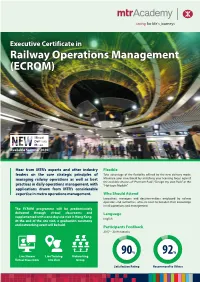
Railway Operations Management (ECROM)
Executive Certificate in Railway Operations Management (ECROM) Available Summer 2020 Hear from MTR’s experts and other industry Flexible leaders on the core strategic principles of Take advantage of the flexibility offered by the new delivery mode. managing railway operations as well as best Maximise your investment by matching your learning focus against the available choices of “Premium Pack”, “Design-my-own Pack” or the practices in daily operations management, with “Hot-topic Module”. applications drawn from MTR’s considerable expertise in metro operations management. Who Should Attend Executives, managers and decision-makers employed by railway operators and authorities, who are keen to broaden their knowledge in rail operations and management. The ECROM programme will be predominately delivered through virtual classrooms and Language supplemented with a one-day site visit in Hong Kong. English At the end of the site visit, a graduation ceremony and networking event will be held. Participants Feedback 2017 – 2019 statistics 90% 92% Live Stream Live Training Networking Virtual Classroom Site Visit Group Satisfaction Rating Recommend to Others Executive Certificate in Railway Operations Management (ECROM) Overview The modular syllabus kicks off with macroscopic discussions on high level transport policy as pertaining to the development of modern societies. Subsequent sessions take a practical look at MTR’s strategies for meeting passenger demand and service benchmarks, with special focus on customer service, maintenance strategies, -

Transport Department Notice Special Traffic and Transport Arrangements
Transport Department Notice Special Traffic and Transport Arrangements for Lunar New Year’s Eve 2010 Notice is hereby given that the following special traffic and transport arrangements will be implemented on the Lunar New Year’s Eve 2010: I. SPECIAL TRAFFIC ARRANGEMENTS HONG KONG ISLAND The following special traffic arrangements will be implemented on 13 February 2010 from the time specified below until 7.00 am on 14 February 2010. The implementation time may be varied if necessary: (A) Road closures (a) The pedestrian scheme will be implemented on the following roads from 12.00 noon (i) Lockhart Road east of Cannon Street; (ii) East Point Street; (iii) Great George Street west of Paterson Street; (iv) Pak Sha Road; (v) Yun Ping Road between Lan Fong Road and Kai Chiu Road; (vi) Kai Chiu Road; and (vii) Lee Garden Road between Hennessy Road and Pak Sha Road. (b) The following roads will be closed to all vehicular traffic from 3.30 pm onwards and as necessary (i) Sugar Street; and (ii) Gloucester Road service road northbound between Sugar Street and Yee Wo Street. (c) The following roads will be closed to all vehicular traffic from 5.00 pm onwards and as necessary (i) Cleveland Street; (ii) Paterson Street; (iii) Kingston Street; (iv) Great George Street between Paterson Street and Gloucester Road; P.1 (v) The kerbside lane of Gloucester Road service road between Gloucester Road service road and Cannon Street; (vi) Jardine’s Bazaar; (vii) Inner lane of Pennington Street between Irving Street and Yee Wo Street; (viii) Inner lane of Hennessy Road westbound between Jardine’s Bazaar and Lee Garden Road; (ix) Inner lane of Hennessy Road and Yee Wo Street eastbound between Lee Garden Road and East Point Road; and (x) Electric Road between Yacht Street and Lau Sin Street (except for franchised buses, police vehicles, vehicles of local residents to Park Tower and vehicles bearing labels issued by Food and Environment Hygiene Department). -

MTR Corporation Limited's Paper on the Review of Mass Transit Railway
CB(4)890/16-17(07) Legislative Council Panel on Transport Subcommittee on Matters Relating to Railways Review of Mass Transit Railway By-laws and Mass Transit Railway (North-West Railway) Bylaw Purpose The MTR Corporation Limited (“MTRCL”) mentioned at the meeting of the Subcommittee on Matters Relating to Railways on 19 April 2016 that it would conduct a review on the Mass Transit Railway By-laws (Cap. 556B) (“MTR By-laws”) and Mass Transit Railway (North-West Railway) Bylaw (Cap 556H) (“MTR (NWR) Bylaw”). This paper reports the findings of the review and consults Members on the way forward. Background 2. Currently, more than 5 million passenger trips are made on the MTR network every day. With its dedicated rail corridor, as well as the cooperation of passengers, the MTR operates smoothly and effectively as a mass transit system. 3. In addition, a comprehensive legal framework is essential to ensure smooth railway operation. Upon the rail merger, having regard to the scope of MTRCL’s business, the Government amended the then Mass Transit Railway Corporation Ordinance to become the existing Mass Transit Railway Ordinance (Cap. 556) (“Ordinance”). The Ordinance grants the franchise of railway service to MTRCL and regulates the operation of the Corporation under the franchise, including the compliance with requirements concerning railway safety. 4. To enable MTRCL to provide proper and efficient railway service, Section 34 of the Ordinance stipulates that MTRCL may make bylaws. The main purpose of making bylaws is to suitably regulate the conduct of passengers so that MTRCL can provide safe, reliable and smooth railway service to passengers. -

TAC Annual Report
QUARTERLY REPORT No. 1 of 2018 by the TRANSPORT COMPLAINTS UNIT of the TRANSPORT ADVISORY COMMITTEE for the period 1 January 2018 – 31 March 2018 Transport Complaints Unit 20/F East Wing Central Government Offices 2 Tim Mei Avenue Tamar Hong Kong. Hotline : 2889 9999 Faxline No. : 2577 1858 Website : www.info.gov.hk/tcu E-mail : info@tcu.gov.hk CONTENTS Chapter Page 1 Major Areas of Complaints and Suggestions 4-9 2 Major Events and Noteworthy Cases 10-12 3 Feature Article 13-19 LIST OF ANNEXES Annex A Complaints and Suggestions Received by TCU 20-21 B Trends of Complaints and Suggestions Received by TCU 22-23 C Summary of Results of Investigations into Complaints and 24-25 Suggestions D Public Suggestions Taken on Board by Relevant 26-27 Government Departments/Public Transport Operators E Complaints and Suggestions on Public Transport Services 28-29 F Complaints and Suggestions on the Services of Kowloon 30-32 Motor Bus, Citybus (Franchise 1) and New World First Bus in the Past Eight Quarters G Complaints and Suggestions on Taxi Services in the Past 33 Eight Quarters H Breakdown of Complaints and Suggestions on Taxi 34 Services I Complaints and Suggestions on Traffic and Road 35 Conditions J Complaints and Suggestions on Major Improper Driving 36 Behaviours of Public Transport Drivers 2013 – 2017 K Breakdown of Complaints and Suggestions about Improper 37-38 Driving Behaviour of Public Transport Drivers L Breakdown of Complaints and Suggestions about Improper 39-42 Driving Behaviour of Franchised Bus, Green Minibus, Red Minibus and Taxi Drivers - 2 - M Breakdown of Enforcement Actions Taken against 43 Drivers/Vehicles of Taxi, Public Light Bus and Bus N How to Make Suggestions and Complaints to the Transport 44 Complaints Unit - 3 - Chapter 1 Major Areas of Complaints and Suggestions This is the first quarterly report for 2018 covering the period from 1 January to 31 March 2018. -
The Demand for Public Transport: a Practical Guide
The demand for public transport: a practical guide R Balcombe, TRL Limited (Editor) R Mackett, Centre for Transport Studies, University College London N Paulley, TRL Limited J Preston, Transport Studies Unit, University of Oxford J Shires, Institute for Transport Studies, University of Leeds H Titheridge, Centre for Transport Studies, University College London M Wardman, Institute for Transport Studies, University of Leeds P White, Transport Studies Group, University of Westminster TRL Report TRL593 First Published 2004 ISSN 0968-4107 Copyright TRL Limited 2004. This report has been produced by the contributory authors and published by TRL Limited as part of a project funded by EPSRC (Grants No GR/R18550/01, GR/R18567/01 and GR/R18574/01) and also supported by a number of other institutions as listed on the acknowledgements page. The views expressed are those of the authors and not necessarily those of the supporting and funding organisations TRL is committed to optimising energy efficiency, reducing waste and promoting recycling and re-use. In support of these environmental goals, this report has been printed on recycled paper, comprising 100% post-consumer waste, manufactured using a TCF (totally chlorine free) process. ii ACKNOWLEDGEMENTS The assistance of the following organisations is gratefully acknowledged: Arriva International Association of Public Transport (UITP) Association of Train Operating Companies (ATOC) Local Government Association (LGA) Confederation of Passenger Transport (CPT) National Express Group plc Department for Transport (DfT) Nexus Engineering and Physical Sciences Research Network Rail Council (EPSRC) Rees Jeffery Road Fund FirstGroup plc Stagecoach Group plc Go-Ahead Group plc Strategic Rail Authority (SRA) Greater Manchester Public Transport Transport for London (TfL) Executive (GMPTE) Travel West Midlands The Working Group coordinating the project consisted of the authors and Jonathan Pugh and Matthew Chivers of ATOC and David Harley, David Walmsley and Mark James of CPT. -

How You Can Have Your Say Greater Wellington Regional Council’S Local Governance Statement
How you can have your say Greater Wellington Regional Council’s local governance statement Contents Summary 5 1. Introduction 7 2. Functions, responsibilities and activities 9 3. Legislation 11 3.1 Key local government legislation 11 3.2 Local legislation 13 4. Electoral systems 15 4.1 First past the post – the Council’s current electoral system 15 4.2 Single transferable vote – an option for the Council 15 4.3 Choosing the Council’s electoral system 15 5. Representation arrangements 17 5.1 Representation review 17 5.2 Maori constituencies 17 6. Roles and conduct 19 6.1 Roles 19 6.2 Councillors’ conduct 21 7. Governance structures and processes 23 7.1 Committee structures 23 7.2 Schedule of committee meetings 23 7.3 Delegations 23 8. Council organisations 25 8.1 The WRC Holdings Group of Companies 25 8.2 The boards of directors 25 8.3 Objectives of the companies 25 9. Meeting processes 27 9.1 Notice of meetings 27 9.2 Public participation at meetings 27 9.3 Meeting agendas 28 9.4 Maintaining order at meetings and standing orders 29 9.5 Minutes of meetings 29 10. Consultation policies 31 11. Policies for liaising with Maori 33 11.1 Ara Tahi – inter-iwi representative group 33 11.2 Developing Maori capacity 33 12. Management structures and relationships 35 13. Equal employment opportunities 39 14. Key approved planning and policy documents 41 15. Systems for public access 47 16. How to request information from us 49 Summary Greater Wellington Regional Council (Greater Wellington) aims to involve the region’s community in its decision-making processes. -

Sustainable Urban Mobility and Public Transport in Unece Capitals
UNITED NATIONS ECONOMIC COMMISSION FOR EUROPE SUSTAINABLE URBAN MOBILITY AND PUBLIC TRANSPORT IN UNECE CAPITALS UNITED NATIONS ECONOMIC COMMISSION FOR EUROPE SUSTAINABLE URBAN MOBILITY AND PUBLIC TRANSPORT IN UNECE CAPITALS This publication is part of the Transport Trends and Economics Series (WP.5) New York and Geneva, 2015 ©2015 United Nations All rights reserved worldwide Requests to reproduce excerpts or to photocopy should be addressed to the Copyright Clearance Center at copyright.com. All other queries on rights and licenses, including subsidiary rights, should be addressed to: United Nations Publications, 300 East 42nd St, New York, NY 10017, United States of America. Email: publications@un.org; website: un.org/publications United Nations’ publication issued by the United Nations Economic Commission for Europe. The designations employed and the presentation of the material in this publication do not imply the expression of any opinion whatsoever on the part of the Secretariat of the United Nations concerning the legal status of any country, territory, city or area, or of its authorities, or concerning the delimitation of its frontiers or boundaries. Maps and country reports are only for information purposes. Acknowledgements The study was prepared by Mr. Konstantinos Alexopoulos and Mr. Lukasz Wyrowski. The authors worked under the guidance of and benefited from significant contributions by Dr. Eva Molnar, Director of UNECE Sustainable Transport Division and Mr. Miodrag Pesut, Chief of Transport Facilitation and Economics Section. ECE/TRANS/245 Transport in UNECE The UNECE Sustainable Transport Division is the secretariat of the Inland Transport Committee (ITC) and the ECOSOC Committee of Experts on the Transport of Dangerous Goods and on the Globally Harmonized System of Classification and Labelling of Chemicals. -

Transport Infrastructure and Traffic Review
Transport Infrastructure and Traffic Review Planning Department October 2016 Hong Kong 2030+ 1 TABLE OF CONTENTS 1 PREFACE ........................................................... 1 5 POSSIBLE TRAFFIC AND TRANSPORT 2 CHALLENGES ................................................... 2 ARRANGEMENTS FOR THE STRATEGIC Changing Demographic Profile .............................................2 GROWTH AREAS ............................................. 27 Unbalanced Spatial Distribution of Population and Synopsis of Strategic Growth Areas ................................. 27 Employment ........................................................................3 Strategic Traffic and Transport Directions ........................ 30 Increasing Growth in Private Vehicles .................................6 Possible Traffic and Transport Arrangements ................. 32 Increasing Cross-boundary Travel with Pearl River Delta Region .......................................................................7 3 FUTURE TRANSPORT NETWORK ................... 9 Railways as Backbone ...........................................................9 Future Highway Network at a Glance ................................11 Connecting with Neighbouring Areas in the Region ........12 Transport System Performance ..........................................15 4 STRATEGIC DEVELOPMENT DIRECTIONS FROM TRAFFIC AND TRANSPORT PERSPECTIVE ................................................. 19 Transport and Land Use Optimisation ...............................19 Railways Continue to be -
Rail-Based Public Transport Service Quality and User Satisfaction
Ibrahim ANH, Borhan MN, Md. Yusoff NI, Ismail A. Rail-based Public Transport Service Quality and User Satisfaction... AHMAD NAZRUL HAKIMI IBRAHIM, M.Sc.1 Human-Transport Interaction E-mail: nazrulhakimi@siswa.ukm.edu.my Review MUHAMAD NAZRI BORHAN, Ph.D.1 Submitted: 23 May 2019 (Corresponding author) Accepted: 19 Feb. 2020 E-mail: mnazri_borhan@ukm.edu.my NUR IZZI MD. YUSOFF, Ph.D.1 E-mail: izzi@ukm.edu.my AMIRUDDIN ISMAIL, Ph.D.1 E-mail: aismail@ukm.edu.my 1 Department of Civil Engineering Faculty of Engineering and Built Environment Universiti Kebangsaan Malaysia 43600 UKM Bangi, Selangor, Malaysia RAIL-BASED PUBLIC TRANSPORT SERVICE QUALITY AND USER SATISFACTION – A LITERATURE REVIEW ABSTRACT 1. INTRODUCTION While rail-based public transport is clearly a more In today’s society, public transport plays a vi- advanced and preferable alternative to driving and a way tal role both in urban and rural settings and most of overcoming traffic congestion and pollution problems, people are either directly or indirectly affected by the rate of uptake for rail travel has remained stagnant as a result of various well-known issues such as that com- the quality, availability and accessibility of public muters either use a more reliable and comfortable alter- transport services. Many countries have prioritised native to get from A to B and/or that they are not satisfied developing good public rail services in order to cut with the quality of service provided. This study examined down on car dependency. Indeed, it is now univer- the factor of user satisfaction regarding rail-based public sally recognised that dependence on cars is a very transport with the aim of discovering precisely what fac- negative development which has only led to traffic tors have a significant effect on the user satisfaction and jams, environmental problems, noise, accidents and uptake of rail travel. -
Rail Merger (1) Connected Transactions (2) Very Substantial Acquisition
THIS CIRCULAR IS IMPORTANT AND REQUIRES YOUR IMMEDIATE ATTENTION This Circular does not constitute, or form part of, an offer or invitation, or solicitation or inducement of an offer, to subscribe for or purchase any of the MTRC Shares or other securities of the Company. If you are in any doubt as to any aspect of this Circular, or as to the action to be taken, you should consult a licensed securities LR 14.63(2)(b) dealer, bank manager, solicitor, professional accountant or other professional adviser. LR 14A.58(3)(b) If you have sold or transferred all your MTRC Shares, you should at once hand this Circular to the purchaser or transferee or to the bank, licensed securities dealer or other agent through whom the sale or transfer was effected for transmission to the purchaser or transferee. The Stock Exchange of Hong Kong Limited takes no responsibility for the contents of this Circular, makes no representation as to its LR 14.58(1) accuracy or completeness and expressly disclaims any liability whatsoever for any loss howsoever arising from or in reliance upon the LR 14A.59(1) whole or any part of the contents of this Circular. App. 1B, 1 LR 13.51A RAIL MERGER (1) CONNECTED TRANSACTIONS (2) VERY SUBSTANTIAL ACQUISITION Joint Financial Advisers to the Company Goldman Sachs (Asia) L.L.C. UBS Investment Bank Independent Financial Adviser to the Independent Board Committee and the Independent Shareholders Merrill Lynch (Asia Pacific) Limited It is important to note that the purpose of distributing this Circular is to provide the Independent Shareholders of the Company with information, amongst other things, on the proposed Rail Merger, so that they may make an informed decision on voting in respect of the EGM Resolution. -

Impact of Transport on Access to Health Services for PLWHA in Namibia August 2008 BEN Namibia · Yelula/U-Khâi · LAC · ICW-Namibia Contents
Impact of transport on access to health services for PLWHA in Namibia August 2008 BEN Namibia · Yelula/U-khâi · LAC · ICW-Namibia Contents Acknowledgements............................................Page 1 Research Team ...................................................Page 1 Acronyms ...........................................................Page 2 Executive Summary ..........................................Page 3 I. Introduction....................................................Page 4 II. Methodology .................................................Page 6 III. Geographical Focus ....................................Page 9 IV. Findings ........................................................Page 12 V. Final remarks and way forward .................Page 21 References ..........................................................Page 23 Annex ..................................................................Page 24 Acknowledgements The research team would like to thank all of the health and transportation professionals who participated in the methodology workshop and in the analysis of findings, providing us with insightful comments and suggestions for the work. We also would like to thank all participants in the focus group discussions and interviews in Omusati and Karas regions for giving their time. Research team Clarisse Cunha Linke, Bicycling Empowerment Network Namibia (Coordinator) Immanuel Iita, Legal Assistance Centre – Ongwediva Aloysius Katzao, Legal Assistance Centre – Keetmanshoop Leena Nakatana, International Community of Women