Sitka Alder (Alnus Viridis Ssp. Sinuata) Plant Guide
Total Page:16
File Type:pdf, Size:1020Kb
Load more
Recommended publications
-
Technical Note 37: Identification, Ecology, Use, and Culture of Sitka
TECHNICAL NOTES _____________________________________________________________________________________________ US DEPT. OF AGRICULTURE NATURAL RESOURCES CONSERVATION SERVICE Portland, OR April 2005 PLANT MATERIALS No. 37 Identification, Ecology, Use and Culture of Sitka Alder Dale C. Darris, Conservation Agronomist, Corvallis Plant Materials Center Introduction Sitka alder [Alnus viridis (Vill.) Lam. & DC. subsp. sinuata (Regel) A.& D. Löve] is a native deciduous shrub or small tree that grows to height of 20 ft, occasionally taller. Although a non-crop species, it has several characteristics useful for reclamation, forestry, and erosion control. The species is known for abundant leaf litter production, the fixation of atmospheric nitrogen in association with Frankia bacteria, and a strong fibrous root system. Where locally abundant, it naturally colonizes landslide chutes, areas of stream scour and deposition, soil slumps, and other drastic disturbances resulting in exposed minerals soils. These characteristics make Sitka alder particularly useful for streambank stabilization and soil building on impoverished sites. In addition, its low height and early slowdown in growth rate makes it potentially more desirable than red alder (Alnus rubra) to interplant with conifers such as Douglas fir (Pseudotsuga menzieii) and lodgepole pine (Pinus contorta) where soil fertility is moderate to low. However, high densities can hinder forest regeneration efforts. The species may also be useful as a fast growing shrub row in field windbreaks. Sitka alder is most abundant at mid to subalpine elevations. Low elevation seed sources (below 100 m) are uncommon but probably provide the best material for reclamation and erosion control projects on valley floors and terraces. Distribution and Identification Sitka alder (Alnus viridis subsp. sinuata) is a native deciduous shrub or small tree that grows to a height of 1-6 m (3-19 ft) in the mountains and 6-12 m (19-37ft) at low elevations. -
The Prosopis Juliflora - Prosopis Pallida Complex: a Monograph
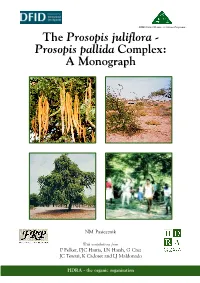
DFID DFID Natural Resources Systems Programme The Prosopis juliflora - Prosopis pallida Complex: A Monograph NM Pasiecznik With contributions from P Felker, PJC Harris, LN Harsh, G Cruz JC Tewari, K Cadoret and LJ Maldonado HDRA - the organic organisation The Prosopis juliflora - Prosopis pallida Complex: A Monograph NM Pasiecznik With contributions from P Felker, PJC Harris, LN Harsh, G Cruz JC Tewari, K Cadoret and LJ Maldonado HDRA Coventry UK 2001 organic organisation i The Prosopis juliflora - Prosopis pallida Complex: A Monograph Correct citation Pasiecznik, N.M., Felker, P., Harris, P.J.C., Harsh, L.N., Cruz, G., Tewari, J.C., Cadoret, K. and Maldonado, L.J. (2001) The Prosopis juliflora - Prosopis pallida Complex: A Monograph. HDRA, Coventry, UK. pp.172. ISBN: 0 905343 30 1 Associated publications Cadoret, K., Pasiecznik, N.M. and Harris, P.J.C. (2000) The Genus Prosopis: A Reference Database (Version 1.0): CD ROM. HDRA, Coventry, UK. ISBN 0 905343 28 X. Tewari, J.C., Harris, P.J.C, Harsh, L.N., Cadoret, K. and Pasiecznik, N.M. (2000) Managing Prosopis juliflora (Vilayati babul): A Technical Manual. CAZRI, Jodhpur, India and HDRA, Coventry, UK. 96p. ISBN 0 905343 27 1. This publication is an output from a research project funded by the United Kingdom Department for International Development (DFID) for the benefit of developing countries. The views expressed are not necessarily those of DFID. (R7295) Forestry Research Programme. Copies of this, and associated publications are available free to people and organisations in countries eligible for UK aid, and at cost price to others. Copyright restrictions exist on the reproduction of all or part of the monograph. -

Marketing Brochure (Updated 2021)
DSA MARKETING MATE RI ALS DSA 2019-2020 Catalogue SKU: 3017 Price: No Charge Wynstellar Collection Catalogue SKU: 3021 Price: No Charge DSA 2021 Price Guide SKU: 3018 Price: No Charge PRINTED PRICE 2021 PRICE GUIDE COMING SOON! PDF 2021 Price Guide available now Stain Sample Keyring SKU: /DSA STAIN SAMP Price: No Charge 2-1/4” X 4” Stain Samples Finishes: Coco, Russet, Chestnut Wood Species: Mahogany & Knotty Alder 6 total stain samples Wynstellar Sample Keyring SKU: /DSA STAIN SAMP Price: No Charge 3” X 4” Stain Samples Finishes: Ebony & CInnamon Bark Wood Species: Accoya 2 total stain samples Glass Sample SKU: GLASS SAMPLE Price: $20.00 Shipping Cost: $15.00 Ships Via: UPS 3” X 3” Panes Overall Size: 13” X 6-3/4” Glass Types: Rain, Flemish, Clear Beveled, Sandblasted, Gluechip, Grain IG Low E, White Laminated, and Fluted IG Low E Miniature Wynstellar Bi Fold Door SKU: 3037-FD Price: $900.00 Crating Cost: $100.00 Shipping Cost: $175.00 ShipsVia: Averrit *can be shipped with existing order to avoid seperate S&H - crating still applies 13” X 27” Door Panels Dual-Finished : Ebony & Primed (back) Timber: Accoya Clear Ig Low E Glass Overall Size: 48” X 36” Mahogany Pre-Hung Sample SKU: 3006 Price: $100 Shipping Cost: $50 Ships Via: UPS 17-3/4” X 19-1/2” Frame Size Timber: Mahoghany Knotty Alder Pre-Hung Sample SKU: 3006 Price: $100 Shipping Cost: $50 Ships Via: UPS 17-3/4” X 19-1/2” Frame Size Timber: Knotty Alder Mahogany Corner Cut Samples SKU: 3001 Price: $40 Shipping Cost: $30 Ships Via: UPS 12” X 12” Sample Timber: Mahogany Coco, Russet, -
A Case Study on the Potential of the Multipurpose Prosopis Tree
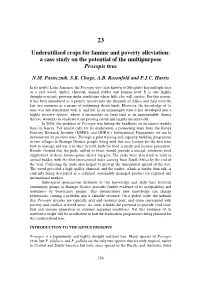
23 Underutilised crops for famine and poverty alleviation: a case study on the potential of the multipurpose Prosopis tree N.M. Pasiecznik, S.K. Choge, A.B. Rosenfeld and P.J.C. Harris In its native Latin America, the Prosopis tree (also known as Mesquite) has multiple uses as a fuel wood, timber, charcoal, animal fodder and human food. It is also highly drought-resistant, growing under conditions where little else will survive. For this reason, it has been introduced as a pioneer species into the drylands of Africa and Asia over the last two centuries as a means of reclaiming desert lands. However, the knowledge of its uses was not transferred with it, and left in an unmanaged state it has developed into a highly invasive species, where it encroaches on farm land as an impenetrable, thorny thicket. Attempts to eradicate it are proving costly and largely unsuccessful. In 2006, the problem of Prosopis was hitting the headlines on an almost weekly basis in Kenya. Yet amidst calls for its eradication, a pioneering team from the Kenya Forestry Research Institute (KEFRI) and HDRA’s International Programme set out to demonstrate its positive uses. Through a pilot training and capacity building programme in two villages in Baringo District, people living with this tree learned for the first time how to manage and use it to their benefit, both for food security and income generation. Results showed that the pods, milled to flour, would provide a crucial, nutritious food supplement in these famine-prone desert margins. The pods were also used or sold as animal fodder, with the first international order coming from South Africa by the end of the year. -

New Nomenclature Combinations in the Green Alder Species Complex
A peer-reviewed open-access journal PhytoKeys 56:New 1–6 nomenclature(2015) combinations in the green alder species complex (Betulaceae) 1 doi: 10.3897/phytokeys.56.5225 RESEARCH ARTICLE http://phytokeys.pensoft.net Launched to accelerate biodiversity research New nomenclature combinations in the green alder species complex (Betulaceae) Joyce Chery1 1 Department of Integrative Biology, University of California, Berkeley, California 94720 Corresponding author: Joyce Chery (chery.joyce@berkeley.edu) Academic editor: Hugo De Boer | Received 1 May 2015 | Accepted 10 June 2015 | Published 14 August 2015 Citation: Chery J (2015) New nomenclature combinations in the green alder species complex (Betulaceae). PhytoKeys 56: 1–6. doi: 10.3897/phytokeys.56.5225 Abstract The name Alnus viridis (Chaix) DC., based on Betula viridis Chaix (1785), has traditionally been attributed to green alders although it is based on a later basionym. Alnus alnobetula (Ehrh.) K. Koch based on Betula alnobetula Ehrh. (1783) is the correct name for green alders. In light of the increasing use and recognition of the name Alnus alnobetula (Ehrh.) K. Koch in the literature. I herein propose new nomenclatural combinations to account for the Japanese and Chinese subspecies respectively: Alnus alnobetula subsp. maximowiczii (Callier ex C.K. Schneid.) J. Chery and Alnus alnobetula subsp. mandschurica (Callier ex C.K. Schneid.) J. Chery. Recent phylogenetic analyses place these two taxa in the green alder species complex, suggesting that they should be treated as infraspecific taxa under the polymorphic Alnus alnobetula. Keywords Green alders, Alnus viridis, Alnus alnobetula, Betulaceae Introduction Characteristic to the genus, Alnus alnobetula (Ehrh.) K. Koch is an anemophilous shrub with carpellate catkins that develop into woody strobili. -

COMÚN INGLÉS COMÚN ESPAÑOL NOMBRE CIENTÍFICO Alder Aliso
COMÚN INGLÉS COMÚN ESPAÑOL NOMBRE CIENTÍFICO Alder Aliso Alnus spp. Alligator juniper Tascate Juniperus deppeana Almond Almendro Prunus dulcis Anaqua Manzanillo Ehretia anacua Apricot Albaricoquero Prunus armeniaca Ash Fresno, plumero Fraxinus spp. Ashe juniper Sabino Juniperus ashei Basswood Tilo Tilia spp. Ball moss Gallitos Tillandsia recurvata Beech Haya Fagus spp. Birch Abedul Betula spp. Black cherry Cerezo Prunus serotina Black locust Algarrobo Robinia pseudoacacia Boxelder Negundo Acer negundo Buckeye Castaño de Indias Aesculus spp. Buckthorn Rhamnus Rhamnus spp. Bumelia Coma Bumelia spp. Catalpa Catalpa Catalpa spp. Catclaw acacia Uña de gato Acacia greggii Cedar Cedro Cedrus spp. Chestnut Castaño Castanea spp. Chinaberry Canelo, lila de China, paraiso, jaboncillo Melia azedarach Common apple Manzano Malus x domestica Common edible fig Higo Ficus carica Common olive Olivo Olea europaea Cottonwood/aspen Álamo/ álamo temblón Populus spp. Crape myrtle Crespón, reina de las flores Langerstroemia spp. Cypress Ciprés Cupressus spp. Desert willow Flor de mimbre Chilopsis linearis Dogwood Cornejo Cornus spp. Eastern red cedar Cedro rojo, enebro Juniperus virginiana Ebony Ébano Diospyros spp. Elm Olmo Ulmus spp. Eucalyptus Eucalipto Eucalyptus spp. Evergreen sumac Lantrisco, lentisco Rhus sempervirens Filbert nut tree Avellano Corylus avellana Fir Abeto Abies spp. Ginkgo, maidenhair Gingo Ginkgo biloba Grape Parra, uva Vitis spp. Hackberry Palo blanco Celtis spp. Hemlock Cicuta Tsuga spp. Hickory Nogal americano Carya spp. Holly Acebo Ilex spp. Juniper Enebro Juniperus spp. Larch Alerce Larix spp. Leadtree Tepeguaje Leucaena spp. Live oak Encino, tesmoli, texmol Quercus virginiana Loquat Níspero Eriobotrya japonica Madrone Madroño Arbutus spp. Magnolia Palo de cacique, magnolio Magnolia grandiflora Mahogany Caoba Swietenia spp. -
Draft Plant Propagation Protocol
Plant Propagation Protocol for [Alnus viridis] ESRM 412 – Native Plant Production TAXONOMY Plant Family Scientific Name Alnus viridis Common Name Green alder Species Scientific Name Scientific Name Family: Betulaceae Genus: Alnus Mill. – alder Alnus viridis (Chaix) DC. – green alder Varieties Sub-species Alnus viridis subsp. crispa Alnus viridis subsp. fruticosa Alnus viridis subsp. sinuata Alnus viridis subsp. suaveolens Alnus viridis subsp. viridis Cultivar Shrub, tree. Common Synonym(s) Alnus alnobetula Betula alnobetula Common Name(s) Green alder Species Code ALVI5 GENERAL INFORMATION Geographical range It ranges from sohern alaska south to norther calfornia and into northern Idaho and Montana. (2) Ecological distribution Green alder is widely distributed throughout interior, central, and northern Alaska across the Yukon Territory and interior Canada to Labrador, Newfoundland, and Greenland. It extends south through New England and the Great Lakes States, and into the Pacific Northwest. Disjunct populations are documented in south-central Pennsylvania and west- central North Carolina (1) Climate and elevation range Grows from sea level up to 1200m (2) Local habitat and abundance Most common native habitats are high mountains swamps, and bottom lands along streams. Plant strategy type / successional A. viridis is a light-demanding, fast-growing shrub that stage grows well on poorer soils. In many areas, it is a highly characteristic colonist of avalanche chutes in mountains, where potentially competing larger trees are killed by regular avalanche damage. Plant characteristics It is a large shrub or small tree 3–12 m tall with smooth grey bark even in old age. The leaves are shiny green with light green undersurfaces, ovoid, 3–8 cm long and 2–6 cm broad. -
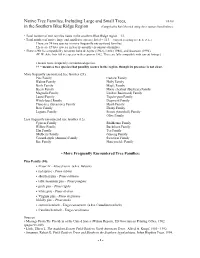
Native Tree Families, Including Large and Small Trees, 1/1/08 in the Southern Blue Ridge Region (Compiled by Rob Messick Using Three Sources Listed Below.)
Native Tree Families, Including Large and Small Trees, 1/1/08 in the Southern Blue Ridge Region (Compiled by Rob Messick using three sources listed below.) • Total number of tree families listed in the southern Blue Ridge region = 33. • Total number of native large and small tree species listed = 113. (Only 84 according to J. B. & D. L..) There are 94 tree species in more frequently encountered families. There are 19 tree species in less frequently encountered families. • There is 93 % compatibility between Ashe & Ayers (1902), Little (1980), and Swanson (1994). (W. W. Ashe lists 105 tree species in the region in 1902. These are fully compatible with current listings.) ▸means more frequently encountered species. ?? = means a tree species that possibly occurs in the region, though its presence is not clear. More frequently encountered tree families (21): Pine Family Cashew Family Walnut Family Holly Family Birch Family Maple Family Beech Family Horse-chestnut (Buckeye) Family Magnolia Family Linden (Basswood) Family Laurel Family Tupelo-gum Family Witch-hazel Family Dogwood Family Plane-tree (Sycamore) Family Heath Family Rose Family Ebony Family Legume Family Storax (Snowbell) Family Olive Family Less frequently encountered tree families (12): Cypress Family Bladdernut Family Willow Family Buckthorn Family Elm Family Tea Family Mulberry Family Ginseng Family Custard-apple (Annona) Family Sweetleaf Family Rue Family Honeysuckle Family ______________________________________________________________________________ • More Frequently Encountered Tree Families: Pine Family (10): ▸ Fraser fir - Abies fraseri (a.k.a. Balsam) ▸ red spruce - Picea rubens ▸ shortleaf pine - Pinus echinata ▸ table mountain pine - Pinus pungens ▸ pitch pine - Pinus rigida ▸ white pine - Pinus strobus ▸ Virginia pine - Pinus virginiana loblolly pine - Pinus taeda ▸ eastern hemlock - Tsuga canadensis (a.k.a. -

Alder Alnus Glutinosa Fearnóg Alder Is a Native Deciduous Tree Species Which Is Often Found Growing Along Banks of Streams and Rivers and in Low-Lying Swampy Land
Trees Alder Alnus glutinosa Fearnóg Alder is a native deciduous tree species which is often found growing along banks of streams and rivers and in low-lying swampy land. It is a water-loving tree reaching heights of 21m (70ft). During spring, four stages of production can be seen on an alder at any given time: the old cones of last years fruiting, the new leaf-buds or leaves and the male and female catkins of this year. Alder is our only broadleaved tree to produce cones. It matures at around 30 years of age and is then capable of a full crop of seeds. Alder leaves are held out horizontally. They are rounded and of an inverted heart-shape, with the broadest part furthest from the stem. When young they are somewhat sticky, as a gum is produced by the tree to ward off moisture. Alder catkins form in the autumn preceding their flowering. They remain dormant on the tree throughout winter and open in the spring before the leaves. The female catkins have threads hanging from them which catch the pollen from the developed male catkins, after which they grow larger and become dark reddish-brown as the seeds develop within. The ripe seeds fall in October and November. They have airtight cavities in their walls which allow them to float on water, along with a coating of oil to preserve them. Alder wood resists decay when in water and has traditionally been used to make boats, canal lockgates, bridges, platforms and jetties. Out of the water alder wood is soft and splits easily. -

Université De Montréal Inuit Ethnobotany in the North American
Université de Montréal Inuit Ethnobotany in the North American Subarctic and Arctic: Celebrating a Rich History and Expanding Research into New Areas Using Biocultural Diversity par Christian H. Norton Département de sciences biologiques Faculté des arts et des sciences Mémoire présenté à la Faculté des études supérieures en vue de l’obtention du grade de maîtrise en sciences biologiques Novembre 2018 © Christian H. Norton 2018 2 Résumé Historiquement, l'utilisation des plantes par les Inuits était considérée comme minimale. Notre compréhension de l'utilisation des plantes par les Inuits a commencé par suite de la prise en compte de concepts tels que la diversité bioculturelle et les espèces clés, et ces nouvelles idées ont commencé à dissiper les mythes sur le manque d’importance des plantes dans la culture inuite. Les Inuits peuvent être regroupés en quatre régions en fonction de la langue: l'Alaska, l'Arctique ouest canadien, l'Arctique et la région subarctique est canadienne et le Groenland. Le chapitre 1 passera en revue la littérature sur l'utilisation des plantes inuites de l'Alaska au Groenland. Au total, 311 taxons ont été mentionnés dans les quatre régions, ce qui correspond à 73 familles. Les niveaux de diversité étaient similaires dans les quatre régions. Seuls 25 taxons et 16 familles étaient communs à toutes les régions, mais 50%-75% des taxons et 75%-90% familles étaient signalés dans au moins deux régions, et les régions voisines ont généralement un chevauchement plus élevé que les régions plus éloignées. De la même manière, les Inuits des quatre régions ont indiqué comestible, médecine, incendie et design comme principales catégories d'utilisation, ainsi qu'une différenciation commune claire en ce qui concerne les taxons utilisés à des fins spécifiques. -
Redalyc.IMPROVING the TOLERANCE of VICIA FABA
Acta Biológica Colombiana ISSN: 0120-548X racbiocol_fcbog@unal.edu.co Universidad Nacional de Colombia Sede Bogotá Colombia KAMEL, MOHAMED IMPROVING THE TOLERANCE OF VICIA FABA AGAINST ENVIRONMENTAL SALINITY RESULTED FROM THE IRRIGATION WITH SEA WATER BY USING KNO3 AND (NH4)2SO4 AS CHEMICAL OSMOREGULATORS. Acta Biológica Colombiana, vol. 17, núm. 2, 2012, pp. 295-308 Universidad Nacional de Colombia Sede Bogotá Bogotá, Colombia Available in: http://www.redalyc.org/articulo.oa?id=319028028006 How to cite Complete issue Scientific Information System More information about this article Network of Scientific Journals from Latin America, the Caribbean, Spain and Portugal Journal's homepage in redalyc.org Non-profit academic project, developed under the open access initiative Vol17-2D_Maquetación 1 1/10/12 20:42 Página 295 Acta biol. Colomb., Vol. 17 n.º 2, 2012 295 - 308 IMPROVING THE TOLERANCE OF VICIA FABA AGAINST ENVIRONMENTAL SALINITY RESULTED FROM THE IRRIGATION WITH SEA WATER BY USING KNO 3 AND (NH 4)2SO 4 AS CHEMICAL OSMOREGULATORS. Mejoramiento de la tolerancia de Vicia faba a salinidad ocasionada por irrigación con agua de mar usando KNO 3 y (NH 4)2SO 4 como osmoreguladores químicos MOHAMED KAMEL 1, Ph. D. 1 Botany Department, Faculty of Sciences at Qena, South Valley University, BOX 83523, Qena, Egypt. mohamedkamelahmed@yahoo.com Presentado el 30 de enero de 2012, aceptado el 2 de mayo de 2012, correcciones el 21 de junio de 2012. ABSTRACT + + 2+ 2+ - 3- 2- The familiar solutes, Na , K , Ca , Mg , Cl , PO 4 , SO 4 , soluble carbohydrates, amino acids and soluble proteins, which play a role in osmotic adjustment were estimated to investigate the role of potassium nitrate and ammonium sulphate as osmoregulators and their effects on the solutes composition. -

California Forest Insect and Disease Training Manual
California Forest Insect and Disease Training Manual This document was created by US Forest Service, Region 5, Forest Health Protection and the California Department of Forestry and Fire Protection, Forest Pest Management forest health specialists. The following publications and references were used for guidance and supplemental text: Forest Insect and Disease Identification and Management (training manual). North Dakota Forest Service, US Forest Service, Region 1, Forest Health Protection, Montana Department of Natural Resources and Conservation and Idaho Department of Lands. Forest Insects and Diseases, Natural Resources Institute. US Forest Service, Region 6, Forest Health Protection. Forest Insect and Disease Leaflets. USDA Forest Service Furniss, R.L., and Carolin, V.M. 1977. Western forest insects. USDA Forest Service Miscellaneous Publication 1339. 654 p. Goheen, E.M. and E.A. Willhite. 2006. Field Guide to Common Disease and Insect Pests of Oregon and Washington Conifers. R6-NR-FID-PR-01-06. Portland, OR. USDA Forest Service, Pacific Northwest Region. 327 p. M.L. Fairweather, McMillin, J., Rogers, T., Conklin, D. and B Fitzgibbon. 2006. Field Guide to Insects and Diseases of Arizona and New Mexico. USDA Forest Service. MB-R3-16-3. Pest Alerts. USDA Forest Service. Scharpf, R. F., tech coord. 1993. Diseases of Pacific Coast Conifers. USDA For. Serv. Ag. Hndbk. 521. 199 p.32, 58. Tree Notes Series. California Department of Forestry and Fire Protection. Wood, D.L., T.W. Koerber, R.F. Scharpf and A.J. Storer, Pests of the Native California Conifers, California Natural History Series, University of California Press, 2003. Cover Photo: Don Owen. 1978. Yosemite Valley.