The Małopolskie Economic Region1
Total Page:16
File Type:pdf, Size:1020Kb
Load more
Recommended publications
-

WCZESNOŚREDNIOWIECZNY GRÓD W ŁAPCZYCY, POW. BOCHNIA, W ŚWIETLE BADAŃ LAT 1965—1967 I 1972
Sprawozdania Archeologiczne, t. XXVI, 1974 ANTONI JODŁOWSKI WCZESNOŚREDNIOWIECZNY GRÓD W ŁAPCZYCY, POW. BOCHNIA, W ŚWIETLE BADAŃ LAT 1965—1967 i 1972 WSTĘP W Łapczycy położonej w odległości 4 km w kierunku zachodnim od Bochni, na prawym brzegu Raby znajduje się grodzisko usytuowane na wzniesieniu o na- zwie „Grodzisko" (ryc. 1—2). Jest to jeden z cyplowatych występów pasma wznie- sień, ciągnącego się równoleżnikowo od miejscowości Chełm — a ściślej od potoku Moszczenickiego — na zachodzie po Bochnię na wschodzie, stanowiącego granicę między Pogórzem Karpackim a Kotliną Sandomierską. Grodzisko leży na północnym stoku owego grzbietu, znacznie poniżej jego kulminacji i ograniczone jest od pół- nocy, północnego zachodu oraz północnego wschodu doliną Raby, która dawniej prze- pływała bezpośrednio u jego podnóża (obecnie koryto rzeki znajduje się w odle- głości 230 m na północ). Od południa i południowego wschodu zbocza grodziska opadają stromo do małej doliny z wysychającym okresowo niedużym strumykiem bez nazwy, natomiast od strony zachodniej i południowo-zachodniej, gdzie teren wznosi się łagodnie ku południowi, obiekt oddzielony był od pozostałej części wzgó- rza naturalnym obniżeniem, pogłębionym sztucznie w celu zwiększenia obronności. Wschodnia partia grodziska zniszczona została częściowo przez wybieranie gliny, majdan zaś, zbocze zachodnie i podgrodzie zajęte są pod uprawę, która spowodo- wała silne zniwelowanie wałów. Pierwotną formę i rozmiary grodu wyznaczają naturalne załomy zboczy oraz zachowane miejscami fragmenty umocnień obronnych. Wskazują one, że gród skła- dał się z dwóch części: z grodu właściwego w kształcie nieregularnego owalu zbliżonego do wieloboku o wym. 96 X 58 m, tj. 55,68 ara, wydłużonego wzdłuż osi NE—SW (ryc. 3), i czworobocznego podgrodzia o powierzchni 60,9 ara (105 X 58 m), przylegającego do grodu od strony północno-wschodniej. -

Pdf, 945.96 KB
REVIEWS POLEMICS DOI: 10.48261/pjs200119 Tomasz Domański PhD1 Institute of National Remembrance Delegation in Kielce CORRECTING THE PICTURE? SOME REFLECTIONS ON THE USE OF SOURCES IN DALEJ JEST NOC. LOSY ŻYDÓW W WYBRANYCH POWIATACH OKUPOWANEJ POLSKI [NIGHT WITHOUT AN END. THE FATE OF JEWS IN SELECTED COUNTIES OF OCCUPIED POLAND], ED. B. ENGELKING, J. GRABOWSKI, STOWARZYSZENIE CENTRUM BADAŃ NAD ZAGŁADĄ ŻYDÓW [POLISH CENTER FOR HOLOCAUST RESEARCH], WARSAW 2018, VOL. 1, ISBN: 9788363444600, 868 PP., VOL. 2, ISBN: 9788363444631, 832 PP.2 lthough many books have been written on the fate of the Jews in German- -occupied Poland,3 the death of around three million Polish Jews still A motivates successive generations of Holocaust scholars and researchers studying the history of Poland’s Jewish community to take up the subject. After 1989, i.e. after Poland regained its independence and cast off the restrictions of Communist 1 I would like to kindly thank all those who have helped me prepare this review by sharing their comments and observations with me. I am especially grateful to Maciej Korkuć PhD from the Cracow Branch of the Polish Institute of National Remembrance. 2 This review refers to the entirety of the book (Night without an end. The fate of Jews in selected counties of occupied Poland, vol. 1–2, ed. Barbara Engelking, Jan Grabowski, Warsaw 2018) with a special focus on Łuków, Złoczów and Miechów counties (powiaty). The abbreviated titleNight without an end is used throughout this article. 3 I use the terms ‘Germans’ and ‘German’ instead of ‘Nazis’ and ‘Nazi’ because all the persons of German origin (by occupation-era standards) employed in the administrative apparatus of the occupied territories were in fact acting on behalf of the German state, i.e. -
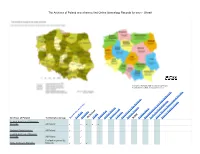
The Archives of Poland and Where to Find Online Genealogy Records for Each - Sheet1
The Archives of Poland and where to find Online Genealogy Records for each - Sheet1 This work is licensed under a Creative Commons Attribution-ShareAlike 3.0 Unported License Archives of Poland Territorial coverage Search theGenBaza ArchivesGenetekaJRI-PolandAGAD Przodek.plGesher Archeion.netGalicia LubgensGenealogyPoznan in the BaSIAProject ArchivesPomGenBaseSzpejankowskisPodlaskaUpper and Digital Szpejenkowski SilesianSilesian Library Genealogical Digital Library Society Central Archives of Historical Records All Poland ✓ ✓ ✓ ✓ ✓ National Digital Archive All Poland ✓ ✓ Central Archives of Modern Records All Poland ✓ ✓ Podlaskie (primarily), State Archive in Bialystok Masovia ✓ ✓ ✓ The Archives of Poland and where to find Online Genealogy Records for each - Sheet1 Branch in Lomza Podlaskie ✓ ✓ Kuyavian-Pomerania (primarily), Pomerania State Archive in Bydgoszcz and Greater Poland ✓ ✓ ✓ ✓ Kuyavian-Pomerania (primarily), Greater Branch in Inowrocław Poland ✓ ✓ ✓ ✓ Silesia (primarily), Świetokrzyskie, Łódz, National Archives in Częstochowa and Opole ✓ ✓ ✓ ✓ Pomerania (primarily), State Archive in Elbląg with the Warmia-Masuria, Seat in Malbork Kuyavian-Pomerania ✓ ✓ ✓ ✓ State Archive in Gdansk Pomerania ✓ ✓ ✓ ✓ Gdynia Branch Pomerania ✓ ✓ ✓ State Archive in Gorzow Lubusz (primarily), Wielkopolski Greater Poland ✓ ✓ ✓ Greater Poland (primarily), Łódz, State Archive in Kalisz Lower Silesia ✓ ✓ ✓ ✓ ✓ Silesia (primarily), State Archive in Katowice Lesser Poland ✓ ✓ ✓ ✓ Branch in Bielsko-Biala Silesia ✓ ✓ ✓ Branch in Cieszyn Silesia ✓ ✓ ✓ Branch -
Stony Brook University
SSStttooonnnyyy BBBrrrooooookkk UUUnnniiivvveeerrrsssiiitttyyy The official electronic file of this thesis or dissertation is maintained by the University Libraries on behalf of The Graduate School at Stony Brook University. ©©© AAAllllll RRRiiiggghhhtttsss RRReeessseeerrrvvveeeddd bbbyyy AAAuuuttthhhooorrr... Invasions, Insurgency and Interventions: Sweden’s Wars in Poland, Prussia and Denmark 1654 - 1658. A Dissertation Presented by Christopher Adam Gennari to The Graduate School in Partial Fulfillment of the Requirements for the Degree of Doctor of Philosophy in History Stony Brook University May 2010 Copyright by Christopher Adam Gennari 2010 Stony Brook University The Graduate School Christopher Adam Gennari We, the dissertation committee for the above candidate for the Doctor of Philosophy degree, hereby recommend acceptance of this dissertation. Ian Roxborough – Dissertation Advisor, Professor, Department of Sociology. Michael Barnhart - Chairperson of Defense, Distinguished Teaching Professor, Department of History. Gary Marker, Professor, Department of History. Alix Cooper, Associate Professor, Department of History. Daniel Levy, Department of Sociology, SUNY Stony Brook. This dissertation is accepted by the Graduate School """"""""" """"""""""Lawrence Martin "" """""""Dean of the Graduate School ii Abstract of the Dissertation Invasions, Insurgency and Intervention: Sweden’s Wars in Poland, Prussia and Denmark. by Christopher Adam Gennari Doctor of Philosophy in History Stony Brook University 2010 "In 1655 Sweden was the premier military power in northern Europe. When Sweden invaded Poland, in June 1655, it went to war with an army which reflected not only the state’s military and cultural strengths but also its fiscal weaknesses. During 1655 the Swedes won great successes in Poland and captured most of the country. But a series of military decisions transformed the Swedish army from a concentrated, combined-arms force into a mobile but widely dispersed force. -

Turystyka Tourism POŁOŻENIE OD WYDAWCY from the EDITOR
Turystyka Tourism POŁOŻENIE OD WYDAWCY FROM THE EDITOR Gmina Dębica jest gminą o niezwykłych Szanowni Państwo, Ladies and Gentlemen, walorach krajobrazowych, potencjale in- z prawdziwą przyjemnością prezentuję Państwu Gminę Dębica- with great pleasure Iwould like to present you the Municipali- westycyjnym oraz turystycznym. Dzięki jej walory geograficzne, przyrodnicze oraz historyczne. Zdaje- ty of Dębica- its geographical, natural and historical values. We swojej atrakcyjnej lokalizacji i dostępie do my sobie sprawę, że z tak bogatego zasobu wiadomości, przeżyć realize that from such a rich resource of news, experiences and głównych szlaków tranzytowych, takich i wspomnień trudno jest wyłonić rzeczy najważniejsze, najbar- memories it is difficult to emerge the most important things. jak autostrada A4, droga krajowa Kra- dziej istotne. Dlatego lektura ta stanowi skrótowy opis Gminy Therefore, this publication is a brief description of the Debica ków-Rzeszów, droga wojewódzka Dę- Dębica, który ma zaciekawić i zachęcić czytelnika do dalszego Municipality, which has intrigue and entice the reader to fur- bica-Mielec, magistrala kolejowa Medy- zgłębiania wiedzy na tematy najbardziej dla niego interesujące ther exploration of knowledge on the subjects most interesting ka-Zgorzelec, czy bliskim usytuowaniem oraz do odwiedzenia Gminy Dębica, która ma sporo do zaofe- for him, and to visit the Municipality of Debica, which has a lot portów lotniczych: Rzeszow-Jasionka, rowania. Cenne zabytki, piękne krajobrazy, bogata fauna i flo- to offer. Valuable monuments, beautiful scenery, rich fauna and Kraków-Balice jest niezwykle dostępnym ra, dobrze rozwinięta baza turystyczna, noclegowa i gastrono- flora, well-developed tourist, accommodation and catering base, miejscem dla turystów oraz inwestorów miczna, miejsca dla amatorów sportów zimowych oraz letnich, room for lovers of winter and summer sports, as well as peace krajowych, jak i zagranicznych. -
{Journal by Warren Blatt 2 0 EXTRACT DATA in THIS ISSUE 2 2
/N TH/S /SSUE... POLISH STATE ARCHIVES IN SANDOMIERZ by Warren Blatt 3 OPATÔWYIZKORLIST by Steven Weiss 7 JEWISH RECORDS INDEXING UPDATE POLISH STATE ARCHIVES PROJECT by Stan Diamond and Warren Blatt 1 1 THE SYNAGOGUE IN KLIMONTÔW by Adam Penkalla 1 3 Qpedd interest Qroup BIULETYN ZYDOWSKIEGOINSTYTUTU HISTORYCZNEGO w POLSCE {journal by Warren Blatt 2 0 EXTRACT DATA IN THIS ISSUE 2 2 • PINCZÔ W DEATHS 1810-182 5 by Heshel Teitelbaum 2 4 glimmer 1999 • KLIMONTÔ W BIRTHS 1826-183 9 by Ronald Greene 3 8 • KLIMONTÔ W MARRIAGES 1826-183 9 by Ronald Greene 4 9 o • C H Ml ELN IK MARRIAGES 1876-188 4 covering tfte Qufoernios of by David Price 5 7 and <I^ GLOSSARY, PRONUNCIATION GUIDE ... 72 ...but first a word from your coordinator 2 ojtfk as <kpne as tfie^ existed, Kieke-Radom SIG Journal, VoL 3 No. 3 Summer 1999 ... but first a word from our coordinator It has been a tumultuous few months since our last periodical. Lauren B. Eisenberg Davis, one of the primary founders of our group, Special Merest Group and the person who so ably was in charge of research projects at the SIG, had to step down from her responsibilities because of a serious journal illness in her family and other personal matters. ISSN No. 1092-800 6 I remember that first meeting in Boston during the closing Friday ©1999, all material this issue morning hours of the Summer Seminar. Sh e had called a "birds of a feather" meeting for all those genealogists interested in forming a published quarterly by the special interest group focusing on the Kielce and Radom gubernias of KIELCE-RADOM Poland. -

Polish-Jewish Genealogical Research Handout
Polish-Jewish Genealogical Research Warren Blatt HISTORICAL OVERVIEW OF POLISH BORDER CHANGES: 1795 — 3rd and final partition of Poland; Poland ceases to exist as a nation. Northern and western areas (Poznañ, Kalisz, Warsaw, £om¿a, Bia³ystok) taken by Prussia; Eastern areas (Vilna, Grodno, Brest) taken by Russia; Southern areas (Kielce, Radom, Lublin, Siedlce) becomes part of Austrian province of West Galicia. 1807 — Napoleon defeats Prussia; establishes Grand Duchy of Warsaw from former Prussian territory. 1809 — Napoleon defeats Austria; West Galicia (includes most of future Kielce-Radom-Lublin-Siedlce gubernias) becomes part of Napoleon's Duchy of Warsaw. 1815 — Napoleon defeated at Waterloo; Congress of Vienna establishes “Kingdom of Poland” (aka “Congress Poland” or “Russian Poland”) from former Duchy of Warsaw, as part of the Russian Empire; Galicia becomes part of Austro-Hungarian Empire; Western provinces are retained by Prussia. 1918 — End of WWI. Poland reborn at Versailles, but only comprising 3/5ths the size of pre-partition Poland. 1945 — End of WWII. Polish borders shift west: loses territory to U.S.S.R., gains former German areas. LOCATING THE ANCESTRAL SHTETL: _______, Gemeindelexikon der Reichsrate vertretenen Königreiche und Länder [Gazetteer of the Crown Lands and Territories Represented in the Imperial Council]. (Vienna, 1907). {Covers former Austrian territory}. _______, Spis Miejscowoœci Polskiej Rzeczypospolitej Ludowej [Place Names in the Polish Peoples' Republic]. (Warszawa: Wydawnictwo Komunicacji i Lacznosci, 1967). _______, Wykas Wredowych Nazw Miejscowoœci w Polsce [A List of Official Geographic Place Names in Poland]. (Warszawa: Wydawnictwa Akcydensowe, 1880). Barthel, Stephen S. and Daniel Schlyter. “Using Prussian Gazetteers to Locate Jewish Religious and Civil Records in Poznan”, in Avotaynu, Vol. -

The Mineral Industries of Central Europe in 2003
THE MINERAL INDUSTRIES OF CENTRAL EUROPE CZECH REPUBLIC, HUNGARY, POLAND, AND SLOVAKIA By Walter G. Steblez The Central European transitional economy countries of privatization of the iron and steel sector continued to be a the Czech Republic, Hungary, Poland, and Slovakia represent dominant issue in the country’s mineral industry. one of the more economically dynamic regions of the former centrally planned economy countries of Europe and Central Government Policies and Programs Eurasia. As founding members of the Central European Free Trade Agreement (Bulgaria, Romania, and Slovenia joined in The Government continued policies of economic development 1999), these countries have continued to implement policies that were aimed at integrating the country into the European designed to harmonize standards and trade with a view to Union (EU). The country’s membership in the International integrate themselves fully into the European Union (EU), Monetary Fund, the Organisation for Economic Co-operation as they had done already in the European security sphere and Development (OECD), the World Bank for Reconstruction through membership in the North Atlantic Treaty Organization. and Development, and the World Trade Organization, as well To accommodate new standards, the development of new as participation in the General Agreement on Tariffs and Trade commercial infrastructure in the region has added special was largely an outcome of the Czech Republic’s full orientation importance to the region’s cement and steel industries; major toward a Western European political system and market economy. consumption increases of these commodities serve as markers Three constituent acts comprise the country’s mining law, for likely consumption increases of base metals and many other which forms the foundation of the Government’s mining and mineral commodity groups. -

Poland's Voivodeships and Poviats and the Geographies Of
Prace Komisji Geografii Przemysłu Polskiego Towarzystwa Geograficznego Studies of the Industrial Geography Commission of the Polish Geographical Society 30 (2) · 2016 UniversityStanley of Kentucky,D. Brunn Lexington, USA CracowMarcin University Semczuk of Economics, Poland PedagogicalRafał Koszek, UniversityPoland’s Karolinaof VoivodeshipsCracow, Poland Gołuszka, and Poviats Gabriela and the Bołoz Geographies of Knowledge: Addressing Uneven Human Resources Abstract: - - In a postindustrial economic world, information economies are key components in local, region al and national development. These are service economies, built on the production, consumption and dis semination of information, including education, health care, outsourcing, tourism, sustainability and related- perlinkshuman welfare are electronic services. knowledge We explore data the that geography/knowledge can be mapped to highlight intersections the areas in Poland’sof most and voivodeships least informa and- poviats by using the volumes of information or hyperlinks about selected information economies. Google hy tion about certain subject categories. While some mapping results are expected, such as Warsaw and Krakow, being prominent, in other regions there are unexpected gaps within eastern, northern and southern Poland,- including some places near major metropolitan centers. There is a significant difference between the cities with poviat rights, which stand out in the number of information on items comparing to the poviats that sur round them. The majority of poviats in Mazowieckie voivodeship are surprisingly recognized as core areas onKeywords: the map of knowledge, nevertheless they are considered undeveloped from the economic point of view. Received: Google hyperlinks; human welfare; knowledge economies; knowledge gaps Accepted: 13 January 2016 Suggested 6citation: June 2016 Prace Komisji Geografii przemy- słuBrunn, Polskiego S.D., Semczuk, Towarzystwa M., Koszek, Geograficznego R., Gołuszka, [Studies K., Bołoz of the G. -
Prezentacja Programu Powerpoint
Provinces’ investment attractiveness Subcarpathia province Subcarpathia province Basic info ➢ Capital – Rzeszów ➢ Area – 17 845.76 k² ➢ Cities with district rights – 4 ➢ Number of districts – 21 ➢ Number of municipalities – 16 ➢ Population – 2 127 656 ➢ Working age population – 1 337 727 2 Subcarpathia province Prospective sectors Intelligent specialities Aviation Cosmonautics Automotive IT and cmmunications Quality of well-being 3 Subcarpathia province Major companies / investors Stalowa Wola Mielec Jarosław, Miele Dęia Rzeszów Krosno Sanok 4 Subcarpathia province Special Economic Zones Mielec Special Economic Zone F The EURO-PARK MIELEC Special Economic Zone was established as the first in Poland in 1995. Today, it has a special place on the economic map of Poland. Its values are appreciated by many foreign and domestic investors who build new factories here. EURO-PARK MIELEC SEZ is an area with exceptional conditions for entrepreneurs for achieving quick return of investment and effective management, offering long-term tax exemptions and facilities. Kraków Special Economic Zone ff The Special Economic Zone of the Krakow Technology Park covers areas located in the Lesser Poland, Subcarpathian and Holy Cross voivodships. KTP offers investors primarily greenfield areas. The Krakow Special Economic Zone consists of 36 subzones located in 35 communes and currently covers an area of over 949 hectares. The offer also includes office space located in attractive areas. f Tarnobrzeg Special Economic Zone „EURO-PARK WISŁOSAN” f There are 9 subzones included in the zone. It covers the area of 1049.18 hectares. So far TSSE „EUROPARK WISŁOSAN” has issued 136 permissions for conducting business activities. As many as 84 companies have already invested there. -
Sifting Poles from Germans? Ethnic Cleansing and Ethnic Screening In
Sifting Poles from Germans? Ethnic Cleansing and Ethnic Screening in Upper Silesia, 1945–1949 Author(s): HUGO SERVICE Reviewed work(s): Source: The Slavonic and East European Review, Vol. 88, No. 4 (October 2010), pp. 652-680 Published by: the Modern Humanities Research Association and University College London, School of Slavonic and East European Studies Stable URL: http://www.jstor.org/stable/41061897 . Accessed: 25/08/2012 13:48 Your use of the JSTOR archive indicates your acceptance of the Terms & Conditions of Use, available at . http://www.jstor.org/page/info/about/policies/terms.jsp . JSTOR is a not-for-profit service that helps scholars, researchers, and students discover, use, and build upon a wide range of content in a trusted digital archive. We use information technology and tools to increase productivity and facilitate new forms of scholarship. For more information about JSTOR, please contact support@jstor.org. Modern Humanities Research Association and University College London, School of Slavonic and East European Studies are collaborating with JSTOR to digitize, preserve and extend access to The Slavonic and East European Review. http://www.jstor.org SEER, Vol. 88, No. 4, October2010 SiftingPoles fromGermans? Ethnic Cleansingand EthnicScreening in Upper Silesia,1 945-1 949 HUGO SERVICE I The ethniccleansing which engulfedCentral and EasternEurope in the firsthalf of the twentiethcentury was oftena matterof indiscrimi- nate expulsionin whichlittle or no timewas takento reflecton the culturalidentity of the victims.Yet not all of it was carriedout in this manner.The occupiersand governmentswhich implementedethnic cleansingpolicies in Poland and Czechoslovakiaduring and afterthe Second World War came to the conclusionthat there were many inhabitantsof the territoriesthey wished to 'cleanse' who could not be instantlyrecognized as belongingto one nationalgroup or another. -
Subcarpathian Voivodeship)
Project co-financed by the Minister of Economic Development Business and Local Government, Finance, Economy, Innovation BUSINESS AND LOCAL GOVERNMENT, FINANCE, ECONOMY, INNOVATIONS We are pleased to present to you a publication in which we describe the Pol- ish investment and export potential. In the first part, we present the regions that, according to the results of regional analyses, generate the highest percentage of domestic exports or show continuous development in this direction. The second part of the publication is dedicated to the presentation of Polish companies that are conquering the Polish export market and focusing largely on innovation in their business models. The voivodeships we present include, among others, the Masovian and Silesian regions, which generate almost a quarter of national exports. The value of the ex- port market in these regions as well as in Greater Poland exceeds EUR 20 billion. In recent years, other regions, such as Lower Silesian Voivodeship, have recorded the greatest increase in the value of exported goods. Zygmunt Berdychowski Chairman of the Economic Forum The synthetic summaries include a compendium of knowledge about the Programme Council voivodeships, thanks to which a potential investor or entrepreneur who wants to start or develop a business in Poland will find information about the location, net- work of connections, transport accessibility, level of urbanization, sectoral structure of enterprises, employment structure, percentages regarding projects with foreign capital. Of course, we also point out the innovation of a given voivodeship and smart specializations of the region. They include, among others, modern medicine, information technologies and energy. In the second part, you will find profiles of over 20 selected Polish companies that want to expand their cooperation with foreign partners.