What Dead Celebrities Can Teach Us About Estate Planning
Total Page:16
File Type:pdf, Size:1020Kb
Load more
Recommended publications
-
N Ieman Reports
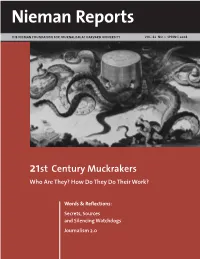
NIEMAN REPORTS Nieman Reports One Francis Avenue Cambridge, Massachusetts 02138 Nieman Reports THE NIEMAN FOUNDATION FOR JOURNALISM AT HARVARD UNIVERSITY VOL. 62 NO. 1 SPRING 2008 VOL. 62 NO. 1 SPRING 2008 21 ST CENTURY MUCKRAKERS THE NIEMAN FOUNDATION HARVARDAT UNIVERSITY 21st Century Muckrakers Who Are They? How Do They Do Their Work? Words & Reflections: Secrets, Sources and Silencing Watchdogs Journalism 2.0 End Note went to the Carnegie Endowment in New York but of the Oakland Tribune, and Maynard was throw- found times to return to Cambridge—like many, ing out questions fast and furiously about my civil I had “withdrawal symptoms” after my Harvard rights coverage. I realized my interview was lasting ‘to promote and elevate the year—and would meet with Tenney. She came to longer than most, and I wondered, “Is he trying to my wedding in Toronto in 1984, and we tried to knock me out of competition?” Then I happened to keep in touch regularly. Several of our class, Peggy glance over at Tenney and got the only smile from standards of journalism’ Simpson, Peggy Engel, Kat Harting, and Nancy the group—and a warm, welcoming one it was. I Day visited Tenney in her assisted living facility felt calmer. Finally, when the interview ended, I in Cambridge some years ago, during a Nieman am happy to say, Maynard leaped out of his chair reunion. She cared little about her own problems and hugged me. Agnes Wahl Nieman and was always interested in others. Curator Jim Tenney was a unique woman, and I thoroughly Thomson was the public and intellectual face of enjoyed her friendship. -

In Praise of Statutes of Limitations in Sex Offense Cases James Herbie Difonzo Maurice A
Maurice A. Deane School of Law at Hofstra University Scholarly Commons at Hofstra Law Hofstra Law Faculty Scholarship 2004 In Praise of Statutes of Limitations in Sex Offense Cases James Herbie DiFonzo Maurice A. Deane School of Law at Hofstra University Follow this and additional works at: https://scholarlycommons.law.hofstra.edu/faculty_scholarship Recommended Citation James Herbie DiFonzo, In Praise of Statutes of Limitations in Sex Offense Cases, 41 Hous. L. Rev. 1205 (2004) Available at: https://scholarlycommons.law.hofstra.edu/faculty_scholarship/461 This Article is brought to you for free and open access by Scholarly Commons at Hofstra Law. It has been accepted for inclusion in Hofstra Law Faculty Scholarship by an authorized administrator of Scholarly Commons at Hofstra Law. For more information, please contact lawcls@hofstra.edu. ARTICLE IN PRAISE OF STATUTES OF LIMITATIONS IN SEX OFFENSE CASES James Herbie DiFonzo* "Rapists Shouldn't Be Able to Run Out the Clock."' "'[DNA] is very, very reliable if you do two things right: if you test it right, and if you interpret the results right .... The problem is that jurors think it's absolute and infallible.'"2 TABLE OF CONTENTS I. INTRODUCTION ................................................................... 1206 II. ARE STATUTES OF LIMITATIONS STILL RELEVANT IN THE AGE OF DNA? .......................................................... 1209 A. Limitations Policy Revisited ....................................... 1209 B. The Impact of DNA Technology on Limitations Policy in Sexual Offense Cases ................................... 1217 C. Indicting "JohnDoe, Unknown Male with Matching Deoxyribonucleic Acid (DNA) Profile"........ 1226 * Professor of Law, Hofstra University School of Law. J.D., M.A., 1977, Ph.D., 1993, University of Virginia. E-mail: lawjhd@hofstra.edu. -
The Data Journalism Handbook
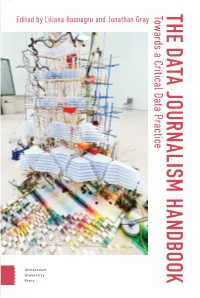
THE DATA JOURNALISM HANDBOOK Towards a Critical Data Practice Edited by Liliana Bounegru and Jonathan Gray 1 Bounegru & Gray (eds.) The Data Journalism Handbook “This is a stellar collection that spans applied and scholarly perspectives on practices of data journalism, rich with insights into the work of making data tell stories.” − Kate Crawford, New York University + Microsoft Research New York; author of Atlas of AI “Researchers sometimes suffer from what I call journalist-envy. Journalists, after all, write well, meet deadlines, and don’t take decades to complete their research. But the journalistic landscape has changed in ways that scholars should heed. A new, dynamic field—data journalism—is flourishing, one that makes the boundaries between our fields less rigid and more interesting. This exciting new volume interrogates this important shift, offering journalists and researchers alike an engaging, critical introduction to this field. Spanning the globe, with an impressive variety of data and purposes, the essays demonstrate the promise and limits of this form of journalism, one that yields new investigative strategies, one that warrants analysis. Perhaps new forms of collaboration will also emerge, and envy can give way to more creative relations.” − Wendy Espeland, Northwestern University; co-author of Engines of Anxiety: Academic Rankings, Reputation, and Accountability “It is now established that data is entangled with politics and embedded in history and society. This bountiful book highlights the crucial role of data journalists -

African American Studies Young, Kurt B. B.A
ABSTRACT AFRICAN AMERICAN STUDIES YOUNG, KURT B. B.A., UNIVERSITY OF FLORIDA, 1991 INSTITUTIONAL RACISM, REDLINING AND THE DECLINE OF SIX ATLANTA CO~UNITIES Advisor: Dr. Michael Bailey Thesis dated July, 1994 Bank, mortgage and insurance redlining, as an extension of institutional racism, has been detrimental to the development of African American communities. Racism has always existed as a negative force in the lives of African Americans and has historically been observed with relative ease. Today, racism continues to hamper the social, political and economic advancement of African Americans but it has become highly sophisticated and less visible, making it much more difficult to detect by its victims. This difficulty in detection has caused confusion in the problem-solving efforts of those concerned with the decline of African American neighborhoods. This study discusses the impact of redlining in six Atlanta communities, first by analyzing the ideology responsible for the practice of racism; second, by discussing how racism has become institutionalized; and last, by examining redlining’s role in community housing markets and 1 household finance. The research pinpoints particular indicators of neighborhood decline, such as homeownership, vacancy, abandonment and property value. Then the relationship between the redlining and decline, reflected in the behavior of the indicators, is exposed. The study found that redlining, in spite of legislation to stop it, continues to stunt the growth of African ~inerican communities. Specifically, its practice results in fewer new homes, more residents forced to rent, more vacancies and lower relative property value. These factors combine to generate a process of decline in African American neighborhoods over time. -

Gabor Loses Round in Suit Against Daughter
NBC 4 Gabor Loses Round In Suit Against Daughter Judge Refuses To Freeze Daughter's Property SANTA MONICA , Calif. -- A Santa Monica judge refused Tuesday to grant an order to freeze a Laurel Canyon property owned by Zsa Zsa Gabor's only daughter in a lawsuit that alleges she stole nearly $2 million from her mother. Gabor and her husband, Frederic Prinz Von Anhalt, sued Francesca Hilton on June 1. Gabor gave birth to her daughter in 1947 during her marriage to hotel magnate Conrad Hilton, making the younger woman the great-aunt of Paris Hilton. Gabor's lawsuit alleges her daughter and others conspired to take out a $3.75 million loan on her Bel Air home through the use of forged powers of attorney and then stole $2 million, which Hilton used to buy herself a home and also invested in a phantom company in New York . In ruling against Gabor on the requested freeze, Superior Court Judge Jacqueline Connor found "no evidence" that Hilton was planning to sell her Carmar Drive home. "Ultimately , what appears to be at issue is not the property, but the money used to purchase the property (the equity from plaintiffs' Bel Air home)," Connor wrote. "As long as the applicant can sue for money damages, an injunction should be denied, as there is an adequate legal remedy available." According to Hilton's court papers, she has been living since 1982 at the Carmar Drive house, which Gabor gave to her "free and clear in 1998." "At this point in the case, there wasn't enough evidence to justify an asset freeze pretrial," Hilton's attorney, Ronald Richards , said after the hearing. -
Discussion Guide
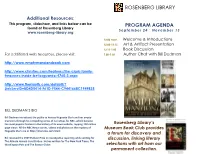
ROSENBERG LIBRARY Additional Resources: This program, slideshow, and links below can be PROGRAM AGENDA found at Rosenberg Library September 24 · November 13 www.rosenberg-library.org 12:00 noon Welcome & Introductions 12:00-12:15 Art & Artifact Presentation 12:15-1:00 Book Discussion For additional web resources, please visit: 1:00-1:30 Author Chat with Bill Dedman http://www.emptymansionsbook.com http://www.christies.com/features/the-clark-family- treasures-inside-bellosguardo-4760-3.aspx http://www.theriaults.com/default/? LinkServID=BD4D5414-F61D-F544-C9441668C1949B35 BILL DEDMAN’S BIO Bill Dedman introduced the public to heiress Huguette Clark and her empty mansions through his compelling series of narratives for NBC, which became the most popular feature in the history of its news website, topping 110 million Rosenberg Library’s page views. All the NBC News stories, videos and photos on the mystery of Museum Book Club provides Huguette Clark are at http://nbcnews.com/clark. a forum for discovery and Bill received the 1989 Pulitzer Prize in investigative reporting while writing for discussion, linking literary The Atlanta Journal-Constitution. He has written for The New York Times, The Washington Post and The Boston Globe. selections with art from our permanent collection. Discussion... “Like her attention-grabbing father and her music-loving Empty Mansions is based on facts, documents, and testimony. mother, both strong-willed and That leaves mysteries in the lives of its characters. Did the private in their own ways, uncertainties add or detract from your enjoyment of the story? Huguette was a formidable personality who lived life as she Would you have preferred that the authors psychoanalyze wanted, always on her own Huguette, creating dialog and filling in missing scenes as a terms.” -p. -

Subprime Lending, Mortgage Foreclosures and Race: How Far Have We Come and How Far Have We to Go?
Subprime Lending, Mortgage Foreclosures and Race: How far have we come and how far have we to go? Ira Goldstein, Ph.D. Director, Policy & Information Services The Reinvestment Fund With: Dan Urevick-Ackelsberg The Reinvestment Fund Subprime Lending, Mortgage Foreclosures and Race Background For most of the 20 th century, lending discrimination occurred primarily through the denial of credit to minority group members and to the neighborhoods in which they lived. Redlining is a place-based practice in which lenders denied mortgage credit to neighborhoods with substantial numbers of minorities – typically, African Americans and Latinos. Together with the differential treatment of minority and White applicants, a people-based practice, mortgage credit discrimination accelerated segregation and neighborhood decline. For many years, the private market and federal government (e.g., through the explicit practices of the Federal Housing Administration) operated under laws and policies that permitted (and many argue, promoted) redlining and racial segregation.1 After the passage of a number of historically significant federal laws in the 1960s and 1970s, especially the Fair Housing Act (Title VIII of the Civil Rights Act of 1968) and the Equal Credit Opportunity Act of 1974 (ECOA), federal law and policy outlawed lending discrimination, and started to require data collection among federally-regulated lending institutions. However, early enforcement of federal fair lending laws was anemic as evidenced by the limited number of legal actions filed, most of which were by private actors.2 Data collection on lending institutions did not begin in earnest amongst regulators until petitions were made to the financial regulatory agencies by the National Urban League in 1971. -
Rosenberg Library Announces Museum Book Club Fall Selection
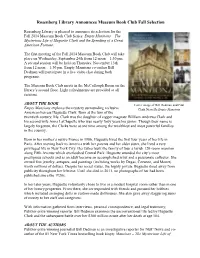
Rosenberg Library Announces Museum Book Club Fall Selection Rosenberg Library is pleased to announce its selection for the Fall 2014 Museum Book Club Series: Empty Mansions – The Mysterious Life of Huguette Clark and the Spending of a Great American Fortune. The first meeting of the Fall 2014 Museum Book Club will take place on Wednesday, September 24th from 12 noon – 1:30 pm. A second session will be held on Thursday, November 13th from 12 noon – 1:30 pm. Empty Mansions co-author Bill Dedman will participate in a live video chat during both programs. The Museum Book Club meets in the McCullough Room on the library’s second floor. Light refreshments are provided at all sessions. ABOUT THE BOOK Cover image of Bill Dedman and Paul Empty Mansions explores the mystery surrounding reclusive Clark Newell's Empty Mansions American heiress Huguette Clark. Born at the turn of the twentieth century, Ms. Clark was the daughter of copper magnate William Andrews Clark and his second wife Anna LaChapelle who was nearly forty years his junior. Though their name is largely forgotten, the Clarks were at one time among the wealthiest and most powerful families in the country. Born in her mother’s native France in 1906, Huguette lived the first four years of her life in Paris. After moving back to America with her parents and her older sister, she lived a very privileged life in New York City. Her father built the family of four a lavish 120-room mansion along Fifth Avenue which overlooked Central Park. Huguette attended the city’s most prestigious schools and as an adult became an accomplished artist and a passionate collector. -

"On the Take": the Black Box of Credit Scoring and Mortgage Discrimination
University of Baltimore Law ScholarWorks@University of Baltimore School of Law All Faculty Scholarship Faculty Scholarship Spring 2011 "On the Take": The lB ack Box of Credit Scoring and Mortgage Discrimination Cassandra Jones Havard University of Baltimore School of Law, chavard@ubalt.edu Follow this and additional works at: http://scholarworks.law.ubalt.edu/all_fac Part of the Banking and Finance Law Commons, Civil Rights and Discrimination Commons, Property Law and Real Estate Commons, and the Social Welfare Law Commons Recommended Citation "On the Take": The lB ack Box of Credit Scoring and Mortgage Discrimination, 20 B.U. Pub. Int. L.J. 241 (2011) This Article is brought to you for free and open access by the Faculty Scholarship at ScholarWorks@University of Baltimore School of Law. It has been accepted for inclusion in All Faculty Scholarship by an authorized administrator of ScholarWorks@University of Baltimore School of Law. For more information, please contact snolan@ubalt.edu. "ON THE TAKE": THE BLACK BOX OF CREDIT SCORING AND MORTGAGE DISCRIMINATION CASSANDRA JONES HA V ARD* ABSTRACT Subprime credit, a relatively new method of risk-based pricing, has been hailed as a way to open-up markets and provide credit to those who would otherwise be excluded. However, evidence suggests that subprime mortgage segmentation increases, rather than reduces, exclusionary practices in lending. Furthermore, it is unclear how lenders determine who qualifies as a subprime borrower. This concern became apparent when studies demonstrated that mi nority borrowers, regardless of creditworthiness, are more likely to receive ex pensive, subprime loans. The disparity is properly attributed to lenders' credit pricing policies. -

Vallo Asperk Ullabritt Laanemets Tõnis Pärn Reimo Esaul
Authors: Vallo Asperk Ullabritt Laanemets Tõnis Pärn Reimo Esaul Tallinn School of Economics and Business Administration 2011 TABLE OF CONTENTS Abstract .............................................................................................................................. 3 Introduction........................................................................................................................ 4 1. Corporate overview ........................................................................................................ 5 1.1. Key Dates......................................................................................................................... 5 1.2. The Founder .................................................................................................................... 6 1.3. Corporate development.................................................................................................. 7 1.3.1. Early 20th‐Century Origins ....................................................................................... 7 1.3.2. Depression‐Era Wrangling over Corporate Ownership ........................................... 8 1.3.3. Postwar Expansion ................................................................................................... 9 1.3.4. Second Generation of Management Introduces Casino‐Hotels .............................. 9 1.3.5. Dispute over Founder's Will Spans 1980s.............................................................. 13 1.3.6. The 1990s and Beyond .......................................................................................... -

Pulitzer Prize Winners and Finalists
WINNERS AND FINALISTS 1917 TO PRESENT TABLE OF CONTENTS Excerpts from the Plan of Award ..............................................................2 PULITZER PRIZES IN JOURNALISM Public Service ...........................................................................................6 Reporting ...............................................................................................24 Local Reporting .....................................................................................27 Local Reporting, Edition Time ..............................................................32 Local General or Spot News Reporting ..................................................33 General News Reporting ........................................................................36 Spot News Reporting ............................................................................38 Breaking News Reporting .....................................................................39 Local Reporting, No Edition Time .......................................................45 Local Investigative or Specialized Reporting .........................................47 Investigative Reporting ..........................................................................50 Explanatory Journalism .........................................................................61 Explanatory Reporting ...........................................................................64 Specialized Reporting .............................................................................70 -
ENDNOTES Endnotes
CHAPTER 1 ENDNOTES Endnotes 1 Guantánamo Remarks Cost Policy Chief His Job, CNN (Feb. 2, 2007), available at http://www.cnn. com/2007/US/02/02/gitmo.resignation (“When corporate CEOs see that those firms are representing the very terrorists who hit their bottom line back in 2001, those CEOs are going to make those law firms choose between representing terrorists or representing reputable firms.”). 2 Task Force staff interview with Moazzam Begg, Omar Deghayes, Bisher al-Rawi (Apr. 17, 2012) [hereinafter Begg, Deghayes, al-Rawi Interview]. 3 Neil A. Lewis, U.S. Military Eroding Trust of Detainees, Lawyers Say, N.Y. TIMES (Mar. 9, 2005), available at http://www.nytimes.com/2005/03/08/world/americas/08iht-gitmo.html (“Another lawyer, Marc Falkoff of New York, whose firm represents several Yemenis at the naval base in Cuba, said some of his clients had told him that a person who said he was a lawyer and had civilian clothes had conferred several times with some detainees. That person, Falkoff said his clients had told him, later appeared at the detention center in uniform, leading the inmates to distrust anyone claiming to be a lawyer and acting in their interest.”). See also Neil A. Lewis, Detainee’s Lawyer Says Captors Foment Mistrust, N.Y. TIMES (Dec. 7, 2005), available at http://www.nytimes.com/2005/12/07/international/07hamdan.html (“The Guantánamo authorities violated a court order by moving a prisoner from the general population there and placing him in close contact with a hard-core operative for Al Qaeda known for urging detainees to refuse to cooperate with their lawyers, according to papers filed with the United States District Court here by Lt.