World Working Group on Storks, Ibises . . and Spoonbills '·
Total Page:16
File Type:pdf, Size:1020Kb
Load more
Recommended publications
-
Comments on the Ornithology of Nigeria, Including Amendments to the National List
Robert J. Dowsett 154 Bull. B.O.C. 2015 135(2) Comments on the ornithology of Nigeria, including amendments to the national list by Robert J. Dowsett Received 16 December 2014 Summary.—This paper reviews the distribution of birds in Nigeria that were not treated in detail in the most recent national avifauna (Elgood et al. 1994). It clarifies certain range limits, and recommends the addition to the Nigerian list of four species (African Piculet Verreauxia africana, White-tailed Lark Mirafra albicauda, Western Black-headed Batis Batis erlangeri and Velvet-mantled Drongo Dicrurus modestus) and the deletion (in the absence of satisfactory documentation) of six others (Olive Ibis Bostrychia olivacea, Lesser Short-toed Lark Calandrella rufescens, Richard’s Pipit Anthus richardi, Little Grey Flycatcher Muscicapa epulata, Ussher’s Flycatcher M. ussheri and Rufous-winged Illadopsis Illadopsis rufescens). Recent research in West Africa has demonstrated the need to clarify the distributions of several bird species in Nigeria. I have re-examined much of the literature relating to the country, analysed the (largely unpublished) collection made by Boyd Alexander there in 1904–05 (in the Natural History Museum, Tring; NHMUK), and have reviewed the data available in the light of our own field work in Ghana (Dowsett-Lemaire & Dowsett 2014), Togo (Dowsett-Lemaire & Dowsett 2011a) and neighbouring Benin (Dowsett & Dowsett- Lemaire 2011, Dowsett-Lemaire & Dowsett 2009, 2010, 2011b). The northern or southern localities of species with limited ranges in Nigeria were not always detailed by Elgood et al. (1994), although such information is essential for understanding distribution patterns and future changes. For many Guineo-Congolian forest species their northern limit in West Africa lies on the escarpment of the Jos Plateau, especially Nindam Forest Reserve, Kagoro. -

Turkey Birding Eastern Anatolia Th Th 10 June to 20 June 2021 (11 Days)
Turkey Birding Eastern Anatolia th th 10 June to 20 June 2021 (11 days) Caspian Snowcock by Alihan Vergiliel Turkey, a country the size of Texas, is a spectacular avian and cultural crossroads. This fascinating nation boasts an ancient history, from even before centuries of Greek Roman and Byzantine domination, through the 500-year Ottoman Empire and into the modern era. Needless to say, with such a pedigree the country holds some very impressive archaeological and cultural sites. Our tour of Eastern Turkey starts in the eastern city of Van, formerly known as Tuspa and 3,000 years ago the capital city of the Urartians. Today there are historical structures from the Seljuk and Ottoman periods, and Urartian artifacts can be seen at its archaeological museum. RBL Turkey Itinerary 2 However, it is the birds that are of primary interest to us as here, at the eastern limits of the Western Palearctic, we expect to find some very special and seldom-seen species, including Mountain ‘Caucasian’ Chiffchaff, Green Warbler, Mongolian Finch and Grey-headed Bunting. Around the shores of Lake Van we will seek out Moustached and Paddyfield Warblers in the dense reed beds, while on the lake itself, our targets include Marbled Teal, the threatened White-headed Duck, Dalmatian Pelican, Pygmy Cormorant and Armenian Gull, plus a selection of waders that may include Terek and Broad-billed Sandpiper. As we move further north-east into the steppe and semi desert areas, we will attempt to find Great Bustards and Demoiselle Cranes, with a potential supporting cast of Montagu’s Harrier, Steppe Eagle, the exquisite Citrine Wagtail and Twite, to name but a few. -

Detailed Species Accounts from The
Threatened Birds of Asia: The BirdLife International Red Data Book Editors N. J. COLLAR (Editor-in-chief), A. V. ANDREEV, S. CHAN, M. J. CROSBY, S. SUBRAMANYA and J. A. TOBIAS Maps by RUDYANTO and M. J. CROSBY Principal compilers and data contributors ■ BANGLADESH P. Thompson ■ BHUTAN R. Pradhan; C. Inskipp, T. Inskipp ■ CAMBODIA Sun Hean; C. M. Poole ■ CHINA ■ MAINLAND CHINA Zheng Guangmei; Ding Changqing, Gao Wei, Gao Yuren, Li Fulai, Liu Naifa, Ma Zhijun, the late Tan Yaokuang, Wang Qishan, Xu Weishu, Yang Lan, Yu Zhiwei, Zhang Zhengwang. ■ HONG KONG Hong Kong Bird Watching Society (BirdLife Affiliate); H. F. Cheung; F. N. Y. Lock, C. K. W. Ma, Y. T. Yu. ■ TAIWAN Wild Bird Federation of Taiwan (BirdLife Partner); L. Liu Severinghaus; Chang Chin-lung, Chiang Ming-liang, Fang Woei-horng, Ho Yi-hsian, Hwang Kwang-yin, Lin Wei-yuan, Lin Wen-horn, Lo Hung-ren, Sha Chian-chung, Yau Cheng-teh. ■ INDIA Bombay Natural History Society (BirdLife Partner Designate) and Sálim Ali Centre for Ornithology and Natural History; L. Vijayan and V. S. Vijayan; S. Balachandran, R. Bhargava, P. C. Bhattacharjee, S. Bhupathy, A. Chaudhury, P. Gole, S. A. Hussain, R. Kaul, U. Lachungpa, R. Naroji, S. Pandey, A. Pittie, V. Prakash, A. Rahmani, P. Saikia, R. Sankaran, P. Singh, R. Sugathan, Zafar-ul Islam ■ INDONESIA BirdLife International Indonesia Country Programme; Ria Saryanthi; D. Agista, S. van Balen, Y. Cahyadin, R. F. A. Grimmett, F. R. Lambert, M. Poulsen, Rudyanto, I. Setiawan, C. Trainor ■ JAPAN Wild Bird Society of Japan (BirdLife Partner); Y. Fujimaki; Y. Kanai, H. -
Age Estimation of Black Stork (Ciconia Nigra) Nestlings from Wing, Bill, Head, and Tarsus Lengths at the Time of Ringing
Turkish Journal of Zoology Turk J Zool (2018) 42: 132-136 http://journals.tubitak.gov.tr/zoology/ © TÜBİTAK Short Communication doi:10.3906/zoo-1702-42 Age estimation of black stork (Ciconia nigra) nestlings from wing, bill, head, and tarsus lengths at the time of ringing 1 1 1 2 1, Maciej KAMIŃSKI , Bartosz JANIC , Lidia MARSZAŁ , Jerzy BAŃBURA , Piotr ZIELIŃSKI * 1 Department of Ecology and Vertebrate Zoology, Faculty of Biology and Environmental Protection, University of Lodz, Lodz, Poland 2 Department of Experimental Zoology and Evolutionary Biology, Faculty of Biology and Environmental Protection, University of Lodz, Lodz, Poland Received: 20.02.2017 Accepted/Published Online: 11.09.2017 Final Version: 10.01.2018 Abstract: Black stork nestlings were measured (wing, bill, head, and tarsus lengths) at weekly intervals in central Poland in 2012, 2014, and 2015. The aim of the study was to provide growth equations based on nestling measurements to allow age estimation of black stork nestlings. The hatching hour and date of nestlings in five nests were determined using trail cameras. The age of the measured nestlings ranged from 18 to 53 days. Wing, bill, and head lengths showed linear growth, while tarsus growth was only linear for nestlings not exceeding 35 days old. Within the age range studied, wing length grew 9.6 mm per day, head length grew 2.3 mm per day, and bill length grew 1.8 mm per day. The study provides the first growth parameters for the black stork. Key words: Breeding ecology, growth formulas, ringing, biometrics, storks, trail cameras Compared to the white stork (Ciconia ciconia), the 2005). -

South Africa: Magoebaskloof and Kruger National Park Custom Tour Trip Report
SOUTH AFRICA: MAGOEBASKLOOF AND KRUGER NATIONAL PARK CUSTOM TOUR TRIP REPORT 24 February – 2 March 2019 By Jason Boyce This Verreaux’s Eagle-Owl showed nicely one late afternoon, puffing up his throat and neck when calling www.birdingecotours.com info@birdingecotours.com 2 | TRIP REPORT South Africa: Magoebaskloof and Kruger National Park February 2019 Overview It’s common knowledge that South Africa has very much to offer as a birding destination, and the memory of this trip echoes those sentiments. With an itinerary set in one of South Africa’s premier birding provinces, the Limpopo Province, we were getting ready for a birding extravaganza. The forests of Magoebaskloof would be our first stop, spending a day and a half in the area and targeting forest special after forest special as well as tricky range-restricted species such as Short-clawed Lark and Gurney’s Sugarbird. Afterwards we would descend the eastern escarpment and head into Kruger National Park, where we would make our way to the northern sections. These included Punda Maria, Pafuri, and the Makuleke Concession – a mouthwatering birding itinerary that was sure to deliver. A pair of Woodland Kingfishers in the fever tree forest along the Limpopo River Detailed Report Day 1, 24th February 2019 – Transfer to Magoebaskloof We set out from Johannesburg after breakfast on a clear Sunday morning. The drive to Polokwane took us just over three hours. A number of birds along the way started our trip list; these included Hadada Ibis, Yellow-billed Kite, Southern Black Flycatcher, Village Weaver, and a few brilliant European Bee-eaters. -
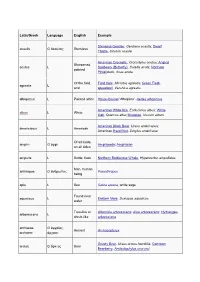
Dwarf Thistle, Cirsi
Latin/Greek Language English Example Stemless Gentian, Gentiana acaulis; Dwarf acaulis G ἄκαυλος Stemless Thistle, Cirsium acaule American Crocodile, Crocodylus acutus; Angled Sharpened, acutus L Sunbeam (Butterfly), Curetis acuta; Northern pointed Pintailduck, Anas acuta Of the field, Field Vole, Microtus agrestis; Green Field- agrestis L wild speedwell, Veronica agrestis albopictus L Painted white Hosta fortunei 'Albopicta', Aedes albopictus American White Ibis, Eudocimus albus; White albus L White Oak, Quercus alba; Mistletoe, Viscum album American Black Bear, Ursus americanus; americanus L American American Hazel Nut, Corylus americana Of all kinds, amphi- G ἀμφί Amphipoda; Amphibian on all sides ampulla L Bottle, flask Northern Bottlenose Whale, Hyperoodon ampullatus Man, human anthropos G ἄνθρωπος Paranthropus being apis L Bee Salvia apiana, white sage Found near aquaticus L Eastern Mole, Scalopus aquaticus water Tree-like or Artemisia arborescens; Aloe arborescens; Hydrangea arborescens L shrub-like arborescens archaeos, G ἀρχαῖος, Ancient Archaeopteryx archaeo- ἀρχαιο- Grizzly Bear, Ursus arctos horribilis; Common arctos G ἄρκτος Bear Bearberry, Arctostaphylos uva-ursi argentatus L Silvery Herring Gull, Larus argentatus arthron G ἄρθρον Joint Arthropoda arvensis L In the field Skylark, Alauda arvensis astron, astro-, G ἄστρον, Star Starfish (class), Asteroidea astero- ἀστρο-, ἀστερο- Acer palmatum 'Atropurpureum'; Berberis atropurpureum L Deep purple thunbergii f. atropurpurea Daphne odora 'Aureomarginata'; Taxus aureomarginata -

Specialist Group on Storks, Ibises and Spoonbills Newsletter
INTERNATIONAL WATERFOWL AND WETLANDS RESEARCH BUREAU/ INTERNATIONAL COUNCIL FOR BIRD PRESERVATION/ IUCN -- THE WORLD CONSERVATION UNION SPECIALIST GROUP ON STORKS, IBISES AND SPOONBILLS NEWSLETTER Volume 5, Number 1/2 November, 1992 LETTER FROM THE CO-CHAIRS improve management of small populations of endangered species. There is a great deal of exciting activity and new involvement within SIS. In April, Koen attended Initially, Michael Soull! and others began the Waldrapp Ibis Conservation meeting in Rabat, using mathematical models to examine the vulner Morocco (page 8). This was a productive meeting. abilities of small, threatened populations and to The increased interest and cooperation will lead to a contribute to their management (See references more unified and effective conservation effort. We below). More recently, the IUCN/SSC Captive hope that similar cooperative efforts will be generated Breeding Specialist Group has developed one for other species. aspect of the use of models. Special (PVA) meetings are held to model individual endangered In July, Malcolm attended a workshop for the species (e.g., the recent PVA meeting on the conservation of storks and cranes in the Amur River Waldrapp Ibis in Rabat). At these meetings a Basin (page 9). The meeting was well attended by single computer model is used: Vortex which was Russians, Chinese, Japanese, Koreans as well as written by Robert Lacy of the Brookfield Zoo. conservationists from Hong Kong and the United States. One working group dealt with the Oriental Because it is commonly used, the term White Stork Ciconia boyciana. We discussed and PVA has come to mean different things to differ summarized the conservation needs of the species. -

Common Characteristics of Behaviour, Habitat, and Diet of Endangered Wetland Birds
Lakehead University Knowledge Commons,http://knowledgecommons.lakeheadu.ca Electronic Theses and Dissertations Undergraduate theses 2018 Common characteristics of behaviour, habitat, and diet of endangered wetland birds Zong, Zhen http://knowledgecommons.lakeheadu.ca/handle/2453/4427 Downloaded from Lakehead University, KnowledgeCommons COMMON CHARACTERISTICS OF BEHAVIOUR, HABITAT, AND DIET OF ENDANGERED WETLAND BIRDS by Zhen Zong FACULTY OF NATURAL RESOURCES MANAGEMENT LAKEHEAD UNIVERSITY THUNDER BAY, ONTARIO April 2018 I COMMON CHARACTERISTICS OF BEHAVIOUR, HABITAT, AND DIET OF ENDANGERED WETLAND BIRDS by Zhen Zong An undergraduate Thesis Submitted in Partial Fulfillment of the Requirements for the Degree of Honours Bachelor of Science in Forestry Faculty of Natural Resources Management Lakehead University April 2018 Major Advisor Second Reader II LIBRARY RIGHTS STATEMENT In presenting this thesis in partial fulfillment of the requirement for the H.B.Sc.F degree at Lakehead University in Thunder Bay, I agree that the University will make it freely available for inspection. This thesis is made by my authority solely for the purpose of private study and research and may not be copied or reproduced in whole or in part (expect as permitted by the Copyright Laws) without my written authority. Signature: Date III A CAUTION TO THE READER This H.B.Sc.F. thesis has been through a semi-formal process of review and comment by at least two faculty members. It is made available for loan by the Faculty of Natural Resources Management for the purpose of advancing the practice of professional and scientific forestry. The reader should be aware that opinions and conclusions expressed in this document are those of the student and do not necessarily reflect the opinions of either the thesis supervisor, the faculty or Lakehead University. -

Review of the Status of Introduced Non-Native Waterbird Species in the Area of the African-Eurasian Waterbird Agreement: 2007 Update
Secretariat provided by the Workshop 3 United Nations Environment Programme (UNEP) Doc TC 8.25 21 February 2008 8th MEETING OF THE TECHNICAL COMMITTEE 03 - 05 March 2008, Bonn, Germany ___________________________________________________________________________ Review of the Status of Introduced Non-Native Waterbird Species in the Area of the African-Eurasian Waterbird Agreement: 2007 Update Authors A.N. Banks, L.J. Wright, I.M.D. Maclean, C. Hann & M.M. Rehfisch February 2008 Report of work carried out by the British Trust for Ornithology under contract to AEWA Secretariat © British Trust for Ornithology British Trust for Ornithology, The Nunnery, Thetford, Norfolk IP24 2PU Registered Charity No. 216652 CONTENTS Page No. List of Tables...........................................................................................................................................5 List of Figures.........................................................................................................................................7 List of Appendices ..................................................................................................................................9 EXECUTIVE SUMMARY..................................................................................................................11 RECOMMENDATIONS .....................................................................................................................13 1. INTRODUCTION.................................................................................................................15 -
Spread-Wing Postures and Their Possible Functions in the Ciconiidae
THE AUK A QUARTERLY JOURNAL OF ORNITHOLOGY Von. 88 Oc:roBE'a 1971 No. 4 SPREAD-WING POSTURES AND THEIR POSSIBLE FUNCTIONS IN THE CICONIIDAE M. P. KAI-IL IN two recent papers Clark (19'69) and Curry-Lindahl (1970) have reported spread-wingpostures in storks and other birds and discussed someof the functionsthat they may serve. During recent field studies (1959-69) of all 17 speciesof storks, I have had opportunitiesto observespread-wing postures. in a number of speciesand under different environmentalconditions (Table i). The contextsin which thesepostures occur shed somelight on their possible functions. TYPES OF SPREAD-WING POSTURES Varying degreesof wing spreadingare shownby at least 13 species of storksunder different conditions.In somestorks (e.g. Ciconia nigra, Euxenuragaleata, Ephippiorhynchus senegalensis, and ]abiru mycteria) I observedno spread-wingpostures and have foundno referenceto them in the literature. In the White Stork (Ciconia ciconia) I observedonly a wing-droopingposture--with the wings held a short distanceaway from the sidesand the primaries fanned downward--in migrant birds wetted by a heavy rain at NgorongoroCrater, Tanzania. Other species often openedthe wingsonly part way, in a delta-wingposture (Frontis- piece), in which the forearmsare openedbut the primariesremain folded so that their tips crossin front o.f or below the. tail. In some species (e.g. Ibis leucocephalus)this was the most commonly observedspread- wing posture. All those specieslisted in Table i, with the exception of C. ciconia,at times adopted a full-spreadposture (Figures i, 2, 3), similar to those referred to by Clark (1969) and Curry-Lindahl (1970) in severalgroups of water birds. -

Bird Checklists of the World Country Or Region: Myanmar
Avibase Page 1of 30 Col Location Date Start time Duration Distance Avibase - Bird Checklists of the World 1 Country or region: Myanmar 2 Number of species: 1088 3 Number of endemics: 5 4 Number of breeding endemics: 0 5 Number of introduced species: 1 6 7 8 9 10 Recommended citation: Lepage, D. 2021. Checklist of the birds of Myanmar. Avibase, the world bird database. Retrieved from .https://avibase.bsc-eoc.org/checklist.jsp?lang=EN®ion=mm [23/09/2021]. Make your observations count! Submit your data to ebird. -

(Ciconia Maguari) in the Pampa Eco-Region of South
NORTH-WESTERN JOURNAL OF ZOOLOGY 17 (1): 106-110 ©NWJZ, Oradea, Romania, 2021 Article No.: e201603 http://biozoojournals.ro/nwjz/index.html Citizen science for the knowledge of tropical birds: the diet of the Maguari Stork (Ciconia maguari) in the Pampa ecoregion of southern Brazil Dárius Pukenis TUBELIS1* and Milena WACHLEVSKI2 1. Department of Biosciences, Universidade Federal Rural do Semi-Árido, Mossoró, RN, 59625-900, Brazil. 2. Laboratory of Animal Behavior and Ecology, Department of Biosciences, Universidade Federal Rural do Semi-Árido, Mossoró, RN, 59625-900, Brazil. * Corresponding author, D.P. Tubelis, E-mail: darius.tubelis@gmail.com Received: 04. October 2020 / Accepted: 01. December 2020 / Available online: 15. December 2020 / Printed: June 2021 Abstract.The Maguari Stork (Ciconia maguari) occurs extensively in South America where it inhabits mainly wetlands. Despite being common in some regions, information on several aspects of its ecology is lacking. The objective of this study was to investigate the diet of Maguari Storks in the Pampa ecoregion of southern Brazil using citizen science. A compilation of records of foraging birds was done in two on-line databases - WikiAves and e-Bird Brasil. A total of 36 records, obtained by citizens between 2008 and 2020, reported storks holding preys with their bills. The most frequent food item was the muçum fish (Synbranchus marmoratus), representing 39% of the preys. Squamate reptiles and anuran amphibians comprised 33% and 19% of the food items, respectively. Most preys had a serpentiform body shape, being represented mainly by muçum and snakes. This study suggests that our knowledge regarding the natural history of Brazilian birds can increase through citizen science.