Generation-Europe.Pdf
Total Page:16
File Type:pdf, Size:1020Kb
Load more
Recommended publications
-
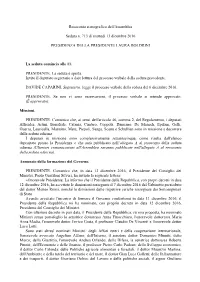
Resoconto Stenografico Dell'assemblea Seduta N. 713 Di
Resoconto stenografico dell'Assemblea Seduta n. 713 di martedì 13 dicembre 2016 PRESIDENZA DELLA PRESIDENTE LAURA BOLDRINI La seduta comincia alle 11. PRESIDENTE. La seduta è aperta. Invito il deputato segretario a dare lettura del processo verbale della seduta precedente. DAVIDE CAPARINI, Segretario, legge il processo verbale della seduta del 6 dicembre 2016. PRESIDENTE. Se non vi sono osservazioni, il processo verbale si intende approvato. (È approvato). Missioni. PRESIDENTE. Comunico che, ai sensi dell'articolo 46, comma 2, del Regolamento, i deputati Alfreider, Artini, Bonafede, Catania, Cimbro, Coppola, Damiano, De Menech, Epifani, Gelli, Guerra, Lauricella, Mannino, Meta, Piepoli, Sanga, Scanu e Schullian sono in missione a decorrere dalla seduta odierna. I deputati in missione sono complessivamente settantacinque, come risulta dall'elenco depositato presso la Presidenza e che sarà pubblicato nell’allegato A al resoconto della seduta odierna (Ulteriori comunicazioni all'Assemblea saranno pubblicate nell'allegato A al resoconto della seduta odierna). Annunzio della formazione del Governo. PRESIDENTE. Comunico che, in data 13 dicembre 2016, il Presidente del Consiglio dei Ministri, Paolo Gentiloni Silveri, ha inviato la seguente lettera: «Onorevole Presidente, La informo che il Presidente della Repubblica, con propri decreti in data 12 dicembre 2016, ha accettato le dimissioni rassegnate il 7 dicembre 2016 dal Gabinetto presieduto dal dottor Matteo Renzi, nonché le dimissioni dalle rispettive cariche rassegnate dai Sottosegretari di Stato. Avendo accettato l'incarico di formare il Governo conferitomi in data 11 dicembre 2016, il Presidente della Repubblica mi ha nominato, con proprio decreto in data 12 dicembre 2016, Presidente del Consiglio dei Ministri. Con ulteriore decreto in pari data, il Presidente della Repubblica, su mia proposta, ha nominato Ministri senza portafoglio la senatrice dottoressa Anna Finocchiaro, l'onorevole dottoressa Maria Anna Madia, l'onorevole dottor Enrico Costa, il professor Claudio De Vincenti e l'onorevole dottor Luca Lotti. -

Italy 2017 International Religious Freedom Report
ITALY 2017 INTERNATIONAL RELIGIOUS FREEDOM REPORT Executive Summary The constitution protects freedom of religion and the right of religious communities to establish their own institutions. The constitution specifies the state and the Catholic Church are independent, their relations governed by treaties, which include a concordat granting the Church a number of privileges and benefits, as well as financial support. Other religious groups must register to receive tax and other benefits. Registered groups may request an accord with the state that provides most of the same benefits granted the Catholic Church. Muslims continued to report difficulties in acquiring permission from local governments to construct mosques or keep them open. In February the Ministry of Interior (MOI) signed an agreement with the country’s largest Muslim organization with the stated purpose of preventing radicalization and promoting the training of imams to manage funds transparently and deliver sermons in Italian. Following the ruling, Milan municipal officials continued to withhold authorization to build two new mosques and a Protestant church, citing limited capability to identify proper venues as required by the law. Local governments closed Bangladeshi informal “garage” mosques in Mestre and in Rome, and a group sought a referendum to block a new mosque in Pisa. In separate rulings, a Lazio court ordered authorities to reopen the five garage mosques that Rome officials had closed down in 2016. There were anti-Semitic and anti-Muslim incidents, including threats, hate speech, graffiti, and vandalism. In 2016, the most recent year for which data were available, the quasi-governmental National Office against Racial Discrimination (UNAR) reported 240 cases of discrimination based on religion, compared with 28 the previous year. -

Europarties and Euroscepticism in the 2014 European Elections
More Europe Vs. No Europe: Europarties and Euroscepticism in the 2014 European Elections Essays by David J. Bailey, Eleonora Poli, Ania Skrzypek More Europe Vs. No Europe: Europarties and Euroscepticism in the 2014 European Elections Italianieuropei: Hedwig Giusto and Virginia Cavaliere Graphic design: Emanuele Ragnisco, Mekkanografici Associati Page layout: Futura Grafica 70 Srl ISbn 978-88-89988-69-5 © 2014 Foundation for European Progressive Studies and Fondazione Italianieuropei Published with the financial support of the European Parliament CONTENTS 7 Foreword 9 Eurosceptic Vs. Europhile Parties: A Scenario of the next European Parliamentary Elections Eleonora Poli 25 Politicising Europe: Political Leadership and Courage of Europarties? Ania Skrzypek 73 On Political Will in the Era of Austerity David J. Bailey 5 Foreword In 2013 the Foundation for European Progressive Studies, the Fondazione Italianieuropei and the Rome office of the Friedrich- Ebert-Stiftung co-sponsored an international seminar entitled “Democratic Legitimacy and Political Leadership in the Euro- pean Union. Towards the 2014 European Elections”. On that oc- casion the discussion, moving from the impact that the economic and political downturn had on the EU citizens’ disenchantment with politics and democracy, both at the national and European levels, focused on the need to politicise the EU dimension and provide the common institutions with that democratic legitima- tion which they were largely missing. The discussion focused in particular on two factors that, it was argued, could contribute to the achievement of those goals: the direct election of the President of the European Commission, and the enhancement of the Europarties and the creation of a competitive party system. -

Europe and Social Democracy SOCIAL DEMOCRACY READER 4 SOCIAL DEMOCRACYREADER4 Social Democracy and Europe Etal
Europe and Social Democracy SOCIAL DEMOCRACY READER 4 SOCIAL DEMOCRACYREADER4 Social Democracy Social Europe and Cäcilie Schildberg etal. ISBN 978-3-86498-844-8 2nd, updated edition, 1st English edition Published by Friedrich-Ebert-Stiftung German edition: Political Academy, Bonn, February 2014 English edition: Division for International Cooperation, Berlin, May 2014 The fi rst (German) edition was supported fi nancially by the Erich-Brost-Schenkung. »One of the advantages of democracy that no other form of state can substitute is discussion; only that enables the voters to take their bearings. That alone forces them to take a position.« (Erich Brost 1951) Editing: Jochen Dahm, Tobias Gombert, Christian Krell, Cäcilie Schildberg, Martin Timpe, Anne Wagenführ Contact: christian.krell@fes.de / jochen.dahm@fes.de / nachkontakte@fes.de Printing: Mauser + Tröster GbR, Mössingen Layout and typesetting: DIE.PROJEKTOREN, Berlin Title photo: Sven Hopp, fotolia.com The authors of the individual sections of this publication are responsible for the views it contains. The opinions expressed are not necessarily those of the Friedrich-Ebert-Stiftung in all instances. SOCIAL DEMOCRACY READER 4 Cäcilie Schildberg et al. Europe and Social Democracy CONTENTS Foreword to the First English-language Edition 4 1. Introduction 6 2. Social Democracy – A Compass for Europe 10 2.1. Basic Values 12 2.2. Fundamental Rights 16 2.3. Europe and Social Democracy: Three Connections 20 2.4. Five Principles of Policy on Europe 24 2.5. Social Europe 32 3. Europe Today: How It Came into Being – What It Is 40 3.1. Democracy: Institutional Construction of the EU 48 3.2. -

State Visit of H.E. Paul BIYA, President of the Republic of Cameroon, to Italy 20 - 22 March 2017
TRAVAIL WORK FATHERLANDPATRIE PAIX REPUBLIQUEDU CAMEROUN PEACE REPUBLIQUE OF CAMEROON Paix - Travail - Patrie Peace - Work- Fatherland ------- ------- CABINET CIVIL CABINET CIVIL ------- ------- R E CELLULE DE COMMUNICATION R COMMUNICATION UNIT P N U EP N U B UB OO L LIC O MER O IQ F CA ER UE DU CAM State Visit of H.E. Paul BIYA, President of the Republic of Cameroon, to Italy 20 - 22 March 2017 PRESS KIT Our Website : www.prc.cm TRAVAIL WORK FATHERLANDPATRIE PAIX REPUBLIQUEDU CAMEROUN PEACE REPUBLIQUE OF CAMEROON Paix - Travail - Patrie Peace - Work- Fatherland ------- ------- CABINET CIVIL CABINET CIVIL R ------- E ------- P RE N U P N U B UB OO L LIC O MER O IQ F CA ER CELLULE DE COMMUNICATION UE DU CAM COMMUNICATION UNIT THE CAMEROONIAN COMMUNITY IN ITALY - It is estimated at about 12,000 people including approximately 4.000 students. - The Cameroonian students’ community is the first African community and the fifth worldwide. - Fields of study or of specialization are: medicine (about 2800); engineering (about 400); architecture (about 300); pharmacy (about 150) and economics (about 120). - Some Cameroonian students receive training in hotel management, law, communication and international cooperation. - Cameroonian workers in Italy are about 300 in number. They consist essentially of former students practicing as doctors, pharmacists, lawyers or business executives. - Other Cameroonians with precarious or irregular status operate in small jobs: labourers, domestic workers, mechanics, etc. The number is estimated at about 1.500. 1 TRAVAIL WORK FATHERLANDPATRIE REPUBLIQUEDU CAMEROUN PAIX REPUBLIQUE OF CAMEROON PEACE Paix - Travail - Patrie Peace - Work- Fatherland ------- ------- CABINET CIVIL CABINET CIVIL ------- ------- R E ELLULE DE COMMUNICATION R C P E N COMMUNICATION UNIT U P N U B UB OO L LIC O MER O IQ F CA ER UE DU CAM GENERAL PRESENTATION OF CAMEROON ameroon, officially the Republic of Cameroon is History a country in the west Central Africa region. -

The Valence Side of the EU: Advocating for National Interests in Europe
The Valence Side of the EU: Advocating for National Interests in Europe Luca Carrieri (lcarrieri@luiss.it) and Davide Angelucci, (dangelucci@luiss.it)1 2 Abstract In the last decades, many challenger parties have tried to mobilize a conflict on European integration, increasing their entrepreneurial efforts on the EU issues. In fact, the permissive consensus on integration policies has progressively vanished, with citizens expressing polarized attitudes towards the EU. As a consequence, the issue competition on European integration has been mainly conceived as a positional struggle, where voter/party preferences are ordered along a Pro-/-Anti-EU general dimension. However, some parties may be prone to deploy a different strategy, mobilizing valence aspects related to the EU. These strategies revolve around party competence in advocating for national interests at the EU level, which has been considered as a generally desired goal of domestic electorates. Relying on their claimed superior competence to defend national interests within the EU, parties adopt a valence frame on the EU to avoid divisions within their electorates. However, it is still unclear how much and whether the voters have electorally responded to EU valence issues. This paper advances the following research questions: Have EU valence issues affected electoral preferences? Have EU valence issues outweighed the EU positional ones in explaining the voting preferences? Which parties have been more likely to benefit from EU valence issues? To answer these questions, we use an innovative dataset, the Issue Competition Comparative Project (2017-2018), including information on voters’ attitudes on a number of issues. Most importantly, the dataset has tapped public opinion attitudes on both EU positional and valence issues in Italy and France. -

6 Who Are the Europeans and How Does This Matter for Politics?1
//FS2/CUP/3-PAGINATION/CKZ/2-PROOFS/3B2/9780521883016C06.3D 132 [132–166] 7.8.2008 7:58AM 6 Who are the Europeans and how does this matter for politics?1 NEIL FLIGSTEIN Introduction The European Union has produced a remarkable set of agreements to guide the political interactions of countries across Europe in the past fifty years. These agreements have produced collective rules governing market transactions of all varieties, created a single currency, estab- lished a rule of law that includes a European court, and promoted increased interactions for people who live within the boundaries of Europe. Moreover, the EU has expanded from six to twenty-seven countries. The endpoint of the EU has been left intentionally vague and can be encapsulated by the ambiguous phrase “toward an ever closer union.” Much of the political criticism of the EU has focussed on the lack of transparency in its procedures and in its accountability to a larger demo- cratic public (Baun 1996; Dinan 2002; McCormick 2002). Many of Europe’s citizens have little knowledge about the workings of the EU (Gabel 1998). This lack of “connectedness” to the EU by ordinary citizens has caused scholars to try to understand why a European identity (equivalent to a “national” identity), a European “civil society,” and a European politics have been so slow to emerge (Laffan et al. 2000). The main focus of these efforts is why, after fifty years of the integration project, there is so little evidence of public attitudes that reflect more feelings of solidarity across Europe. Even among those who work in Brussels, there are mixed feelings about being European (Hooghe 2005; Beyer 2005). -

Guy VERHOFSTADT* “More Europe Is the Solution…”
Revista_comunicare_31.qxd 5/26/2014 2:43 PM Page 67 Guy VERHOFSTADT* “More Europe is the solution…” Lectio Prima delivered by Guy Verhofstadt, MEP, Leader of the ALDE Group in the Eu- ropean Parliament, on the occasion of receiving the Doctor Honoris Causa award from the National University of Political Studies and Public Administration, Bucharest (Romania). The awarding ceremony took place on November 8, 2013, as part of the „European Citizen- ship Week”. This initiative carried out by the NUPSPA comprised a series of events to mark 20 years from the introduction of the European citizenship through the Treaty of Maastricht. Guy Verhofstadt, leader of the Liberals and Democrats, is one of the most influential voic- es in the European Parliament. He is currently running for President of the European Com- mission in the 2014 European elections. Throughout his political career, Verhofstadt has been a keen promoter of reforms within the EU; he has fought for a faster decision-making process and has supported the active consultation and involvement of European citizens in matters regarding the future of the European Union. In his address to the academic community of the National University of Political Studies and Public Administration, Guy Verhofstadt plainly stated that the EU is currently at a cross- roads and that a decision has to be made with regard to its future. The options available de- fine the role that the EU seeks to play in the globalized world: either the EU becomes more integrated and fit to cope with the new rules of the game or it remains an intergovernmental organization that “continues to think within its borders”. -

1 Roma, 3 Marzo 2014 Circolare N. 53/2014 Oggetto
Confederazione Generale Italiana dei Trasporti e della Logistica 00198 Roma - via Panama 62 – tel.068559151-3337909556 - fax 068415576 e-mail: confetra@confetra.com - http://www.confetra.com Roma, 3 marzo 2014 Circolare n. 53/2014 Oggetto: Composizione del Governo Renzi. Si riporta la composizione del Governo Renzi comprensiva dei 9 Vice Ministri e dei 35 Sottosegretari nominati il 28 febbraio scorso. Per ciascun nominativo viene indicato luogo e data di nascita, i principali incarichi precedentemente ricoperti nonché, qualo- ra trattasi di componente del Parlamento, partito di appartenenza e circoscrizione elettorale. Fabio Marrocco Per riferimenti confronta circ.ri conf.li n.42/2014 e 105/2013 Responsabile di Area Lc/lc © CONFETRA – La riproduzione totale o parziale è consentita esclusivamente alle organizzazioni aderenti alla Confetra. PRESIDENZA DEL CONSIGLIO Presidente: dr. Matteo RENZI Firenze, 1975 – Sindaco di Firenze Sottosegretari: • prof. Graziano Delrio Reggio Emilia 1960 – Già Ministro per gli Affari Regionali e le Au- tonomie nel Governo Letta on. Luca Lotti (PD) con delega all’editoria Empoli (FI) 1982 – Circoscrizione XII (Toscana) on. Sandro Gozi (PD) con delega agli affari europei Sogliano al Rubicone (Forlì-Cesena) 1968 – Circoscrizione IV (Lombardia 2) sen. Domenico Minniti (PD) con delega ai servizi segreti Reggio Calabria 1956 – Regione Calabria - Confermato MINISTERO DELLE INFRASTRUTTURE E DEI TRASPORTI Ministro: on. Maurizio Lupi (NCD) Milano 1959 – Circoscrizione III (Lombardia 1) - Confermato Vice Ministro: sen. Riccardo Nencini (PSI) Barberino di Mugello 1959 (FI) – Regione Marche Sottosegretari: • on. Umberto Del Basso De Caro (PD) Benevento 1953 – Circoscrizione XX (Campania 2) sen. Antonio Gentile (NCD) Cosenza 1950 – Regione Calabria 1 MINISTERO DELLO SVILUPPO ECONOMICO Ministro: dr.ssa Federica Guidi Modena 1969 – Amministratore Delegato Ducati Energia Vice Ministri: • prof. -

Journal of Contemporary European Research Euroscepticism Between
Journal of Contemporary European Research Volume 17, Issue 2 (2021) Research Article Euroscepticism between Populism and Technocracy: The Case of Italian Lega and Movimento 5 Stelle Franco Zappettini and Marzia Maccaferri Citation Zappettini, F. and Maccaferri, M. (2021). ‘Euroscepticism between Populism and Technocracy: The Case of Italian Lega and Movimento 5 Stelle’ in, Journal of Contemporary European Research 17 (2): 239-257. https://doi.org/10.30950/jcer.v17i2.1184 First published at: www.jcer.net Volume 17, Issue 2 (2021) Franco Zappettini and Marzia Maccaferri Abstract This paper analyses the digital communication of Italian parties Lega and Movimento 5 Stelle during their campaigns for the European Parliament elections (January-May 2019). We focus on the Italian case as it is representative of a generalised shift in European public discourse towards an overt delegitimation of the European project and its re-imagination. In the Italian case, Lega and Movimento 5 Stelle, which were in a Government coalition for fourteen months, have been instrumental in Italy’s shift from a strong Europhile country to one of the most Eurosceptic. However, while Lega has definitely aligned itself with a strong right-wing populist agenda, Movimento 5 Stelle has promoted a populist technocratic vision of democracy. Our analysis shows that the articulation of Eurosceptic discourses from both parties by and large reflects the two stances above with Lega’s messages (primarily produced by its leader Matteo Salvini) characterised by a ‘hyperled’ style of communication and stronger nativist elements (for example the appeal to an ethno-centric and ‘sovereign’ idea of Italy) than those of Movimento 5 Stelle, which instead relied on a ‘horizontal’ communicative style. -

Joaquín Roy and María Lorca-Susino Spain in the European Union
“Spain is the problem. Europe is the solution”. In this fashion Ortega y Gasset (1986-2011) Years Twenty-Five the First Union: Spain in the European once dramatized the need to “Europeanize” Spain. The results over the first twenty five years of EU membership have been truly impressive. When Spain became a member of the EC, some of the best and brightest of Spain’s govern- mental cadres and universities joined the expanded European institutions, taking on positions of responsibility. The most prominent chaired the European Court of Justice (Gil-Carlos Rodríguez Iglesias) and the Parliament (Enrique Barón, José- María Gil Robles, and Josep Borrell), holding key positions in the Commission, and filling the newly created position of High Representative for the Common Foreign and Security Policy (Javier Solana). Spain, in sum, “was not different”, contrary to what old-fashion tourist publicity for the country used to say. It was a European country like any other that was returning to its natural home after a long exile. Spain, in turn, received considerable benefits from EU membership through funds for regional investment policies, agriculture and rural develop- ment, and the modernisation of national infrastructure. From an index of 60 percent of the European average in 1986, today Spain’s income per head is in the range of 105 percent, with some regions surpassing 125 percent. From being a country that was a net receiver from the EU budget, Spain today is a net contributor. Reflecting this development, the present volume examines different di- mensions of the deepening relationship between Spain and the rest of Europe through membership of the EU (its history, and its impact on policy development on economic growth and on relations with third countries). -

Analysis of the Perception of the Eu and Eu‘S Policies Abroad
ANALYSIS OF THE PERCEPTION OF THE EU AND EU‘S POLICIES ABROAD FINAL REPORT December 7, 2015 0 The study was requested by the European Commission's Service for Foreign Policy Instruments (FPI) and was implemented in January – November 2015 by the following three partner organisations: the Public Policy and Management Institute (PPMI) (the lead partner) based in Vilnius, Lithuania; the National Centre for Research on Europe (NCRE), located at the University of Canterbury in Christchurch, New Zealand; and the NFG Research Group, based at Freie Universität Berlin, Germany. The study also drew on the expertise of expert teams based in 10 Strategic Partner countries: Brazil, Canada, China, India, Japan, Mexico, Russia, South Africa, South Korea, and the US. The public opinion poll in the 10 countries was carried out by TNS Global. The social media analysis was carried out by the NCRE with substantive support of the Statistical Cybermetrics Research Group at the University of Wolverhampton, the UK. The main contributors to this study are, in alphabetic order: Egidijus Barcevičius (Public Policy and Management Institute, Vilnius) Haroldas Brožaitis (Public Policy and Management Institute, Vilnius) Elma Caicedo (Public Policy and Management Institute, Vilnius) Natalia Chaban (NCRE, University of Canterbury) Johanna C. Günther (NFG, Freie Universität Berlin) Martin Holland (NCRE, University of Canterbury) Anja Lutz (NFG, Freie Universität Berlin) May-Britt U. Stumbaum (NFG, Freie Universität Berlin) The country expert teams are presented in Annex I. The study was presented to the Steering Committee on November 12, 2015. It has been revised to reflect ideas discussed during the meeting as well as follow-up suggestions received via e- mail.