The Essex Field Club
Total Page:16
File Type:pdf, Size:1020Kb
Load more
Recommended publications
-
Dipterists Digest
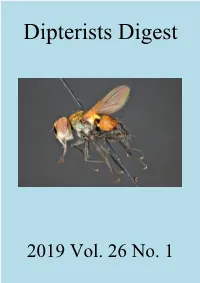
Dipterists Digest 2019 Vol. 26 No. 1 Cover illustration: Eliozeta pellucens (Fallén, 1820), male (Tachinidae) . PORTUGAL: Póvoa Dão, Silgueiros, Viseu, N 40º 32' 59.81" / W 7º 56' 39.00", 10 June 2011, leg. Jorge Almeida (photo by Chris Raper). The first British record of this species is reported in the article by Ivan Perry (pp. 61-62). Dipterists Digest Vol. 26 No. 1 Second Series 2019 th Published 28 June 2019 Published by ISSN 0953-7260 Dipterists Digest Editor Peter J. Chandler, 606B Berryfield Lane, Melksham, Wilts SN12 6EL (E-mail: chandgnats@aol.com) Editorial Panel Graham Rotheray Keith Snow Alan Stubbs Derek Whiteley Phil Withers Dipterists Digest is the journal of the Dipterists Forum . It is intended for amateur, semi- professional and professional field dipterists with interests in British and European flies. All notes and papers submitted to Dipterists Digest are refereed. Articles and notes for publication should be sent to the Editor at the above address, and should be submitted with a current postal and/or e-mail address, which the author agrees will be published with their paper. Articles must not have been accepted for publication elsewhere and should be written in clear and concise English. Contributions should be supplied either as E-mail attachments or on CD in Word or compatible formats. The scope of Dipterists Digest is: - the behaviour, ecology and natural history of flies; - new and improved techniques (e.g. collecting, rearing etc.); - the conservation of flies; - reports from the Diptera Recording Schemes, including maps; - records and assessments of rare or scarce species and those new to regions, countries etc.; - local faunal accounts and field meeting results, especially if accompanied by ecological or natural history interpretation; - descriptions of species new to science; - notes on identification and deletions or amendments to standard key works and checklists. -
SLAM Project
Biodiversity Data Journal 9: e69924 doi: 10.3897/BDJ.9.e69924 Data Paper SLAM Project - Long Term Ecological Study of the Impacts of Climate Change in the natural forest of Azores: I - the spiders from native forests of Terceira and Pico Islands (2012-2019) Ricardo Costa‡, Paulo A. V. Borges‡,§ ‡ cE3c – Centre for Ecology, Evolution and Environmental Changes / Azorean Biodiversity Group and Universidade dos Açores, Rua Capitão João d’Ávila, São Pedro, 9700-042, Angra do Heroismo, Azores, Portugal § IUCN SSC Mid-Atlantic Islands Specialist Group,, Angra do Heroísmo, Azores, Portugal Corresponding author: Paulo A. V. Borges (paulo.av.borges@uac.pt) Academic editor: Pedro Cardoso Received: 09 Jun 2021 | Accepted: 05 Jul 2021 | Published: 01 Sep 2021 Citation: Costa R, Borges PAV (2021) SLAM Project - Long Term Ecological Study of the Impacts of Climate Change in the natural forest of Azores: I - the spiders from native forests of Terceira and Pico Islands (2012-2019). Biodiversity Data Journal 9: e69924. https://doi.org/10.3897/BDJ.9.e69924 Abstract Background Long-term monitoring of invertebrate communities is needed to understand the impact of key biodiversity erosion drivers (e.g. habitat fragmentation and degradation, invasive species, pollution, climatic changes) on the biodiversity of these high diverse organisms. The data we present are part of the long-term project SLAM (Long Term Ecological Study of the Impacts of Climate Change in the natural forest of Azores) that started in 2012, aiming to understand the impact of biodiversity erosion drivers on Azorean native forests (Azores, Macaronesia, Portugal). In this contribution, the design of the project, its objectives and the first available data for the spider fauna of two Islands (Pico and Terceira) are described. -

Dipterists Forum
BULLETIN OF THE Dipterists Forum Bulletin No. 76 Autumn 2013 Affiliated to the British Entomological and Natural History Society Bulletin No. 76 Autumn 2013 ISSN 1358-5029 Editorial panel Bulletin Editor Darwyn Sumner Assistant Editor Judy Webb Dipterists Forum Officers Chairman Martin Drake Vice Chairman Stuart Ball Secretary John Kramer Meetings Treasurer Howard Bentley Please use the Booking Form included in this Bulletin or downloaded from our Membership Sec. John Showers website Field Meetings Sec. Roger Morris Field Meetings Indoor Meetings Sec. Duncan Sivell Roger Morris 7 Vine Street, Stamford, Lincolnshire PE9 1QE Publicity Officer Erica McAlister roger.morris@dsl.pipex.com Conservation Officer Rob Wolton Workshops & Indoor Meetings Organiser Duncan Sivell Ordinary Members Natural History Museum, Cromwell Road, London, SW7 5BD d.sivell@nhm.ac.uk Chris Spilling, Malcolm Smart, Mick Parker Nathan Medd, John Ismay, vacancy Bulletin contributions Unelected Members Please refer to guide notes in this Bulletin for details of how to contribute and send your material to both of the following: Dipterists Digest Editor Peter Chandler Dipterists Bulletin Editor Darwyn Sumner Secretary 122, Link Road, Anstey, Charnwood, Leicestershire LE7 7BX. John Kramer Tel. 0116 212 5075 31 Ash Tree Road, Oadby, Leicester, Leicestershire, LE2 5TE. Darwyn.sumner@ntlworld.com john.kramer@btinternet.com Assistant Editor Treasurer Judy Webb Howard Bentley 2 Dorchester Court, Blenheim Road, Kidlington, Oxon. OX5 2JT. 37, Biddenden Close, Bearsted, Maidstone, Kent. ME15 8JP Tel. 01865 377487 Tel. 01622 739452 judy.webb@virgin.net howard@hbentley.wanadoo.co.uk Conservation Dipterists Digest contributions Robert Wolton Locks Park Farm, Hatherleigh, Oakhampton, Devon EX20 3LZ Dipterists Digest Editor Tel. -

Biologie, Vývoj a Zoogeografie Vybraných Saproxylických Skupin
1 Masarykova univerzita Přírodovědecká fakulta Katedra zoologie a ekologie Biologie, vývoj a zoogeografie vybraných saproxylických skupin orientálních druhů čeledi Stratiomyidae Diplomová práce 2007 Prof. RNDr. R. Rozkošný, Dr. Sc. Alena Bučánková 2 Biologie, vývoj a zoogeografie vybraných saproxylických skupin orientálních druhů čeledi Stratiomyidae Abstrakt Je popsána morfologie, biologie a zoogeografie larev čtyř druhů z čeledi Stratiomyidae. Dva z nich, Pegadomyia pruinosa a Craspedometopon sp. n., patří do podčeledi Pachygasterinae, další dva, Adoxomyia bistriata a Cyphomyia bicarinata , patří do podčeledi Clitellariinae. Larvy byly sbírány Dr. D. Kovacem pod kůrou padlých stromů v Malysii a Thajsku. Saproxylický způsob života larev v rámci celé čeledi je zde diskutován jako původní stav. Byly vytypovány morfologické a biologické znaky larev s možným fylogenetickým významem a jejich platnost byla vyzkoušena v kladistických programech Nona a Winclada. Zjištěný fylogenetický vztah hlavních podčeledí odpovídá v podstatě současnému systému čeledi. Překážkou detailnímu vyhodnocení jsou zatím jen nedostatečné popisy larev a jejich malá znalost, zvláště v tropických oblastech. Biology, development and zoogeography of some saproxylic Oriental species of Stratiomyidae (Diptera) Abstract The morphology, biology and zoogeography of four larvae of Stratiomyidae are described. Two of them, Pegadomyia pruinosa , Craspedometopon sp. n. belong to the subfamily Pachygasteinae, the others, Adoxomyia bistriata and Cyphomyia bicarinata are placed to the subfamily Clitellariinae. The larvae were collected under the bark of fallen trees in Malaysia and Thailand by Dr. D. Kovac. The saproxylic habitat of stratiomyid larvae is discussed in this thesis as an original state. The morphological and biological characters of possible phylogenetic significance are evaluated and their value was verified with use of Nona and Winclada programs. -

Sawbridgeworth to Bishop's Stortford
Sawbridgeworth to Bishop’s Stortford (Full Walk) Sawbridgeworth to Bishop’s Stortford (Short Walk) 1st walk check 2nd walk check 3rd walk check 1st walk check 2nd walk check 3rd walk check 15th March 2014 06th July 2019 06th July 2019 Current status Document last updated Sunday, 07th July 2019 This document and information herein are copyrighted to Saturday Walkers’ Club. If you are interested in printing or displaying any of this material, Saturday Walkers’ Club grants permission to use, copy, and distribute this document delivered from this World Wide Web server with the following conditions: • The document will not be edited or abridged, and the material will be produced exactly as it appears. Modification of the material or use of it for any other purpose is a violation of our copyright and other proprietary rights. • Reproduction of this document is for free distribution and will not be sold. • This permission is granted for a one-time distribution. • All copies, links, or pages of the documents must carry the following copyright notice and this permission notice: Saturday Walkers’ Club, Copyright © 2014-2019, used with permission. All rights reserved. www.walkingclub.org.uk This walk has been checked as noted above, however the publisher cannot accept responsibility for any problems encountered by readers. Sawbridgeworth to Bishop’s Stortford (via Henry Moore Foundation) Start: Sawbridgeworth Station Finish: Bishop’s Stortford station Sawbridgeworth Station, map reference TL 490 150, is 6 km south of Bishop’s Stortford, and 48m above sea level. Bishop’s Stortford Station, map reference TL 491 208, is 43 km northeast of Charing X and 61m above sea level. -

Spider Biodiversity Patterns and Their Conservation in the Azorean
Systematics and Biodiversity 6 (2): 249–282 Issued 6 June 2008 doi:10.1017/S1477200008002648 Printed in the United Kingdom C The Natural History Museum ∗ Paulo A.V. Borges1 & Joerg Wunderlich2 Spider biodiversity patterns and their 1Azorean Biodiversity Group, Departamento de Ciˆencias conservation in the Azorean archipelago, Agr´arias, CITA-A, Universidade dos Ac¸ores. Campus de Angra, with descriptions of new species Terra-Ch˜a; Angra do Hero´ısmo – 9700-851 – Terceira (Ac¸ores); Portugal. Email: pborges@uac.pt 2Oberer H¨auselbergweg 24, Abstract In this contribution, we report on patterns of spider species diversity of 69493 Hirschberg, Germany. the Azores, based on recently standardised sampling protocols in different hab- Email: joergwunderlich@ t-online.de itats of this geologically young and isolated volcanic archipelago. A total of 122 species is investigated, including eight new species, eight new records for the submitted December 2005 Azorean islands and 61 previously known species, with 131 new records for indi- accepted November 2006 vidual islands. Biodiversity patterns are investigated, namely patterns of range size distribution for endemics and non-endemics, habitat distribution patterns, island similarity in species composition and the estimation of species richness for the Azores. Newly described species are: Oonopidae – Orchestina furcillata Wunderlich; Linyphiidae: Linyphiinae – Porrhomma borgesi Wunderlich; Turinyphia cavernicola Wunderlich; Linyphiidae: Micronetinae – Agyneta depigmentata Wunderlich; Linyph- iidae: -

A Review of the Status of Larger Brachycera Flies of Great Britain
Natural England Commissioned Report NECR192 A review of the status of Larger Brachycera flies of Great Britain Acroceridae, Asilidae, Athericidae Bombyliidae, Rhagionidae, Scenopinidae, Stratiomyidae, Tabanidae, Therevidae, Xylomyidae. Species Status No.29 First published 30th August 2017 www.gov.uk/natural -england Foreword Natural England commission a range of reports from external contractors to provide evidence and advice to assist us in delivering our duties. The views in this report are those of the authors and do not necessarily represent those of Natural England. Background Making good decisions to conserve species This report should be cited as: should primarily be based upon an objective process of determining the degree of threat to DRAKE, C.M. 2017. A review of the status of the survival of a species. The recognised Larger Brachycera flies of Great Britain - international approach to undertaking this is by Species Status No.29. Natural England assigning the species to one of the IUCN threat Commissioned Reports, Number192. categories. This report was commissioned to update the threat status of Larger Brachycera flies last undertaken in 1991, using a more modern IUCN methodology for assessing threat. Reviews for other invertebrate groups will follow. Natural England Project Manager - David Heaver, Senior Invertebrate Specialist david.heaver@naturalengland.org.uk Contractor - C.M Drake Keywords - Larger Brachycera flies, invertebrates, red list, IUCN, status reviews, IUCN threat categories, GB rarity status Further information This report can be downloaded from the Natural England website: www.gov.uk/government/organisations/natural-england. For information on Natural England publications contact the Natural England Enquiry Service on 0300 060 3900 or e-mail enquiries@naturalengland.org.uk. -
Biodiversity and Ecosystem Processes in an Experimental Island System
Biodiversity and ecosystem processes in an experimental island system Dissertation to obtain the Dr. sc. agr. In the Ph. D. Program for Agricultural Sciences in Göttingen (PAG) At the Faculty of Agricultural Sciences, Georg-August-University Göttingen, Germany Presented by Hagen Andert Born in Görlitz (Germany) Göttingen, September 2017 D 7 1. Referentin/Referent: Prof. Dr. Teja Tscharntke 2. Korreferentin/Korreferent: Prof. Dr. Christoph Scherber Tag der mündlichen Prüfung: 15. November 2017 2 To Darja, Arnt and Lea, and those, who always keep the bright lantern burning in dark nights. 3 Alles Wissen und alle Vermehrung unseres Wissens endet nicht mit einem Schlusspunkt, sondern mit Fragezeichen. [All knowledge and all multiplication of our knowledge does not end with a final point, but with question marks.] Hermann Hesse (1877-1962) 4 Contents CHAPTER 1: .............................................................................................................................. 7 General Introduction .................................................................................................................. 7 GENERAL INTRODUCTION .......................................................................................... 8 STUDY REGION AND EXPERIMENTAL ISLAND SYSTEM ..................................... 9 The German barrier island Spiekeroog .................................................................................. 9 Experimental Islands – the BEFmate project ...................................................................... -

RIVER STORT DRAFT CATCHMENT MANAGEMENT PLAN May 1991
NRA Thames 252 RIVER STORT DRAFT CATCHMENT MANAGEMENT PLAN FLOOD DEFENCE AND THE ENVIRONMENT May 1991 NRA National Rii'ers Authority Thames Region U lJ \ T lW ltS RIVER STORT DRAFT CATCHMENT MANAGEMENT PLAN FOR FLOOD DEFENCE AND THE ENVIRONMENT MAY 1991 prepared by The National Rivers Authority Thames Region with the assistance of Land Use Consultants Flynn and Kothweii Herts and Middlesex Wildlife Trust Essex Wildlife Trust Lee Donaldson Associates ENVIRONMENT AGENCY 123198 A VISION FOR THE RIVER STORT CATCHMENT The river corridors of ihe Stort Catchment are a valuable natural resource, comprising sensitive ecological habitats, a landscape of considerable diversity and value, and areas which are popular for informal recreation. The Stort Navigation is of particular historical significance and its characteristics make it unique in the Thames Region. The objective of the NRA TR is to conserve and, wherever possible, enhance the value of this resource. This will be achieved through appropriate direct management of the water environment, including the provision of appropriate standards of urban flood protection, and partnership with the riparian local authorities, British Waterways Board and other interested organisations. A central part of this objective is to secure the designation of the corridor of the Lower Stort Valley and the Stort Navigation as a ’Special Heritage Area* in the statutory development plans. EXECUTIVE SUMMARY Aim of the Catchment Management Plan Under the 1989 Water Act the National Rivers Authority (NRA) is required to conserve and enhance the water environment. Such an important role requires a multi-disciplinary approach; catchment management planning seeks to provide a multi-disciplinary strategy for each catchment. -
A Manual for the Survey and Evaluation of the Aquatic Plant and Invertebrate Assemblages of Grazing Marsh Ditch Systems
A manual for the survey and evaluation of the aquatic plant and invertebrate assemblages of grazing marsh ditch systems Version 6 Margaret Palmer Martin Drake Nick Stewart May 2013 Contents Page Summary 3 1. Introduction 4 2. A standard method for the field survey of ditch flora 5 2.1 Field survey procedure 5 2.2 Access and licenses 6 2.3 Guidance for completing the recording form 6 Field recording form for ditch vegetation survey 10 3. A standard method for the field survey of aquatic macro- invertebrates in ditches 12 3.1 Number of ditches to be surveyed 12 3.2 Timing of survey 12 3.3 Access and licences 12 3.4 Equipment 13 3.5 Sampling procedure 13 3.6 Taxonomic groups to be recorded 15 3.7 Recording in the field 17 3.8 Laboratory procedure 17 Field recording form for ditch invertebrate survey 18 4. A system for the evaluation and ranking of the aquatic plant and macro-invertebrate assemblages of grazing marsh ditches 19 4.1 Background 19 4.2 Species check lists 19 4.3 Salinity tolerance 20 4.4 Species conservation status categories 21 4.5 The scoring system 23 4.6 Applying the scoring system 26 4.7 Testing the scoring system 28 4.8 Conclusion 30 Table 1 Check list and scoring system for target native aquatic plants of ditches in England and Wales 31 Table 2 Check list and scoring system for target native aquatic invertebrates of grazing marsh ditches in England and Wales 40 Table 3 Some common plants of ditch banks that indicate salinity 50 Table 4 Aquatic vascular plants used as indicators of good habitat quality 51 Table 5a Introduced aquatic vascular plants 53 Table 5a Introduced aquatic invertebrates 54 Figure 1 Map of Environment Agency regions 55 5. -

SA Spider Checklist
REVIEW ZOOS' PRINT JOURNAL 22(2): 2551-2597 CHECKLIST OF SPIDERS (ARACHNIDA: ARANEAE) OF SOUTH ASIA INCLUDING THE 2006 UPDATE OF INDIAN SPIDER CHECKLIST Manju Siliwal 1 and Sanjay Molur 2,3 1,2 Wildlife Information & Liaison Development (WILD) Society, 3 Zoo Outreach Organisation (ZOO) 29-1, Bharathi Colony, Peelamedu, Coimbatore, Tamil Nadu 641004, India Email: 1 manjusiliwal@rediffmail.com; 3 herpinvert@vsnl.com ABSTRACT Thesaurus, (Vol. 1) in 1734 (Smith, 2001). Most of the spiders After one year since publication of the Indian Checklist, this is described during the British period from South Asia were by an attempt to provide a comprehensive checklist of spiders of foreigners based on the specimens deposited in different South Asia with eight countries - Afghanistan, Bangladesh, Bhutan, India, Maldives, Nepal, Pakistan and Sri Lanka. The European Museums. Indian checklist is also updated for 2006. The South Asian While the Indian checklist (Siliwal et al., 2005) is more spider list is also compiled following The World Spider Catalog accurate, the South Asian spider checklist is not critically by Platnick and other peer-reviewed publications since the last scrutinized due to lack of complete literature, but it gives an update. In total, 2299 species of spiders in 67 families have overview of species found in various South Asian countries, been reported from South Asia. There are 39 species included in this regions checklist that are not listed in the World Catalog gives the endemism of species and forms a basis for careful of Spiders. Taxonomic verification is recommended for 51 species. and participatory work by arachnologists in the region. -
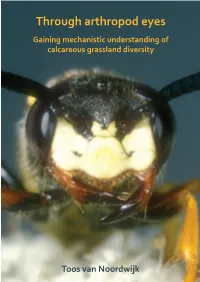
Through Arthropod Eyes Gaining Mechanistic Understanding of Calcareous Grassland Diversity
Through arthropod eyes Gaining mechanistic understanding of calcareous grassland diversity Toos van Noordwijk Through arthropod eyes Gaining mechanistic understanding of calcareous grassland diversity Van Noordwijk, C.G.E. 2014. Through arthropod eyes. Gaining mechanistic understanding of calcareous grassland diversity. Ph.D. thesis, Radboud University Nijmegen, the Netherlands. Keywords: Biodiversity, chalk grassland, dispersal tactics, conservation management, ecosystem restoration, fragmentation, grazing, insect conservation, life‑history strategies, traits. ©2014, C.G.E. van Noordwijk ISBN: 978‑90‑77522‑06‑6 Printed by: Gildeprint ‑ Enschede Lay‑out: A.M. Antheunisse Cover photos: Aart Noordam (Bijenwolf, Philanthus triangulum) Toos van Noordwijk (Laamhei) The research presented in this thesis was financially spupported by and carried out at: 1) Bargerveen Foundation, Nijmegen, the Netherlands; 2) Department of Animal Ecology and Ecophysiology, Institute for Water and Wetland Research, Radboud University Nijmegen, the Netherlands; 3) Terrestrial Ecology Unit, Ghent University, Belgium. The research was in part commissioned by the Dutch Ministry of Economic Affairs, Agriculture and Innovation as part of the O+BN program (Development and Management of Nature Quality). Financial support from Radboud University for printing this thesis is gratefully acknowledged. Through arthropod eyes Gaining mechanistic understanding of calcareous grassland diversity Proefschrift ter verkrijging van de graad van doctor aan de Radboud Universiteit Nijmegen op gezag van de rector magnificus prof. mr. S.C.J.J. Kortmann volgens besluit van het college van decanen en ter verkrijging van de graad van doctor in de biologie aan de Universiteit Gent op gezag van de rector prof. dr. Anne De Paepe, in het openbaar te verdedigen op dinsdag 26 augustus 2014 om 10.30 uur precies door Catharina Gesina Elisabeth van Noordwijk geboren op 9 februari 1981 te Smithtown, USA Promotoren: Prof.