Constituents from Chloranthaceae Plants and Their Biological Activities
Total Page:16
File Type:pdf, Size:1020Kb
Load more
Recommended publications
-

NEWSLETTER NUMBER 84 JUNE 2006 New Zealand Botanical Society
NEW ZEALAND BOTANICAL SOCIETY NEWSLETTER NUMBER 84 JUNE 2006 New Zealand Botanical Society President: Anthony Wright Secretary/Treasurer: Ewen Cameron Committee: Bruce Clarkson, Colin Webb, Carol West Address: c/- Canterbury Museum Rolleston Avenue CHRISTCHURCH 8001 Subscriptions The 2006 ordinary and institutional subscriptions are $25 (reduced to $18 if paid by the due date on the subscription invoice). The 2006 student subscription, available to full-time students, is $9 (reduced to $7 if paid by the due date on the subscription invoice). Back issues of the Newsletter are available at $2.50 each from Number 1 (August 1985) to Number 46 (December 1996), $3.00 each from Number 47 (March 1997) to Number 50 (December 1997), and $3.75 each from Number 51 (March 1998) onwards. Since 1986 the Newsletter has appeared quarterly in March, June, September and December. New subscriptions are always welcome and these, together with back issue orders, should be sent to the Secretary/Treasurer (address above). Subscriptions are due by 28th February each year for that calendar year. Existing subscribers are sent an invoice with the December Newsletter for the next years subscription which offers a reduction if this is paid by the due date. If you are in arrears with your subscription a reminder notice comes attached to each issue of the Newsletter. Deadline for next issue The deadline for the September 2006 issue is 25 August 2006 Please post contributions to: Joy Talbot 17 Ford Road Christchurch 8002 Send email contributions to joytalbot@free.net.nz or talbotj@cpit.ac.nz. Files are preferably in MS Word (Word XP or earlier) or saved as RTF or ASCII. -

"National List of Vascular Plant Species That Occur in Wetlands: 1996 National Summary."
Intro 1996 National List of Vascular Plant Species That Occur in Wetlands The Fish and Wildlife Service has prepared a National List of Vascular Plant Species That Occur in Wetlands: 1996 National Summary (1996 National List). The 1996 National List is a draft revision of the National List of Plant Species That Occur in Wetlands: 1988 National Summary (Reed 1988) (1988 National List). The 1996 National List is provided to encourage additional public review and comments on the draft regional wetland indicator assignments. The 1996 National List reflects a significant amount of new information that has become available since 1988 on the wetland affinity of vascular plants. This new information has resulted from the extensive use of the 1988 National List in the field by individuals involved in wetland and other resource inventories, wetland identification and delineation, and wetland research. Interim Regional Interagency Review Panel (Regional Panel) changes in indicator status as well as additions and deletions to the 1988 National List were documented in Regional supplements. The National List was originally developed as an appendix to the Classification of Wetlands and Deepwater Habitats of the United States (Cowardin et al.1979) to aid in the consistent application of this classification system for wetlands in the field.. The 1996 National List also was developed to aid in determining the presence of hydrophytic vegetation in the Clean Water Act Section 404 wetland regulatory program and in the implementation of the swampbuster provisions of the Food Security Act. While not required by law or regulation, the Fish and Wildlife Service is making the 1996 National List available for review and comment. -

Ascarina Lucida Var. Lanceolata
Ascarina lucida var. lanceolata COMMON NAME Kermadec Islands Hutu SYNONYMS Ascarina lanceolata Hook.f. FAMILY Chloranthaceae AUTHORITY Ascarina lucida var. lanceolata (Hook.f.) Allan FLORA CATEGORY Vascular – Native ENDEMIC TAXON Yes ENDEMIC GENUS No Hutu. Photographer: Bec Stanley ENDEMIC FAMILY No STRUCTURAL CLASS Trees & Shrubs - Dicotyledons NVS CODE ASCLVL CHROMOSOME NUMBER 2n = 26 CURRENT CONSERVATION STATUS Hutu. Photographer: Bec Stanley 2012 | At Risk – Naturally Uncommon | Qualifiers: IE, OL PREVIOUS CONSERVATION STATUSES 2009 | At Risk – Naturally Uncommon | Qualifiers: IE, OL 2004 | Not Threatened BRIEF DESCRIPTION Small bushy tree of upland Kermadec Islands. Leaves narrow and tapering to a narrow tip and with coarse black- tipped teeth on margins. Flowers in clusters of spikes. Fruit small, white. DISTRIBUTION Endemic. Kermadec Islands, Raoul Island only. HABITAT One of the characteristic trees of the wet forests of Raoul Island which are mostly found above 245m. However, in the ravines this tree may extend down to almost sea level. In the wet forest it is mostly a subcanopy tree which co- associates with Coprosma acutifolia, Pseudopanax kermadecensis, Melicytus aff. ramiflorus and on occasion Boehmeria australis subsp. dealbata. Occasionally, such as on the ridge lines and crater rim it may form part of the forest canopy. FEATURES Glabrous gynodioecious tree up to 15 m tall. Trunk up to 500 mm diameter. Bark greyish-white. Branchlets slender, striate, initially pale green maturing dark green to emerald green. Interpetiolar stipules conspicuous, comprising 3 1.2-2.6 mm long pale pink to red, filaments; these connate near base, behind which are 3-6 smaller hyaline filaments. Petioles up to 15-20 mm long, lamina subcoriacous, somewhat fleshy, 50-100 × 10-30 mm, green, emerald green to dark green above, paler beneath, serrations weakly pigmented, pink to pale maroon often fading into pale pink spotting, narrowly lanceolate, lanceolate, lanceolate- oblong to narrowly elliptic, acuminate to acute. -
Outline of Angiosperm Phylogeny
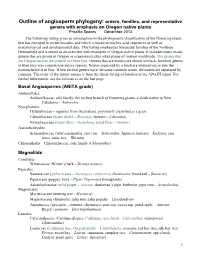
Outline of angiosperm phylogeny: orders, families, and representative genera with emphasis on Oregon native plants Priscilla Spears December 2013 The following listing gives an introduction to the phylogenetic classification of the flowering plants that has emerged in recent decades, and which is based on nucleic acid sequences as well as morphological and developmental data. This listing emphasizes temperate families of the Northern Hemisphere and is meant as an overview with examples of Oregon native plants. It includes many exotic genera that are grown in Oregon as ornamentals plus other plants of interest worldwide. The genera that are Oregon natives are printed in a blue font. Genera that are exotics are shown in black, however genera in blue may also contain non-native species. Names separated by a slash are alternatives or else the nomenclature is in flux. When several genera have the same common name, the names are separated by commas. The order of the family names is from the linear listing of families in the APG III report. For further information, see the references on the last page. Basal Angiosperms (ANITA grade) Amborellales Amborellaceae, sole family, the earliest branch of flowering plants, a shrub native to New Caledonia – Amborella Nymphaeales Hydatellaceae – aquatics from Australasia, previously classified as a grass Cabombaceae (water shield – Brasenia, fanwort – Cabomba) Nymphaeaceae (water lilies – Nymphaea; pond lilies – Nuphar) Austrobaileyales Schisandraceae (wild sarsaparilla, star vine – Schisandra; Japanese -

Wood Anatomy of Ascarina (Chloranthaceae) and the Tracheid-Vessel Element Transition
ALISO 12(4), 1990, pp. 667-684 WOOD ANATOMY OF ASCARINA (CHLORANTHACEAE) AND THE TRACHEID-VESSEL ELEMENT TRANSITION SHERWTN CARLQUIST Rancho Santa Ana Botanic Garden and Department of Biology, Pomona College Claremont, California 91711 ABSTRACT Quantitative and qualitative features are presented for 13 collections of 8 species of Ascarina. Wood anatomy is maximally primitive in most respects; moderate exception occurs in the imperforate tracheary elements, which range from tracheidlike (A. solmsiana) to fiber-tracheids (septate in two species). Perforation plates are scalariform, average more than 100 bars per plate, and have bordered bars. Even more significantly, portions of the primary walls in perforations characteristically fail to dissolve; these pit membrane portions range from nearly intact (much like the pit membranes in pits on end walls of tracheids of vesselless dicotyledons) to remnant strands or flakes. Dissolution of pit membranes in perforations is apparently inhibited by deposition of resinlike substances in some species; the rugose surfaces formed by these deposits may account for a report of vesturing on vessel walls of Ascarina. Axial parenchyma is diffuse, with only very small expressions of diversification; apotracheal banded parenchyma is, however, present in A. swamyana. Wood of Ascarina is highly mesomorphic. With age of plant, vessels increase in diameter, vessel elements and fiber-tracheids increase in length, and rays become wider and have a higher proportion of procumbent cells; uniseriate rays decrease in abundance. The implications of wood anatomy data on generic distinctions within the family and on the systematic position of Chloranthaceae will be examined when monographs on woods of the other genera have been completed. -

Alphabetical Lists of the Vascular Plant Families with Their Phylogenetic
Colligo 2 (1) : 3-10 BOTANIQUE Alphabetical lists of the vascular plant families with their phylogenetic classification numbers Listes alphabétiques des familles de plantes vasculaires avec leurs numéros de classement phylogénétique FRÉDÉRIC DANET* *Mairie de Lyon, Espaces verts, Jardin botanique, Herbier, 69205 Lyon cedex 01, France - frederic.danet@mairie-lyon.fr Citation : Danet F., 2019. Alphabetical lists of the vascular plant families with their phylogenetic classification numbers. Colligo, 2(1) : 3- 10. https://perma.cc/2WFD-A2A7 KEY-WORDS Angiosperms family arrangement Summary: This paper provides, for herbarium cura- Gymnosperms Classification tors, the alphabetical lists of the recognized families Pteridophytes APG system in pteridophytes, gymnosperms and angiosperms Ferns PPG system with their phylogenetic classification numbers. Lycophytes phylogeny Herbarium MOTS-CLÉS Angiospermes rangement des familles Résumé : Cet article produit, pour les conservateurs Gymnospermes Classification d’herbier, les listes alphabétiques des familles recon- Ptéridophytes système APG nues pour les ptéridophytes, les gymnospermes et Fougères système PPG les angiospermes avec leurs numéros de classement Lycophytes phylogénie phylogénétique. Herbier Introduction These alphabetical lists have been established for the systems of A.-L de Jussieu, A.-P. de Can- The organization of herbarium collections con- dolle, Bentham & Hooker, etc. that are still used sists in arranging the specimens logically to in the management of historical herbaria find and reclassify them easily in the appro- whose original classification is voluntarily pre- priate storage units. In the vascular plant col- served. lections, commonly used methods are systema- Recent classification systems based on molecu- tic classification, alphabetical classification, or lar phylogenies have developed, and herbaria combinations of both. -
Resolution of Deep Angiosperm Phylogeny Using Conserved Nuclear Genes and Estimates of Early Divergence Times
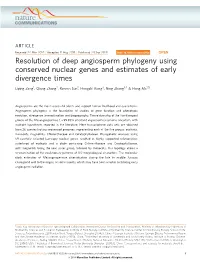
ARTICLE Received 24 Mar 2014 | Accepted 11 Aug 2014 | Published 24 Sep 2014 DOI: 10.1038/ncomms5956 OPEN Resolution of deep angiosperm phylogeny using conserved nuclear genes and estimates of early divergence times Liping Zeng1, Qiang Zhang2, Renran Sun1, Hongzhi Kong3, Ning Zhang1,4 & Hong Ma1,5 Angiosperms are the most successful plants and support human livelihood and ecosystems. Angiosperm phylogeny is the foundation of studies of gene function and phenotypic evolution, divergence time estimation and biogeography. The relationship of the five divergent groups of the Mesangiospermae (B99.95% of extant angiosperms) remains uncertain, with multiple hypotheses reported in the literature. Here transcriptome data sets are obtained from 26 species lacking sequenced genomes, representing each of the five groups: eudicots, monocots, magnoliids, Chloranthaceae and Ceratophyllaceae. Phylogenetic analyses using 59 carefully selected low-copy nuclear genes resulted in highly supported relationships: sisterhood of eudicots and a clade containing Chloranthaceae and Ceratophyllaceae, with magnoliids being the next sister group, followed by monocots. Our topology allows a re-examination of the evolutionary patterns of 110 morphological characters. The molecular clock estimates of Mesangiospermae diversification during the late to middle Jurassic correspond well to the origins of some insects, which may have been a factor facilitating early angiosperm radiation. 1 State Key Laboratory of Genetic Engineering and Collaborative Innovation Center for Genetics and Development, Ministry of Education Key Laboratoryof Biodiversity Sciences and Ecological Engineering, Institute of Plant Biology, Institute of Biodiversity Science, Center for Evolutionary Biology, School of Life Sciences, Fudan University, 220 Handan Road, Yangpu District, Shanghai 200433, China. 2 Guangxi Institute of Botany, Guangxi Zhuang Autonomous Region and the Chinese Academy of Sciences, Guilin 541006, China. -
GENOME EVOLUTION in MONOCOTS a Dissertation
GENOME EVOLUTION IN MONOCOTS A Dissertation Presented to The Faculty of the Graduate School At the University of Missouri In Partial Fulfillment Of the Requirements for the Degree Doctor of Philosophy By Kate L. Hertweck Dr. J. Chris Pires, Dissertation Advisor JULY 2011 The undersigned, appointed by the dean of the Graduate School, have examined the dissertation entitled GENOME EVOLUTION IN MONOCOTS Presented by Kate L. Hertweck A candidate for the degree of Doctor of Philosophy And hereby certify that, in their opinion, it is worthy of acceptance. Dr. J. Chris Pires Dr. Lori Eggert Dr. Candace Galen Dr. Rose‐Marie Muzika ACKNOWLEDGEMENTS I am indebted to many people for their assistance during the course of my graduate education. I would not have derived such a keen understanding of the learning process without the tutelage of Dr. Sandi Abell. Members of the Pires lab provided prolific support in improving lab techniques, computational analysis, greenhouse maintenance, and writing support. Team Monocot, including Dr. Mike Kinney, Dr. Roxi Steele, and Erica Wheeler were particularly helpful, but other lab members working on Brassicaceae (Dr. Zhiyong Xiong, Dr. Maqsood Rehman, Pat Edger, Tatiana Arias, Dustin Mayfield) all provided vital support as well. I am also grateful for the support of a high school student, Cady Anderson, and an undergraduate, Tori Docktor, for their assistance in laboratory procedures. Many people, scientist and otherwise, helped with field collections: Dr. Travis Columbus, Hester Bell, Doug and Judy McGoon, Julie Ketner, Katy Klymus, and William Alexander. Many thanks to Barb Sonderman for taking care of my greenhouse collection of many odd plants brought back from the field. -
ABSTRACTS 117 Systematics Section, BSA / ASPT / IOPB
Systematics Section, BSA / ASPT / IOPB 466 HARDY, CHRISTOPHER R.1,2*, JERROLD I DAVIS1, breeding system. This effectively reproductively isolates the species. ROBERT B. FADEN3, AND DENNIS W. STEVENSON1,2 Previous studies have provided extensive genetic, phylogenetic and 1Bailey Hortorium, Cornell University, Ithaca, NY 14853; 2New York natural selection data which allow for a rare opportunity to now Botanical Garden, Bronx, NY 10458; 3Dept. of Botany, National study and interpret ontogenetic changes as sources of evolutionary Museum of Natural History, Smithsonian Institution, Washington, novelties in floral form. Three populations of M. cardinalis and four DC 20560 populations of M. lewisii (representing both described races) were studied from initiation of floral apex to anthesis using SEM and light Phylogenetics of Cochliostema, Geogenanthus, and microscopy. Allometric analyses were conducted on data derived an undescribed genus (Commelinaceae) using from floral organs. Sympatric populations of the species from morphology and DNA sequence data from 26S, 5S- Yosemite National Park were compared. Calyces of M. lewisii initi- NTS, rbcL, and trnL-F loci ate later than those of M. cardinalis relative to the inner whorls, and sepals are taller and more acute. Relative times of initiation of phylogenetic study was conducted on a group of three small petals, sepals and pistil are similar in both species. Petal shapes dif- genera of neotropical Commelinaceae that exhibit a variety fer between species throughout development. Corolla aperture of unusual floral morphologies and habits. Morphological A shape becomes dorso-ventrally narrow during development of M. characters and DNA sequence data from plastid (rbcL, trnL-F) and lewisii, and laterally narrow in M. -
Clear Felling Atop Aucklands Highest Peak: the Destruction of Submontane Shrubland on Kohukohunui Hunua Range T
Autumn is a time for fruiting of the shrubs and many Botanical Gardens). colourful red or orange fruits were evident especially Other particularly prominent families are Asteraceae on Berberis Cotoneaster Rosa and Lonicera Rosaceae and Fabaceae. Artemisia is exceptionally ManyGentianaceae were in flower and two species of common on the Loess Plateau and in ruderal great beauty were Swertia dichotoma and Gentianavegetation . There are dozens of species all of which lawrencei var. farreri. Gentianceae is an important are highly aromatic (wormwood or sagebush). family here (Comastoma Gentiana Gentianopsis Potentilla abounds with shrubby as well as creeping Ha Ien ia Lomatogonium Swertia) and I met Dr Chen herbaceous species (e.g. P. anserina) in the steppe Shilong of the Northwest Plateau Institute of Biology and meadow vegetation. Of the legumes Astragalus who with his colleagues is "doing" the Gentianaceae Caragana Hedysarum Oxytropis and Thermopsis for the new Flora of China series in English (Missouri widely occur. Acknowledgements Plants were identified with the help of three local experts Wei Zhengduo retired Qinghai Forestry Bureau engineer; Lu Xuefeng Northwest Plateau Institute of Biology; and Zhang Zhihe retired Grassland Institute scientist. I sincerely thank Marta Treskonova for her ecological observations in the field. References Liu Shangwu (Chief ed.) 1999: Flora Qinghalca. 4 volumes. Qinghai Peoples Publishing House Xining. Ren Jizhou; Zhu Tingcheng; Guo Benzhao (advisors); Cai Zhaoguang; Lan Baining; Lei Gengxing (compilers) 1986: An atlas of rangeland and its main plant resources on the Qi nghai Tibet Plateau. Volume: Qinghai. Agricultural Publishing House Xining. Wu Yuhu; Mei Lijuan (eds.) 2001: The plant resources in the source area of the Yellow River and its environment. -
UC Davis UC Davis Previously Published Works
UC Davis UC Davis Previously Published Works Title Integrating early Cretaceous fossils into the phylogeny of living angiosperms: Anita lines and relatives of Chloranthaceae Permalink https://escholarship.org/uc/item/3bj1s569 Journal International Journal of Plant Sciences, 175(5) ISSN 1058-5893 Authors Doyle, JA Endress, PK Publication Date 2014 DOI 10.1086/675935 Peer reviewed eScholarship.org Powered by the California Digital Library University of California Int. J. Plant Sci. 175(5):555–600. 2014. ᭧ 2014 by The University of Chicago. All rights reserved. 1058-5893/2014/17505-0006$15.00 DOI: 10.1086/675935 INTEGRATING EARLY CRETACEOUS FOSSILS INTO THE PHYLOGENY OF LIVING ANGIOSPERMS: ANITA LINES AND RELATIVES OF CHLORANTHACEAE James A. Doyle1,* and Peter K. Endress† *Department of Evolution and Ecology, University of California, Davis, California 95616, USA; and †Institute of Systematic Botany, University of Zurich, 8008 Zurich, Switzerland Editor: Patrick S. Herendeen Premise of research. Discoveries of fossil flowers in Cretaceous rocks offer improved evidence for rela- tionships with living clades, but for more secure inferences formal phylogenetic analyses are desirable. We extend previous analyses of magnoliids, monocots, and basal eudicots to Aptian, Albian, and Cenomanian fossils related to the basal “ANITA” lines and Chloranthaceae. Methodology. We performed parsimony analyses of a morphological data set of Recent angiosperms and published fossils, with the arrangement of Recent taxa constrained to backbone trees based primarily on molecular data. Pivotal results. Not only Monetianthus (as previously inferred) but also Carpestella is nested within Nymphaeaceae, while Pluricarpellatia may be a stem relative of Cabombaceae or Nymphaeaceae. Anacostia (with Similipollis pollen) is nested within Austrobaileyales. -
Universidad De Los Andes Facultad De Ciencias
UNIVERSIDAD DE LOS ANDES FACULTAD DE CIENCIAS, DEPARTAMENTO DE CIENCIAS BIOLÓGICAS TRACING BACK THE POLLEN FOSSIL RECORD OF HEDYOSMUM (C HLORANTHACEAE ), A BASAL ANGIOSPERM CAMILA MARTÍNEZ AGUILLÓN Trabajo de grado para optar al título de Biólogo Director: Carlos Jaramillo, STRI Co-director: Santiago Madriñán, Universidad de los Andes Bogotá D.C., 2009 TRACING BACK THE POLLEN FOSSIL RECORD OF HEDYOSMUM (C HLORANTHACEAE ), A BASAL ANGIOSPERM ABSTRACT The Chloranthaceae family has been described as one of the oldest lineages within the angiosperms. Hedyosmum is the only Neotropical genus and is composed of approximately 45 species. The fossil record shows that the first apparition of the genus was in the Early Cretaceous (~120 Ma), followed by a time gap of 70 Ma during the Paleogene, where no fossil records of Hedyosmum were found. It is only until the Early Miocene when a new record associated with Hedyosmum: Clavainaperturites microclavatus is found. The association was established using only transmitted light microscopy. The aim of this study was to determinate the relationship between the fossil Clavainaperturites microclavatus from the Miocene and the extant genus Hedyosmum using transmitted light microscopy, scanning and transmitted electron microscopy. The quantitative characters were evaluated with a non-metric multidimensional scaling. Given the high morphological affinity of the pollen fossil with the extant Hedyosmum it is concluded that C. microclavatus belongs to Hedyosmum, and that the radiation of the genus could have occurred in Central and South America in the Early Miocene, before to the emergence of the Panamanian Isthmus and the rising of the Andean cordillera. Two hypotheses were suggested to explain the gap in the fossil record of the genus, a change in the pollination syndrome or/and a dramatic population decrease after the K/T event.