Plant Quarantine Import Requirements for Fresh Cherry from Chile
Total Page:16
File Type:pdf, Size:1020Kb
Load more
Recommended publications
-

Polillas Y Mariposas Orden: Lepidoptera • Familias: Tortricidae, Gracillariidae, Pyralidae, Noctuidae, Psychidae, Oecophoridae, Cossidae
227 Manejo de plagas en paltos y cítricos Polillas y Mariposas Orden: Lepidoptera • Familias: Tortricidae, Gracillariidae, Pyralidae, Noctuidae, Psychidae, Oecophoridae, Cossidae Las polillas y mariposas pertenecen a los lepidópteros grupo que incluye a plagas de gran importancia econó- tanto su presencia origina rechazos de las parti- mica. La característica más sobresaliente de estos insec- das en la inspección al embarque. tos es que sus alas se encuentran cubiertas por diminutas En hojas se alimenta de la lámina, plegándola escamas que dan el diseño y colorido a cada una de las mediante hilos de seda. especies. En general, se tiene la idea que los individuos adultos son de gran tamaño, sin embargo, existe un nú- mero muy importante de especies de tamaño pequeño o microlepidópteros. El adulto presenta un aparato bucal Descripción morfológica muy especializado que se denomina espiritrompa y que Los adultos en reposo pliegan las alas en forma de techo, mantiene enrollado cuando no se está alimentando de alcanzando una longitud de 11 a 14 mm entre el ápice de sustancias líquidas. La larva posee fuertes mandíbulas la cabeza al extremo de las alas. que le permiten alimentarse de hojas y frutos y en algu- nas especies cavar galerías en hojas y frutos. Por lo tanto, La hembra presenta tanto en la cabeza como en el pro- es la larva la que tiene la capacidad de producir daño a noto y el margen basal anterior de las alas hasta la altura las plantas. del primer par de patas una banda frontal de escamas gris oscuro mezcladas con blancas, la cual se separa del resto del ala por una angosta franja, observable en la vis- Enrollador de hojas, Enrollador del ta lateral del cuerpo. -

Surveillance of Grape Berry Moth, Paralobesia Viteana Clemens (Lepidoptera
Surveillance of grape berry moth, Paralobesia viteana Clemens (Lepidoptera: Tortricidae), in Virginia vineyards by Timothy Augustus Jordan Dissertation submitted to the faculty of the Virginia Polytechnic Institute and State University in partial fulfillment of the requirements for the degree of DOCTOR OF PHILOSOPHY in Entomology Douglas G. Pfeiffer, Chair J. Christopher Bergh Carlyle C. Brewster Thomas P. Kuhar Tony K. Wolf March 21, 2014 Blacksburg, Virginia Keywords: Remote, Vitis, Sex pheromone trap, Infestation, Degree-day, Landscape Chapter 3*****by Entomological Society of America used with permission All other material © 2014 by Timothy A. Jordan Surveillance of grape berry moth, Paralobesia viteana Clemens (Lepidoptera: Tortricidae), in Virginia vineyards by Timothy Augustus Jordan ABSTRACT My research addressed pheromone lure design and the activity of the grape berry moth, Paralobesia viteana, flight and infestation across three years of study. In my lure evaluations, I found all commercial lures contained impurities and inconsistencies that have implications for management. First, sex pheromone concentration in lures affected both target and non-target attraction to traps, while the blend of sex pheromones impacted attraction to P. viteana. Second, over the duration of study, 54 vineyard blocks were sampled for the pest in and around cultivated wine grape in Virginia. The trapping studies indicated earliest and sustained emergence of the spring generation in sex pheromone traps placed in a wooded periphery. Later, moths were detected most often in the vineyard, which indicated that P. viteana emerged and aggregated in woods prior to flying and egg-laying in vineyards. My research supports use of woods and vineyard trap monitoring at both the height of 2 meters and in the periphery of respective environments. -

Lobesia Botrana, the European Grapevine Moth
D-13-03 Phytosanitary import requirements to prevent the introduction of Lobesia botrana, the European grapevine moth Effective date: January 2, 2018 (1st revision) Subject This directive provides the phytosanitary import requirements for fresh fruits and plants for planting to prevent the introduction of Lobesia botrana, the European grapevine moth, into Canada. The following changes were made as part of this revision: Following the eradication of L. botrana in the United States, this country has been removed from the list of regulated countries in Annex 2. The following taxa, both fruits and plants, have been removed from the list of regulated articles in Annex 1 as they have been re-evaluated as posing a relatively low risk for the introduction of L. botrana into Canada: Actinidia spp. (kiwi), Berberis vulgaris (European barberry), Diospyros kaki (persimmon), Punica granatum (pomegranate), Ziziphus jujube (Chinese date). Cut plant material (e.g. for consumption or decorative purposes) of regulated host taxa is now exempt from requirements for L. botrana. For plants for planting, the requirement for a pest-free area, systems approach or fumigation has been replaced with a requirement for an additional declaration stating the plants have been inspected and found free from flowers, fruits and L. botrana. These measures are considered sufficient to mitigate the risk of L. botrana being introduced through this pathway, based on a review of the scientific literature. For fresh fruit, the wording of the additional declarations for pest-free areas and systems approaches has been modified. January 2, 2018 D-13-03 (1st revision) The fumigation schedules for fresh fruit have been moved from the appendices of this directive to a stand-alone webpage referenced in the directive. -

Lobesia Botrana Denis E Schiffermüller (Lepidoptera: Tortricidae)
Capítulo 13 Lobesia botrana Denis e Schiffermüller (Lepidoptera: Tortricidae) Marcos Botton, Aline Nondillo, Jairo Carbonari, Andrea Lucchi Identificação da praga • Nome científico: Lobesia botrana Denis e Schiffermüller, 1776. Posição taxonômica: • Reino: Metazoa. • Filo: Artropoda. • Classe: Insecta. • Ordem: Lepidoptera. • Família: Tortricidae. • Gênero: Lobesia. • Espécie: Lobesia botrana. 196 PRIORIZAÇÃO DE PRAGAS QUARENTENÁRIAS AUSENTES NO BRASIL Sinonímias • Coccyx botrana, Praun, 1869. • Cochylis botrana Herrich-Schaffer, 1843. • Cochylis vitisana, Audouin, 1842. • Eudemis botrana, Frey, 1880. • Eudemis rosmarinana, Millière, 1866. • Grapholita botrana, Heinemann, 1863. • Grapholita botrana, Heinemann, 1863. • Lobesia rosmariana (misspelling for rosmarinana Milliere, 1866). • Noctua romani O. G. Costa, 1840. • Polychrosis botrana, Ragonot, 1894. • Polychrosis botrana flavosquamella Dufrane, 1960 (form). • Tortrix botrana Denis e Schiffermüller, 1775. • Tortrix reliquana sensu Treitschke, 1835 non Hübner, 1816. • Tortrix romaniana O. G. Costa, 1840. • Tortrix vitisana Jacquin, 1788. Hospedeiros A traça-europeia dos cachos da videira L. botrana é uma praga polífaga que se alimenta de diversos hospedeiros. Além da videira, diversas espécies vegetais pertencentes a 27 famílias já foram relatadas como hospedeiras da praga (Tabela 1) (Bradley et al., 1979; Whittle, 1985; Moleas, 1988; Zhang, 1994; Stavridis; Savopoulou-Soultani, 1998; Savopoulou-Soultani et al., 1999; Cabi, 2018) (Tabela 1). Na maioria destas plantas hospedeiras, as -
Update of the Lobesia Botrana Program in California
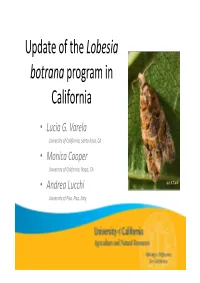
Update of the Lobesia botrana program in California • Lucia G. Varela University of California, Santa Rosa, CA • Monica Cooper University of California, Napa, CA • Andrea Lucchi Jack K Clark University of Pisa, Pisa, Italy 1st detected September 2009 in Napa Valley, California Legend Lobesia botrana pupae Lobesia botrana larvae Lobesia botrana males Lobesia botrana female collected 3 mile (4.8 km) buffer LBAM State interior quarantine How did it enter the US? Investigated by USDA APHIS SITC. So far, the introduction pathway is unknown. Some possible entries: • Machinery (pupa stage). • Nursery stock (olives). • Fruit? Detection Trapping Quarantine area: In 2010/11: 5 mile radius (8 km) from a find. Traps deployed in vineyards: • Quarantine area: 25 traps/mi 2 (~10 traps/km2) • Outside quarantine: 25 to 9 traps/mi 2 (~3.5 traps/km2) Traps deployed in urban areas: • 5 traps/mi 2 (~2 traps/km2) Quarantine Areas Individual Moth Catches Mendocino 36 As of 10/08/2010 Napa 100,793 Sonoma 59 San Joaquin 2 Merced 4 Santa Clara 3 Santa Cruz 1 Fresno 11 Monterey 1 Male catches 1st generation Male catches 2nd generation Male catches 3rd generation Total # moths caught per County in 2010 How did it spread in California? Infestations associated with: • Movement of infested winegrapes. • Movement of infested machinery. • Movement of vineyard wooden stakes. Treatment recommendations for 2010 • Insecticide treatments: – To Vineyards within 1000 meters of a find (Napa within 200 meters of a find). – Applications: • 1st generation: 2 conventional or 3 organic insecticides. • 2nd and 3 rd generations: 1 conventional or 2 organic insecticides for each generation. -

Caracterización Del Comportamiento (2015).Pdf
UNIVERSIDAD DE CHILE FACULTAD DE CIENCIAS AGRONÓMICAS ESCUELA DE POSTGRADO CARACTERIZACIÓN DEL COMPORTAMIENTO SEXUAL Y ESTIMACIÓN DEL GRADO DE ESTEREOTIPIA DE Proeulia auraria CLARKE (LEPIDOPTERA: TORTRICIDAE) Tesis para optar al grado de Magister en Ciencias Agropecuarias YURI KRISTAL CUEVAS RIVAS Director de Tesis TOMISLAV CURKOVIC S. Profesores Consejeros AMANDA HUERTA FUENTES JAIME ARAYA CLÉRICUS SANTIAGO - CHILE 2015 UNIVERSIDAD DE CHILE FACULTAD DE CIENCIAS AGRONÓMICAS ESCUELA DE POSTGRADO CARACTERIZACIÓN DEL COMPORTAMIENTO SEXUAL Y ESTIMACIÓN DEL GRADO DE ESTEREOTIPIA DE Proeulia auraria CLARKE (LEPIDOPTERA: TORTRICIDAE) Tesis presentada como parte de los requisitos para optar al Grado de Magister en Ciencias Agropecuarias YURI KRISTAL CUEVAS RIVAS Calificaciones DIRECTOR DE TESIS Tomislav Curkovic S. 6,0 Ing. Agr., Ph.D PROFESORES CONSEJEROS Amanda Huerta F. 6,5 Ing. Forestal, Dra. Jaime Araya C. 6,0 Ing. Agr., MS, Ph.D Santiago, Chile 2015 ÍNDICE DE CONTENIDO CAPÍTULO I: MONOGRAFÍA ............................................................................................ 1 COMPORTAMIENTO SEXUAL EN TORTRÍCIDOS MEDIADO POR COMPUESTOS QUÍMICOS FEROMONALES EN ESPECIES PRESENTES EN CHILE. ......................... 1 Revisión Bibliográfica ....................................................................................................... 2 1. Tortrícidos .................................................................................................................. 3 2. Comportamiento animal ............................................................................................ -
List of Other Pests of Interest
EU project number 613678 Strategies to develop effective, innovative and practical approaches to protect major European fruit crops from pests and pathogens Work package 1. Pathways of introduction of fruit pests and pathogens Deliverable 1.3. PART 8 - Other interesting findings: -pests listed in one or several of the Alert Lists which are also important for other fruit crops grown in the EU -pests of interest for other crops identified during the study 1 Pests listed in one or several of the Alert Lists which are also important for other fruit crops grown in the EU Information was extracted from the datasheets prepared for the Alert list. Please refer to the datasheets for more information (e.g. on Distribution, full host range, etc). Pest (taxonomic group) Hosts/damage Alert List Aegorhinus superciliosus A. superciliosus is mentioned as the most important pest of Apple (Coleoptera: raspberry and blueberry in the South of Chile. It is also a pest on Vaccinium Curculionidae) currant, hazelnut, fruit crops, berries, gooseberries. Amyelois transitella A. transitella is a serious pest of some nut crops (e.g. almonds, Grapevine (Lepidoptera: Pyralidae) pistachios, walnut) Orange- mandarine Archips argyrospilus In the past, heavy damage in the USA and Canada, with serious Apple (Lepidoptera: Tortricidae) outbreaks mostly on Rosaceae (especially apple and pear with Orange- 40% fruit losses in some cases) mandarine Argyrotaenia sphaleropa This species also damage Diospyrus kaki and pear in Brazil Grapevine (Lepidoptera: Tortricidae) Orange- mandarine Vaccinium Carpophilus davidsoni Polyphagous. Belongs to most serious pests of stone fruit in South Grapevine (Coleoptera: Nitidulidae) Australia (peaches, nectarines and apricots). -
Lobesia Botrana
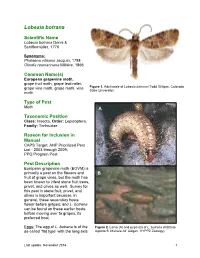
Lobesia botrana Scientific Name Lobesia botrana Denis & Schiffermüller, 1776 Synonyms: Phalaena vitisana Jacquin, 1788 Olindia rosmarinana Millière, 1866 Common Name(s) European grapevine moth, grape fruit moth, grape leaf-roller, grape vine moth, grape moth, vine Figure 1. Adult male of Lobesia botrana (Todd Gilligan, Colorado State University). moth Type of Pest Moth A Taxonomic Position Class: Insecta, Order: Lepidoptera, Family: Tortricidae Reason for Inclusion in Manual CAPS Target: AHP Prioritized Pest List - 2003 through 2009; PPQ Program Pest Pest Description European grapevine moth (EGVM) is primarily a pest on the flowers and B fruit of grape vines, but the moth has been known to infest stone fruit trees, privet, and olives as well. Survey for this pest in stone fruit, privet, and olives is important because, in general, these secondary hosts flower before grapes; and L. botrana can be found on these earlier hosts before moving over to grapes, its preferred host. Eggs: The egg of L. botrana is of the Figure 2. Larva (A) and pupa (B) of L. botrana (Instituto so-called ‘flat type’ with the long axis Agrario S. Michele All’ Adigen, HYPPZ Zoology). Last update: November 2014 1 horizontal and the micropyle at one end. Eggs are elliptical, flattened, and slightly convex. The egg measures about 0.65 to 0.90 mm x 0.45 to 0.75 mm. Freshly laid eggs are pale yellow, later becoming light gray and translucent with iridescent glints (opalescent). The chorion is macroscopically smooth but presents a slight polygonal reticulation in the border and around the micropyle (CABI, 2009; Gilligan et al., 2011). -

Sex, Wine and Chemical Communication in Grapevine Moth Lobesia Botrana
Sex, Wine and Chemical Communication in Grapevine Moth Lobesia botrana Marco Tasin Faculty of Landscape Planning, Horticulture and Agricultural Science Department of Crop Science Alnarp Doctoral thesis Swedish University of Agricultural Sciences Alnarp 2005 1 Acta Universitatis Agriculturae Sueciae 2005: 85 ISSN 1652-6880 ISBN 91-576-6984-8 © 2005 Marco Tasin, Alnarp Tryck: Reproenheten SLU Alnarp 2 Abstract Tasin, M., 2005. Sex, wine and chemical communication in grapevine moth Lobesia botrana. Doctor’s dissertation. ISSN 1652-6880, ISBN 91-576-6984-8 The grapevine moth, Lobesia botrana, is a destructive pest of grapevine. Deregulation of many of the insecticides used in the control of this pest along with public demand of residue-free products, have augmented the interest for innovative tools in pest management. Behaviour-modifying semiochemicals can be used for environmentally safe insect management and are a promising alternative to insecticides. The aim of this thesis was (1) to reinvestigate the female sex pheromone and (2) to identify behaviourally active host plant compounds. In the flight tunnel, L. botrana females were attracted to green grapes and shoots of grapevine Vitis vinifera. Females were also attracted to headspace collections from grape, showing that they rely on olfactory cues during host search. Analysis of the volatiles of V. vinifera headspace disclosed high variation in the odour profiles both between varieties of the same species and different phenological stages of the same variety. A synthetic mimic of grape volatiles, consisting of the compounds eliciting the strongest antennal responses, was as attractive as the host-plant to mated L. botrana females in the wind tunnel. -
Side Effects of Sulfur Dust on the European Grapevine Moth Lobesia
insects Article Side Effects of Sulfur Dust on the European Grapevine Moth Lobesia botrana and the Predatory Mite Kampimodromus aberrans in Vineyards Federico Tacoli, Elena Cargnus, Pietro Zandigiacomo and Francesco Pavan * Department of Agricultural, Food, Environmental and Animal Sciences, University of Udine, Via delle Scienze 206, 3100 Udine, Italy; tacoli@outlook.it (F.T.); elena.cargnus@uniud.it (E.C.); pietro.zandigiacomo@uniud.it (P.Z.) * Correspondence: francesco.pavan@uniud.it; Tel.: +39-0432-558-504; Fax: +39-0432-558-501 Received: 6 October 2020; Accepted: 20 November 2020; Published: 23 November 2020 Simple Summary: The European grapevine moth Lobesia botrana is the most important carpophagous pest in European vineyards. Synthetic insecticides are usually applied for moth control, but their impact on human health and environmental quality requires a reduction in their usage. The exploitation of the side effects of inorganic fungicides of natural origin repeatedly used during the growing season can contribute to achieve this goal. In this study, a possible effect on L. botrana infestation of sulfur dust applied to control powdery mildew is tested under laboratory and field conditions. Sulfur dust reduced egg laying by around 80% in both laboratory and field bioassays. In the laboratory, the product showed a slight contact toxicity on eggs and reduced larval settlement. A single field application of sulfur dust during L. botrana egg laying reduced larval infestation by approximately 40%. No adverse effects were observed on the predatory phytoseiid mite Kampimodromus aberrans. Abstract: To reduce the impact of synthetic insecticides on human health and the environment, eco-friendly alternatives must be investigated. -
EU Project Number 613678
EU project number 613678 Strategies to develop effective, innovative and practical approaches to protect major European fruit crops from pests and pathogens Work package 1. Pathways of introduction of fruit pests and pathogens Deliverable 1.3. PART 7 - REPORT on Oranges and Mandarins – Fruit pathway and Alert List Partners involved: EPPO (Grousset F, Petter F, Suffert M) and JKI (Steffen K, Wilstermann A, Schrader G). This document should be cited as ‘Grousset F, Wistermann A, Steffen K, Petter F, Schrader G, Suffert M (2016) DROPSA Deliverable 1.3 Report for Oranges and Mandarins – Fruit pathway and Alert List’. An Excel file containing supporting information is available at https://upload.eppo.int/download/112o3f5b0c014 DROPSA is funded by the European Union’s Seventh Framework Programme for research, technological development and demonstration (grant agreement no. 613678). www.dropsaproject.eu dropsa@fera.co.uk DROPSA DELIVERABLE REPORT on ORANGES AND MANDARINS – Fruit pathway and Alert List 1. Introduction ............................................................................................................................................... 2 1.1 Background on oranges and mandarins ..................................................................................................... 2 1.2 Data on production and trade of orange and mandarin fruit ........................................................................ 5 1.3 Characteristics of the pathway ‘orange and mandarin fruit’ ....................................................................... -

Lobesia Botrana Poster
The European Grapevine Moth, Lobesia botrana Recommendations for Sustainable and Effective Resistance Management Insecticide Resistance Action Committee www.irac-online.org . Lobesia botrana - Background Life Cycle Insecticide Resistance Management Lobesia (=Polychrosis) botrana (Denis et Schiffermuller) (Lepidoptera: Adult Egg Control of Lobesia botrana may require multiple insecticide applications in Tortricidae), also known as the European grapevine moth (EGVM) is one season. Foliar sprays are mostly targeted to the control of the 2nd traditionally a major vineyard pest throughout Europe, the Middle East, generation in wine grapes, and the 2nd and 3rd generations in table grapes. North and West Africa, and Southern Russia. Native of South Europe, it was Normally 1 to 3 applications are needed in wine grapes and up to 6 in late- more recently reported in Chile and Argentina (2008) and found in the maturing table grapes. United States (Napa Valley) in October 2009. Lobesia botrana is regulated as a quarantine pest in a number of countries. Insecticide Resistance Management (IRM) Larva Sustainable IRM management programs are based on the integration of as many pest management tools as possible. Use insecticides only when needed, based on established thresholds and alternating effective insecticides belonging to different MoA groups. The adoption of all applicable control measures (including mating disruption) together with MoA group alternation remains best IRM strategy, as it minimizes the selection pressure for resistance. Cocoon Insecticide Mode of Action (MoA) Window Approach Lobesia botrana can have two to four generations per year depending L. botrana species range on the climatic conditions and the date of grape harvest. EPPO (2015) EPPO Global Database https://gd.eppo.int L.