Download 381.29 KB
Total Page:16
File Type:pdf, Size:1020Kb
Load more
Recommended publications
-
Educated Youth Should Go to the Rural Areas: a Tale of Education, Employment and Social Values*
Educated Youth Should Go to the Rural Areas: A Tale of Education, Employment and Social Values* Yang You† Harvard University This draft: July 2018 Abstract I use a quasi-random urban-dweller allocation in rural areas during Mao’s Mass Rustication Movement to identify human capital externalities in education, employment, and social values. First, rural residents acquired an additional 0.1-0.2 years of education from a 1% increase in the density of sent-down youth measured by the number of sent-down youth in 1969 over the population size in 1982. Second, as economic outcomes, people educated during the rustication period suffered from less non-agricultural employment in 1990. Conversely, in 2000, they enjoyed increased hiring in all non-agricultural occupations and lower unemployment. Third, sent-down youth changed the social values of rural residents who reported higher levels of trust, enhanced subjective well-being, altered trust from traditional Chinese medicine to Western medicine, and shifted job attitudes from objective cognitive assessments to affective job satisfaction. To explore the mechanism, I document that sent-down youth served as rural teachers with two new county-level datasets. Keywords: Human Capital Externality, Sent-down Youth, Rural Educational Development, Employment Dynamics, Social Values, Culture JEL: A13, N95, O15, I31, I25, I26 * This paper was previously titled and circulated, “Does living near urban dwellers make you smarter” in 2017 and “The golden era of Chinese rural education: evidence from Mao’s Mass Rustication Movement 1968-1980” in 2015. I am grateful to Richard Freeman, Edward Glaeser, Claudia Goldin, Wei Huang, Lawrence Katz, Lingsheng Meng, Nathan Nunn, Min Ouyang, Andrei Shleifer, and participants at the Harvard Economic History Lunch Seminar, Harvard Development Economics Lunch Seminar, and Harvard China Economy Seminar, for their helpful comments. -
Resettlement Action Plan Report Appendix
Public Disclosure Authorized Resettlement Action Plan Report Appendix Public Disclosure Authorized Newly- built Harbin- Jiamusi Railway Public Disclosure Authorized China Railway Third Survey and Design Institute Company December 2012 Public Disclosure Authorized Statement of Compilation The appendix to the Resettlment Action Plan Report for the newly-built Harbin-Jiamusi Raiwlay is an important part of the Resettlment Action Plan (RAP). This appendix displays data and work achievements that have been gained during field investigation for the RAP and also data information analysis and processing during report compilation. Reference to this attachement has been indicated in the RAP. 1 Appendix of Resettlement Action Plan Report of Newly-built Harbin-Jiamusi Railway STATEMENT OF COMPILATION .......................................... 1 APPENDIX1 RESETTLEMENT POLICY FRAMEWORK ......................... 2 APPENDIX 2 HARBIN –JIAMUSI RAILWAY LINE DIAGRAM ................. 17 APPENDIX 3 PERMANENT LAND REQUISITION STATISTICS BY VILLAGE OF HA-JIA LINE ............................................................. 19 APPENDIX 4 LAND REQUISITION AREA TO CULTIVATED LAND AREA RATIO STATISTICS OF THE AFECTED VILLAGE ........................................... 24 APPENDIX 5 TEMPORARY LAND USING STATISTICS BY VILLAGE OF HA-JIA LINE ................................................................. 31 APPENDIX 6 DEMOLITION STATISTICS BY VILLAGE(STREET) OF HA-JIA LINE 35 SOURCE:BASED ON RESEARCH AND FIELD SURVEY DATA APPENDIX 7 SOCIO-ECONOMIC SURVEY FOR HAJIA -
Gully Erosion Control Practices in Northeast China: a Review
Article Gully Erosion Control Practices in Northeast China: A Review Xiaobing Liu 1, Hao Li 1, Shengmin Zhang 2, Richard M. Cruse 3 and Xingyi Zhang 1,* 1 Key Laboratory of Mollisols Agroecology, Northeast Institute of Geography and Agroecology, Chinese Academy of Sciences, Harbin 150081, China 2 Faculty of Engineering Management, University of Chinese Academy of Sciences, Beijing 100049, China 3 Department of Agronomy, Iowa State University, Ames, IA 500011, USA * Correspondence: zhangxy@iga.ac.cn Received: 13 August 2019; Accepted: 10 September 2019; Published: 16 September 2019 Abstract: Gully erosion is the destructive and dramatic form of land degradation in Northeast China. The region is the grain production and ecological security base of China where the fertile and productive Mollisols are distributed. Though the region was agriculturally developed relatively recently, it went through high intensity cultivation and fast succession processes within short-time scales. Coupled with irrational farming practice choice and land use, hillslope erosion and gully erosion are seriously threatening agricultural production and environmental stability in the region. The awareness of gully erosion by the local governments started in the 1970s, and conservation measures were thus implemented. In this paper, based on our survey, communications with local farmers and stakeholders as well as investigation for gully erosion for the past three years, we summarize the practical and efficient practices to manage gully erosion developed by researchers and farmers in Northeast China during the past 50 years. These practices include various drop structures, soil check dams, masonry check dams, gabion check dams, wicker check dams, continuous live wicker, a shrub plant enclosure, and an arbor plant enclosure. -
Environmental Performance Reviews
OECD Environmental Performance Reviews CHINA ORGANISATION FOR ECONOMIC CO-OPERATION AND DEVELOPMENT ORGANISATION FOR ECONOMIC CO-OPERATION AND DEVELOPMENT The OECD is a unique forum where the governments of 30 democracies work together to address the economic, social and environmental challenges of globalisation. The OECD is also at the forefront of efforts to understand and to help governments respond to new developments and concerns, such as corporate governance, the information economy and the challenges of an ageing population. The Organisation provides a setting where governments can compare policy experiences, seek answers to common problems, identify good practice and work to co-ordinate domestic and international policies. The OECD member countries are: Australia, Austria, Belgium, Canada, the Czech Republic, Denmark, Finland, France, Germany, Greece, Hungary, Iceland, Ireland, Italy, Japan, Korea, Luxembourg, Mexico, the Netherlands, New Zealand, Norway, Poland, Portugal, the Slovak Republic, Spain, Sweden, Switzerland, Turkey, the United Kingdom and the United States. The Commission of the European Communities takes part in the work of the OECD. OECD Publishing disseminates widely the results of the Organisation’s statistics gathering and research on economic, social and environmental issues, as well as the conventions, guidelines and standards agreed by its members. This work is published on the responsibility of the Secretary-General of the OECD. The opinions expressed and arguments employed herein do not necessarily reflect the official views of the Organisation or of the governments of its member countries. Also available in French under the title: Examens environnementaux de l’OCDE : CHINE and in Chinese under the title: © OECD 2007 No reproduction, copy, transmission or translation of this publication may be made without written permission. -
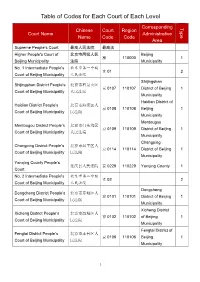
Table of Codes for Each Court of Each Level
Table of Codes for Each Court of Each Level Corresponding Type Chinese Court Region Court Name Administrative Name Code Code Area Supreme People’s Court 最高人民法院 最高法 Higher People's Court of 北京市高级人民 Beijing 京 110000 1 Beijing Municipality 法院 Municipality No. 1 Intermediate People's 北京市第一中级 京 01 2 Court of Beijing Municipality 人民法院 Shijingshan Shijingshan District People’s 北京市石景山区 京 0107 110107 District of Beijing 1 Court of Beijing Municipality 人民法院 Municipality Haidian District of Haidian District People’s 北京市海淀区人 京 0108 110108 Beijing 1 Court of Beijing Municipality 民法院 Municipality Mentougou Mentougou District People’s 北京市门头沟区 京 0109 110109 District of Beijing 1 Court of Beijing Municipality 人民法院 Municipality Changping Changping District People’s 北京市昌平区人 京 0114 110114 District of Beijing 1 Court of Beijing Municipality 民法院 Municipality Yanqing County People’s 延庆县人民法院 京 0229 110229 Yanqing County 1 Court No. 2 Intermediate People's 北京市第二中级 京 02 2 Court of Beijing Municipality 人民法院 Dongcheng Dongcheng District People’s 北京市东城区人 京 0101 110101 District of Beijing 1 Court of Beijing Municipality 民法院 Municipality Xicheng District Xicheng District People’s 北京市西城区人 京 0102 110102 of Beijing 1 Court of Beijing Municipality 民法院 Municipality Fengtai District of Fengtai District People’s 北京市丰台区人 京 0106 110106 Beijing 1 Court of Beijing Municipality 民法院 Municipality 1 Fangshan District Fangshan District People’s 北京市房山区人 京 0111 110111 of Beijing 1 Court of Beijing Municipality 民法院 Municipality Daxing District of Daxing District People’s 北京市大兴区人 京 0115 -
Analysis of Compositions and Physical Characteristics of Different Rice from Heilongjiang China
SAMSE IOP Publishing IOP Conf. Series: Materials Science and Engineering1234567890 322 (2018)‘’“” 042009 doi:10.1088/1757-899X/322/4/042009 Analysis of Compositions and Physical Characteristics of Different Rice From Heilongjiang China Fenglian Chena, Xinming Lib, Mingshou Lvc,Yanguo Shid,* Department of Food Science & Engineering, Harbin University of Commerce, Harbin 150076, China *Corresponding author e-mail: d*yanguosh@163.com afinesxm@163.com, b931367406@qq.com, chrbcufood@126.com, dCampa@purdue.edu, Abstract. Diversity and correlation between composition, texture characteristics and sensory features of twenty kinds of purebred rice from Heilongjiang China were studied. Experimental results showed significant differences in content of fat, amylose and protein, however those differences were not extended to perceived taste evaluation by sensory evaluation. More protein led to lower viscosity but better hardness and springiness, higher amylose content resulted lower taste but higher springiness. Moisture content was significantly negatively correlated with resilience; the content of protein was significantly positively correlated with resilience. The adhesiveness of texture characteristic and the viscosity of taste showed significant positive correlation. 1. Introduction Rice is one of the most popular staple foods, and today half of the world population are living depend on it[1]. Rice is being produced in Asia, Southern Europe, tropical America and some parts of Africa, and the total production is ranked 3 among the world's total crop yields[2]. The area of Heilongjiang is located in the center of the northeastern Asia economic zone, which is one of the three world famous black soil zone and the rice produced from Heilongjiang is popular with acceptable quality[3]. -

Download 448.33 KB
Environmental Assessment Report Summary Environmental Impact Assessment Project Number: 39038 February 2006 People’s Republic of China: Heilongjiang Road Network Development Project Prepared by Heilongjiang Provincial Communications Department for the Asian Development Bank (ADB). The The summaryviews expressed environmental herein areimpact those assessment of the consul is tanta document and do not of necessarilythe borrower. represent The views those expressed of ADB’s herein members, do not Board necessarily of Directors, represent Management, those of orADB’s staff, Boardand may of Directors,be preliminary Mana ingement, nature. or staff, and may be preliminary in nature. CURRENCY EQUIVALENTS (as of 13 February 2006) Currency Unit – yuan (CNY) CNY1.00 = $0.1242 $1.00 = CNY8.0505 ABBREVIATIONS ADB – Asian Development Bank BOD5 – biological oxygen demand (5-day) CO – carbon monoxide COD – chemical oxygen demand EIA – environmental impact assessment EMP – environmental management plan GB – guojia biaozhun (national standard) HIV/AIDS – human immunodeficiency syndrome/acquired immunodeficiency syndrome HPCD – Heilongjiang Provincial Communications Department NO2 – nitrogen dioxide PRC – People’s Republic of China RP – resettlement plan SEIA – summary environmental impact assessment SEPP – soil erosion prevention plan TSP – total suspended particles WEIGHTS AND MEASURES dB(A) – decibel (measured in audible noise bands) ha – hectare km – kilometer km2 – square kilometer m – meter m2 – square meter m3 – cubic meter mg – milligram MTE – medium truck equivalent mu – unit of area commonly used in the PRC; 15 mu = 1 hectare NOTE In this report, "$" refers to US dollars. CONTENTS Page MAP I. INTRODUCTION 1 II. DESCRIPTION OF THE PROJECT 1 III. DESCRIPTION OF THE ENVIRONMENT 2 A. Physical Resources 2 B. -
Vegetation Changes and the Relationship with Climate Variability in the Upper and Middle Reaches of the Nenjiang River Basin, China
The International Archives of the Photogrammetry, Remote Sensing and Spatial Information Sciences, Volume XLI-B8, 2016 XXIII ISPRS Congress, 12–19 July 2016, Prague, Czech Republic VEGETATION CHANGES AND THE RELATIONSHIP WITH CLIMATE VARIABILITY IN THE UPPER AND MIDDLE REACHES OF THE NENJIANG RIVER BASIN, CHINA F. Huang a,*, D.H. Wenb, P. Wang a a School of Geographical Sciences, Northeast Normal University, Renmin Street, Changchun, China- joycehf@126.com, wangp666@nenu.edu.cn b Changchun Institute of Optics, Fine Mechanics and Physics, Chinese Academy of Science, Dong Nanhu Road, Changchun, China- 563334610@qq.com Commission VIII, WG VIII/8 KEY WORDS: Vegetation Dynamics, NDVI, Climate Variability, Correlation Analysis, Rescaled Range Analysis, SPOT VEGETATION, the Upper and Middle Reaches of the Nenjiang River ABSTRACT: To detect changes in vegetation is desirable for modeling and predicting interactions between land surface and atmosphere. Multi- temporal series of SPOT VEGETATION NDVI dataset and meteorological data were integrated to interpret vegetation dynamics and the linkage with climate variations in the upper and middle reaches of the Nenjiang River Basin (NRB) from 1999 to 2010 using the correlation analysis and the rescaled range (R/S) analysis. The results demonstrate that annual NDVI increased slightly and 26.02% vegetation coverage of the study area significantly improved. The area of significantly decreased in vegetation cover took up 13.33% of the total land in spring. In autumn, 26.2% of the study area showed a significant vegetation increase. The improved activity of vegetation might reinforce in summer and autumn, while the decreasing tendency in spring might be persistent in the future. -

5 Environmental Baseline
E2646 V1 1. Introduction Public Disclosure Authorized 1.1. Project Background The proposed Harbin-Jiamusi (HaJia Line hereafter) Railway Project is a new 342 km double track railway line starting from the city of Harbin, running through Bing County, Fangzheng County, Yilan County, and ending at the city of Jiasmusi. The Project is located in Heilongjiang Province, and the south of the Songhua River, in the northeast China (See Figure 1-1). The total investment of the Project is RMB 38.66 Billion Yuan, including a World Bank loan of USD 300 million. The construction period is expected to last 4 years, commencing in July 2010. Commissioning of the line is proposed by June 2014. Public Disclosure Authorized HaJia Line, as a Dedicated Passenger Line (DPL) for inter-city communications and an important part of the fast passenger transportation network in northeast of China will extend the Harbin-Dalian dedicated passenger Line to the the northeastern area of Heilongjiang Province, and will be the key line for the transportation system in Heilongjiang Province to go beyond. The project will bring together more closely than before Harbin , Jiamusi and Tongjiang, Shuangyashan, Hegang, Yinchun among which there exists a busy mobility of people potentially demanding high on passenger transportation. The completion of the project will make it possible for the passenger line and cargo train line between Harbin and Jiamusi to be separated, and will extend the the Public Disclosure Authorized line Harbin-Dalian passenger line to the northeast of Heilongjiang Province,It willl also strengthen the skeleton of the railway network of the northeastern part of China and optimize the express passenger transportation network of the northeast. -

Confidential: for Review Only
BMJ Confidential: For Review Only Incidence of type 1 diabetes mellitus in China: population based study, 2010 – 2013 Journal: BMJ Manuscript ID BMJ.2017.040488 Article Type: Research BMJ Journal: BMJ Date Submitted by the Author: 21-Jul-2017 Complete List of Authors: Weng, Jianping; Sun Yat-sen University Third Hospital; Guangdong Provincial Key Laboratory of Diabetology Zhou, Zhiguang; the Second Xiangya Hospital, Central South University, Institue of Endocrinology and Metabolism Guo, Lixin; Beijing Hospital Zhu, Dalong; Nanjing University Medical School Affiliated Nanjing Drum Tower Hospital Ji, Linong; Peking University People’s Hospital, Department of Endocrinology and Metabolism Luo, Xiaoping; Tongji Hospital of Tongji Medical College, Huazhong University of Science & Technology Mu, Yiming; People’s Liberation Army General Hospital, China, Jia, Wei-Ping; The Sixth Affiliated People’s Hospital, Shanghai Jiao Tong University, YANG, WEN YING; CHINA JAPAN FRIENDSHIP HOSPITAL, ENDOCRINOLOGY Kuang, Hongyu; The First Affiliated Hospital of Harbin Medical University Li, Qiang; The Second Affiliated Hospital of Harbin Medical University, Li, Yanbing; The First Affiliated Hospital of Sun Yat-sen University Yuan, Li; Union Hospital, Tongji Medical College, Huazhong University of Science & Technology Yu, Xuefeng; Wuhan Tongji Hospital, China, Shan, Zhongyan; First Affiliated Hospital, Chinese Medical University, Ji, Qiuhe; Xijing Hospital, Fourth Military Medical University, Ran, Xing-wu; West China Hospital of Sichuan University, Diabetic -

World Bank Document
Certificate No.: Guohuanpingzheng Jiazi No. 1703 Public Disclosure Authorized Environmental Impact Assessment For Harbin Cold Weather Smart Public Transportation System Project (Public Transport Corridors Component) Restructuring Stage Public Disclosure Authorized Entrusted by Public Disclosure Authorized Harbin Transportation Bureau Prepared by Heilongjiang Xingye Environmental Protection Technology Co., Ltd. Revised by HJI Group (USA) Public Disclosure Authorized July 2019 Project Name: Harbin Cold Weather Smart Public Transportation System Project (Public Transport Corridors Component) Project No.: HKYBGS - (2013) 008 Entrusted by: Harbin Transportation Bureau Prepared by: Heilongjiang Xingye Environmental Protection Technology Co., Ltd. Legal Representative: Chi Xiaode EIA Certificate: Guohuanpingzheng Jiazi No. 1703 Task Team Leaders: Sun Baini A17030081000 He Chenyan A17030009 Technical Reviewer: Guan Kezhi A17030023 Prepared by No. of Prepared by Duty Title Registration/Qualification Signature Certificate Sun Baini Report preparation Senior engineer A17030081000 PREFACE Urbanization and motorization have led to constant increase in gasoline consumption in China, and energy will become an important factor affecting China's social and economic development in the future. Over a long time, China's urban public transport system has been underdeveloped, and unable to meet the high-quality daily travelling demand of urban residents. The prominent contradictions between supply and demand in urban transport are shown by the incomplete capacity of urban public transport system, the failure of urban public transport system development in keeping simultaneous with urban development, the single structure of urban public transport system, the lack of advanced transport planning concepts, and the lack of public transport-oriented planning experience for most cities. The project is intended to optimize Harbin's urban public transport system, to improve social and economic development, and to alleviate residents' travel difficulties in cold weather. -

Social Evaluation Report for Harbin-Jiamusi Railway Passenger Dedicated Line
E2646 Public Disclosure Authorized V5 Social Evaluation Report for Harbin-Jiamusi Railway Passenger Dedicated Line Public Disclosure Authorized Public Disclosure Authorized The Third Railway Survey and Design Institute Group Corporation Public Disclosure Authorized Tianjin September 2010 Contents Contents LIST OF TABLES··················································································································································· III 1. BRIEF INTRODUCTION AND BACKGROUND ··························································································· 1 2. SOCIAL AND ECONOMIC CONDITIONS IN HEILONGJIANG PROVINCE ········································ 1 2.1 SOCIAL AND ECONOMIC CONDITIONS OF CITIES AND COUNTIES ALONG THE LINE ·····································3 2.2 SOCIAL INVESTIGATION ALONG THE LINE ···································································································7 2.3 SOCIAL BENEFIT AND IMPACT ANALYSIS ····································································································12 3 ADAPTABILITY ANALYSIS··························································································································30 3.1 ATTITUDES OF DIFFERENT STAKEHOLDERS······························································································30 3.2 ATTITUDES OF LOCAL SOCIAL COMMUNITIES····························································································32 3.3 TRAFFIC DEMAND OF LOCAL SOCIAL COMMUNITIES