The Enlightenment, the French Revolution and Romanticism
Total Page:16
File Type:pdf, Size:1020Kb
Load more
Recommended publications
-
Quick Study Guide
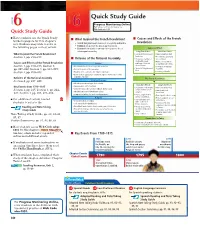
WH07_te_ch06_rev_MOD_s.fm Page 240 Monday, March 5, 2007 5:10WH07MOD_se_CH06_rev_s.fm PM Page 240 Friday, January 26, 2007 12:12 PM Quick Study Guide CHAPTER Progress Monitoring Online 6 6 For: Self-test with vocabulary practice 6 Web Code: nba-1851 Quick Study Guide ■ Have students use the Quick Study ■ What Inspired the French Revolution? ■ Causes and Effects of the French Guide to prepare for this chapter’s Revolution test. Students may wish to refer to • Social: Enlightenment ideas such as equality and justice the following pages as they review: • Political: Ideas from the American Revolution • Economic: Inequalities among classes; unrest due to Cause and Effect extravagant monarchy Long-Term Causes Immediate Causes What Inspired the French Revolution? • Corrupt and inconsistent • Huge government debt Section 1, pp. 210–213 leadership • Poor harvests and rising ■ Reforms of the National Assembly • Prosperous members of price of bread Third Estate resent • Failure of Louis XVI to Causes and Effects of the French Revolution Political privileges of First and accept financial reforms Second Estates. Section 1, pp. 210–215; Section 2, • Proclaimed all male citizens equal before the law. • Formation of National • Spread of Enlightenment • Limited the power of the monarchy. Assembly pp. 217–222; Section 3, pp. 223–227; ideas Section 4, pp. 230–238 • Established the Legislative Assembly to make laws. • Storming of Bastille • Granted all tax-paying male citizens the right to elect members of the Legislative Assembly. Reforms of the National Assembly The French Revolution Section 2, pp. 217–220 Social and Economic • Abolished special privileges of the nobility. Immediate Effects Long-Term Effects • Announced an end to feudalism. -

Nationalism in the French Revolution of 1789
The University of Maine DigitalCommons@UMaine Honors College 5-2014 Nationalism in the French Revolution of 1789 Kiley Bickford University of Maine - Main Follow this and additional works at: https://digitalcommons.library.umaine.edu/honors Part of the Cultural History Commons Recommended Citation Bickford, Kiley, "Nationalism in the French Revolution of 1789" (2014). Honors College. 147. https://digitalcommons.library.umaine.edu/honors/147 This Honors Thesis is brought to you for free and open access by DigitalCommons@UMaine. It has been accepted for inclusion in Honors College by an authorized administrator of DigitalCommons@UMaine. For more information, please contact um.library.technical.services@maine.edu. NATIONALISM IN THE FRENCH REVOLUTION OF 1789 by Kiley Bickford A Thesis Submitted in Partial Fulfillment of the Requirement for a Degree with Honors (History) The Honors College University of Maine May 2014 Advisory Committee: Richard Blanke, Professor of History Alexander Grab, Adelaide & Alan Bird Professor of History Angela Haas, Visiting Assistant Professor of History Raymond Pelletier, Associate Professor of French, Emeritus Chris Mares, Director of the Intensive English Institute, Honors College Copyright 2014 by Kiley Bickford All rights reserved. Abstract The French Revolution of 1789 was instrumental in the emergence and growth of modern nationalism, the idea that a state should represent, and serve the interests of, a people, or "nation," that shares a common culture and history and feels as one. But national ideas, often with their source in the otherwise cosmopolitan world of the Enlightenment, were also an important cause of the Revolution itself. The rhetoric and documents of the Revolution demonstrate the importance of national ideas. -
Inscriptive Masculinity in Balzac's Comédie Humaine
University of Nebraska - Lincoln DigitalCommons@University of Nebraska - Lincoln Theses, Dissertations, Student Research: Modern Languages and Literatures, Department Modern Languages and Literatures of 4-20-2009 Inscriptive Masculinity in Balzac’s Comédie Humaine Alana K. Eldrige University of Nebraska - Lincoln, alana.eldrige@gmail.com Follow this and additional works at: https://digitalcommons.unl.edu/modlangdiss Part of the Modern Languages Commons Eldrige, Alana K., "Inscriptive Masculinity in Balzac’s Comédie Humaine" (2009). Theses, Dissertations, Student Research: Modern Languages and Literatures. 6. https://digitalcommons.unl.edu/modlangdiss/6 This Article is brought to you for free and open access by the Modern Languages and Literatures, Department of at DigitalCommons@University of Nebraska - Lincoln. It has been accepted for inclusion in Theses, Dissertations, Student Research: Modern Languages and Literatures by an authorized administrator of DigitalCommons@University of Nebraska - Lincoln. INSCRIPTIVE MASCULINITY IN BALZAC’S COMÉDIE HUMAINE by Alana K. Eldrige A DISSERTATION Presented to the Faculty of The Graduate College at the University of Nebraska In Partial Fulfillment of Requirements For the Degree of Doctor in Philosophy Major: Modern Languages and Literature (French) Under the Supervision of Professor Marshall C. Olds Lincoln, Nebraska May, 2009 INSCRIPTIVE MASCULINITY IN BALZAC’S COMÉDIE HUMAINE Alana K. Eldrige, Ph.D. University of Nebraska, 2009. Adviser: Marshall C. Olds This reading of La Comédie humaine traces the narrative paradigm of the young hero within Balzac’s literary universe. A dynamic literary signifier in nineteenth-century literature, the young hero epitomizes the problematic existence encountered by the individual in post-revolutionary France. At the same time, he serves as a mouth-piece for an entire youthful generation burdened by historical memory. -

Place Saint-Michel the Place Saint-Michel Is
Place Saint-Michel The Place Saint-Michel is simple – a triangle between two streets, uniform buildings along both, designed by the same architect, a walk of smooth cobblestone. The centerpiece is St. Michael defeating a devil; far above them are four statues symbolizing the four cardinal virtues of prudence, fortitude, temperance, and justice. This monument came to be because of the 1848 Revolution and a cholera epidemic in Paris that followed it which killed thousands. This idea of abstract concepts given human form had been popular during the Revolution, the big one, representing the kind of big virtues – like the Four Cardinal Virtues – that everyone could strive for, instead of a single human being whose actions and legacy would turn people against each other. Simultaneous with the creation of Place Saint-Michel, Napoleon III’s renovation brought the Boulevard Saint-Michel into being, and that is the next part of our walk. Facing the fountain with the river at your back, walk on Boulevard Saint-Michel, it’s the street to your left. Walk away from the river along that street. Ultimately, you’ll be turning left on Rue des Écoles, but it’ll be about five minutes to get there, and you can listen to the next track on the way. Boulevard Saint-Michel The character of the street you’re on – wide-open space lined with trees and long, harmonious buildings, plus, often, a view of some landmark in the distance – was a central part of the renovation plan, or the Haussmann plan, as it’s also known. -

Jacques-Louis David's 'Oath of the Tennis Court'
EXTENSION ACTIVITIES – Jacques-Louis David’s ‘Oath of the Tennis Court’, 1791 Read the discussion of Jacques-Louis-David’s ‘Oath of the Tennis Court’ (1791) on p. 3-8 of this handout. Then complete the following extension activities: 1. One of the big problems which faced David as the Revolution progressed was that many of the figures to whom he had given prominence in the 1791 drawing fell from favour as political conditions changed. Using Liberating France (including the Who’s Who) and other sources, find out what happened to Mounier, Mirabeau, Bailly, Barère, Barnave, and Robespierre. Then research the clergymen, Abbé Grégoire and Abbé Sieyès. 2. David alludes to the popular movement which became known as the sans-culottes through the strong and robust figure in the red bonnet of liberty in the lower left hand corner. Referring to Liberating France (including the Section B Timeline), write a paragraph to outline the role played by the sans-culottes movement from 10 August 1792 until the days of Germinal and Prairial Year III, (1 April and 20-23 May 1795). 3. Using Liberating France (including the Who’s Who) and other sources, outline David’s revolutionary career – both as a painter and as a politician. In your answer consider the importance his paintings and drawings 1789-1795, and his role in organising public ceremonies. Then investigate his political activities as a deputy in the National Convention. 4. David uses at least eight revolutionary ideas in his 1791 study of the Tennis Court Oath. Locate them and any other revolutionary ideas not mentioned in the summary above. -

The Democratic Sphere Communications with the French National Assembly's Committee of Research,1789-1791
The Democratic Sphere Communications with the French National Assembly's Committee of Research,1789-1791 Maia Kirby Queen Mary, University of London Submitted in partial fulfilment of the requirements of the degree of Doctor of Philosophy 1 I, Maia Olive Claire Kirby, confirm that the research included within this thesis is my own work or that where it has been carried out in collaboration with, or supported by others, that this is duly acknowledged below and my contribution indicated. Previously published material is also acknowledged below. I attest that I have exercised reasonable care to ensure that the work is original, and does not to the best of my knowledge break any UK law, infringe any third party’s copyright or other Intellectual Property Right, or contain any confidential material. I accept that the College has the right to use plagiarism detection software to check the electronic version of the thesis. I confirm that this thesis has not been previously submitted for the award of a degree by this or any other university. The copyright of this thesis rests with the author and no quotation from it or information derived from it may be published without the prior written consent of the author. Signature: Maia Kirby Date: 24.08.16 2 Abstract On 28 July 1789 the National Assembly established the Committee of Research as a mechanism through which it could identify threats to its existence from amongst its large correspondence. In the time it was active, the committee received thousands of letters from across France. In the early 1990s the archivist Pierre Caillet wrote a thorough inventory and a general synthesis of the communications which further opened them up as a resource that could provide insight into popular reponses to various themes. -
Introduction
© Copyright, Princeton University Press. No part of this book may be distributed, posted, or reproduced in any form by digital or mechanical means without prior written permission of the publisher. CHAPTER 1 Introduction French Society in 1789 Historians working on the French Revolution have a problem. All of our attempts to find an explanation in terms of social groups or classes, or particular segments of society becoming powerfully activated, have fallen short. As one expert aptly expressed it: “the truth is we have no agreed general theory of why the French Revolution came about and what it was— and no prospect of one.”1 This gaping, causal void is cer- tainly not due to lack of investigation into the Revolution’s background and origins. If class conflict in the Marxist sense has been jettisoned, other ways of attributing the Revolution to social change have been ex- plored with unrelenting rigor. Of course, every historian agrees society was slowly changing and that along with the steady expansion of trade and the cities, and the apparatus of the state and armed forces, more (and more professional) lawyers, engineers, administrators, officers, medical staff, architects, and naval personnel were increasingly infusing and diversifying the existing order.2 Yet, no major, new socioeconomic pressures of a kind apt to cause sudden, dramatic change have been identified. The result, even some keen revisionists admit, is a “somewhat painful void.”3 Most historians today claim there was not one big cause but instead numerous small contributory impulses. One historian, stressing the absence of any identifiable overriding cause, likened the Revolution’s origins to a “multi- coloured tapestry of interwoven causal factors.”4 So- cial and economic historians embracing the “new social interpretation” identify a variety of difficulties that might have rendered eighteenth- century French society, at least in some respects, more fraught and vulnerable than earlier. -

The Price of Revolution Alison Patrick As Patrice Gueniffey Has Noted
The Price of Revolution 13 The Price of Revolution Alison Patrick As Patrice Gueniffey has noted, interest in the Terror as a French revolutionary phenomenon has waxed and waned, but has never disappeared, though focus and emphasis have changed from time to time. In preparation for the French 1789 bicentennial, Mitterand decided that France, unlike the United States, would not treat its revolutionary decade as a serial story, but would celebrate national liberation in a lump, with Chinese students wheeling empty bicycles at the head of the Bastille Day procession as a reminder that some countries had not yet caught up. This decision made it possible to avoid divisive areas, freeing the heirs of the Revolution to commemorate whatever they chose, but outside Paris, foreign visitors might find themselves puzzled by the range of local traditions which presumably shaped the festivities. (Exactly why did the Arles school children produce an exhibition of émigré biographies?) It would at least seem from the size and complexity of Gueniffey’s book that re-visits to the Terror are likely to continue.1 One realizes with surprise that one part of the story has still not had much attention. The normal focus has been on the development of Terror as an instrument of government policy, on the numbers and character of those affected by it, and on the crisis of Thermidor and its sequel. Gueniffey has a good deal about the political maneuvers that culminated in the events of Prairial, placing Robespierre in the centre of the stage, and the Thermidorians naturally get their share of notice. -

French Revolution Political Freedom!
French Revolution Part 2: Political Freedom! Part 2: Political Freedom! Objective: Understand what political freedom is. Determine what the right balance is between security and freedom. Assessment Goals: (Learning Target 1,2,3,6,7): Identify the changes in government and rights of people throughout the revolution. Determine when you believe people were the most free. Explain and defend using primary and secondary source evidence. ____________________________________________________________________________________________________________________________________________ A: Initial Revolutionary Movements _____________________________________________ Estates General Tennis Court Oath Storming of the Bastille http://www.nationalarchives.gov.uk/education/resources/french-revolution/source-2/ ‘The London Gazette’ – Saturday 18 July – Tuesday 21 July, 1789 (ZJ 1/85 Transcript In the Evening a Detachment with Two Pieces of Cannon went to the Bastile, to demand the Ammunition deposited there. A Flag of Truce had been sent before them, which was answered from within; But nevertheless, the Governor (the Marquis de Launay) ordered the Guard to fire, and several were killed. The Populace, enraged at this Proceeding, rushed forward to the Assault, when the Governor agreed to admit a certain Number, on Condition that they should not commit any Violence. A Detachment of about Forty accordingly passed the Drawbridge, which was instantly drawn up, and the whole Party massacred. This Breach of Faith, aggravated by so glaring an instance of Inhumanity, naturally excited a Spirit of revenge and Tumult not to be appeased. A Breach was soon made in the Gate, and the Fortress surrendered. The Governor, the principal Gunner, the Jailer, and Two old Invalids, who had been noticed as being more active than the Rest, were seized, and carried before the Council assembled at the Hotel de Ville, by whom the Marquis de Launay was sentenced to be beheaded, which was accordingly put in Execution at the Place de Grêve, and the other Prisoners were also put to Death. -

American Enlightenment & the Great Awakening
9/9/2019 American Enlightenment & the Great Awakening Explain how & why the movement of a variety of people & ideas across the Atlantic contributed to the development of American culture over time. (Topic 2.7) Enlightenment: Defining the Period 4 Fundamental Principles 1. Lawlike order of the natural world 2. Power of human reason 3. Natural rights of individuals 4. Progressive improvement of society • Natural laws applied to social, political and economic relationships • Could figure out natural laws if they employed reasoning: rationalism 1 9/9/2019 Most Influential • John Locke • Two Treatises of Government: gov’t is bound to follow “natural laws” based on the rights of that people have as humans; sovereignty resides with the people; people have the right to overthrown a government that fails to protect their rights. • Jean-Jacques Rousseau • The Social Contract: Argued that a government should be formed by the consent of the people, who then make their own laws. • Montesquieu • The Spirit of Laws: 3 types of political power – legislative, judicial & executive which each power separated into different branches to protect people’s liberties. Rationale for the American Revolution and the principles of the U.S. Constitution American Enlightenment Start Date/Event 1636: Roger Williams est. R.I. Separation of church & state Freedom of religion Rejects the divine right of kings & supports popular sovereignty 2 9/9/2019 Benjamin Franklin 1732: popularizes the Enlightenment with publication of his almanac Formed clubs for “mutual improvement” -

Peasantry and the French Revolution
“1st. What is the third estate? Everything. 2nd. What has it been heretofore in the political order? Nothing. 3rd. What does it demand? To become something therein.” -Abbe Sieyes 1789 Pre-Revolution • Louis XVI came to the throne in the midst of a serious financial crisis • France was nearing bankruptcy due to the outlays that were outpacing income • A new tax code was implemented under the direction of Charles Alexandre de Calonne • This proposal included a land tax • Issues with the Three Estates and inequality within it Peasant Life pre-Revolution • French peasants lived better than most of their class, but were still extremely poor • 40% worked land, but it was subdivided into several small plots which were shared and owned by someone else • Unemployment was high due to the waning textile industry • Rent and food prices continued to rise • Worst harvest in 40 years took place during the winter of 1788-89 Peasant Life pre-Revolution • The Third Estate, which was the lower classes in France, were forced by the nobility and the Church to pay large amounts in taxes and tithes • Peasants had experienced a lot of unemployment during the 1780s because of the decline in the nation’s textile industry • There was a population explosion of about 25-30% in roughly 90 years that did not coincide with a rise in food production Direct Causes of the Revolution • Famine and malnutrition were becoming more common as a result of shortened food supply • Rising bread prices contributes to famine • France’s near bankruptcy due to their involvement in various -
The Journal of Gemmology Editor: Dr R.R
he Journa TGemmolog Volume 25 No. 8 October 1997 The Gemmological Association and Gem Testing Laboratory of Great Britain Gemmological Association and Gem Testing Laboratory of Great Britain 27 Greville Street, London Eel N SSU Tel: 0171 404 1134 Fax: 0171 404 8843 e-mail: gagtl@htinternet.com Website: www.gagtl.ac.uklgagtl President: Professor R.A. Howie Vice-Presidents: LM. Bruton, Af'. ram, D.C. Kent, R.K. Mitchell Honorary Fellows: R.A. Howie, R.T. Liddicoat Inr, K. Nassau Honorary Life Members: D.). Callaghan, LA. lobbins, H. Tillander Council of Management: C.R. Cavey, T.]. Davidson, N.W. Decks, R.R. Harding, I. Thomson, V.P. Watson Members' Council: Aj. Allnutt, P. Dwyer-Hickey, R. fuller, l. Greatwood. B. jackson, J. Kessler, j. Monnickendam, L. Music, l.B. Nelson, P.G. Read, R. Shepherd, C.H. VVinter Branch Chairmen: Midlands - C.M. Green, North West - I. Knight, Scottish - B. jackson Examiners: A.j. Allnutt, M.Sc., Ph.D., leA, S.M. Anderson, B.Se. (Hons), I-CA, L. Bartlett, 13.Se, .'vI.phil., I-G/\' DCi\, E.M. Bruton, FGA, DC/\, c.~. Cavey, FGA, S. Coelho, B.Se, I-G,\' DGt\, Prof. A.T. Collins, B.Sc, Ph.D, A.G. Good, FGA, f1GA, Cj.E. Halt B.Sc. (Hons), FGr\, G.M. Howe, FG,'\, oo-, G.H. jones, B.Se, PhD., FCA, M. Newton, B.Se, D.PhiL, H.L. Plumb, B.Sc., ICA, DCA, R.D. Ross, B.5e, I-GA, DGA, P..A.. Sadler, 13.5c., IGA, DCA, E. Stern, I'GA, DC/\, Prof. I.