Women Writers : Their Works and Ways
Total Page:16
File Type:pdf, Size:1020Kb
Load more
Recommended publications
-

Diplomarbeit
View metadata, citation and similar papers at core.ac.uk brought to you by CORE provided by OTHES DIPLOMARBEIT Titel der Diplomarbeit „Das Amerikabild Fredrika Bremers und ihre Vermittlungsarbeit in Schweden“ Verfasserin Michaela Pichler angestrebter akademischer Grad Magistra (Mag.) Wien, 2012 Studienkennzahl lt. Studienblatt: A057/393 Studienrichtung lt. Studienblatt: Individuelles Diplomstudium: Literatur- und Verlagskunde Betreuer: Dr. Ernst Grabovszki Böckerna ha blivit mitt käraste sällskap och betraktelsen en vän, som följer mig livet igenom och låter mig suga honung ur livets alla örter, även de bittra. Fredrika Bremer I Bedanken möchte ich mich bei meinem Betreuer Dr. Ernst Grabovszki, bei meinem Hauptkorrekturleser und guten Freund Johannes (Yogi) Rokita, sowie bei allen anderen, die durch Zuspruch und auffangende Worte ein Fertigstellen dieses Projektes direkt & indirekt unterstützt und dadurch ermöglicht haben! DANKE! II INHALTSVERZEICHNIS: 1 Einleitung ______________________________________________________ 1 2 Theoretische Grundlagen / Definitionen ______________________________ 5 2.1 Imagologie _______________________________________________________ 5 2.1.1 Image – Mirage ________________________________________________________ 8 2.1.2 Autoimage/Heteroimage ________________________________________________ 9 2.1.3 Xenologie, Stereotyp, Klischee ____________________________________________ 9 2.2 Reisebericht als Literaturgattung ____________________________________ 10 2.3 Auswandererbericht/Auswandererbrief ______________________________ -

Den Läsande Hjältinnan
Den läsande hjältinnan Kön, begär och intimitet i tre romaner av Fredrika Bremer ______ Camilla Wallin Bergström Ämne: Litteraturvetenskap Nivå: Master Poäng: 45 hp Ventilerad: VT 2018 Handledare: Sigrid Schottenius Cullhed Examinator: Otto Fischer Abstract: This thesis explores fictional representations of women’s reading practices in the early novels of Fredrika Bremer. I examine these in relation to the negotiations of reading habits in Sweden and Europe during the 1830’s, particularly pertaining to questions of gender, intimacy, desire, and corporeality. The material consists of three novels (The Family H***, The Neighbours and Home), in which the motif of women’s reading plays a significant part. In the four chapters of the thesis, I analyse key aspects of gender and reading in Bremer’s novels: 1) the popular stereotype of obsessive novel reading, and how this specific practice is portrayed in relation to the duties of a wife and mother, as well as to intimacy and secrecy; 2) representations of corrupted or illicit readers, whose reading practices disturbs the confines of nineteenth-century femininity; and 3) how these characters may challenge or bypass the restrictions of gender roles through fictional engagement. The thesis argues that Bremer’s representations of women’s reading are more complex and varied than has previously been recognized, and it reveals new aspects of these representations, such as the significance of intimacy with oneself and others in Bremer’s depictions of silent reading practices, and the transgressive power of feminine empathy. Keywords: Fredrika Bremer, history of reading, sexuality, gender, interiority, intimacy, empathy, the reading debate 2 Innehållsförteckning Inledning 4 Syfte och frågeställningar 6 Metod och material 6 Teoretiska utgångspunkter 11 Forskningsöversikt 16 Undersökningens disposition 18 1. -

Gaskell Society Newsletter Contents
GASKELL SOCIETY NEWSLETTER CONTENTS No.1. March 1986. Nussey, John. Inauguration of the Gaskell Society: a Brontë Society Members’ Account. p3-5. Brill, Barbara. Annie A. and Fleeming [Jenkin]. p6-11. [Leach, Joan]. Mrs Gaskell – a Cinderella at Chatsworth. p14-16. No.2. August 1986. Brill, Barbara. Job Legh and the working class naturalists. p3-6. [Keaveney, Jennifer]. Mastermind. p6. Kirkland, Janice. Mrs Gaskell’s country houses, [Boughton House, Worcester; Hulme Walfield, Congleton; The Park, near Manchester]. p10-11. Leach, Joan. Mrs Gaskell’s Cheshire; Summer Outing – June 29th 1986, [Tabley House & chapel. The Mount, Bollington]. [illus.] p12-19. Monnington, Rod. Where can I find Mrs Gaskell? [The Diary of a Hay on Wye Bookseller, by Keith Gowen, 1985]. p23-24. No.3. Spring 1987. Hewerdine, H., F.R.S.H. Cross Street Chapel. p3-5. Marroni, Francesco. Elizabeth Gaskell in Italian translation. p6-8. Leach, Joan. Cleghorn. p9-10. Moon, Richard. Letter on Boughton Park, [Worcester]. p14. Leach, Joan. Thomas Wright, the Good Samaritan [by G.F. Watts]. [illus.] p15-25. No.4. August 1987. Thwaite, Mary. The “Whitfield” Gaskell collection, [Knutsford Library]. p3-5. Brill, Barbara. William Gaskell’s hymns. p6-8. [Leach, Joan]. Green Heys Fields, [Manchester]. [Country rambles and wild flowers by Leo Grindon, 1858]. p11-12. [Heathwaite House, Knutsford]. [illus. of 1832 water colour]. p13. Summer outing to North Wales, [Sunday June 29th 1987]. [gen. table]. p14-21. [Lascelles, Gen. Sir Alan]. A Cranford fan. p23. [Leach, Joan]. The Gaskells and poetry. p24. No.5. March 1988. Jacobi, Elizabeth (later Rye). Mrs. Gaskell, [port. by H.L. -

The Second American Revolution: Era of Preparation
BYU Studies Quarterly Volume 1 Issue 2 Article 6 4-1-1959 The Second American Revolution: Era of Preparation Hyrum L. Andrus Follow this and additional works at: https://scholarsarchive.byu.edu/byusq Recommended Citation Andrus, Hyrum L. (1959) "The Second American Revolution: Era of Preparation," BYU Studies Quarterly: Vol. 1 : Iss. 2 , Article 6. Available at: https://scholarsarchive.byu.edu/byusq/vol1/iss2/6 This Article is brought to you for free and open access by the Journals at BYU ScholarsArchive. It has been accepted for inclusion in BYU Studies Quarterly by an authorized editor of BYU ScholarsArchive. For more information, please contact scholarsarchive@byu.edu, ellen_amatangelo@byu.edu. Andrus: The Second American Revolution: Era of Preparation second american revolution era preparation HYRUM L ANDRUS I1 general preparations analysis origin mormonism historical setting reveals several interesting relationships between principles objectives trends society day although these relationships do warrant conclusion joseph smith borrowed major ideas historical setting do show fhatahat claims made principles set forth compatible spirit aspirations age accepted many means attaining goals urgently sought period during joseph smith activity history intensely revolutionary termed second american revolution unlike political revolution preceding century occurred between 1820 1845was184518451 social religious economic well political orestes brownson said nature turbulent era tolertolerableableabieobserver signs time failed perceive vicinity -

Fredrika Bremer: Famillen H***
Fredrika Bremer FAMILLEN H*** SVENSKA FÖRFATTARE NY SERIE Fredrika Bremer FAMILLEN H*** Utgiven med inledning och kommentarer av Åsa Arping SVS SVENSKA VITTERHETSSAMFUNDET STOCKHOLM 2000 Utgiven med bidrag av Stiftelsen Riksbankens Jubileumsfond Abstract Fredrika Bremer, Famillen H***. Utgiven med inledning och kommentarer av Åsa Arping. (Fredrika Bremer, The H-Family. Edited with introduction and commentary by Åsa Arping, Department of Comparative Literature, Göteborg University, Box 200, SE-405 30 Göteborg, Sweden.) Skrifter utgivna av Svenska Vitterhetssamfundet. Svenska författare. Ny serie, XXVI+242 pp., Stockholm. ISBN 91-7230-094-9 Famillen H*** (The H-Family) appeared in the second and third part of Teck- ningar utur hvardagslifvet (Sketches from Every-day Life), published anon- ymously in 1830–31. This début was an immediate success and the writer’s identity was soon revealed. Here Fredrika Bremer (1801–1865) presented the reader to a literary landscape previously unknown in Sweden. Ordinary con- temporary milieus and characters are unerringly described through a quick prose easily varying from elevated to quiet and humouristic. Alongside of and often in opposition to romanesque conventions this book offered a new kind of realistic account. For the first time Famillen H*** now appeares in a critical edition. The text, based on the first edition, is preceded by an introduction presenting the creation and reception of the novel, and is followed by a commentary. © Svenska Vitterhetssamfundet ISBN 91-7230-094-9 Svenska Vitterhetssamfundet c/o Svenska Akademiens Nobelbibliotek Box 2118, SE-103 13 Stockholm http://svenska.gu.se/vittsam.html Printed in Sweden by Bloms i Lund Tryckeri AB Lund 2000 Inledning Det är besatt, besatt, besatt! Jag tror att någon välmenande hexa har sagt hokus pokus öfver mig och min lilla bok. -

European Reform Movements and the Making of the International Congress, 1840–1860
The International History Review ISSN: (Print) (Online) Journal homepage: https://www.tandfonline.com/loi/rinh20 European Reform Movements and the Making of the International Congress, 1840–1860 Jakob Kihlberg To cite this article: Jakob Kihlberg (2020): European Reform Movements and the Making of the International Congress, 1840–1860, The International History Review, DOI: 10.1080/07075332.2020.1808506 To link to this article: https://doi.org/10.1080/07075332.2020.1808506 © 2020 The Author(s). Published by Informa UK Limited, trading as Taylor & Francis Group Published online: 24 Aug 2020. Submit your article to this journal View related articles View Crossmark data Full Terms & Conditions of access and use can be found at https://www.tandfonline.com/action/journalInformation?journalCode=rinh20 THE INTERNATIONAL HISTORY REVIEW https://doi.org/10.1080/07075332.2020.1808506 European Reform Movements and the Making of the International Congress, 1840–1860 Jakob Kihlberg Department of History of Science and Ideas, Uppsala University, Uppsala, Sweden ABSTRACT KEYWORDS In historical research on internationalism and the international sphere, Internationalism; the rise of the international congress during the nineteenth century has international congresses; long played a prominent role. This article investigates the making of the reform movements; international congress as a phenomenon by comparing three early ser- public speaking ies of meetings – anti-slavery conventions, peace congresses and philan- thropic congresses during the 1840 s and 1850 s – as communicative events. The analysis shows that their staging was influenced by the fact that these meetings were organised to mobilise reform movements, and that they relied on a public sphere where elite groups, gathered in the metropoles of Europe, could expect that their speeches would reach geographically dispersed audiences through print media. -
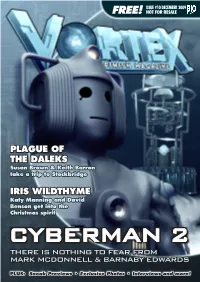
Plague of the Daleks Iris Wildthyme
ISSUE #10 DECEMBER 2009 FREE! NOT FOR RESALE PLAGUE OF THE DALEKS Susan Brown & Keith Barron take a trip to Stockbridge IRIS WILDTHYME Katy Manning and David Benson get into the Christmas spirit CYBERMAN 2 THERE IS NOTHING TO FEAR FROM MARK MCDONNELL & barnaby EDWARDS PLUS: Sneak Previews • Exclusive Photos • Interviews and more! EDITORIAL THE BIG FINISH SALE Hello! This month’s editorial comes to you direct Now, this month, we have Sherlock Holmes: The from Chicago. I know it’s impossible to tell if that’s Death and Life, which has a really surreal quality true, but it is, honest! I’ve just got into my hotel to it. Conan Doyle actually comes to blows with Prices slashed from 1st December 2009 until 9th January 2010 room and before I’m dragged off to meet and his characters. Brilliant stuff by Holmes expert greet lovely fans at the Doctor Who convention and author David Stuart Davies. going on here (Chicago TARDIS, of course), I And as for Rob’s book... well, you may notice on thought I’d better write this. One of the main the back cover that we’ll be launching it to the public reasons we’re here is to promote our Sherlock at an open event on December 19th, at the Corner Holmes range and Rob Shearman’s book Love Store in London, near Covent Garden. The book will Songs for the Shy and Cynical. Have you bought be on sale and Rob will be signing and giving a either of those yet? Come on, there’s no excuse! couple of readings too. -

Special 150Th Anniversary Issue Ramsey County and Its Territorial Years —Page 8
RAMSEY COUNTY In the Beginning: The Geological Forces A Publication o f the Ramsey County Historical Society That Shaped Ramsey County Page 4 Spring, 1999 Volume 34, Number 1 Special 150th Anniversary Issue Ramsey County And Its Territorial Years —Page 8 “St. Paul in Minnesotta, ” watercolor, 1851, by Johann Baptist Wengler. Oberösterreichisches Landes Museum, Linz, Austria. Photo: F. GangI. Reproduced by permission of the museum. Two years after the establishment of Minnesota Territory, St. Paul as its capital was a boom town, “... its situation is as remarkable for beauty as healthiness as it is advantageous for trade, ” Fredrika Bremer wrote in 1853, and the rush to settlement was on. See “A Short History of Ramsey County” and its Territorial Years, beginning on page 8. RAMSEY COUNTY HISTORY Executive Director Priscilla Famham An Exciting New Book Editor Virginia Brainard Kunz for Young Readers RAMSEY COUNTY Volume 34, Number 1 Spring, 1999 HISTORICAL SOCIETY BOARD OF DIRECTORS Laurie A. Zenner CONTENTS Chair Howard M. Guthmann President James Russell 3 Message from the President First Vice President Anne Cowie Wilson 4 In the Beginning Second Vice President The Geological Forces that Shaped Ramsey Richard A. Wilhoit Secretary County and the People Who Followed Ronald J. Zweber Scott F. Anfinson Treasurer W. Andrew Boss, Peter K. Butler, Charlotte H. 8 A Short History of Ramsey County— Drake, Mark G. Eisenschenk, Joanne A. Eng- lund, Robert F. Garland, Judith Frost Lewis, Its Territorial Years and the Rush to Settlement John M. Lindley, George A. Mairs, Marlene Marschall, Richard T. Murphy, Sr., Bob Olsen, 2 2 Ramsey County’s Heritage Trees Linda Owen, Fred Perez, Marvin J. -

Love Is GREAT Edition 1, March 2015
An LGBT guide Brought to you by for international media March 2015 Narberth Pembrokeshire, Wales visitbritain.com/media Contents Love is GREAT guide at a glance .................................................................................................................. 3 Love is GREAT – why? .................................................................................................................................... 4 Britain says ‘I do’ to marriage for same sex couples .............................................................................. 6 Plan your dream wedding! ............................................................................................................................. 7 The most romantic places to honeymoon in Britain ............................................................................. 10 10 restaurants for a romantic rendezvous ............................................................................................... 13 12 Countryside Hideaways ........................................................................................................................... 16 Nightlife: Britain’s fabulous LGBT clubs and bars ................................................................................. 20 25 year of Manchester and Brighton Prides .......................................................................................... 25 Shopping in Britain ....................................................................................................................................... -

Fredrika Bremer' S , American Travel Narrative
Domesticating Geographical Exploration: Fredrika Bremer' s , American Travel Narrative Anka Ryall University of Tromsgi Europeans have always seen America as the embodiment of the future. In the nineteenth century, as a result of its "democratic experiment," the United States became a the favourite setting for both utopian and dystopian social visions.* The publication of literally hundreds of American travel books and the enormous popularity of some of them document the centralitjr of the United States in European imaginations. In book after book the New World was emplotted in the image of European cultural and political preoccupations. Although the single most influential of these books was Alexis de Tocqueville's De la de'mocratie en Ame'rique, the numerous British travel writers seem to have dominated the field and determined the parameters of the debate.1 The most important Scandinavian contribution was Fredrika Bremer's Hemmen i den Nya Varlden (1853-54), which was published in an English translation a few months before the Swedish edition came out and afterwards quickly translated into Dutch, French and German.2 * An earlier version of this paper was presented at the Annual Meeting of the Society for the Advancement of Scandinavian Study in Madison, Wisconsin, 3-5 May 1990. I would like to thank PA1 Bjarby and 0yvind Gulliksen for their helpful comments and suggestions. 1 According to Max Berger, over two hundred and thirty British wave1 books about America appeared during the period from 1836 to 1860. The market for such books was so great, he claims, that "practically every manuscript having a trace of merit or interest sooner or later appeared in book form" (The British Traveller in America, 1836-1860 [New York: Columbia University Press, 19431, p. -

The Unitarian Heritage an Architectural Survey of Chapels and Churches in the Unitarian Tradition in the British Isles
UNITARIP The Unitarian Heritage An Architectural Survey of Chapels and Churches in the Unitarian tradition in the British Isles. Consultant: H.1. McLachlan Text and Research: G~ahamHague Text and Book Design: Judy Hague Financial Manager: Peter Godfrey O Unitarian Heritage 1986. ISBN: Q 9511081 O 7 Disrributur. Rev P B. Codfrey, 62 Hastlngs Road, Sheffield, South Yorkshirc. S7 2GU. Typeset by Sheaf Graphics, 100 Wellington Street, Sheffield si 4HE Printed in England. The production of this book would have been impossible without the generous help and hospitality of numerous people: the caretakers, secretaries and ministers oi chapels, and those now occupying disused chapels; the staff of public libraries and archives in many towns and cities; the bus and train dr~verswho enabled us to visit nearly every building. We would like to record grateful thanks to the staff of Dx Williams's Library and the National Monument Record for their always courteous help; Annette Percy for providing the typescript; Charrnian Laccy for reading and advising on the scnpt; and to the North Shore Unitarian Veatch Program, and District Associations in the British Isles for their generous financial help. Sla~rmsa.Burv St Edmunds. Unirarjan Chapel. 5 Contents: Introduction Chapter 1: The Puritans before 1662 2: The Growth of Dissent 1662-1750 Gazetteer 1662-1750 3: New Status, New Identity, New Technology 1750-1 840 Gazetteer 1750-18411 4: The Gothic Age 1840-1918 Gazetteer 1840-1918 5: Decay, Destruction and Renewal 1918-1984 Top photogruph c. 1900 cf Bessels Green Old Meeting House (1716). Gazetteer 1918-1984 Below. engravmg of 1785 91 Slockron-on-Tees,meeung-house on nghr 6: The Unitarian Chapels of Wales Gazetteer 7: The Unitarian Chapels of Scotland by Andrew Hi11 Gazetteer 8: Chapels of the Non-Subscribing Presbyterian Church of Ireland by John McLachlan Gazetteer Maps and Plans Bibliography Index Chapters I to 8 are each composcd a/ an introduction, an alp~ab~t~ca. -

Unitarian Members of Parliament in the Nineteenth Century
View metadata, citation and similar papers at core.ac.uk brought to you by CORE provided by Stirling Online Research Repository Unitarian Members of Parliament in the Nineteenth Century A Catalogue D. W. Bebbington Professor of History, University of Stirling The catalogue that follows contains biographical data on the Unitarians who sat in the House of Commons during the nineteenth century. The main list, which includes ninety-seven MPs, is the body of evidence on which the paper on „Unitarian Members of Parliament in the Nineteenth Century‟ is based. The paper discusses the difficulty of identifying who should be treated as a Unitarian, the criterion chosen being that the individual appears to have been a practising adherent of the denomination at the time of his service in parliament. A supplementary list of supposed Unitarian MPs, which follows the main list, includes those who have sometimes been identified as Unitarians but who by this criterion were not and some who may have been affiliated to the denomination but who were probably not. The borderline is less sharp than might be wished, and, when further research has been done, a few in each list may need to be transferred to the other. Each entry contains information in roughly the same order. After the name appear the dates of birth and death and the period as an MP. Then a paragraph contains general biographical details drawn from the sources indicated at the end of the entry. A further paragraph discusses religious affiliation and activities. Unattributed quotations with dates are from Dod’s Parliamentary Companion, as presented in Who’s Who of British Members of Parliament.