Tenantry on the New York Manors Arthur E
Total Page:16
File Type:pdf, Size:1020Kb
Load more
Recommended publications
-
To the Franklin Pierce Papers
INDEX TO THE Franklin Pierce Papers THE LIBRARY OF CONGRESS • PRESIDENTS' PAPERS INDEX SERIES INDEX TO THE Franklin Pierce Papers MANUSCRIPT DIVISION • REFERENCE DEPARTMENT LIBRARY OF CONGRESS WASHINGTON: 1962 Library of Congress Catalog Card Number 60-60077 For sale by the Superintendent of Documents, U.S. Government Printing Office Washington 25, D.C. - Price 25 cents Preface THIS INDEX to the Franklin Pierce Papers is a direct result of the wish of the Congress and the President, as expressed by Public Law 85-147 of August 16,1957, and amended by Public Law 87-263 dated September 21,1961, to arrange, micro film, and index the papers of the Presidents in the Library of Congress in order "to preserve their contents against destruction by \'.'ar or other calamity," to make the Pierce and other Presidential Papers more "readily available for study and research," and to inspire informed patriotism. An appropriation to carry out the provision of the law was approved on July 31, 1958, and actual operations began on August 25. The microfilm of the Pierce Papers became available in 1960. Positive copies of the film may be purchased from the Chief, Photoduplication Service, Library of Congress, \Vashington 25, D.C. A positive print is available for interlibrary loan through the Chief, Loan Division, Library of Congress. Contents Introduction PAGE Provenance . V Selected Bibliography vi How to Use This Index vi Reel List viii A b brevia tions viii Index The Index 1 Appendices National Union Catalog of Manuscript Collections card 14 Description of the Papers 15 Sources of Acquisition 15 Statement of the Librarian of Congress 16 III Introduction Provenance These surviving Pierce Papers represent but a small part of \vhat must have existed when Pierce left the E\V HAMPSHIRE \vas silent for half a \Vhite House. -

Signers of the United States Declaration of Independence Table of Contents
SIGNERS OF THE UNITED STATES DECLARATION OF INDEPENDENCE 56 Men Who Risked It All Life, Family, Fortune, Health, Future Compiled by Bob Hampton First Edition - 2014 1 SIGNERS OF THE UNITED STATES DECLARATION OF INDEPENDENCE TABLE OF CONTENTS INTRODUCTON Page Table of Contents………………………………………………………………...………………2 Overview………………………………………………………………………………...………..5 Painting by John Trumbull……………………………………………………………………...7 Summary of Aftermath……………………………………………….………………...……….8 Independence Day Quiz…………………………………………………….……...………...…11 NEW HAMPSHIRE Josiah Bartlett………………………………………………………………………………..…12 William Whipple..........................................................................................................................15 Matthew Thornton……………………………………………………………………...…........18 MASSACHUSETTS Samuel Adams………………………………………………………………………………..…21 John Adams………………………………………………………………………………..……25 John Hancock………………………………………………………………………………..….29 Robert Treat Paine………………………………………………………………………….….32 Elbridge Gerry……………………………………………………………………....…….……35 RHODE ISLAND Stephen Hopkins………………………………………………………………………….…….38 William Ellery……………………………………………………………………………….….41 CONNECTICUT Roger Sherman…………………………………………………………………………..……...45 Samuel Huntington…………………………………………………………………….……….48 William Williams……………………………………………………………………………….51 Oliver Wolcott…………………………………………………………………………….…….54 NEW YORK William Floyd………………………………………………………………………….………..57 Philip Livingston…………………………………………………………………………….….60 Francis Lewis…………………………………………………………………………....…..…..64 Lewis Morris………………………………………………………………………………….…67 -

Washington and Saratoga Counties in the War of 1812 on Its Northern
D. Reid Ross 5-8-15 WASHINGTON AND SARATOGA COUNTIES IN THE WAR OF 1812 ON ITS NORTHERN FRONTIER AND THE EIGHT REIDS AND ROSSES WHO FOUGHT IT 1 TABLE OF CONTENTS Illustrations Maj. Gen. Jacob Brown 3 Map upstate New York locations 4 Map of Champlain Valley locations 4 Chapters 1. Initial Support 5 2. The Niagara Campaign 6 3. Action on Lake Champlain at Whitehall and Training Camps for the Green Troops 10 4. The Battle of Plattsburg 12 5. Significance of the Battle 15 6. The Fort Erie Sortie and a Summary of the Records of the Four Rosses and Four Reids 15 7. Bibliography 15 2 Maj. Gen. Jacob Brown as depicted3 in an engraving published in 1862 4 1 INITIAL SUPPORT Daniel T. Tompkins, New York’s governor since 1807, and Peter B. Porter, the U.S. Congressman, first elected in 1808 to represent western New York, were leading advocates of a war of conquest against the British over Canada. Tompkins was particularly interested in recruiting and training a state militia and opening and equipping state arsenals in preparation for such a war. Normally, militiamen were obligated only for three months of duty during the War of 1812, although if the President requested, the period could be extended to a maximum of six months. When the militia was called into service by the governor or his officers, it was paid by the state. When called by the President or an officer of the U.S. Army, it was paid by the U.S. Treasury. In 1808, the United States Congress took the first steps toward federalizing state militias by appropriating $200,000 – a hopelessly inadequate sum – to arm and train citizen soldiers needed to supplement the nation’s tiny standing army. -

Xerox University Microfilms 3 0 0North Zeeb Road Ann Arbor, Michigan 48106 75 - 21,515
INFORMATION TO USERS This material was produced from a microfilm copy of the original document. While the most advanced technological means to photograph and reproduce this document have been used, the quality is heavily dependent upon the quality of the original submitted. The following explanation of techniques is provided to help you understand markings or patterns which may appear on this reproduction. 1 .T h e sign or "target" for pages apparently lacking from the document photographed is "Missing Page(s)". If it was possible to obtain the missing page(s) or section, they are spliced into the film along with adjacent pages. This may have necessitated cutting thru an image and duplicating adjacent pages to insure you complete continuity. 2. When an image on the film is obliterated with a large round black mark, it is an indication that the photographer suspected that the copy may have moved during exposure and thus cause a blurred image. You will find a good image of the page in the adjacent frame. 3. When a map, drawing or chart, etc., was part of the material being photographed the photographer followed a definite method in "sectioning" the material. It is customary to begin photoing at the upper le ft hand corner of a large sheet and to continue photoing from left to right in equal sections with a small overlap. If necessary, sectioning is continued again — beginning below the first row and continuing on until complete. 4. The majority of users indicate that the textual content is of greatest value, however, a somewhat higher quality reproduction could be made from "photographs" if essential to the understanding of the dissertation. -

The Democratic Party and the Transformation of American Conservatism, 1847-1860
PRESERVING THE WHITE MAN’S REPUBLIC: THE DEMOCRATIC PARTY AND THE TRANSFORMATION OF AMERICAN CONSERVATISM, 1847-1860 Joshua A. Lynn A dissertation submitted to the faculty at the University of North Carolina at Chapel Hill in partial fulfillment of the requirements for the degree of Doctor of Philosophy in the Department of History. Chapel Hill 2015 Approved by: Harry L. Watson William L. Barney Laura F. Edwards Joseph T. Glatthaar Michael Lienesch © 2015 Joshua A. Lynn ALL RIGHTS RESERVED ii ABSTRACT Joshua A. Lynn: Preserving the White Man’s Republic: The Democratic Party and the Transformation of American Conservatism, 1847-1860 (Under the direction of Harry L. Watson) In the late 1840s and 1850s, the American Democratic party redefined itself as “conservative.” Yet Democrats’ preexisting dedication to majoritarian democracy, liberal individualism, and white supremacy had not changed. Democrats believed that “fanatical” reformers, who opposed slavery and advanced the rights of African Americans and women, imperiled the white man’s republic they had crafted in the early 1800s. There were no more abstract notions of freedom to boundlessly unfold; there was only the existing liberty of white men to conserve. Democrats therefore recast democracy, previously a progressive means to expand rights, as a way for local majorities to police racial and gender boundaries. In the process, they reinvigorated American conservatism by placing it on a foundation of majoritarian democracy. Empowering white men to democratically govern all other Americans, Democrats contended, would preserve their prerogatives. With the policy of “popular sovereignty,” for instance, Democrats left slavery’s expansion to territorial settlers’ democratic decision-making. -

Daniel D. Tompkins, War Governor
Daniel D. Tompkins, War Governor Richard V. Barbuto {Editor’s note: This paper was presented at the 6th Annual International War of 1812 Symposium at Oswego New York on 2 April 2016} New York and the contiguous British provinces of Upper and Lower Canada were the center of fighting for the duration of the war. From the Niagara River across Lakes Ontario and Champlain and down the Saint Lawrence River toward Montreal, soldiers, sailors, and native warriors contended fiercely while civilians suffered grievously. While the U.S. Constitution assigned the defense of the nation and the function of declaring and waging war to the federal government, it was widely understood that the conduct of war was a shared enterprise between the federal and state governments. While the governors of the New England states avoided participation in the conflict, Governor Daniel D. Tompkins of New York worked closely with the Madison Administration to prosecute the war. General studies of the war focus largely on the conduct of the federal government. However, the role of New York, both as a staging area for the invasions of the Canadas and as a source of material and human resources, has been treated lightly. Historians have cited Tompkins as an ardent supporter of the war, but his specific contributions receive minimal attention. This is somewhat odd, since in his role as commander-in-chief of the state militia, he had a potential land force larger than the regular army. This essay is a preliminary examination of his efforts over five years to prepare New York for war with the British Empire and his work resourcing the conflict once Congress declared war. -

The Legacy of Alida Livingston of New York
Graduate Theses, Dissertations, and Problem Reports 2011 A Dutch Woman in an English World: The Legacy of Alida Livingston of New York Melinda M. Mohler West Virginia University Follow this and additional works at: https://researchrepository.wvu.edu/etd Recommended Citation Mohler, Melinda M., "A Dutch Woman in an English World: The Legacy of Alida Livingston of New York" (2011). Graduate Theses, Dissertations, and Problem Reports. 4755. https://researchrepository.wvu.edu/etd/4755 This Dissertation is protected by copyright and/or related rights. It has been brought to you by the The Research Repository @ WVU with permission from the rights-holder(s). You are free to use this Dissertation in any way that is permitted by the copyright and related rights legislation that applies to your use. For other uses you must obtain permission from the rights-holder(s) directly, unless additional rights are indicated by a Creative Commons license in the record and/ or on the work itself. This Dissertation has been accepted for inclusion in WVU Graduate Theses, Dissertations, and Problem Reports collection by an authorized administrator of The Research Repository @ WVU. For more information, please contact researchrepository@mail.wvu.edu. A Dutch Woman in an English World: The Legacy of Alida Livingston of New York Melinda M. Mohler Dissertation submitted to the College of Arts and Sciences at West Virginia University in partial fulfillment of the requirements for the degree of Doctor of Philosophy in History Jack Hammersmith, Ph.D., Chair Mary Lou Lustig, Ph.D. Elizabeth Fones-Wolf, Ph.D. Kenneth Fones-World, Ph.D. Martha Pallante, Ph.D. -

Ten Broeck Family Papers, 1761-1950, AE 117
A Guide to the Ten Broeck Family Papers, 1761-1950 Summary Information Repository Albany Institute of History & Art Library Creator Ten Broeck Family Title Ten Broeck Family Papers, 1761-1950 Identifier AE 117 Date 1761-1950 Physical Description 3 boxes Physical Location The materials are located onsite in the Museum. Language of the Material English Abstract The Ten Broeck family was one of the most prominent and oldest families in Albany, New York, and were of Dutch descent. Wessel Ten Broeck came to the colony of New Netherland in 1626. His children were Wesselse, Dirck, Hendrick and Cornelia. Dirck would be one of the first aldermen of Albany. This collection contains correspondence, wills, inventories, certificates, promissory notes, land estate records, and genealogical records. Preferred Citation Preferred citation for this material is as follows: Ten Broeck Family Papers, 1761-1950, AE 117. Albany Institute of History & Art Library, Albany, New York. Conditions Governing Access and Use Restrictions on Access None Copyright The researcher assumes full responsibility for conforming with the laws of copyright. Whenever possible, the Albany Institute of History & Art Library will provide information about copyright owners and other restrictions, but the legal determination ultimately rests with the researcher. Requests for permission to publish material from this collection should be discussed with the Archivist/Librarian. Immediate Source of Acquisition Accession: #AE 117 Accession Date: November 1963 Processing Information Processed in December 1990. Finding aid updated by H. Harrington, November 2003, and H. Cox, September 2020. Biographical/Historical The Ten Broeck family was one of the most prominent and oldest families in Albany. -
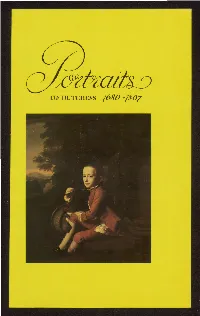
Portraits of Dutchess
OF DUTCHESS /680 ,.,/807 Cover: DANIEL CROMMELIN VERPLANCK 1762-1834 Painted by John Singlecon Copley in 1771 CottrteJy of The Metropolitan J\f11Jeum of Art New York. Gift of Bayard Verplanck, 1949 (See page 42) OF DUTCHESS /680-/807 by S. Velma Pugsley Spo11sored by THE DUTCHESS COUNTY AMERICAN REVOLUTION BICENTENNIAL COMMISSION as a 1976 Project Printed by HAMILTON REPRODUCTIONS, Inc. Poughkeepsie, N. Y. FOREWORD The Bicentennial Project rirled "Portraits of Dutchess 1680-1807" began as a simple, personal arrempr ro catalog existing porrrairs of people whose lives were part of rhe county's history in rhe Colonial Period. As rhe work progressed ir became certain rhar relatively few were srill in the Durchess-Purnam area. As so many of rhem had become the property of Museums in other localities it seemed more important than ever ro lisr rhem and their present locations. When rhe Dutchess County American Revolution Bicentennial Commission with great generosity undertook rhe funding ir was possible ro illustrate rhe booklet with photographs from rhe many available sources. This document is nor ro be considered as a geneological or historic record even though much research in rhose directions became a necessity. The collection is meant ro be a pictorial record, only, hoping rhar irs readers may be made more aware rhar these paintings are indeed pictures of our ancestors. Ir is also hoped rhar all museum collections of Colonial Painting will be viewed wirh deeper and more personal interest. The portraits which are privately owned are used here by rhe gracious consent of the owners. Those works from public sources are so indicated. -

Van Rensselaer Family
.^^yVk. 929.2 V35204S ': 1715769 ^ REYNOLDS HISTORICAL '^^ GENEALOGY COLLECTION X W ® "^ iiX-i|i '€ -^ # V^t;j^ .^P> 3^"^V # © *j^; '^) * ^ 1 '^x '^ I It • i^© O ajKp -^^^ .a||^ .v^^ ^^^ ^^ wMj^ %^ ^o "V ^W 'K w ^- *P ^ • ^ ALLEN -^ COUNTY PUBLIC LIBR, W:^ lllillllli 3 1833 01436 9166 f% ^' J\ ^' ^% ^" ^%V> jil^ V^^ -llr.^ ^%V A^ '^' W* ^"^ '^" ^ ^' ?^% # "^ iir ^M^ V- r^ %f-^ ^ w ^ '9'A JC 4^' ^ V^ fel^ W' -^3- '^ ^^-' ^ ^' ^^ w^ ^3^ iK^ •rHnviDJ, ^l/OL American Historical Magazine VOL 2 JANUARY. I907. NO. I ' THE VAN RENSSELAER FAMILY. BY W. W. SPOONER. the early Dutch colonial families the Van OF Rensselaers were the first to acquire a great landed estate in America under the "patroon" system; they were among the first, after the English conquest of New Netherland, to have their possessions erected into a "manor," antedating the Livingstons and Van Cortlandts in this particular; and they were the last to relinquish their ancient prescriptive rights and to part with their hereditary demesnes under the altered social and political conditions of modem times. So far as an aristocracy, in the strict understanding of the term, may be said to have existed under American institu- tions—and it is an undoubted historical fact that a quite formal aristocratic society obtained throughout the colonial period and for some time subsequently, especially in New York, — the Van Rensselaers represented alike its highest attained privileges, its most elevated organization, and its most dignified expression. They were, in the first place, nobles in the old country, which cannot be said of any of the other manorial families of New York, although several of these claimed gentle descent. -

SILAS WRIGHT AMD TEE ANTI-RENT WAR, 18¥F-18^6
SILAS WRIGHT AMD TEE ANTI-RENT WAR, 18¥f-18^6 APPROVED: Ail Mayor Professor Minor Professor "1 director of the Department of History ,7 -7 ~_i_ ^ / lean'of the Graduate School" SILAS WEIGHT AND THE ANT I-BENT WAR, 18HV-18^-6 THESIS Presented to the Graduate Council of the North Texas State University In Partial Fulfillment of the Requirements For the Degree of MASTER OF ARTS By Eldrldge PL Pendleton, B. A. Denton. Texas January, 1968 TABLE OF CONTENTS Page LIST OF ILLUSTRATIONS ii Chapter I. THE NEW YORK LEASEHOLD SYSTEM AND THE ANTI-RENT REBELLION 1 II. SILAS WRIGHT - RELUCTANT CANDIDATE 28 III. "MAKE NO COMPROMISES WITH ANY ISMS." 59 IV. THE FALL OF KING SILAS ............ 89 APPENDIX ... 128 BIBLIOGRAPHY 133 LIST OF ILLUSTRATIONS Figure Page 1. Leasehold Counties in New York 18V+-18V6 132 ii CHAPTER I THE NEW YORK LEASEHOLD SYSTEM AND THE ANTI-RENT REBELLION Silas Wright was one of the most universally respected Democrats of the Jacksonian period. As United States Senator from 1833 to 18M+, he established a record for political integrity, honesty, and courage that made him a valuable leader of the Democratic Party and gained for him the respect of the Whig opposition. Wright's position in Washington as a presidential liaison in the Senate caused him to play an influential role in both the Jackson and Van Bur9:1 administrations. He maintained a highly developed sense of political Idealism throughout his career. Although Wright was aware of the snares of political corruption that continually beset national politicians, his record remained irreproachable and untainted.^ The conditions of political life during the Jacksonian era were an affront to Wright's sense of idealism- Gradually disillusioned by the political . -

The Unitary Executive During the Second Half-Century
THE UNITARY EXECUTIVE DURING THE SECOND HALF-CENTURY * STEVEN G. CALABRESI ** CHRISTOPHER S. YOO I. INTRODUCTION .....................................................668 II. THE UNITARY EXECUTIVE DURING THE JACKSONIAN PERIOD, 1837-1861 .........................669 A. Martin Van Buren .................................................670 B. William H. Harrison ..............................................678 C. John Tyler...............................................................682 D. James K. Polk..........................................................688 E. Zachary Taylor.......................................................694 F. Millard Fillmore.....................................................698 G. Franklin Pierce.......................................................704 H. James Buchanan .....................................................709 III. THE UNITARY EXECUTIVE DURING THE CIVIL WAR, 1861-1869 ..................................717 A. Abraham Lincoln....................................................718 B. Andrew Johnson.....................................................737 C. The Tenure of Office Act and the Impeachment of Andrew Johnson .................................................746 IV. THE UNITARY EXECUTIVE DURING THE GILDED AGE, 1869-1889................................759 A. Ulysses S. Grant ....................................................759 B. Rutherford B. Hayes...............................................769 C. James A. Garfield....................................................780 D. Chester