Laodicea - Living Between Hot and Cold
Total Page:16
File Type:pdf, Size:1020Kb
Load more
Recommended publications
-
The Menorah and the Cross: Historiographic Reflections on a Recent Discovery from Laodicea on the Lycus
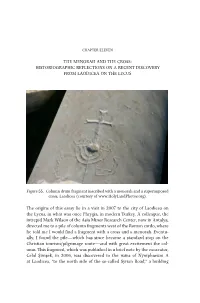
CHAPTER ELEVEN THE MENORAH AND THE CROSS: HISTORIOGRAPHIC REFLECTIONS ON A RECENT DISCOVERY FROM LAODICEA ON THE LYCUS Figure 55. Column drum fragment inscribed with a menorah and a superimposed cross, Laodicea (courtesy of www.HolyLandPhotos.org). The origins of this essay lie in a visit in 2007 to the city of Laodicea on the Lycus, in what was once Phrygia, in modern Turkey. A colleague, the intrepid Mark Wilson of the Asia Minor Research Center, now in Antalya, directed me to a pile of column fragments west of the Roman cardo, where he told me I would find a fragment with a cross and a menorah. Eventu- ally, I found the pile—which has since become a standard stop on the Christian tourism/pilgrimage route—and with great excitement the col- umn. This fragment, which was published in a brief note by the excavator, Celal Şimşek, in 2006, was discovered in the ruins of Nymphaeum A at Laodicea, “to the north side of the so-called Syrian Road,” a building 196 chapter eleven destroyed in an earthquake in 494 CE.1 The presence of a menorah in the nymphaeum compound at the very center of the city did not surprise me. After all, numerous roughly inscribed menorahs were found in the Sebastion of Aphrodisias from late antiquity, a period during which the erstwhile emperor temple compound was subdivided into shops.2 Similar rough menorahs were found in the shops adjacent to the Sardis synagogue (also a building in the city center),3 on a reused marble slab found in the Library of Celsus in Ephesus, and adorning tombs—including some in nearby Hierapolis (Pamukkale)—at numerous other sites.4 Alternatively, perhaps this well-carved column fragment derived from some lost Jewish communal building—perhaps a synagogue. -

The Expansion of Christianity: a Gazetteer of Its First Three Centuries
THE EXPANSION OF CHRISTIANITY SUPPLEMENTS TO VIGILIAE CHRISTIANAE Formerly Philosophia Patrum TEXTS AND STUDIES OF EARLY CHRISTIAN LIFE AND LANGUAGE EDITORS J. DEN BOEFT — J. VAN OORT — W.L. PETERSEN D.T. RUNIA — C. SCHOLTEN — J.C.M. VAN WINDEN VOLUME LXIX THE EXPANSION OF CHRISTIANITY A GAZETTEER OF ITS FIRST THREE CENTURIES BY RODERIC L. MULLEN BRILL LEIDEN • BOSTON 2004 This book is printed on acid-free paper. Library of Congress Cataloging-in-Publication Data Mullen, Roderic L. The expansion of Christianity : a gazetteer of its first three centuries / Roderic L. Mullen. p. cm. — (Supplements to Vigiliae Christianae, ISSN 0920-623X ; v. 69) Includes bibliographical references and index. ISBN 90-04-13135-3 (alk. paper) 1. Church history—Primitive and early church, ca. 30-600. I. Title. II. Series. BR165.M96 2003 270.1—dc22 2003065171 ISSN 0920-623X ISBN 90 04 13135 3 © Copyright 2004 by Koninklijke Brill nv, Leiden, The Netherlands All rights reserved. No part of this publication may be reproduced, translated, stored in a retrieval system, or transmitted in any form or by any means, electronic, mechanical, photocopying, recording or otherwise, without prior written permission from the publisher. Authorization to photocopy items for internal or personal use is granted by Brill provided that the appropriate fees are paid directly to The Copyright Clearance Center, 222 Rosewood Drive, Suite 910 Danvers, MA 01923, USA. Fees are subject to change. printed in the netherlands For Anya This page intentionally left blank CONTENTS Preface ........................................................................................ ix Introduction ................................................................................ 1 PART ONE CHRISTIAN COMMUNITIES IN ASIA BEFORE 325 C.E. Palestine ..................................................................................... -

First Missionary Journey & the Jerusalem Conference
The Apostle Paul, Servant of Christ Boiling Springs, NC Overview Study Guide 704 966-6845 Unit II, Chapter 5 clv@cranfordville.com “The First Missionary Journey” © All rights reserved by Lorin L Cranford Quick Links to Study 5.0 First Missionary Journey 5.0.1 Establishing Christian Congregations 5.0.2 Discipling Christian Congregations, Acts 14:21-28 5.0.1.1 Work in Seleucia, Acts 13:4 Summary: Gal. 3:1-5, 4:12-20 5.0.1.2 Work in Cyprus, Acts 13:5-12 5.1. Jerusalem Council, Acts 15:1-36, Gal. 2:1-10 5.0.1.3 Work in Perga, Acts 13:13 5.1.1 Problems at Antioch, Acts 15:1-3 5.0.1.4 Work in Pisidian Antioch, Acts 13:14-52 5.1.2 Victory in Jerusalem, Acts 15:4-29, Gal. 2:1-10 5.0.1.5 Work in Iconium, Acts 14:1-7 5.1.3 Ministry in Antioch, Acts 15:30-35, Gal. 2:11-14 5.0.1.6 Work in Lystra, Acts 14:8-20 5.0.1.7 Work in Derbe, Acts 14:21 Conclusion Introduction After Paul and Barnabas arrived back at Antioch, along with John Mark, some time passed before the next major event that would change Christianity forever. The breakthrough to the non-Jewish world with the Gos- pel had largely started at Antioch. And now this group of believers would launch a movement toward Gentiles that would revolutionize Christianity. This event was the beginning of the first missionary journey of Paul and Barnabas. -
Christianizing Asia Minor Paul Mckechnie Index More Information
Cambridge University Press 978-1-108-48146-5 — Christianizing Asia Minor Paul McKechnie Index More Information Index 1 John, New Testament epistle, 51, 56, 118 Alexander son of Antonios, 148, 150, 1 Peter, New Testament epistle, 51, 213 165–6, 210, 247 1 Timothy, New Testament epistle, 152 Alexander, bishop of Jerusalem, 214 4 Ezra, 100 Alexander, martyr, 117 Alexandria, 27, 51, 167, 193, 214, 216 ab epistulis, 76, 177 Alexandros aka Artemon, 192 Abdul Hamid, 150, 158 Alexandros son of Domnos, 242 Aberkios stone, 157, 179 Alexandros son of Epigonos, 199 Aberkios, bishop of Hierapolis, 16, 45, 127, Alexandros son of Gaios, 199, 223, 293 131, 137, 139, 147–65, 207, 210, 221, Alexandros son of Menekrates, 220, 290 228, 240, 244, 246–7, 263–87 alimentary schemes, 180 Abgar VIII, 162 Allexandreia, 235 Abraham, bishop of Seleucia-Ctesiphon, 62 Allexandros, 235 Abras, presbyter, 256 aloes, 55 Abris, bishop of Seleucia-Ctesiphon, 62 Alphios, presbyter, 256 Achaean/s, 69 Anaitis, 41 Acts of St Trophimus, 199 Ancyra, 18, 30, 127–8, 146, 188–9, 259, Adana, 72 308 Adıgüzel Dam, 99 angel/s, 4, 20, 25, 31–2, 85, 94, 96–7, 103, Adrianople, 258 111, 130, 153, 155, 161, 173, 184–5, aedicula, 155 227–8, 287 Aegean, 8 Anicetus, bishop of Rome, 79, 82 Aelius Aristides, 86 Aniketos, 257 Aelius Glykon, 65 Anne, Queen, 79 Aelius Publius Julius, 116, 131 anonymous anti-Montanist writer, 100–2, aeons, 70 106, 108, 120, 126, 128, 131, 144, 158 Africa, 97, 101, 129–30, 164, 213, 255 anti-Marcionite prologue, 55 Afyonkarahisar, 166, 215, 234, 291 antimony, 108 Ağa -

Sir William M. Ramsay: Archaeologist and New Testament Scholar
W. Ward Gasque, Sir William M. Ramsay: Archaeologist and New Testament Scholar. A Survey of His Contribution to the Study of the New Testament. Grand Rapids: Baker Book House, 1966. pp.95. Sir William M. Ramsay: Archaeologist and New Testament Scholar A Survey of His Contribution to the Study of the New Testament Baker Studies in Biblical Archaeology by W. Ward Gasque Foreword by F. F. Bruce Baker Book House Grand Rapids, Michigan Library of Congress Catalog Card Number: 66-18312 Copyright, 1966, by Baker Book House Company First printing, August 1966 Second printing, August 1967 W. Ward Gasque, Sir William M. Ramsay: Archaeologist and New Testament Scholar. A Survey of His Contribution to the Study of the New Testament. Grand Rapids: Baker Book House, 1966. pp.95. CONTENTS Foreword 7 Preface 10 List of Abbreviations 12 Chapter I. An Introduction to the Man and His Work 13 II. Luke the Historian 23 III. Paul the Missionary Statesman 38 IV. The Seven Churches of Asia 48 V. Potpourri 56 VI. Conclusion 61 Appendix I. A Chronological List of Ramsay’s Major Works 66 II. An Index of Select Subjects from Ramsay’s Major Works 68 III. Index of Scripture References from Ramsay’s Works 74 IV. An Index of Greek Terms from Ramsay’s Works 76 V. A Summer Journey in Asia Minor” by William M. Ramsay 78 Bibliography 86 Index 92 W. Ward Gasque, Sir William M. Ramsay: Archaeologist and New Testament Scholar. A Survey of His Contribution to the Study of the New Testament. Grand Rapids: Baker Book House, 1966. -
CHG Library Book List
CHG Library Book List (Belgium), M. r. d. a. e. d. h. (1967). Galerie de l'Asie antérieure et de l'Iran anciens [des] Musées royaux d'art et d'histoire, Bruxelles, Musées royaux d'art et dʹhistoire, Parc du Cinquantenaire, 1967. Galerie de l'Asie antérieure et de l'Iran anciens [des] Musées royaux d'art et d'histoire by Musées royaux d'art et d'histoire (Belgium) (1967) (Director), T. P. F. H. (1968). The Metropolitan Museum of Art Bulletin: Volume XXVI, Number 5. New York: Metropolitan Museum of Art (January, 1968). The Metropolitan Museum of Art Bulletin: Volume XXVI, Number 5 by Thomas P.F. Hoving (1968) (Director), T. P. F. H. (1973). The Metropolitan Museum of Art Bulletin: Volume XXXI, Number 3. New York: Metropolitan Museum of Art (Ed.), A. B. S. (2002). Persephone. U.S.A/ Cambridge, President and Fellows of Harvard College Puritan Press, Inc. (Ed.), A. D. (2005). From Byzantium to Modern Greece: Hellenic Art in Adversity, 1453-1830. /Benaki Museum. Athens, Alexander S. Onassis Public Benefit Foundation. (Ed.), B. B. R. (2000). Christian VIII: The National Museum: Antiquities, Coins, Medals. Copenhagen, The National Museum of Denmark. (Ed.), J. I. (1999). Interviews with Ali Pacha of Joanina; in the autumn of 1812; with some particulars of Epirus, and the Albanians of the present day (Peter Oluf Brondsted). Athens, The Danish Institute at Athens. (Ed.), K. D. (1988). Antalya Museum. İstanbul, T.C. Kültür ve Turizm Bakanlığı Döner Sermaye İşletmeleri Merkez Müdürlüğü/ Ankara. (ed.), M. N. B. (Ocak- Nisan 2010). "Arkeoloji ve sanat. (Journal of Archaeology and Art): Ölümünün 100.Yıldönümünde Osman Hamdi Bey ve Kazıları." Arkeoloji Ve Sanat 133. -

Early Christianity in the Lycus Valley Early Christianity in Asia Minor (ECAM)
Early Christianity in the Lycus Valley Early Christianity in Asia Minor (ECAM) The subseries “Early Christianity in Asia Minor”, of which this is the rst vol- ume to be published, is part of the series AJEC. It stands in the tradition of the work of Adolf von Harnack, Die Mission und Ausbreitung des Christen- tums in den ersten drei Jahrhunderten, Leipzig 41924. Each volume of ECAM will focus on the rise and expansion of Christianity in a speci c geographic region of Asia Minor up to the Council of Chalcedon in AD 451. The mono- graphs endeavor to take into account all relevant literary and non-literary evidence, paying special attention to epigraphical and archaeological mate- rial, and to document the current state of research. This rst volume deals with the rise and expansion of Christianity in the Lycus valley. A second volume on Lycaonian Christianity will follow soon. Volumes on Early Christianity in Phrygia, in Ionia, along the lower Meander and in Cilicia are in preparation. Cilliers Breytenbach Martin Goodman Early Christianity in Asia Minor (ECAM) Editors Cilliers Breytenbach (Berlin), Martin Goodman (Oxford), Christoph Markschies (Berlin), Stephen Mitchell (Exeter) VOLUME 1 Ancient Judaism and Early Christianity Arbeiten zur Geschichte des antiken Judentums und des Urchristentums Founding Editor Martin Hengel† (Tübingen) Executive Editors Cilliers Breytenbach (Berlin) Martin Goodman (Oxford) Editorial Board John Barclay (Durham), Lutz Doering (Durham) Pieter W. van der Horst (Utrecht), Tal Ilan (Berlin), Tessa Rajak (Reading), Daniel R. Schwartz (Jerusalem), Seth Schwartz (New York) VOLUME 85 The titles published in this series are listed at brill.com/ajec Early Christianity in the Lycus Valley By Ulrich Huttner Translation by David Green LEIDEN • BOSTON 2013 Library of Congress Cataloging-in-Publication Data Huttner, U. -

RALEGH. See RALEIGH. RALEIGH (ALEXANDER). --- Life and Doctrine
RALEGH. See RALEIGH. RALEIGH (ALEXANDER). --- Life and doctrine; or, the minister's twofold care ... being the address to the Rev. Gilbert M I Callum ... delivered ... 15th Jan., 1857. Glasgow, 1857. Q P. 296/19. --- The story of Jonah the Prophet. Edin., 1866. X.20.51. RELEIGH (JOHN HENRY). --- Matthew Arnold and American culture. [California Univ. Publ. Eng. Stud. 17.1 Berkeley, 1957• •82485 Ral. --- The plays of Eugene O t Neill. With a preface by H.T. Moore. , [Crosscurrents.] 0 N Carbondale [1965.] .8125 Die.. Ral. RALEIGH (MAURICE). --- Diss. ... inaug. de epilepsia. Edin., 1804. Att.81.7.40/13. Another copy. Att.81.7.41/13. RALEIGH (SAMUEL). --- Address by S.R., present Hon. President of the Actuarial Sociaty of Edinburgh, at their opening meeting for session 1863-64. (Edin.) Q P. 612/11bis. --- Letter to Lord Brougham regarding his Lordship's Bankruptcy and Insolvency Bill for Scotland. and the assimilation of the Scotch to the English system. Edin., 1854• Q P. 574/11• --- Remarks on Mr. Stephen Cave's Bill I To amend the law relating to Life Assurance Companies' ... Edin., 1870. Q P. 613/16. ADDITIONS RALEIGH (MICHAEL J.). -- See STEKLIS (HORST D.) and R. (M.J.). RELEIGH (Sir THOMAS). --- Annals of the Church in Scotland. By Sir T.R. Together with his own autobiographical notes and some reminiscences by Sir H.R. Reichel. Lond., 1921. .27(41) Ral. --- An outline of the law of property. Oxford, 1890. Law Lib. --- The University of Paris from its foundation to the Council of Constance. [Lothian Prize Essay, 1873. 1 Oxford, 1873. -

Is Jesus of Nazareth the Predicted Messiah? a Historical-Evidential
IS JESUS OF NAZARETH THE PREDICTED MESSIAH? A HISTORICAL-EVIDENTIAL APPROACH TO SPECIFIC OLD TESTAMENT MESSIANIC PROPHECIES AND THEIR NEW TESTAMENT FULFILLMENTS By Douglas D. Scott A Dissertation Submitted to the Faculty of LIBERTY UNIVERSITY SEMINARY In Partial Fulfillment of the Requirements for the Degree Doctor of Philosophy May 2017 ABSTRACT The primary purpose of this dissertation is to establish if critically acceptable historical- evidential reasons exist for believing that Jesus Christ is the direct fulfillment of the specific OT messianic texts included in the study. The study presupposes many of the conclusions of historical-critical scholarship and employs historical-evidential criteria to evaluate the evidence and attempt to establish the historical warrant for affirming such belief. Secondarily, this study seeks to find minimal facts related to these specific OT prophetic texts. To qualify as a minimal fact, two conditions must be met: (1) there must be more than adequate scholarly evidences usually consisting of several critically ascertained lines of argumentation; and (2) there must be agreement among the majority of contemporary scholars about the historicity of the event or the specific claim the minimal fact affirms. This investigation envisions the existence of three possible outcomes for each prophecy examined: (1) Jesus directly fulfilled the prophecy and sufficient historical evidence establishes the claim as probable, (2) Jesus directly fulfilled the prophecy, but the available historical evidence is insufficient to establish the claim as probable, and (3) sufficient historical evidence exists to refute the claim that Jesus directly fulfilled the prophecy. The historical-evidential approach employed by this study yields the probability of two direct fulfillments and the emergence of fifteen minimal facts. -

Werner Eck Unter Mitarbeit Von Elisabeth Müller-Luckner
Schriften des Historischen Kollegs Herausgegeben von der Stiftung Historisches Kolleg Kolloquien 42 R. Oldenbourg Verlag München 1999 Lokale Autonomie und römische Ordnungsmacht in den kaiserzeitlichen Provinzen vom 1. bis 3. Jahrhundert Herausgegeben von Werner Eck unter Mitarbeit von Elisabeth Müller-Luckner R. Oldenbourg Verlag München 1999 Schriften cles Historischen Kollegs im Auftrag der Stiftung Historisches Kolleg im Stifterverband für die Deutsche Wissenschaft herausgegeben von Lothar Gail in Verbindung mit Manfred Erhardt, Arnold Esch, Etienne Francois, Klaus Hildebrand, Hilmar Kopper, Jochen Martin, Heinrich Nöth, Winfried Schulze, Michael Stolleis und Ursula Peters Geschäftsführung: Georg Kalmer Redaktion: Elisabeth Müller-Luckncr Organisationsausschuß: Georg Kalmer, Herbert Kießling, Elisabeth Müller-Luckncr, Heinz-Rudi Spiegel Die Stiftung Historisches Kolleg hat sich für den Bereich der historisch orientierten Wissen schaften die Förderung von Gelehrten, die sich durch herausragende Leistungen m For schung und Lehre ausgewiescn haben, zur Aufgabe gesetzt. Sie vergibt zu diesem Zweck jährlich bis zu drei Forschungsstipendien und ein Förderstipendium sowie alle drei Jahre den „Preis des Historischen Kollegs“. Die Forschungsstipendien, deren Verleihung zugleich eine Auszeichnung für die bisherigen Leistungen darstellt, sollen den berufenen Wissenschaftlern während eines Kollegjahres die Möglichkeit bieten, frei von anderen Verpflichtungen eine größere Arbeit abzuschließen. Professor Dr. Werner Eck (Köln) war - zusammen mit Professor Dr. Manfred Hildermeicr (Göttingen), Priv.-Doz. Dr. Wolfram Pyta (Köln) und Professor Dr. Knut Schulz (Berlin) - Stipendiat des Historischen Kollegs im Kollegjahr 1995/96. Den Obliegenheiten der Stipen diaten gemäß hat Werner Eck aus seinem Arbeitsbereich ein Kolloquium zum Thema „Lo kale Autonomie und römische Ordnungsmacht in den kaiserzeitlichen Provinzen vom 1. bis 3. Jahrhundert“ vom 5. bis 7. -

Religioso.Pdf
RELIGIOUS ORIGIN AND LEGENDS OF CASTILLA ACUDECTO - SEGOVIA ORIGIN AND LEGENDS OF CASTILLA BURGOS PALENCIA BURGOS ATAPUERCA PALENCIA COBARRUBIAS SANTO DOMINGO DE SILOS SORIA LERMA VALLADOLID BURGO DE OSMA VALLADOLID AYLLÓN SEGOVIA From $ SEGOVIA 409 3 Days I 2 Nights MADRID MADRID Areas: Castilla y León MONASTERIO SILOS Tour Type: Urban, Religious, Historical Day 01 . Madrid- Ayllon- Burgos De Osma- Monasterio De Silos- Covarrubias- Burgos.- Welcome to your Europamundo Trip Style!!! The information about the meeting place and start time of your circuit can be found on your voucher. We leave to the Northern Mountains of Madrid, and at the beautiful town of AYLLÓN, in the vicinity of the Mountains with the same name, with its red archi- tecture and medieval atmosphere. We continue towards BURGO DE OSMA, an ancient and monumental episco- pal city, located in the province of Soria and known for its history and beautiful Cathedral (entrance included). We visit the SAINT DOMINGO OF SILOS MONASTERY (admission includ- CATEDRAL BURGOS ed), a place of spiritual refuge and one the most beautiful places to admire the Spanish Romanic Art, unique in Europe. Then we arrive at the noble city of CO- VARRUBIAS, with its old walled case, its typical Houses. In the Collegiate Church we can admire the triptych and also visit the tomb of Fernán Gonzalez, first count of Castilla. and its interesting vintage weapons collection. After a brief journey, arrival and accommodation in the city of BURGOS. Day 02 . Burgos- Atapuerca- Lerma- Palencia.- After breakfast time to get to know the city of BURGOS, crossroads; its spectacular Gothic Cathedral stands out, built for more than three centuries, where the tomb of El Cid and his wife Da. -

DATING the CENSUS CYRENIUS /QUIRINIUS in SYRIA and HEROD's DEATH
[AA on BC - Cyrenius - Syria - Census.pdf] ________________________________________________________________________ DATING THE CENSUS CYRENIUS /QUIRINIUS IN SYRIA AND HEROD's DEATH ________________________________________________________________________ [AA on BC - Cyrenius - Syria - Census.pdf] [AA on BC - Cyrenius - Syria - Census.pdf] DATING THE CENSUS, CYRENIUS /QUIRINIUS IN SYRIA, AND HEROD's DEATH ________________________________________________________________________ CONTENTS Page 1] AUGUSTUS' EXTRAORDINARY CENSUS 1 2] WAS CYRENIUS (i.e. QUIRINIUS) A GOVERNOR IN SYRIA AT THIS TIME? 2 SO WHAT WAS CYRENIUS DOING IN SYRIA? The Homonadenses problem 2 WHY DOES LUKE MENTION CYRENIUS AND NOT VARUS? 3 3] WHY DID JOSEPH TAKE MARY WITH HIM TO BETHLEHEM? 4 4] DATING JESUS' BIRTH and HEROD'S DEATH. [Matthew chapter two]. 5 5] QUIRINIUS AND THE FULLNESS OF TIME. 6 ________________________________________________________________________ In the 19th century Sir William Mitchell Ramsay examined available evidence expecting to prove that Luke was not a reliable historian. However his extensive research convinced him that Luke was a meticulously reliable historian. His book on the subject “Was Christ born at Bethlehem?” is on the internet at www.ccel.org/ccel/ramsay/bethlehem.txt ________________________________________________________________________ THE PASSAGE IN QUESTION: ...in those days..there went out a decree from Caesar Augustus, that all the world should be taxed1. (And this taxing2 was first3 made when Cyrenius 4 was governor of Syria.) And all went to be taxed1, every one to his own city. And Joseph also went up from Galilee, out of the city of Nazareth, into Judea, to the city of David, which is called Bethlehem; (because he was of the house and lineage of David:) to be taxed5, with Mary his espoused wife6 being great with child.