A Rough Guide to Afghan Youth Politics
Total Page:16
File Type:pdf, Size:1020Kb
Load more
Recommended publications
-
Justice & Security Practices, Perceptions, and Problems in Kabul and Nangarhar
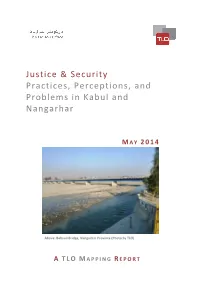
Justice & Security Practices, Perceptions, and Problems in Kabul and Nangarhar M AY 2014 Above: Behsud Bridge, Nangarhar Province (Photo by TLO) A TLO M A P P I N G R EPORT Justice and Security Practices, Perceptions, and Problems in Kabul and Nangarhar May 2014 In Cooperation with: © 2014, The Liaison Office. All rights reserved. No part of this publication may be reproduced, stored in a retrieval system or transmitted in any form or by any means, electronic, recording or otherwise without prior written permission of the publisher, The Liaison Office. Permission can be obtained by emailing info@tlo-afghanistan.org ii Acknowledgements This report was commissioned from The Liaison Office (TLO) by Cordaid’s Security and Justice Business Unit. Research was conducted via cooperation between the Afghan Women’s Resource Centre (AWRC) and TLO, under the supervision and lead of the latter. Cordaid was involved in the development of the research tools and also conducted capacity building by providing trainings to the researchers on the research methodology. While TLO makes all efforts to review and verify field data prior to publication, some factual inaccuracies may still remain. TLO and AWRC are solely responsible for possible inaccuracies in the information presented. The findings, interpretations and conclusions expressed in the report are those of the authors and do not necessarily reflect the views of Cordaid. The Liaison Office (TL0) The Liaison Office (TLO) is an independent Afghan non-governmental organization established in 2003 seeking to improve local governance, stability and security through systematic and institutionalized engagement with customary structures, local communities, and civil society groups. -

Pashtunistan: Pakistan's Shifting Strategy
AFGHANISTAN PAKISTAN PASHTUN ETHNIC GROUP PASHTUNISTAN: P AKISTAN ’ S S HIFTING S TRATEGY ? Knowledge Through Understanding Cultures TRIBAL ANALYSIS CENTER May 2012 Pashtunistan: Pakistan’s Shifting Strategy? P ASHTUNISTAN : P AKISTAN ’ S S HIFTING S TRATEGY ? Knowledge Through Understanding Cultures TRIBAL ANALYSIS CENTER About Tribal Analysis Center Tribal Analysis Center, 6610-M Mooretown Road, Box 159. Williamsburg, VA, 23188 Pashtunistan: Pakistan’s Shifting Strategy? Pashtunistan: Pakistan’s Shifting Strategy? The Pashtun tribes have yearned for a “tribal homeland” in a manner much like the Kurds in Iraq, Turkey, and Iran. And as in those coun- tries, the creation of a new national entity would have a destabilizing impact on the countries from which territory would be drawn. In the case of Pashtunistan, the previous Afghan governments have used this desire for a national homeland as a political instrument against Pakistan. Here again, a border drawn by colonial authorities – the Durand Line – divided the world’s largest tribe, the Pashtuns, into two the complexity of separate nation-states, Afghanistan and Pakistan, where they compete with other ethnic groups for primacy. Afghanistan’s governments have not recog- nized the incorporation of many Pashtun areas into Pakistan, particularly Waziristan, and only Pakistan originally stood to lose territory through the creation of the new entity, Pashtunistan. This is the foundation of Pakistan’s policies toward Afghanistan and the reason Pakistan’s politicians and PASHTUNISTAN military developed a strategy intended to split the Pashtuns into opposing groups and have maintained this approach to the Pashtunistan problem for decades. Pakistan’s Pashtuns may be attempting to maneuver the whole country in an entirely new direction and in the process gain primacy within the country’s most powerful constituency, the military. -

CB Meeting PAK/AFG
Polio Eradication Initiative Afghanistan Current Situation of Polio Eradication in Afghanistan Independent Monitoring Board Meeting 29-30 April 2015,Abu Dhabi AFP cases Classification, Afghanistan Year 2013 2014 2015 Reported AFP 1897 2,421 867 cases Confirmed 14 28 1 Compatible 4 6 0 VDPV2 3 0 0 Discarded 1876 2,387 717 Pending 0 0 *149 Total of 2,421 AFP cases reported in 2014 and 28 among them were confirmed Polio while 6 labelled* 123as Adequatecompatible AFP cases Poliopending lab results 26 Inadequate AFP cases pending ERC 21There Apr 2015 is one Polio case reported in 2015 as of 21 April 2015. Region wise Wild Poliovirus Cases 2013-2014-2015, Afghanistan Confirmed cases Region 2013 2014 2015 Central 1 0 0 East 12 6 0 2013 South east 0 4 0 Districts= 10 WPV=14 South 1 17 1 North 0 0 0 Northeast 0 0 0 West 0 1 0 Polio cases increased by 100% in 2014 Country 14 28 1 compared to 2013. Infected districts increased 2014 District= 19 from 10 to 19 in 2014. WPV=28 28 There30 is a case surge in Southern Region while the 25Eastern Region halved the number of cases20 in comparison14 to 2013 Most15 of the infected districts were in South, East10 and South East region in 2014. No of AFP cases AFP of No 1 2015 5 Helmand province reported a case in 2015 District= 01 WPV=01 after0 a period of almost two months indicates 13 14 15 Year 21continuation Apr 2015 of low level circulation. Non Infected Districts Infected Districts Characteristics of polio cases 2014, Afghanistan • All the cases are of WPV1 type, 17/28 (60%) cases are reported from Southern region( Kandahar-13, Helmand-02, and 1 each from Uruzgan and Zabul Province). -

Afghanistan: Background and U.S. Policy
Afghanistan: Background and U.S. Policy July 18, 2019 Congressional Research Service https://crsreports.congress.gov R45818 SUMMARY R45818 Afghanistan: Background and U.S. Policy July 18, 2019 Afghanistan has been a significant U.S. foreign policy concern since 2001, when the United States, in response to the terrorist attacks of September 11, 2001, led a military Clayton Thomas campaign against Al Qaeda and the Taliban government that harbored and supported it. Analyst in Middle Eastern In the intervening 18 years, the United States has suffered approximately 2,400 military Affairs fatalities in Afghanistan, with the cost of military operations reaching nearly $750 billion. Congress has appropriated approximately $133 billion for reconstruction. In that time, an elected Afghan government has replaced the Taliban, and most measures of human development have improved, although Afghanistan’s future prospects remain mixed in light of the country’s ongoing violent conflict and political contention. Topics covered in this report include: Security dynamics. U.S. and Afghan forces, along with international partners, combat a Taliban insurgency that is, by many measures, in a stronger military position now than at any point since 2001. Many observers assess that a full-scale U.S. withdrawal would lead to the collapse of the Afghan government and perhaps even the reestablishment of Taliban control over most of the country. Taliban insurgents operate alongside, and in periodic competition with, an array of other armed groups, including regional affiliates of Al Qaeda (a longtime Taliban ally) and the Islamic State (a Taliban foe and increasing focus of U.S. policy). U.S. -
“It Is Not Charity, It Is a Chair of Power” - Moving Beyond Symbolic Representation in Afghanistan’S Transition Politics?
“It is not Charity, it is a Chair of Power” - Moving Beyond Symbolic Representation in Afghanistan’s Transition Politics? Andrea Fleschenberg Research Study Publication Series “Reviewing Gender Quotas in Afghanistan and Pakistan” 2016 “It is not Charity, it is a Chair of Power”1- Moving Beyond Symbolic Representation in Afghanistan’s Transition Politics? Research Study Publication Series “Reviewing Gender Quotas in Afghanistan and Pakistan” 2016 Andrea Fleschenberg 1 “It is not charity, it is a chair of power and when you are there, you have to get tough with all the vulnerability you face” (interview with MP Farkhunda Zahra Naderi, Kabul, April 2015). The Heinrich Böll Stiftung is a German foundation and part of the Green political movement that has developed worldwide as a response to the traditional politics of socialism, liberalism, and conservatism. Our main tenets are ecology and sustainability, democracy and human rights, self-determination and justice. We place particular emphasis on gender democracy, meaning social emancipation and equal rights for women and men. We are also committed to equal rights for cultural and ethnic minorities. Finally, we promote non-violence and proactive peace policies. To achieve our goals, we seek strategic partnerships with others who share our values. Our namesake, Heinrich Böll, personifies the values we stand for: protection of freedom, civic courage, tolerance, open debate, and the valuation of art and culture as independent spheres of thought and action. For further information on our country programs in Afghanistan and Pakistan please visit our websites: www.af.boell.org www.pk.boell.org Disclaimer: This comparative action research project and its publication series were prepared with the support of the Heinrich Böll Stiftung, Afghanistan office. -

AFGHANISTAN - Base Map KYRGYZSTAN
AFGHANISTAN - Base map KYRGYZSTAN CHINA ± UZBEKISTAN Darwaz !( !( Darwaz-e-balla Shaki !( Kof Ab !( Khwahan TAJIKISTAN !( Yangi Shighnan Khamyab Yawan!( !( !( Shor Khwaja Qala !( TURKMENISTAN Qarqin !( Chah Ab !( Kohestan !( Tepa Bahwddin!( !( !( Emam !( Shahr-e-buzorg Hayratan Darqad Yaftal-e-sufla!( !( !( !( Saheb Mingajik Mardyan Dawlat !( Dasht-e-archi!( Faiz Abad Andkhoy Kaldar !( !( Argo !( Qaram (1) (1) Abad Qala-e-zal Khwaja Ghar !( Rostaq !( Khash Aryan!( (1) (2)!( !( !( Fayz !( (1) !( !( !( Wakhan !( Khan-e-char Char !( Baharak (1) !( LEGEND Qol!( !( !( Jorm !( Bagh Khanaqa !( Abad Bulak Char Baharak Kishim!( !( Teer Qorghan !( Aqcha!( !( Taloqan !( Khwaja Balkh!( !( Mazar-e-sharif Darah !( BADAKHSHAN Garan Eshkashem )"" !( Kunduz!( !( Capital Do Koh Deh !(Dadi !( !( Baba Yadgar Khulm !( !( Kalafgan !( Shiberghan KUNDUZ Ali Khan Bangi Chal!( Zebak Marmol !( !( Farkhar Yamgan !( Admin 1 capital BALKH Hazrat-e-!( Abad (2) !( Abad (2) !( !( Shirin !( !( Dowlatabad !( Sholgareh!( Char Sultan !( !( TAKHAR Mir Kan Admin 2 capital Tagab !( Sar-e-pul Kent Samangan (aybak) Burka Khwaja!( Dahi Warsaj Tawakuli Keshendeh (1) Baghlan-e-jadid !( !( !( Koran Wa International boundary Sabzposh !( Sozma !( Yahya Mussa !( Sayad !( !( Nahrin !( Monjan !( !( Awlad Darah Khuram Wa Sarbagh !( !( Jammu Kashmir Almar Maymana Qala Zari !( Pul-e- Khumri !( Murad Shahr !( !( (darz !( Sang(san)charak!( !( !( Suf-e- (2) !( Dahana-e-ghory Khowst Wa Fereng !( !( Ab) Gosfandi Way Payin Deh Line of control Ghormach Bil Kohestanat BAGHLAN Bala !( Qaysar !( Balaq -
The Rise of Gerontocracy? Addressing the Intergenerational Democratic Deficit
The rise of gerontocracy? Addressing the intergenerational democratic deficit Dr Craig Berry on behalf of the Intergenerational Foundation May 2012 Intergenerational Foundation, www.if.org.uk, charity no: 1142 230 Contents Foreword 3 Executive summary 5 Introduction 10 1. Democracy and intergenerational equity 13 2. The intergenerational democratic deficit 20 3. Solutions? 44 Appendix: possible objections 66 2 Foreword Debate about the implications of the ageing character of our society has so far been directed towards economic issues, including imbalances in wealth and economic opportunities across the generations. It is now time for us to start considering the civic implications of inequalities arising from Britain's ageing society. The analysis set out in this paper by Dr Craig Berry shows that, if current trends continue, older cohorts may well come to exercise a disproportionate influence on the democratic process in future decades. We could be witnessing a fundamental reconfiguration of the electorate, which is putting more power into the hands of older people and reducing that which younger cohorts possess. Dr Berry's paper illustrates that the life-stages of voters matter more and more in our democracy. Understanding the significance and nature of age-based inequalities should form an important part of the agenda of those committed to the cause of reforming our political system. An electorate which includes a growing number of older people generates new imbalances in terms of voter turnout, voter registration, party support and the social and generational composition of the legislature. The coalition government's proposed changes to the system of voter registration, for instance, require particularly careful scrutiny if they are to avoid making generational inequalities worse. -

Afghanistan: Compilation of Country of Origin Information (COI)
Afghanistan: Compilation of Country of Origin Information (COI) Relevant for Assessing the Availability of an Internal Flight, Relocation or Protection Alternative (IFA/IRA/IPA) to Kabul December 2019 This document provides decision-makers with relevant country of origin information (COI) for assessing the availability of an internal flight, relocation or protection alternative (IFA/IRA/IPA) in Kabul for Afghans who originate from elsewhere in Afghanistan and who have been found to have a well-founded fear of persecution in relation to their home area, or who would face a real risk of serious harm in their home area. UNHCR recalls its position that given the current security, human rights and humanitarian situation in Kabul, an IFA/IRA is generally not available in the city. See: UN High Commissioner for Refugees (UNHCR), Eligibility Guidelines for Assessing the International Protection Needs of Asylum-Seekers from Afghanistan, 30 August 2018, https://www.refworld.org/docid/5b8900109.html, p. 114. Table of Contents 1. The relevance of Kabul as an IFA/IRA: the security situation for civilians in Kabul ............. 2 1.1 Security Trends and Impact on Civilian Population in 2019 ................................................. 2 1.2 Presence and Activity of the Taliban in Kabul....................................................................... 6 1.3 Presence and Activity of ISIL in Kabul .................................................................................. 6 1.4 Other Security Threats in Kabul ........................................................................................... -
Custodians of Culture and Biodiversity
Custodians of culture and biodiversity Indigenous peoples take charge of their challenges and opportunities Anita Kelles-Viitanen for IFAD Funded by the IFAD Innovation Mainstreaming Initiative and the Government of Finland The opinions expressed in this manual are those of the authors and do not nec - essarily represent those of IFAD. The designations employed and the presenta - tion of material in this publication do not imply the expression of any opinion whatsoever on the part of IFAD concerning the legal status of any country, terri - tory, city or area or of its authorities, or concerning the delimitation of its frontiers or boundaries. The designations “developed” and “developing” countries are in - tended for statistical convenience and do not necessarily express a judgement about the stage reached in the development process by a particular country or area. This manual contains draft material that has not been subject to formal re - view. It is circulated for review and to stimulate discussion and critical comment. The text has not been edited. On the cover, a detail from a Chinese painting from collections of Anita Kelles-Viitanen CUSTODIANS OF CULTURE AND BIODIVERSITY Indigenous peoples take charge of their challenges and opportunities Anita Kelles-Viitanen For IFAD Funded by the IFAD Innovation Mainstreaming Initiative and the Government of Finland Table of Contents Executive summary 1 I Objective of the study 2 II Results with recommendations 2 1. Introduction 2 2. Poverty 3 3. Livelihoods 3 4. Global warming 4 5. Land 5 6. Biodiversity and natural resource management 6 7. Indigenous Culture 7 8. Gender 8 9. -
Kandahar Survey Report
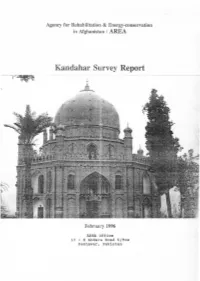
Agency for Rehabilitation & Energy-conservation in Afghanistan I AREA Kandahar Survey Report February 1996 AREA Office 17 - E Abdara Road UfTow Peshawar, Pakistan Agency for Rehabilitation & Energy-conservation in Afghanistan I AREA Kandahar Survey Report Prepared by Eng. Yama and Eng. S. Lutfullah Sayed ·• _ ....... "' Content - Introduction ................................. 1 General information on Kandahar: - Summery ........................... 2 - History ........................... 3 - Political situation ............... 5 - Economic .......................... 5 - Population ........................ 6 · - Shelter ..................................... 7 -Cost of labor and construction material ..... 13 -Construction of school buildings ............ 14 -Construction of clinic buildings ............ 20 - Miscellaneous: - SWABAC ............................ 2 4 -Cost of food stuff ................. 24 - House rent· ........................ 2 5 - Travel to Kanadahar ............... 25 Technical recommendation .~ ................. ; .. 26 Introduction: Agency for Rehabilitation & Energy-conservation in Afghanistan/ AREA intends to undertake some rehabilitation activities in the Kandahar province. In order to properly formulate the project proposals which AREA intends to submit to EC for funding consideration, a general survey of the province has been conducted at the end of Feb. 1996. In line with this objective, two senior staff members of AREA traveled to Kandahar and collect the required information on various aspects of the province. -
The High Stakes Battle for the Future of Musa Qala
JULY 2008 . VOL 1 . ISSUE 8 The High Stakes Battle for district. This created the standard and treated their presumed supporters in of small landlords farming small, the south better,5 this time there would the Future of Musa Qala well-irrigated holdings. While tribal be no mercy shown to “collaborators.” structure, economy and population alike This included executing, along with By David C. Isby have been badly damaged by decades of alleged criminals, several “spies,” which warfare, Musa Qala has a situation that included Afghans who had taken part in since its reoccupation by NATO and is more likely to yield internal stability work-for-food programs.6 Afghan forces in December 2007, the by building on what is left of traditional remote Musa Qala district of northern Afghanistan. The Alizai are also hoping to get more Helmand Province in Afghanistan from the new security situation. They has become important to the future Before the well-publicized October 2006 have requested that Kabul make Musa course of the insurgency but also to the “truce” that Alizai leaders concluded Qala a separate province.7 This proposal future of a Pashtun tribe (the Alizai), with the Taliban, Musa Qala had has been supported by current and a republic (the Islamic Republic of experienced a broad range of approaches former Helmand provincial governors. Afghanistan) and even a kingdom (the to countering the insurgency. In addition This would provide opportunities for United Kingdom). The changes that to their dissatisfaction with British patronage and give them a legally- take place at Musa Qala will influence operations in 2006, local inhabitants recognized base that competing tribal the future of all of them. -

Youth Voter Participation
Youth Voter Participation Youth Voter Participation Involving Today’s Young in Tomorrow’s Democracy Copyright © International Institute for Democracy and Electoral Assistance (International IDEA) 1999 All rights reserved. Applications for permission to reproduce all or any part of this publication should be made to: Publications Officer, International IDEA, S-103 34 Stockholm, Sweden. International IDEA encourages dissemination of its work and will respond promptly to requests for permission for reproduction or translation. This is an International IDEA publication. International IDEA’s publications are not a reflection of specific national or political interests. Views expressed in this publication do not necessarily represent the views of International IDEA’s Board or Council members. Art Direction and Design: Eduard âehovin, Slovenia Illustration: Ana Ko‰ir Pre-press: Studio Signum, Slovenia Printed and bound by: Bröderna Carlssons Boktryckeri AB, Varberg ISBN: 91-89098-31-5 Table of Contents FOREWORD 7 OVERVIEW 9 Structure of the Report 9 Definition of “Youth” 9 Acknowledgements 10 Part I WHY YOUNG PEOPLE SHOULD VOTE 11 A. Electoral Abstention as a Problem of Democracy 13 B. Why Participation of Young People is Important 13 Part II ASSESSING AND ANALYSING YOUTH TURNOUT 15 A. Measuring Turnout 17 1. Official Registers 17 2. Surveys 18 B. Youth Turnout in National Parliamentary Elections 21 1. Data Sources 21 2. The Relationship Between Age and Turnout 24 3. Cross-National Differences in Youth Turnout 27 4. Comparing First-Time and More Experienced Young Voters 28 5. Factors that May Increase Turnout 30 C. Reasons for Low Turnout and Non-Voting 31 1. Macro-Level Factors 31 2.