Volume 59, Number 06 (June 1941) James Francis Cooke
Total Page:16
File Type:pdf, Size:1020Kb
Load more
Recommended publications
-

Boston Symphony Orchestra Concert Programs, Summer, 1946
TANGLEWOOD — LENOX, MASSACHUSETTS SYMPHONY BERKSHIRE FESTIVAL SERGE KOUSSEVITZKY, Conductor Series B AUGUST 1, 3, 4 STEIItWAV it vm Since fhe time of Liszt, the Sfeinway has consistently been, year after year, the medium chosen by an overwhelming number of concert artists to express their art. Eugene List, Mischa Elman and William Kroll, soloists of this Berk- shire Festival, use the Steinway. Significantly enough, the younger artists, the Masters of tomorrow, entrust their future to this world-famous piano — fhey cannot afFord otherwise to en- danger their artistic careers. The Stein- way is, and ever has been, the Glory Road of the Immortals. M. STEINERT & SONS CO. : 162 BOYLSTON ST.. BOSTON Jerome F. Murphy, Prasic/enf • Also Worcester and SpHngfieid MUSIC SHED TANGLEWOOD (Between Stockbridge and Lenox, Massachusetts) NINTH BERKSHIRE FESTIVAL SEASON 1 946 CONCERT BULLETIN of the Boston Symphony Orchestra SERGE KOUSSEVITZKY, Conductor Richard Burgin, Associate Conductor with historical and descriptive notes by John N. Burk COPYRIGHT, 1946, BY BOSTON SYMPHONY ORCHESTRA, IflC. The TRUSTEES of the BOSTON SYMPHONY ORCHESTRA, Inc. Henry B. Cabot President Henry B. Sawyer Vice-President Richard C. Paine Treasurer Philip R. Allen M. A. De Wolfe Howe John Nicholas Brown Jacob J. Kaplan Alvan T. Fuller Roger I. Lee Jerome D. Greene Bentley W. Warren N. Penrose Hallowell Raymond S. Wilkins Francis W. Hatch Oliver Wolcott TANGLEWOOD ADVISORY COMMITTEE Allan J. Blau G. Churchill Francis George P. Clayson Lawrence K. Miller Bruce Crane James T. Owens -
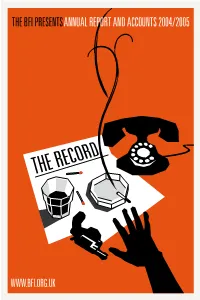
Annual Report and Accounts 2004/2005
THE BFI PRESENTSANNUAL REPORT AND ACCOUNTS 2004/2005 WWW.BFI.ORG.UK The bfi annual report 2004-2005 2 The British Film Institute at a glance 4 Director’s foreword 9 The bfi’s cultural commitment 13 Governors’ report 13 – 20 Reaching out (13) What you saw (13) Big screen, little screen (14) bfi online (14) Working with our partners (15) Where you saw it (16) Big, bigger, biggest (16) Accessibility (18) Festivals (19) Looking forward: Aims for 2005–2006 Reaching out 22 – 25 Looking after the past to enrich the future (24) Consciousness raising (25) Looking forward: Aims for 2005–2006 Film and TV heritage 26 – 27 Archive Spectacular The Mitchell & Kenyon Collection 28 – 31 Lifelong learning (30) Best practice (30) bfi National Library (30) Sight & Sound (31) bfi Publishing (31) Looking forward: Aims for 2005–2006 Lifelong learning 32 – 35 About the bfi (33) Summary of legal objectives (33) Partnerships and collaborations 36 – 42 How the bfi is governed (37) Governors (37/38) Methods of appointment (39) Organisational structure (40) Statement of Governors’ responsibilities (41) bfi Executive (42) Risk management statement 43 – 54 Financial review (44) Statement of financial activities (45) Consolidated and charity balance sheets (46) Consolidated cash flow statement (47) Reference details (52) Independent auditors’ report 55 – 74 Appendices The bfi annual report 2004-2005 The bfi annual report 2004-2005 The British Film Institute at a glance What we do How we did: The British Film .4 million Up 46% People saw a film distributed Visits to -

Elizabeth Sprague Coolidge Foundation Collection [Finding Aid]
Elizabeth Sprague Coolidge Foundation Collection Guides to Special Collections in the Music Division of the Library of Congress Music Division, Library of Congress Washington, D.C. 1980 Revised 2014 Contact information: http://hdl.loc.gov/loc.music/perform.contact Additional search options available at: http://hdl.loc.gov/loc.music/eadmus.mu012012 LC Online Catalog record: http://lccn.loc.gov/2012562124 Processed by the Music Division of the Library of Congress Collection Summary Title: Elizabeth Sprague Coolidge Foundation Collection Span Dates: 1894-1953 Bulk Dates: (bulk 1920-1953) Call No.: ML29 Creator: Coolidge, Elizabeth Sprague, 1864-1953 Extent: 56,680 items ; 109 containers ; 48.50 linear feet Language: Collection material in English Location: Music Division, Library of Congress, Washington, D.C. Summary: Elizabeth Sprague Coolidge was a composer, pianist, and patron of music. In 1925, she created the Elizabeth Sprague Coolidge Foundation at the Library of Congress in support of chamber music. The collection contains Coolidge's correspondence to and from many of the prominent musical artists of the first half of the twentieth century. Extensive correspondence between Coolidge and Library of Congress librarians and administrators is also included. The remaining materials in the collection, including photographs, scrapbooks, business papers, programs, publicity materials, iconography, realia, and clippings, are available for research and will be incorporated into the finding aid at a later date. Music manuscripts of works commissioned by Elizabeth Sprague Coolidge or the Elizabeth Sprague Coolidge Foundation in the Library of Congress comprise a substantial portion of the collection and are cataloged individually. Selected Search Terms The following terms have been used to index the description of this collection in the Library's online catalog. -

Focus 2020 Pioneering Women Composers of the 20Th Century
Focus 2020 Trailblazers Pioneering Women Composers of the 20th Century The Juilliard School presents 36th Annual Focus Festival Focus 2020 Trailblazers: Pioneering Women Composers of the 20th Century Joel Sachs, Director Odaline de la Martinez and Joel Sachs, Co-curators TABLE OF CONTENTS 1 Introduction to Focus 2020 3 For the Benefit of Women Composers 4 The 19th-Century Precursors 6 Acknowledgments 7 Program I Friday, January 24, 7:30pm 18 Program II Monday, January 27, 7:30pm 25 Program III Tuesday, January 28 Preconcert Roundtable, 6:30pm; Concert, 7:30pm 34 Program IV Wednesday, January 29, 7:30pm 44 Program V Thursday, January 30, 7:30pm 56 Program VI Friday, January 31, 7:30pm 67 Focus 2020 Staff These performances are supported in part by the Muriel Gluck Production Fund. Please make certain that all electronic devices are turned off during the performance. The taking of photographs and use of recording equipment are not permitted in the auditorium. Introduction to Focus 2020 by Joel Sachs The seed for this year’s Focus Festival was planted in December 2018 at a Juilliard doctoral recital by the Chilean violist Sergio Muñoz Leiva. I was especially struck by the sonata of Rebecca Clarke, an Anglo-American composer of the early 20th century who has been known largely by that one piece, now a staple of the viola repertory. Thinking about the challenges she faced in establishing her credibility as a professional composer, my mind went to a group of women in that period, roughly 1885 to 1930, who struggled to be accepted as professional composers rather than as professional performers writing as a secondary activity or as amateur composers. -

Spring 2011 Issn 1476-6760
Issue 65 Spring 2011 Issn 1476-6760 Christine Hallett on Historical Perspectives on Nineteenth-Century Nursing Karen Nolte on the Relationship between Doctors and Nurses in Agnes Karll’s Letters Dian L. Baker, May Ying Ly, and Colleen Marie Pauza on Hmong Nurses in Laos during America’s Secret War, 1954- 1974 Elisabetta Babini on the Cinematic Representation of British Nurses in Biopics Anja Peters on Nanna Conti – the Nazis’ Reichshebammenführerin Lesley A. Hall on finding female healthcare workers in the archives Plus Four book reviews Committee news www.womenshistorynetwork.org 9 – 11 September 2011 20 Years of the Women’s History Network Looking Back - Looking Forward The Women’s Library, London Metropolitan University Keynote Speakers: Kathryn Gleadle, Caroline Bressey Sheila Rowbotham, Sally Alexander, Anna Davin Krista Cowman, Jane Rendall, Helen Meller The conference will look at the past 20 years of writing women’s history, asking the question where are we now? We will be looking at histories of feminism, work in progress, current areas of debate such as religion and perspectives on national and international histories of the women’s movement. The conference will also invite users of The Women’s Library to take part in one strand that will be set in the Reading Room. We would very much like you to choose an object/item, which has inspired your writing and thinking, and share your experience. Conference website: www.londonmet.ac.uk/thewomenslibrary/ aboutthecollections/research/womens-history-network-conference-2011.cfm Further information and a conference call will be posted on the WHN website www.womenshistorynetwork.org Editorial elcome to the spring issue of Women’s History This issue, as usual, also contains a collection of WMagazine. -
Lillian Fuchs: Violist, Teacher and Composer
Louisiana State University LSU Digital Commons LSU Doctoral Dissertations Graduate School 2011 Lillian Fuchs: violist, teacher and composer; musical and pedagogical aspects of the 16 Fantasy études for viola Teodora Dimova Peeva Louisiana State University and Agricultural and Mechanical College Follow this and additional works at: https://digitalcommons.lsu.edu/gradschool_dissertations Part of the Music Commons Recommended Citation Peeva, Teodora Dimova, "Lillian Fuchs: violist, teacher and composer; musical and pedagogical aspects of the 16 Fantasy études for viola" (2011). LSU Doctoral Dissertations. 3589. https://digitalcommons.lsu.edu/gradschool_dissertations/3589 This Dissertation is brought to you for free and open access by the Graduate School at LSU Digital Commons. It has been accepted for inclusion in LSU Doctoral Dissertations by an authorized graduate school editor of LSU Digital Commons. For more information, please contactgradetd@lsu.edu. LILLIAN FUCHS: VIOLIST, TEACHER, AND COMPOSER; MUSICAL AND PEDAGOGICAL ASPECTS OF THE 16 FANTASY ÉTUDES FOR VIOLA A Written Document Submitted to the Graduate Faculty of the Louisiana State University and Agricultural and Mechanical College in partial fulfillment of the requirements for the degree of Doctor of Musical Arts in The School of Music by Teodora Peeva B.M., University of California, 2003 M.M., Louisiana State University, 2006 May, 2011 TO THE MEMORY OF MY PARENTS ii ACKNOWLEDGMENTS To David and the entire Weill family, for your unflagging encouragement and support. To Ms. Lori Patterson, for selflessly sharing your wisdom with me and for allowing me the pleasure of knowing you. My deepest gratitude goes to the members of my doctoral committee, for your contribution of time and knowledge in assisting with the completion of this monograph and for your willingness to serve. -

American Viola Works
Cedille Records CDR 90000 053 AMERICAN VIOLA WORKS Cathy Basrak viola William Koehler Robert Koenig piano music by George Rochberg Frederick Jacobi Alan Shulman Quincy Porter Lowell Liebermann DDD Absolutely Digital™ CDR 90000 053 AMERICAN VIOLA WORKS GEORGE ROCHBERG: SONATA FOR VIOLA AND PIANO (1979) (20:24) 1 I. Allegro moderato (10:11) 2 II. Adagio lamentoso (7:06) 3 III. Fantasia: Epilogue (2:58) 4 FREDERICK JACOBI: FANTASY FOR VIOLA AND PIANO (1941) (9:47)* 5 ALAN SHULMAN: THEME AND VARIATIONS (1940) (14:02)** 6 QUINCY PORTER: SPEED ETUDE (1948) (2:21)* LOWELL LIEBERMANN: SONATA FOR VIOLA AND PIANO (1984) (25:23)* 7 I. Allegro moderato (8:53) 8 II. Andante (8:57) 9 III. Recitativo (7:24) CATHY BASRAK, VIOLA WILLIAM KOEHLER 4, 7-9 & ROBERT KOENIG 1-3, 5, 6 PIANO *first recording **first recording of original version TT: (72:35) CDCD EFEFEF Cedille Records is a trademark of The Chicago Classical Recording Foundation, a not-for-profit foundation devoted to promoting the finest musicians and ensembles in the Chicago area. The Chi- cago Classical Recording Foundation’s activities are supported in part by contributions and grants from individuals, foundations, and corporations, including the WPWR-TV Channel 50 Foundation. PROGRAM NOTES compiled by Cathy Basrak eorge Rochberg (b. 1918) studied rederick Jacobi was born in 1891 G composition at the Mannes School F in San Francisco and died in 1952 of Music and the Curtis Institute. In 1948, in New York. A composition pupil of Rubin he joined the faculty at Curtis, then taught Goldmark and Ernest Bloch, Jacobi served at the University of Pennsylvania, retir- as an assistant conductor of the Metropoli- ing in 1983 as Annenberg Professor of tan Opera and taught composition at Juil- the Humanities Emeritus. -
Doctoral Dissertation Template
UNIVERSITY OF OKLAHOMA GRADUATE COLLEGE ALLISON NELSON: PIANIST, TEACHER AND EDITOR A DOCUMENT SUBMITTED TO THE GRADUATE FACULTY in partial fulfillment of the requirements for the Degree of DOCTOR OF MUSICAL ARTS By LYNN WORCESTER Norman, Oklahoma 2015 ALLISON NELSON: PIANIST, TEACHER AND EDITOR A DOCUMENT APPROVED FOR THE SCHOOL OF MUSIC BY ______________________________ Dr. Jane Magrath, Chair ______________________________ Dr. Stephen Beus, Co-Chair ______________________________ Dr. Barbara Fast ______________________________ Dr. Edward Gates ______________________________ Dr. Eugene Enrico ______________________________ Dr. Joseph Havlicek © Copyright by LYNN WORCESTER 2015 All Rights Reserved. ACKNOWLEDGMENTS This work would not have been possible without the guidance and support of the faculty members who served on my committee, Dr. Jane Magrath, Dr. Barbara Fast, Dr. Edward Gates, Dr. Eugene Enrico, Dr. Stephen Beus and Dr. Joseph Havlicek. To Dr. Jane Magrath: Thank you for your patience and continued support through every turn and for showing me how to be the finest professional I can be. Your guidance has allowed me to come in to my own as a pianist, teacher and writer. Special gratitude is reserved for Dr. Allison Nelson who shared her time, memories, and efforts over the course of this past year. Her wisdom, energy, and passion for music will stay with me for the rest of my life. Thank you to all of Dr. Nelson’s colleagues and former students who shared their time and participated in this study. A special thanks is owed to my family—my father, Mark Worcester, my mother, Eiki Worcester and my sister, Leya Worcester—whose love and dedication will always be cherished. -

Department of Music Programs 1968 - 1969 Department of Music Olivet Nazarene University
Olivet Nazarene University Digital Commons @ Olivet School of Music: Performance Programs Music 1969 Department of Music Programs 1968 - 1969 Department of Music Olivet Nazarene University Follow this and additional works at: https://digitalcommons.olivet.edu/musi_prog Part of the Fine Arts Commons, and the Music Performance Commons Recommended Citation Department of Music, "Department of Music Programs 1968 - 1969" (1969). School of Music: Performance Programs. 1. https://digitalcommons.olivet.edu/musi_prog/1 This Book is brought to you for free and open access by the Music at Digital Commons @ Olivet. It has been accepted for inclusion in School of Music: Performance Programs by an authorized administrator of Digital Commons @ Olivet. For more information, please contact digitalcommons@olivet.edu. 7 8 0 . 7 3 9 O M p 1 9 6 8 - 6 9 PROGRAMS 1968-69 7 $ e . DEPARTMENT OF MUSIC i u M a OLIVET NAZARENE COLLEGE DEPARTMENT OF MUSIC presents SENIOR RECITAL GEORGENE FISH PIANO AND CALBERT HOLSTE I N TENOR PHYLLIS HOLSTEIN/ ACCOMPANIST Lasciatemi morire, "Ariana"0oe.....0Claudio Monteverdi Dove sei, amato bene?, "Rodelinda".0o.George F 0 Handel If With All Your Hearts, "Elijah"....Felix Mendelssohn Prelude and Fugue, No. 3.0o...o..Johann Sebastian Bach Fantasia in D minor 0 D 0«».,«5.«.Wolfgang Amadeus Mozart Viens Aurore..ooooooooooooooooooooooooooo.c.o Arro A o L . F el d e m s a m k e i t oooooooo..o.o.oooo..oo.. odohannes Brahms Du bist wie Eine BlumeDo,...t.t....o««Anton Rubenstein M*appari tut" amor, "Martha".....Friedrich von Flowtow Mouvements Perpetuels for Piano........Francis Poulenc I. -

Collective Difference: the Pan-American Association of Composers and Pan- American Ideology in Music, 1925-1945 Stephanie N
Florida State University Libraries Electronic Theses, Treatises and Dissertations The Graduate School 2009 Collective Difference: The Pan-American Association of Composers and Pan- American Ideology in Music, 1925-1945 Stephanie N. Stallings Follow this and additional works at the FSU Digital Library. For more information, please contact lib-ir@fsu.edu FLORIDA STATE UNIVERSITY COLLEGE OF MUSIC COLLECTIVE DIFFERENCE: THE PAN-AMERICAN ASSOCIATION OF COMPOSERS AND PAN-AMERICAN IDEOLOGY IN MUSIC, 1925-1945 By STEPHANIE N. STALLINGS A Dissertation submitted to the College of Music in partial fulfillment of the requirements for the degree of Doctor of Philosophy Degree Awarded: Summer Semester, 2009 Copyright © 2009 Stephanie N. Stallings All Rights Reserved The members of the Committee approve the Dissertation of Stephanie N. Stallings defended on April 20, 2009. ______________________________ Denise Von Glahn Professor Directing Dissertation ______________________________ Evan Jones Outside Committee Member ______________________________ Charles Brewer Committee Member ______________________________ Douglass Seaton Committee Member The Graduate School has verified and approved the above named committee members. ii ACKNOWLEDGMENTS I would like to express my warmest thanks to my dissertation advisor, Denise Von Glahn. Without her excellent guidance, steadfast moral support, thoughtfulness, and creativity, this dissertation never would have come to fruition. I am also grateful to the rest of my dissertation committee, Charles Brewer, Evan Jones, and Douglass Seaton, for their wisdom. Similarly, each member of the Musicology faculty at Florida State University has provided me with a different model for scholarly excellence in “capital M Musicology.” The FSU Society for Musicology has been a wonderful support system throughout my tenure at Florida State. -

Universiv Micrcsilms International
INFORMATION TO USERS This was produced from a copy of a document sent to us for microfilming. While the most advanced technological means to photograph and reproduce this document have been used, the quality is heavily dependent upon the quality of the material submitted. The following explanation of techniques is provided to help you understand markings or notations which may appear on this reproduction. 1. Tlie sign or “target” for pages apparently lacking from the document photographed is “Missing Page(s)”. If it was possible to obtain the missing page(s) or section, they are spliced into the film along with adjacent pages. This may have necessitated cutting through an image and duplicating adjacent pages to assure you of complete continuity. 2. When an image on the film is obliterated with a round black mark it is an indication that the film inspector noticed either blurred copy because of movement during exposure, or duplicate copy. Unless we meant to delete copyrighted materials that should not have been filmed, you will find a good image of the page in the adjacent frame. 3. When a map, drawing or chart, etc., is part of the material being photo graphed the photographer has followed a definite method in “sectioning” the material. It is customary to begin filming at the upper left hand comer of a large sheet and to continue from left to right in equal sections with small overlaps. If necessary, sectioning is continued again—beginning below the first row and continuing on until complete. 4. For any illustrations that cannot be reproduced satisfactorily by xerography, photographic prints can be purchased at additional cost and tipped into your xerographic copy. -
Downloaded from Manchesterhive.Com at 09/25/2021 03:14:56AM Via Free Access
6 Women and the war The Great War, most people would have agreed at the time, was a male cre- ation. Politicians, statesmen and kings bred it and soldiers fought and fed it. Thus far, this study has regarded those women within Bloomsbury whose aes- thetic reactions to the conflict provide such a good starting point when examin- ing the war in this context. What of other women, existing independently from that hot-house of creativity, but who felt similarly? Due to their status in soci- ety as a whole, women necessarily operated within a different cultural milieu to that of men – even when sharing an enlightened, liberal background with them, as within Bloomsbury and its circle. But women emerged from a range of back- grounds and contexts – including that of political agitation linked to specific political aims – whose motivation towards protest, when confronted by the specifics of war, became more individualistic in character and less a part of an organised ‘movement’ or liable to be led by the propaganda of the war-state. Many women in the period leading up to the outbreak of the conflict could lay claim to a history of opposition; during the pre-war period one of the prin- cipal focal points of public dissent against the existing political structure had been the women’s suffrage movement. This cause, by the nature of its specific political goals, had also been largely political in organisation, character and aspiration, though precepts of greater equality for women outside the political sphere – once they had achieved the vote – were meshed to hopes for the ulti- mate cultural emancipation of the female sex.