WAR SINCE 1945 SEMINAR and SYMPOSIUM: Rhodesia: Tactical
Total Page:16
File Type:pdf, Size:1020Kb
Load more
Recommended publications
-
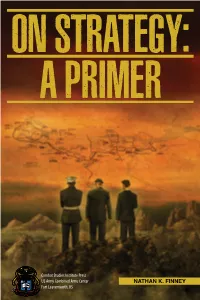
On Strategy: a Primer Edited by Nathan K. Finney
Cover design by Dale E. Cordes, Army University Press On Strategy: A Primer Edited by Nathan K. Finney Combat Studies Institute Press Fort Leavenworth, Kansas An imprint of The Army University Press Library of Congress Cataloging-in-Publication Data Names: Finney, Nathan K., editor. | U.S. Army Combined Arms Cen- ter, issuing body. Title: On strategy : a primer / edited by Nathan K. Finney. Other titles: On strategy (U.S. Army Combined Arms Center) Description: Fort Leavenworth, Kansas : Combat Studies Institute Press, US Army Combined Arms Center, 2020. | “An imprint of The Army University Press.” | Includes bibliographical references. Identifiers: LCCN 2020020512 (print) | LCCN 2020020513 (ebook) | ISBN 9781940804811 (paperback) | ISBN 9781940804811 (Adobe PDF) Subjects: LCSH: Strategy. | Strategy--History. Classification: LCC U162 .O5 2020 (print) | LCC U162 (ebook) | DDC 355.02--dc23 | SUDOC D 110.2:ST 8. LC record available at https://lccn.loc.gov/2020020512. LC ebook record available at https://lccn.loc.gov/2020020513. 2020 Combat Studies Institute Press publications cover a wide variety of military topics. The views ex- pressed in this CSI Press publication are those of the author(s) and not necessarily those of the Depart- ment of the Army or the Department of Defense. A full list of digital CSI Press publications is available at https://www.armyu- press.army.mil/Books/combat-studies-institute. The seal of the Combat Studies Institute authenticates this document as an of- ficial publication of the CSI Press. It is prohibited to use the CSI’s official seal on any republication without the express written permission of the director. Editors Diane R. -
Names, Currency, and Acronyms
PLACE- NAMES, CURRENCY, AND ACRONYMS The convention of historical writing of the country this book is about is to include a list of place- names in the front matter, with Rhodesian names on one side and the Zimbabwean names on the other. I will not do that here. The country I write about had four names between 1960 and 1980; what these were and how they changed are discussed at the start of the first chap- ter. I avoid such lists because of my concerns about a notion of before- and- after in history: a list of place-n ames and their changes suggests a too pat transformation from colony to nation, from bad to good, from minority to majority rule. Such a list also suggests that transitions are instantaneous, that a threshold has been crossed. For the reco rd, however, Rhodesia be- came Southern Rhodesia from mid- December 1979 to April 1980, when it became Zimbabwe. Salisbury, the capital, became Harare only in 1982. More common and never part of any list has been the tendency to use “Rhodesian” to mean white and “Zimbabwean” to mean African. I have tried to avoid this as often as I could throughout this book. With the breakup of the Central African Federation, Rhodesia named its currency the pound (£). Cast out of the sterling zone shortly a fter the Unilateral Declaration of In de pen dence (udi), Rhodesia valued its pound at US$2. In 1970, Rhodesia adopted the dollar as its currency. It was de- signed to be valued at half a British pound and between 1970 and 1980 hovered at about US$1.50. -
Midlands State University Faculty of Arts
MIDLANDS STATE UNIVERSITY FACULTY OF ARTS DEPARTMENT OF HISTORY AND INTERNATIONAL STUDIES AN EXAMINATION OF TACTICS USED BY ZANLA TO PROMOTE THEIR IDEOLOGY AND AGENDA FOR THE LIBERATION OF ZIMBABWE. A CASE STUDY OF MUZARABANI (1972-1979) By THELMA B BOMANI R144662M Being a dissertation submitted in partial fulfilment of the requirements of the BACHELOR OF ARTS DEGREE IN HISTORY AND INTERNATIONAL STUDIES at Midlands State University JUNE 2018 ZVISHAVANE- ZIMBABWE SUPERVISOR: MR G.T NCUBE APPROVAL FORM The undersigned certify that they have supervised the student Thelma B Bomani (R144662M)’s dissertation entitled “An examination of tactics used by ZANLA to promote their ideology and agenda for the liberation of Zimbabwe. A case study of Muzarabani (1972-1979)” Submitted in Partial fulfilment of the requirements of the Bachelor of Arts Honours Degree in History and International Studies offered by Midlands State University. MR. G.T. NCUBE …………………………. SUPERVISOR DATE DR. J. CHAKAWA …………………………. CHAIRPERSON DATE .................................. …………………………… EXTERNAL EXAMINER DATE i DECLARATION I, Thelma B Bomani, hereby declare that this dissertation is my original work which has never been submitted to any university. All sources used in this dissertation which is not mine have been acknowledged to show that it is the work from other scholars in accordance to copy right law. This is submitted in partial fulfilment of the requirements of Bachelor of Arts Honours Degree in History and International Studies offered by the Midlands State University. Thelma B Bomani ………………….. June 2018 ii DEDICATION This dissertation is dedicated to my family. iii ACKNOWLEDGEMENTS There are a number of individuals who are worthy to be acknowledged in the completion of my degree. -
Autonomous Weapon Systems, Asymmetrical Warfare, and Myths1
„Civitas. Studia z fi lozofi i polityki” 2018, nr 23 ISSN 1428-2631 DOI 10.35757/CIV.2018.23.10 Michał Klincewicz Autonomous weapon systems, asymmetrical warfare, and myths1 Introduction Intelligence embodied in inanimate matter is not a new idea. Many creation myths, including those in the Judeo-Christian tradition, involve divine power that grants intelligence to clay and mud. It is also not a particularly new idea that people may, through magic or science, embody intelligence in inanimate matter themselves. This idea is often presented as part of a warning about the dangers of Michał Klincewicz (ORCID 0000-0003-2354-197X) – Currently Assistant Professor in Tilburg University in the Department of Cognitive Science and Artifi cial Intelligence and Assistant Professor in Jagiellonian University in the Department of Cognitive Science, Institute of Philosophy. Past post-doctoral researcher in the Berlin School of Mind and Brain, he obtained a PhD in philosophy in 2013 from the City University of New York. 1 I am grateful to the anonymous reviewers of this journal for helpful and challenging comments. I would also like to thank Marek Pokropski; this paper is at least in part a response to the challenges he aired during a seminar meeting in the Polish Academy of Science in 2015. An earlier version of arguments in this paper were presented as a part of Tomasz Żuradzki’s online Filozofi a w Praktyce (Philosophy in Practice) project in 2016. An earlier version of this paper was also presented at the Philosophy of Risk seminar organized by Sven Nyholm as a part of The Dutch Research School of Philosophy (OZSW) in the Technical University of Eindhoven. -

Hanover Courthouse: the Nionu 'S Tactical Victory and Strategic Failure Jerry Joseph Coggeshall Old Dominion University
Old Dominion University ODU Digital Commons History Theses & Dissertations History Winter 1999 Hanover Courthouse: The nionU 's Tactical Victory and Strategic Failure Jerry Joseph Coggeshall Old Dominion University Follow this and additional works at: https://digitalcommons.odu.edu/history_etds Part of the Military History Commons, and the United States History Commons Recommended Citation Coggeshall, Jerry J.. "Hanover Courthouse: The nionU 's Tactical Victory and Strategic Failure" (1999). Master of Arts (MA), thesis, History, Old Dominion University, DOI: 10.25777/f9k9-0564 https://digitalcommons.odu.edu/history_etds/15 This Thesis is brought to you for free and open access by the History at ODU Digital Commons. It has been accepted for inclusion in History Theses & Dissertations by an authorized administrator of ODU Digital Commons. For more information, please contact digitalcommons@odu.edu. HANOVER COURTHOUSE: THE UNION'S TACTICAL VICTORY AND STRATEGIC FAILURE by Jerry Joseph Coggeshail B.A. May 1997, Old Dominion University A Thesis Submitted to the Faculty of Old Dominion University in Partial Fulfillment of the Requirement for the Degree of MASTER OF ARTS HISTORY OLD DOMINION UNIVERSITY December 1999 Harold S. Wilson (Director) Annecce nnie Sweeneys Reproduced with permission of the copyright owner. Further reproduction prohibited without permission. UMI Number 1398157 Copyright 2000 by Coggeshall, Jerry Joseph All rights reserved. UMI__ ® UMI Microform 1398157 Copyright 2000 by Bell & Howell Information and Learning Company. All rights reserved. This microform edition is protected against unauthorized copying under Title 17, United States Code. Bell & Howell Information and Learning Company 300 North Zeeb Road P.O. Box 1346 Ann Arbor. Ml 48106-1346 Reproduced with permission of the copyright owner. -
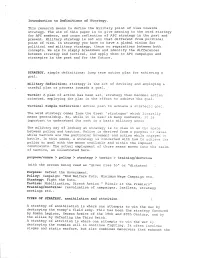
Introduction to Definitions of Strategy-. This Research Means to Define the Military Point of View Towards Strategy. the Aim Of
Introduction to Definitions of Strategy-. This research means to define the military point of view towards strategy. The aim of this paper is to give meaning to the word strategy for APC members, and cause reflection of APC strategy in the past and present. Military strategy is not all that different from political point of view. In strategy you have to have a global vision for political and military strategy, there no separations between both concepts. We aim to simply breakdown and identify the differences between strategy and tactical, and apply them to APC campaigns and strategies in the past and for the future. STRATEGY, simple d.efinitions: L·:>ng term action plan for achie\Ting a goal. Military definition; strategy is the art of devising and employing a careful plan or process towards a goal. Tactic: A plan of action has been set, strategy then becomes action oriented, employing the plan in the effort to achieve' 'che goal. Tactical. Simple Defini·t:ion: Action plan to achieve a s'crate,:ric goa:~. The word strategy comes from the Greek 'strategos l which LU:er511y means generalship. So, while it is used in many contexts, it is important to understand its root in a basic military sense. The military Hay of looking at strateg:l is to vie"" it as the 3pa':::e: between policy and tactics. Policy is derived from a purpose Gr ca~lse while tactics are the particular movement and action while ~ngaged in battle. In this sense, a strategy is concerned with how to achieve ~he policy or goal with the means available and within the imposed constraints. -

A Study of Sun Tzu's Art of War and Clausewitz's On
features 68 A Study of Sun Tzu’s Art of War and Clausewitz’s On War by LTC Ong Cher Howe Abstract: Sun Tzu and Clausewitz are both known to be most recognised and proficient writers on the subject of war and strategies. Although they wrote in different times and were from different backgrounds, their philosophies on war and strategy are still proven to be extremely helpful and effective in current times. This essay serves to compare both Sun Tzu and Clausewitz’s famous texts written on the subject of war: Art of War and On War, as well as prove how both works are not extremely different even when they were written in a divergent, historical, cultural and technological context. Instead, what both Sun Tzu and Clausewitz tried to express were not diametrically opposed. Hence, any contradiction arises from their own slightly unique points of analysis. While both of them defined war as means to rational policy ends, they were both well aware of the power of moral influence and the paradoxical trinity. This essay also studies how both their works can be applied to today’s military applications despite the advanced technology of the modern era. Keywords: Government, People, Philosophy, Technology, Doctrine, Law INTRODUCTION ‘different sides of the same coin.’ Instead of diametrically opposed, they advanced largely similar Sun Tzu’s Art of War and Clausewitz’s On War are the ideas that operate within degrees of contradiction. most studied philosophies on war and strategy. These Those apparent degrees of contradiction are the result two texts were written in eras more than 2,000 years of their different starting point of analysis. -

“OPEN WARFARE” DOCTRINE in the LIGHT of AMERICAN MILITARY HISTORY by Gene Fax
National Archives ••• PERSHING’S “OPEN WARFARE” DOCTRINE IN THE LIGHT OF AMERICAN MILITARY HISTORY By Gene Fax n May 1917, John J. Pershing became the frst American general driving the enemy out into the open and engaging him in a war of Isince the Civil War to lead a feld army of more than a few movement.”2 Americans, he believed, were inherently superior to thousand men. For most of the intervening time, the U.S. Army the soldiers of other nations in their initiative and their aptitude had had three main missions: protecting the coasts, quelling labor for marksmanship.3 In his statement of training principles he unrest, and chasing—but rarely fighting—Indians.1 Pershing declared, “Te rife and the bayonet are the principal weapons of himself operated against Indians in the west, the Spanish in Cuba, the infantry soldier. He will be trained to a high degree of skill Moros in the Philippines, and Pancho Villa in Mexico. None of as a marksman both on the target range and in feld fring. An these prepared him or the Army for the all-consuming war then aggressive spirit must be developed until the soldier feels himself, going on in France. Pershing and the Army were largely unfamiliar as a bayonet fghter, invincible in battle.”4 with modern weapons, tactics, and logistics. Pershing himself had observed the Russo-Japanese War, the frst Yet Pershing knew how he wanted his new Army to fght. Te major confict to use modern weapons. In his reports he described trench-bound stalemate of the Western Front was not for him. -

Abel Muzorewa's Security F and After the War of Liber
ABEL MUZOREWA’S SECURITY FORCE AUXILIARIES (SFA s) DURING AND AFTER THE WAR OF LIBERATION IN HURUNGWE DISTRICT, ZIMBABWE Being a thesis submitted to the Department of History, Midlands State University, Gweru, Zimbabwe in fulfil ment of the requirements of a Doctor of Philosophy By CHAKAWA JOSHUA Registration Number: R0644595 Supervisors: Professors N M. Bhebe and S J Ndlovu -Gatsheni November 2015 i ACKNOWLEDGEMENTS I am indebted to my academic supervisors namely; Professors N M Bhebe and S J Ndlovu- Gatsheni. You greatly assisted me with the relevant expertise, patience and advice to make this thesis a reality. Many thanks also go to members of the History Department at Midlands State University, especially Dr G Mazarire, Dr T Mashingaidze, Mr G Tarugarira, Mrs D Goredema, Mr Chisi and Dr V Z Nyawo-Shava. I should also acknowledge Dr T Javangwe and Mr I Choto for editing and proof-reading this thesis. Mr Muchefa at the National Archives of Zimbabwe did a splendid job in helping me to locate correct files for the thesis. My study at MSU was made possible by the generous financial assistance which I got from the institution. Many thanks go to the Vice Chancellor himself who initiated that whole process and Professor D Z Moyo who implemented it. I was also supported by many friends and relatives. Lastly, I wish to give my sincere acknowledgements to all those who took their time to be interviewed. ii DEDICATION To my teacher and mentor Never Kapungu and the late Michael Chakawa for encouraging me to specialize in History. -
Tactical Implementation of Strategic Guidance During the American Revolutionary War: Pedagogical Application for Classroom Use Ryan Menath
University of North Dakota UND Scholarly Commons Theses and Dissertations Theses, Dissertations, and Senior Projects January 2018 Tactical Implementation Of Strategic Guidance During The American Revolutionary War: Pedagogical Application For Classroom Use Ryan Menath Follow this and additional works at: https://commons.und.edu/theses Recommended Citation Menath, Ryan, "Tactical Implementation Of Strategic Guidance During The American Revolutionary War: Pedagogical Application For Classroom Use" (2018). Theses and Dissertations. 2285. https://commons.und.edu/theses/2285 This Dissertation is brought to you for free and open access by the Theses, Dissertations, and Senior Projects at UND Scholarly Commons. It has been accepted for inclusion in Theses and Dissertations by an authorized administrator of UND Scholarly Commons. For more information, please contact zeineb.yousif@library.und.edu. TACTICAL IMPLEMENTATION OF STRATEGIC GUIDANCE DURING THE AMERICAN REVOLUTIONARY WAR: PEDAGOGICAL APPLICATION FOR CLASSROOM USE by Lieutenant Colonel Ryan Thomas Menath Bachelor of Science, United States Air Force Academy, 2001 Master of Arts, American Military University, 2012 A Final Project Submitted to the Graduate Faculty of the University of North Dakota in partial fulfillment of the requirements for the degree of Doctor of Arts Grand Forks, North Dakota May 2018 The views expressed in this article are those of the author and do not reflect the official policy or position of the United States Air Force, Department of Defense, or the U.S. Government. -

FIGHTING and WRITING the RHODESIAN ARMY at WAR and POSTWAR FIGHTING and WRITING Luise White FIGHTING and WRITING the RHODESIAN ARMY at WAR and POSTWAR
LUISE WHITE FIGHTING AND WRITING THE RHODESIAN ARMY AT WAR AND POSTWAR FIGHTING AND WRITING Luise White FIGHTING AND WRITING THE RHODESIAN ARMY AT WAR AND POSTWAR Duke University Press | Durham and London | 2021 © 2021 Duke University Press All rights reserved Printed in the United States of Amer i ca on acid- free paper ∞ Designed by Matthew Tauch Typeset in Minion Pro by Westchester Publishing Services Library of Congress Cataloging- in- Publication Data Names: White, Luise, author. Title: Fighting and writing : the Rhodesian army at war and postwar / Luise White. Description: Durham : Duke University Press, 2021. | Includes bibliographical references and index. Identifiers: LCCN 2020022213 (print) | LCCN 2020022214 (ebook) | ISBN 9781478010623 (hardcover) | ISBN 9781478011729 (paperback) | ISBN 9781478021285 (ebook) Subjects: LCSH: Southern Rhodesia. Army. Selous Scouts. | Whites—Zimbabwe—History. | Whites—Race identity— Zimbabwe. | Zimbabwe—Race relations—History. | Zimbabwe—History—1965–1980. | Zimbabwe—History— Chimurenga War, 1966–1980. Classification: LCC DT2988 .W45 2021 (print) | LCC DT2988 (ebook) | DDC 968.91/04—dc23 LC record available at https://lccn.loc.gov/2020022213 LC ebook record available at https://lccn.loc.gov/2020022214 Cover art: Eleven Troop 3 Commandos at Deka on the Zambezi, 1978. Photograph by Tom Argyle. Courtesy of Chris Cocks. CONTENTS vii Acknowl edgments xi Place- Names, Currency, and Acronyms 1 1 Zimbabwe’s Liberation Strug gle and Rhodesia’s Bush War: Locating Its History 31 2 “Blood and Ink”: Memoirs, Authors, Histories 59 3 “ Your Shona Is Better Than Mine!”: Pseudo Gangs, Blacking Up, and the Pleasures of Counterinsurgency 83 4 “Each Footprint Tells a Story”: Tracking and Poaching in the Rhodesian Army 109 5 “There Is No Copyright on Facts”: Ron Reid- Daly, Authorship, and the Transkei Defence Force 121 6 “Every Self- Respecting Terrorist Has an ak-47”: Guerrilla Weapons and Rhodesian Imaginations 141 7 “ A Plastic Bag full of Cholera”: Rhodesia and Chemical and Biological Weapons 167 8 “Will Travel Worldwide. -
The Evolution of the US Navy Into an Effective
The Evolution of the U.S. Navy into an Effective Night-Fighting Force During the Solomon Islands Campaign, 1942 - 1943 A dissertation presented to the faculty of the College of Arts and Sciences of Ohio University In partial fulfillment of the requirements for the degree Doctor of Philosophy Jeff T. Reardon August 2008 © 2008 Jeff T. Reardon All Rights Reserved ii This dissertation titled The Evolution of the U.S. Navy into an Effective Night-Fighting Force During the Solomon Islands Campaign, 1942 - 1943 by JEFF T. REARDON has been approved for the Department of History and the College of Arts and Sciences by Marvin E. Fletcher Professor of History Benjamin M. Ogles Dean, College of Arts and Sciences iii ABSTRACT REARDON, JEFF T., Ph.D., August 2008, History The Evolution of the U.S. Navy into an Effective Night-Fighting Force During the Solomon Islands Campaign, 1942-1943 (373 pp.) Director of Dissertation: Marvin E. Fletcher On the night of August 8-9, 1942, American naval forces supporting the amphibious landings at Guadalcanal and Tulagi Islands suffered a humiliating defeat in a nighttime clash against the Imperial Japanese Navy. This was, and remains today, the U.S. Navy’s worst defeat at sea. However, unlike America’s ground and air forces, which began inflicting disproportionate losses against their Japanese counterparts at the outset of the Solomon Islands campaign in August 1942, the navy was slow to achieve similar success. The reason the U.S. Navy took so long to achieve proficiency in ship-to-ship combat was due to the fact that it had not adequately prepared itself to fight at night.