Uma Biblioteca Fascista Em Portugal
Total Page:16
File Type:pdf, Size:1020Kb
Load more
Recommended publications
-

Ambasciata D'italia Presso La Santa Sede 1929
Storia e Diplomazia Il presente volume è stato realizzato a cura dell’Unità per la Documentazione Storico- diplomatica e gli Archivi sotto la direzione del Capo della Unità, Professor Francesco Perfetti. Le opinioni espresse all’interno dei saggi contenuti nel volume sono esclusivamente degli autori e non rappresentano in alcun modo la posizione della struttura. Ministero degli Affari Esteri Segreteria Generale Unità per la Documentazione Storico Diplomatica e gli Archivi Storia e Diplomazia 2 Giugno 2009 SOMMARIO Premessa ............................................................................................................... pag. 7 SAGGI ............................................................................................ » 9 Cesare Maria De Vecchi di Val Cismon. Primo Ambasciatore d’Italia in Vaticano (giugno 1929 – luglio 1935) di Mario Casella ............................................................................ » 11 INVENTARI ..................................................................................... » 29 Il riordinamento delle carte dell’Ambasciata d’Italia presso la Santa Sede di Stefania Ruggeri ......................................................................... » 31 Titolario ...................................................................................... » 33 Inventario .................................................................................... » 35 Inventario delle carte dell’Ambasciata d’Italia presso la Santa Sede a cura di Michele Abbate ............................................................................ -

Download File
Italy and the Sanusiyya: Negotiating Authority in Colonial Libya, 1911-1931 Eileen Ryan Submitted in partial fulfillment of the requirements for the degree of Doctor of Philosophy in the Graduate School of Arts and Sciences COLUMBIA UNIVERSITY 2012 ©2012 Eileen Ryan All rights reserved ABSTRACT Italy and the Sanusiyya: Negotiating Authority in Colonial Libya, 1911-1931 By Eileen Ryan In the first decade of their occupation of the former Ottoman territories of Tripolitania and Cyrenaica in current-day Libya, the Italian colonial administration established a system of indirect rule in the Cyrenaican town of Ajedabiya under the leadership of Idris al-Sanusi, a leading member of the Sufi order of the Sanusiyya and later the first monarch of the independent Kingdom of Libya after the Second World War. Post-colonial historiography of modern Libya depicted the Sanusiyya as nationalist leaders of an anti-colonial rebellion as a source of legitimacy for the Sanusi monarchy. Since Qaddafi’s revolutionary coup in 1969, the Sanusiyya all but disappeared from Libyan historiography as a generation of scholars, eager to fill in the gaps left by the previous myopic focus on Sanusi elites, looked for alternative narratives of resistance to the Italian occupation and alternative origins for the Libyan nation in its colonial and pre-colonial past. Their work contributed to a wider variety of perspectives in our understanding of Libya’s modern history, but the persistent focus on histories of resistance to the Italian occupation has missed an opportunity to explore the ways in which the Italian colonial framework shaped the development of a religious and political authority in Cyrenaica with lasting implications for the Libyan nation. -

Dai Rifiuti Al Re Nasce Il Regime Fascista Fatale Per L’Italia La Miopia Della Classe Dirigente 1 Dicembre 1919
Anno XXXVII – N. 2 Dicembre 2020 AVVISO ALLE POSTE Sped. in a.p. 70% In caso di mancata consegna inviare Poste Italiane Spa – Filiale di Milano TRIMESTRALE DI CULTURA E POLITICA al CMP di Roserio per la restituzione al mittente, che si impegna a pagare la relativa tassa. DAI RIFIUTI AL RE NASCE IL REGIME FASCISTA Fatale per l’Italia la miopia della classe dirigente 1 dicembre 1919. Dal discorso della Corona: “... Il Parlamento, presidio di ogni libertà, difesa e garanzia di tutte le istituzioni democratiche, deve essere oggi più che mai circondato dalla fiducia del Paese… Il nostro Paese raggiunge con la guerra quei confini che la natura gli diede…”. 11 giugno 1921. Dal discorso della Corona “… Perché quest’opera di riassestamento proceda nella concordia delle classi sociali, occorrerà che il Parlamento rivolga l’attività propria all’ordinato ascendere delle classi lavoratrici così delle officine come dei campi… Sarà vanto di questa assemblea… rafforzare gli istituti cooperativi… per consentire alle classi operaie di abilitarsi gradualmente al difficile governo dell’attività economica”. “La rivoluzione fascista si fermò davanti a un trono”* B. Mussolini Vittorio Emanuele III si oppone al fascismo 1918 L’Italia è compiuta 20 novembre 1918. Ore 14. Camera dei Deputati. Vittorio Emanuele Orlando, presidente della Camera: “Onorevoli colleghi! L’Italia è compiuta… Le nostre istituzioni, essenzialmente democratiche, consentono ogni sviluppo e ogni trasformazione. L’Italia, che si fece pari a sé stessa nella guerra, saprà sorpassare sé stessa nella pace”(1) Riprende la vita parlamentare, ma il Direttore del Cor- riere della Sera, Luigi Albertini, senatore e membro del Fascio parlamentare di difesa nazionale, raggruppamento patriottico di partiti durante la guerra, il 21 novembre scri- ve: “I fasci devono ora rappresentare la fine dei vecchi partiti”. -

Memoria Operaia, Vita Quotidiana, Fascismo Di Dianella Gagliani
Rassegna bibliografica Memoria operaia, vita quotidiana, fascismo di Dianella Gagliani Il lavoro di Luisa Passerini su Torino ope dere nell’analisi storica “la vita degli indivi raia e fascismo. Una storia orale (Roma-Ba- dui oscuri e comuni” e di dare spazio ad ri, Laterza, 1984, pp. 296, lire 24.000) rap “aspetti non direttamente politici” ma propri presenta uno dei maggiori contributi alla co dell’esperienza quotidiana (p. 3). noscenza della classe operaia durante il fasci Il problema della rappresentatività dei te smo e, senza dubbio, si pone, per le metodo stimoni, di cui il gruppo più consistente ha logie e le fonti usate, per i problemi posti e le vissuto l’esperienza di lavoro in periodo fa conclusioni raggiunte — a prescindere da scista, si pone anche per altri aspetti, come ogni concordanza con essi — tra i punti di ri nota Luisa Passerini, ammettendo l’impossi ferimento obbligati per quanti vogliano af bilità di costruire con le fonti orali un cam frontare lo stesso tema. Di più: l’analisi delle pione esaurientemente rappresentativo “per fonti orali come percorsi di memoria, l’at problemi di mortalità differenziata, di diva tenzione all’ambivalenza di alcune forme rio nel tempo e di sfasatura irreconciliabile mentali, il rapporto stabilito tra cultura ope tra individui e processi generali” (p. 6). A raia e cultura popolare, aprono problemi e confronto con le acquisizioni della storiogra terreni di ricerca che travalicano il periodo fia sulla classe operaia durante il fascismo, il considerato. gruppo degli intervistati è maggiormente Asse portante della ricerca è la ricostruzio “sperequato a favore di una classe operaia ne della memoria operaia del fascismo. -

Quellen Und Forschungen Aus Italienischen Bibliotheken Und Archiven
Quellen und Forschungen aus italienischen Bibliotheken und Archiven Bd. 80 2000 Copyright Das Digitalisat wird Ihnen von perspectivia.net, der Online-Publi- kationsplattform der Max Weber Stiftung – Deutsche Geisteswis- senschaftliche Institute im Ausland, zur Verfügung gestellt. Bitte beachten Sie, dass das Digitalisat urheberrechtlich geschützt ist. Erlaubt ist aber das Lesen, das Ausdrucken des Textes, das Her- unterladen, das Speichern der Daten auf einem eigenen Datenträ- ger soweit die vorgenannten Handlungen ausschließlich zu priva- ten und nicht-kommerziellen Zwecken erfolgen. Eine darüber hin- ausgehende unerlaubte Verwendung, Reproduktion oder Weiter- gabe einzelner Inhalte oder Bilder können sowohl zivil- als auch strafrechtlich verfolgt werden. LA QUESTIONE DELLA PUNIZIONE DEI CRIMINALI DI GUERRA IN ITALIA DOPO LA FINE DEL SECONDO CONFLITTO MONDIALE di FILIPPO FOCARDI* L L'Italia e la richiesta della punizione dei criminali di guerra tedeschi. - 2.1 processi in Italia contro criminali di guerra tedeschi; le reazioni dell'opinione pubblica e l'azione del governo. - 3. Governo e forze politiche dinanzi alla questione dei criminali di guerra italiani. - 4. Per carità di patria e amore di oblio. 1. Il 13 ottobre 1943 ITtalia di Badoglio e di Vittorio Emanuele III aveva dichiarato ufficialmente guerra alla Germania nazista schie randosi al fianco delle Nazioni Unite, Riconosciuta dagli Stati della coalizione antifascista come „cobelligerante", l'Italia si era allora ve nuta a trovare in una situazione giuridicamente e politicamente ambi gua: ad un tempo nazione sconfitta sottoposta a regime armistiziale e insieme paese di fatto alleato con i suoi vecchi avversari contro il * Il processo contro Erich Priebke ha sollevato grande attenzione in Italia sui crimini nazisti compiuti nel paese durante l'occupazione tedesca. -

World War II at Sea This Page Intentionally Left Blank World War II at Sea
World War II at Sea This page intentionally left blank World War II at Sea AN ENCYCLOPEDIA Volume I: A–K Dr. Spencer C. Tucker Editor Dr. Paul G. Pierpaoli Jr. Associate Editor Dr. Eric W. Osborne Assistant Editor Vincent P. O’Hara Assistant Editor Copyright 2012 by ABC-CLIO, LLC All rights reserved. No part of this publication may be reproduced, stored in a retrieval system, or transmitted, in any form or by any means, electronic, mechanical, photocopying, recording, or otherwise, except for the inclusion of brief quotations in a review, without prior permission in writing from the publisher. Library of Congress Cataloging-in-Publication Data World War II at sea : an encyclopedia / Spencer C. Tucker. p. cm. Includes bibliographical references and index. ISBN 978-1-59884-457-3 (hardcopy : alk. paper) — ISBN 978-1-59884-458-0 (ebook) 1. World War, 1939–1945—Naval operations— Encyclopedias. I. Tucker, Spencer, 1937– II. Title: World War Two at sea. D770.W66 2011 940.54'503—dc23 2011042142 ISBN: 978-1-59884-457-3 EISBN: 978-1-59884-458-0 15 14 13 12 11 1 2 3 4 5 This book is also available on the World Wide Web as an eBook. Visit www.abc-clio.com for details. ABC-CLIO, LLC 130 Cremona Drive, P.O. Box 1911 Santa Barbara, California 93116-1911 This book is printed on acid-free paper Manufactured in the United States of America To Malcolm “Kip” Muir Jr., scholar, gifted teacher, and friend. This page intentionally left blank Contents About the Editor ix Editorial Advisory Board xi List of Entries xiii Preface xxiii Overview xxv Entries A–Z 1 Chronology of Principal Events of World War II at Sea 823 Glossary of World War II Naval Terms 831 Bibliography 839 List of Editors and Contributors 865 Categorical Index 877 Index 889 vii This page intentionally left blank About the Editor Spencer C. -
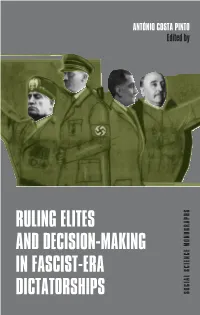
Ruling Elites.Indb
António Costa Pinto is a professor Dictators do not rule alone, and a governing elite stratum is always ANTÓNIO COSTA PINTO After the so-called ‘third wave’ of de- of politics and contemporary Euro- formed below them. This book explores an underdeveloped area in the study ANTÓNIO COSTA PINTO mocratisation at the end of the 20th pean history at the Institute of Social of fascism: the structure of power. The old and rich tradition of elite studies Edited by century had significantly increased the Sciences, University of Lisbon. He has can tell us much about the structure and operation of political power in the number of democracies in the world, been a visiting professor at Stanford dictatorships associated with fascism, whether through the characterisation of the survival of many dictatorships has University (1993) Georgetown Uni- had an important impact. Taking as the modes of political elite recruitment, or by the type of leadership, and the versity (2004), a senior associate mem- starting point the dictatorships that ber at St Antony’s College, Oxford relative power of the political institutions in the new dictatorial system. emerged since the beginning of the University (1995) and a senior visiting Analyzing four dictatorships associated with fascism (Fascist Italy, Nazi 20th century, but mainly those that fellow at Princeton University (1996) Germany, Salazar’s Portugal and Franco’s Spain), the book investigates the were institutionalised after 1945, the and at the University of California, dictator-cabinet-single party triad from -

Florestano Di Fausto and the Politics of Mediterraneità
*Please click on ‘Supporting Material ’ link in left column to access image files * The Light and the Line: Florestano Di Fausto and the Politics of Mediterraneità Sean Anderson Architecture was born in the Mediterranean and triumphed in Rome in the eternal monuments created from the genius of our birth: it must, therefore, remain Mediterranean and Italian. 1 On March 15, 1937 along the Via Balbia, an 1800-kilometer coastal road linking Tunisia and Egypt, Benito Mussolini and Italo Balbo, then provincial governor of Italian Libya, inaugurated the Arco di Fileni, a monumental gateway commemorating two legendary Carthaginian hero- brothers, while on their way to Tripoli to celebrate the first anniversary of the Italian colonial empire. Designed by the architect Florestano Di Fausto, the travertine arch, with its elongated archway and stacked pyramidal 31-meter high profile, was built atop a purported 500 BCE site that marked the division between the Greek territory of Cyrene and Carthaginian holdings to the east. Atop the arch, an inscription by the poet Horace, made popular by the Fascist party with a stamp issued in 1936, emphasized the gateway’s prominence in visual terms: “O quickening sun, may naught be present to thy view more than the city of Rome.”2 The distant horizon of Rome, or more broadly, that of the newfound empire, framed by the arch, condensed an architectural, political, and spectral heroism that was akin to the civilizing mission of Italian colonialism. Here, the triumphant building of the arch, the road that passed through it, and the transformation of the Libyan landscape denoted the symbolic passage of an Italian consciousness into what formerly been indeterminate terrain. -

L'afrique Et La Seconde Guerre Mondiale
Histoire générale de l'Afrique 10 Études et documents Dans cette collection : 1. Le peuplement de VEgypte ancienne et le déchiffrement de récriture méroïtique 2. La traite négrière du XVe au XIXe siècle 3. Les contacts historiques entre VAfrique de l'Est, Madagascar et VAsie du Sud-Est par les voies de l'océan Indien 4. L'historiographie de VAfrique australe 5. La décolonisation de VAfrique. Afrique australe et Corne de VAfrique 6. Ethnonymes et toponymes africains 7. Les relations historiques et socioculturelles entre VAfrique et le monde arabe de 1935 à nos jours 8. La méthodologie de Vhistoire de PAfrique contemporaine 9. Le processus d'éducation et Vhistoriographie en Afrique 10. VAfrique et la seconde guerre mondiale L'Afrique et la seconde guerre mondiale Documents de travail et rapport final du colloque organisé par l'Unesco à Benghazi (Jamahiriya arabe libyenne) du 10 au 13 novembre 1980 .,# v •-* Unesco Publié en 1985 par l'Organisation des Nations Unies pour l'éducation, la science et la culture 7, place de Fontenoy, 75700 Paris Imprimerie des Presses Universitaires de France Vendôme, France. ISBN 92-3-202324-5 Édition anglaise 92-3-102324-1 © Unesco 1985 Préface En 1964, la Conférence générale de PUnesco, dans le cadre des efforts déployés par l'Organisation pour favoriser la compréhension mutuelle des peuples et des nations, a autorisé le Directeur général à prendre les mesures nécessaires en vue de l'élaboration et de la publication d'une Histoire générale de VAfrique. Des colloques et des rencontres scientifiques, consacrés à des sujets connexes, ont été organisés au titre des travaux préparatoires. -

1-14 Inizio Internet.Qxd
BOLLETTINO D’ARCHIVIO DELL’UFFICIO STORICO DELLA MARINA MILITARE Poste Italiane S.p.A. - Spedizione in abb. post. - 70% DCB Roma in abb. S.p.A. - Spedizione Italiane Poste Anno XXVII dicembre 2013 BOLLETTINO D’ARCHIVIO DELL’UFFICIO STORICO DELLA MARINA MILITARE Anno XXVII dicembre 2013 BOLLETTINO D’ARCHIVIO DELL’UFFICIO STORICO DELLA MARINA MILITARE Periodico trimestrale - Anno XXVII - dicembre 2013 Editore MINISTERO DELLA DIFESA Direttore responsabile Capitano di Vascello FRANCESCO LORIGA Direttore editoriale Amministrazione Capitano di Fregata Leonardo Merlini Direzione di Commissariato M. M. Via Taormina, 4 - 00135 Roma Redazione Partita IVA: 02135411003 Marina Pagano Cod. Fisc.: 80234970582 Archivio Ufficio abbonamenti/vendite: Ersilia Graziani Via Taormina, 4 - 00135 Roma Claudia Lazzerini Tel. 06.3680.7240 Maria Rita Precone mail: ufficiostorico.vendite@marina.difesa.it Alessandra Venerosi Pesciolini Direzione e Redazione Ufficio Storico della Marina Militare Via Taormina, 4 - 00135 Roma Registrazione al Tribunale Civile di Roma n. 181 del 1° aprile 1987 La collaborazione alla Rivista è aperta a tutti. La responsabilità degli articoli in essa pubblicati è lasciata interamente agli Autori. Alla Direzione non è attribuita che la responsabilità inerente alla morale correttezza delle cose stampate nei riguardi delle patrie istituzioni, della disciplina morale e del rispetto civile Un fascicolo singolo/arretrato 6,00 € più spese postali Spedizione in contrassegno Il Bollettino d’Archivio è consultabile on line al sito: http://www.marina.difesa.it/documentazione/editoria/bollettino/pagina/numeri–bollettino.aspx -

Anti-Fascism and Italians in Australia, 1922-1945 Index Bibliography ISBN 0 7081 1158 0 1
Although Italians had migrated to Australia since the middle of the nineteenth century, it was not until the 1920s that they became aware that they were a community in a foreign land, not just isolated individuals in search of fortune. Their political, cultural, economic and recreational associations became an important factor. Many of them, although settled in Australia, still thought of themselves as an appendage of Italy, a belief strengthened by Fascism’s nationalist propaganda which urged them to reject alien cultures, customs and traditions. The xenophobic hostility shown by some Australians greatly contributed to the success of these propaganda efforts. Moreover, the issue of Fascism in Italy was a contentious one among Italians in Australia, a large minority fighting with courage and determination against Fascism’s representatives in Australia. This broad study of Italian immigrants before and during World War II covers not only the effects of Fascism, but also records the ordeal of Italian settlers in the cities and the outback during the Depression and the difficulties they faced after the outbreak of the war. It deals with a subject that has long been neglected by scholars and is an important contribution to the history of Italian migrants in Australia. Although Italians had migrated to Australia since the middle of the nineteenth century, it was not until the 1920s that they became aware that they were a community in a foreign land, not just isolated individuals in search of fortune. Their political, cultural, economic and recreational associations became an important factor. Many of them, although settled in Australia, still thought of themselves as an appendage of Italy, a belief strengthened by Fascism’s nationalist propaganda which urged them to reject alien cultures, customs and traditions. -

Italian Land Policy and Practice in Ethiopia, (1935-1941)
Haile M. Larebo THE MYTH AND REALITY OF EMPIRE BUILDING: ITALIAN LAND POLICY AND PRACTICE IN ETHIOPIA, (1935-1941) A Thesis Submitted To University Of London In Fulfilment Of The Requirements For The Degree Of Doctor Of Philosophy School Of Oriental And African Studies February 1990 ProQuest Number: 11010607 All rights reserved INFORMATION TO ALL USERS The quality of this reproduction is dependent upon the quality of the copy submitted. In the unlikely event that the author did not send a com plete manuscript and there are missing pages, these will be noted. Also, if material had to be removed, a note will indicate the deletion. uest ProQuest 11010607 Published by ProQuest LLC(2018). Copyright of the Dissertation is held by the Author. All rights reserved. This work is protected against unauthorized copying under Title 17, United States C ode Microform Edition © ProQuest LLC. ProQuest LLC. 789 East Eisenhower Parkway P.O. Box 1346 Ann Arbor, Ml 48106- 1346 TO ADAMA, IY ANN A, MANITO, PAULINE AND BELOVED PARENTS ABSTRACT Apart from being Italo-centric, the vast majority of scholarly work on the short-lived period of Italian occupation of Ethiopia is mainly preoccupied with political events and particularly with their repercussions on international diploma cy. With the exception of a few pioneering studies, Italian rule and its impact on Ethiopia is given marginal importance. The present thesis confines itself to one specific key area of Italian policy - land. Search for an outlet to settle Italy’s excess population and deploy its surplus capital, had sustained Italian imperialist ambitions from the 19th century and justified the conquest of Ethiopia against quasi universal international opposition.