2008 Tribal Leadership Summit Resource Directory
Total Page:16
File Type:pdf, Size:1020Kb
Load more
Recommended publications
-

Download the Full Report 2007 5.Pdf PDF 1.8 MB
The Northwest Power and Conservation Council’s Directory of Columbia River Basin Tribes Council Document Number: 2007-05 Table of Contents I. Introduction 1 II. Tribes and Tribal Confederations 5 The Burns Paiute Tribe 7 The Coeur d’Alene Tribe 9 The Confederated Salish and Kootenai Tribes of the Flathead Reservation 12 The Confederated Tribes and Bands of the Yakama Nation 15 The Confederated Tribes of the Colville Reservation 18 The Confederated Tribes of the Grand Ronde Community of Oregon 21 The Confederated Tribes of the Umatilla Indian Reservation 23 The Confederated Tribes of the Warm Springs Reservation of Oregon 25 The Kalispel Tribe of Indians 28 The Kootenai Tribe of Idaho 31 The Nez Perce Tribe 34 The Shoshone Bannock Tribes of the Fort Hall Reservation 37 The Shoshone-Paiute Tribes of the Duck Valley Reservation 40 The Spokane Tribe of Indians 42 III. Canadian First Nations 45 Canadian Columbia River Tribes (First Nations) 46 IV. Tribal Associations 51 Canadian Columbia River Inter-Tribal Fisheries Commission 52 Columbia River Inter-Tribal Fish Commission 53 Upper Columbia United Tribes 55 Upper Snake River Tribes 56 The Northwest Power and Conservation Council’s Tribal Directory i ii The Northwest Power and Conservation Council’s Tribal Directory Introduction The Northwest Power and Conservation Council’s Tribal Directory 1 2 The Northwest Power and Conservation Council’s Tribal Directory Introduction The Council assembled this directory to enhance our understanding and appreciation of the Columbia River Basin tribes, including the First Nations in the Canadian portion of the basin. The directory provides brief descriptions and histories of the tribes and tribal confedera- tions, contact information, and information about tribal fi sh and wildlife projects funded through the Council’s program. -
Reconstructing Proto-Sahaptian Sounds
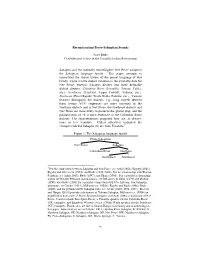
Reconstructing Proto-Sahaptian Sounds Noel Rude Confederated Tribes of the Umatilla Indian Reservation Sahaptin and the mutually unintelligible Nez Perce comprise the Sahaptian language family. This paper attempts to reconstruct the sound system of the parent language of that family. There is little dialect variation in the available data for Nez Perce, whereas Sahaptin divides into three definable dialect clusters: Columbia River (Umatilla, Tenino, Celilo, etc.); Northwest (Klickitat, Upper Cowlitz, Yakima, etc.); Northeast (Priest Rapids, Walla Walla, Palouse, etc.). Various features distinguish the dialects, e.g., long vowels derived from certain VCV sequences are more common in the Northern dialects and in Nez Perce, the Northeast dialects and Nez Perce are more likely to preserve the glottal stop, and the palatalization of *k is most extensive in the Columbia River dialects. The reconstructions proposed here are, as always, more or less tentative. Unless otherwise indicated the examples labeled Sahaptin (S) are from Umatilla.1 Figure 1. The Sahaptian language family Proto-Sahaptian Nez Perce Sahaptin Columbia River Northern Northwest Northeast 1 For the connection between Sahaptin and Nez Perce, see Aoki (1962), Rigsby (1965), Rigsby and Silverstein (1969), and Rude (1996, 2006). For the relationship with Plateau Penutian, see Aoki (1963), Rude (1987), and Pharis (2006). For a possible relationship within the broader Penutian macro-family, see DeLancey & Golla (1979) and Mithun (1999), also Rude (2000) for a possible connection with Uto-Aztecan. For Sahaptin grammars, see Jacobs (1931), Millstein (ca. 1990a), Rigsby and Rude (1996), Rude (2009), and for published NW Sahaptin texts, see Jacobs (1929, 1934, 1937). Beavert and Hargus (2010) provide a dictionary of Yakima Sahaptin, Millstein (ca. -

2008 Tribal Annual Report
Historical Perspective of the Confederated Tribes of Warm Springs Before settlements began throughout what is known today as the United States of America, Indigenous tribes spread across the North American continent like a sunset across an open front. In what is known today as the Columbia River Gorge (We’Mulx (Kiksht) N’Chi Wana (Ichishkin) Pabahuudu (Numu)), tribes of the Warm Springs Indian Reservation of Oregon developed societies beside the Columbia River, the Cascade Mountains, the John Day River, the Klamath Basin, and southern parts of Oregon and Idaho. From the beginning, our tribes were sustained on these bountiful lands blessed with abundant resources. In 1855, Indian Bands of the Columbia River Basin entered into, what the United States called, a peace treaty relinquishing approximately ten million acres of usual and accustomed lands used by the Indian Bands in the area who were then relocated to designated Indian Reservations located inland from their home in the Gorge. A small band of Paiutes later joined the tribes on the Warm Springs reservation in 1879 after being relocated from their southern Oregon homelands to the Yakima Reservation as prisoners of the Bannock War. Today, all three tribes reside on the reservations as family, friends, and an overall connected community. The Wasco bands on the Columbia River were the eastern-most group of Chinookan and Kiksht speaking Indians. Although they were principally fishermen, their frequent contact with other Indians throughout the region provided for abundant trade. Commerce was succeeded with Chinookan bands such as the Clackamas to the west and Sahaptin bands to the east such as the neighboring Warm Springs and Nez Perce. -

1 2 3 4 5 6 7 8 9 10 11 12 13 14 15 16 17 18 19 20 21 22 23 24 25 26
1 2 3 4 5 6 7 8 UNITED STATES DISTRICT COURT WESTERN DISTRICT OF WASHINGTON 9 STATE OF WASHINGTON; STATE OF NO. 10 OREGON; CONFEDERATED TRIBES OF THE CHEHALIS RESERVATION; COMPLAINT 11 CONFEDERATED TRIBES OF THE COOS, LOWER UMPQUA AND 12 SIUSLAW INDIANS; COW CREEK BAND OF UMPQUA TRIBE OF 13 INDIANS; DOYON, LTD.; DUWAMISH TRIBE; 14 CONFEDERATED TRIBES OF THE GRAND RONDE COMMUNITY OF 15 OREGON; HOH INDIAN TRIBE; JAMESTOWN S’KLALLAM TRIBE; 16 KALISPEL TRIBE OF INDIANS; THE KLAMATH TRIBES; MUCKLESHOOT 17 INDIAN TRIBE; NEZ PERCE TRIBE; NOOKSACK INDIAN TRIBE; PORT 18 GAMBLE S’KLALLAM TRIBE; PUYALLUP TRIBE OF INDIANS; 19 QUILEUTE TRIBE OF THE QUILEUTE RESERVATION; 20 QUINAULT INDIAN NATION; SAMISH INDIAN NATION; 21 CONFEDERATED TRIBES OF SILETZ INDIANS; SKOKOMISH INDIAN 22 TRIBE; SNOQUALMIE INDIAN TRIBE; SPOKANE TRIBE OF 23 INDIANS; SQUAXIN ISLAND TRIBE; SUQUAMISH TRIBE; SWINOMISH 24 INDIAN TRIBAL COMMUNITY; TANANA CHIEFS CONFERENCE; 25 CENTRAL COUNCIL OF THE TLINGIT & HAIDA INDIAN TRIBES 26 OF ALASKA; UPPER SKAGIT COMPLAINT 1 ATTORNEY GENERAL OF WASHINGTON Complex Litigation Division 800 5th Avenue, Suite 2000 Seattle, WA 98104-3188 (206) 464-7744 1 INDIAN TRIBE; CONFEDERATED TRIBES AND BANDS OF THE 2 YAKAMA NATION; AMERICAN HISTORICAL ASSOCIATION; 3 ASSOCIATION OF KING COUNTY HISTORICAL ORGANIZATIONS; 4 CHINESE AMERICAN CITIZENS ALLIANCE; HISTORIC SEATTLE; 5 HISTORYLINK; MUSEUM OF HISTORY AND INDUSTRY; OCA 6 ASIAN PACIFIC ADVOCATES – GREATER SEATTLE; WASHINGTON 7 TRUST FOR HISTORIC PRESERVATION; and WING LUKE 8 MEMORIAL FOUNDATION D/B/A WING LUKE MUSEUM, 9 Plaintiffs, 10 v. 11 RUSSELL VOUGHT, in his capacity as 12 Director of the OFFICE OF MANAGEMENT AND BUDGET; 13 DAVID S. -

United Way of King County a Vision for the Urban Indian Community
This report was developed by Kauffman and Associates, Inc., under contract with United Way of King County, and with the support of the City of Seattle, The Seattle Foundation, and the Muckleshoot Charity Fund. A special thank you to our Advisory Committee on this effort, including Theresa Fujiwara, Iris Friday, Laura Wong-Whitebear, Claudia Kauffman, Dana Arviso, Mary Shaw, Jackie Swanson, and Lawney Reyes. Thank you to Andrew Morrison, Native Artist, for allowing KAI to use a photograph of his mural of Chief Sealth on the cover. www.kauffmaninc.com King County Urban Indian Community Assets and Opportunities – 2014 Table of Contents Introduction ......................................................................................................................................1 Background .......................................................................................................................................1 Methodology .....................................................................................................................................3 Environmental Scan and Literature Review .........................................................................................4 Demographics ......................................................................................................................................... 4 Health ..................................................................................................................................................... 6 Education ............................................................................................................................................... -

UNITED STATES of America, Plaintiff, Quinault Tribe of Indians on Its Own Behalf and on Behalf of the Queets Band of Indians, Et Al., Intervenor-Plaintiffs, V
UNITED STATES of America, Plaintiff, Quinault Tribe of Indians on its own behalf and on behalf of the Queets Band of Indians, et al., Intervenor-Plaintiffs, v. STATE OF WASHINGTON, Defendant, Thor C. Tollefson, Director, Washington State Department of Fisheries, et al., Intervenor-Defendants Civ. No. 9213 UNITED STATES DISTRICT COURT FOR THE WESTERN DISTRICT OF WASHINGTON, TACOMA DIVISION 384 F. Supp. 312; 1974 U.S. Dist. LEXIS 12291 February 12, 1974 SUBSEQUENT HISTORY: [**1] On Question Per Reconsideration Motion March 22, 1974. COUNSEL: Stan Pitkin, U.S. Atty., Stuart F. Pierson, Sp. Asst. U.S. Atty., Seattle, Washington, for the U.S.; George D. Dysart, Asst. Regional Sol., U.S. Dept. of the Interior, Portland, Oregon, of counsel. David H. Getches, Native American Rights Fund, Boulder, Colorado, and John H. Sennhauser, Legal Services Center, Seattle, Washington, for Muckleshoot Indian Tribe, Squaxin Island Tribe of Indians, Sauk-Suiattle Indian Tribe, Skokomish Indian Tribe, Stillaguamish Indian Tribe. Alvin J. Ziontz, Ziontz, Pirtle, Morisset & Ernstoff, Seattle, Washington, for Makah Indian Tribe, Lummi Indian Tribe, Quileute Indian Tribe. Michael Taylor, Taholah, Washington, for Quinault Tribe of Indians. James B. Hovis, Hovis, Cockrill & Roy, Yakima, Washington, for Yakima Indian Tribe. Lester Stritmatter, Stritmatter & Stritmatter, Hoquiam, Washington, for Hoh Tribe of Indians. William A. Stiles, Jr., Sedro-Woolley, Washington, for Upper Skagit River Tribe. Slade Gorton, Atty. Gen., Edward B. Mackie, Deputy Atty. Gen., Olympia, Washington, for State of Washington. Joseph Larry Coniff, Jr., Asst. Atty. Gen., Dept. of Game, Olympia, Washington, [**2] for Game Defendants & Carl Crouse. Earl R. McGimpsey, Asst. Atty. Gen., Dept. -

Sdot Art Plan
0 2005 SDOT ART PLAN TABLE OF CONTENTS BOOK I : The Diagnosis ACKNOWLEDGEMENTS 3 EXECUTIVE SUMMARY 5 INTRODUCTION: Origins of the SDOT Art Plan 7 Structure & Audience 8 Objectives 8 Emerging Seattle 9 RESEARCH BACKGROUND + PROCESS: Research Methodology 10 Primer on Public Art 11 SDOT Art History 13 Other Generators of Public Art 14 Guerilla Artwork 15 TUNE-UP RECOMMENDATIONS: Overview of SDOT 19 Re-thinking Repeating Projects 20 1% for Art: Understanding the Finances 24 1% for Art: The Goal 25 Reserved for Addendum 27-34 BOOK II : The Toolkit INTRODUCTION 35 TOOLKIT: Preface / Matrix 39 Street Furniture Introduction 41 Surface Treatment Introduction 51 Art Object Introduction 59 Creative Option Introduction 66 SPECIAL PROJECTS: Preface / Matrix 73 Definitions 74 BOOK III : Sidewalk Survey INTRODUCTION 95 VISUAL SURVEY 97 SURVEY INDEX 111 PUBLIC ART READER 115 BIBLIOGRAPHY 140 A Closing Poem by Lori O’Conel 141 1 2005 SDOT ART PLAN 2 2005 SDOT ART PLAN This Art Plan has been tailored for the Seattle Department of Transportation by its Artist-in-Residence in collaboration with the Mayor’s Office of Arts & Cultural Affairs My residency with the Seattle Department of Transportation (SDOT) proved to be endlessly fascinating and rich with opportunities for theorizing about art, aesthetics, culture and the future of Seattle. I had the sincere pleasure of working closely with the Capital Projects and Roadway Structures management team for the better part of a year (part-time) and enjoyed every minute of it. I would like to extend a special thanks to members of the executive steering committee, Barbara Goldstein and Frank Yanagimachi, who did heavy lifting during the early and most active phases of the residency, though they have since moved on to do more lifting for other agencies. -
Case 2:70-Cv-09213-RSM Document 21063 Filed 07/09/15 Page 1 of 83
Case 2:70-cv-09213-RSM Document 21063 Filed 07/09/15 Page 1 of 83 1 2 3 4 5 6 7 UNITED STATES DISTRICT COURT 8 WESTERN DISTRICT OF WASHINGTON AT SEATTLE 9 UNITED STATES OF AMERICA, et al, No. C70-9213 10 Plaintiffs, Subproceeding No. 09-01 11 v. 12 FINDINGS OF FACT AND CONCLUSIONS OF LAW STATE OF WASHINGTON, et al., AND MEMORANDUM ORDER 13 Defendants. 14 15 I. INTRODUCTION 16 This subproceeding is before the Court pursuant to the request of the Makah Indian Tribe (the 17 “Makah”) to determine the usual and accustomed fishing grounds (“U&A”) of the Quileute Indian 18 Tribe (the “Quileute”) and the Quinault Indian Nation (the “Quinault”), to the extent not specifically 19 determined by Judge Hugo Boldt in Final Decision # 1 of this case. The Court is specifically asked to 20 determine the western boundaries of the U&As of the Quileute and Quinault in the Pacific Ocean, as 21 22 well as the northern boundary of the Quileute’s U&A. A 23-day bench trial was held to adjudicate 23 these boundaries, after which the Court received extensive supplemental briefing by the Makah, 24 Quileute, Quinault, and numerous Interested Parties and took the matter under advisement. The Court 25 has considered the vast evidence presented at trial, the exhibits admitted into evidence, trial, post-trial, 26 FINDINGS OF FACT AND CONCLUSIONS OF LAW - 1 Case 2:70-cv-09213-RSM Document 21063 Filed 07/09/15 Page 2 of 83 1 and supplemental briefs, proposed Findings of Fact and Conclusions of Law, and the arguments of 2 counsel at trial and attendant hearings. -

1. Description 1.1 Tenino; They Spoke a Sahaptin Language of the Penutian Phylum (1) 1.2 Tqn (1) 1.3 Oregon, Warm Springs Reservation (1)
1. Description 1.1 Tenino; They spoke a Sahaptin language of the Penutian phylum (1) 1.2 Tqn (1) 1.3 Oregon, Warm Springs Reservation (1). 1.4 The Tenino lived in north-central Oregon and south-central Washington along the Columbia River from the Deschutes River in the west to the Umatilla River in the east. They moved to the Yakima Indian Reservation in Washington and the Warm Springs Indian Reservation in Oregon (2). 1.5 Influence: The Lewis and Clark Expedition first noted The Tenino people late in October 1805, when several members of the band were recruited to help the Corps to port their boats and equipment around the impassible Celilo Falls. In 1855, the Tenino people were made a party to the Treaty with the Tribes of Middle Oregon, which was negotiated by Oregon Superintendent of Indian Affairs Joel Palmer. The Warm Springs bands are today a part of the Confederated Tribes of Warm Springs, which governs the Warm Springs Indian Reservation in Central Oregon The Tenino people have a right by treaty to use the lands around Government Camp, Orgeon on Mount Hood (5). 1.6 Warm Springs was first settled soon after the Treaty of 1855 by Tygh and Wasco, as well as Tenino remnants. The Northern Paiutes arrived in 1879. The Three primary tribes finally organized as the Confederated Tribes of Warm Springs in 1937. (7) 1.7 50 (Golla 2007). Ethnic population: 1,000 (1977 SIL) (1) 2. Economy 2.1 Main carbohydrate staple(s): berries, venison, nuts, roots, pine nuts (2) 2.2 Protein-lipid sources: Fish (2) 2.3 Weapons: The horns of deer, elk, and mountain sheep and goats supplied the materials for wedges, picks, chisels, net gauges, gambling dice, and projectile points. -
Teaching Materials to Benefit Yakama Language Learning and Natural Resource Management
NAKTKWANINT TIINWfTKI (TO TAKE CARE OF 1HINGS 1HE INDIAN WAY): TEACHING MATERIALS TO BENEFIT YAKAMA LANGUAGE LEARNING AND NATURAL RESOURCE MANAGEMENT A Terminal Project Presented by Roger jacob to the Linguistics Department in Partial Fulfillment of the Requirements for the Degree of Masters of Arts in Linguistics with a Language Teaching Specialization University of Oregon june 2010 TITLE: Nakthl'anint Tiinwitki (To take care ofthings the Indian way): Teaching materials to benefit Yakama language learning and natural resource management AUTHOR: Roger Jacob FIRST READER: Dr. Janne Underriner University ofOregon, Northwest Indian Language Institute SECOND READER: Mr. Robert Elliott University ofOregon, American English Institute ABSTRACT Currently, there is a lack of and a need for Yakama/Sahaptin (lchishkin) teaching materials. Yakama elders and resource managers on the Yakama Reservation have also identified a lack of and a need for a means to identify and better manage Yakama natural and cultural resources. This terminal project attempts to meet these needs through the development ofthe Yakama Nation Forest Resource Catalog (YNFRC). This catalog is comprised of pictures, Ichishkin sentences, and English sentences of culturally significant Yakama resources. As a part of this project, Yakama elders were interviewed in Ichishkin and English. University of Oregon first year Ichishkin students played a key role in the development of the catalog materials. Sample lessons ofhow these materials can be used for language teaching and learning -

Is for Aboriginal
Joseph MacLean lives in the Coast Salish traditional Digital territory (North Vancouver, British Columbia). A is for Aboriginal He grew up in Unama’ki (Cape Breton Island, Nova By Joseph MacLean Scotia) until, at the age of ten, his family moved to Illustrated by Brendan Heard the Kanien’kehá:ka (Mohawk) Territory (Montréal). Joseph is an historian by education, a storyteller by Is For Zuni A Is For Aboriginal avocation and a social entrepreneur by trade. Is For Z “Those who cannot remember the past are His mother, Lieut. Virginia Doyle, a WWII army Pueblo condemned to repeat it.” nurse, often spoke of her Irish grandmother, a country From the Spanish for Village healer and herbalist, being adopted by the Mi'kmaq. - George Santayana (1863-1952) Ancient Anasazi Aboriginal The author remembers the stories of how his great- American SouthwestProof grandmother met Native medicine women on her A is for Aboriginal is the first in the First ‘gatherings’ and how as she shared her ‘old-country’ A:shiwi is their name in their language Nations Reader Series. Each letter explores a knowledge and learned additional remedies from her The language stands alone name, a place or facet of Aboriginal history and new found friends. The author wishes he had written Unique, single, their own down some of the recipes that his mother used when culture. he was growing up – strange smelling plasters that Zuni pottery cured his childhood ailments. geometry and rich secrets The reader will discover some interesting bits of glaze and gleam in the desert sun history and tradition that are not widely known. -
2016 State of Our Watersheds Report Queets – Chehalis Basins
2016 State of Our Watersheds Report Queets – Chehalis Basins he evidence is abundantly clear. We know how Tto manage our fish. We understand sustain- ability. The problems fish are facing are not of our making. But we are definitely a big part of the solution, with the work we do in habitat res- toration and protection, good management and education. – FAWN SHARp, PRESIDENT QUINAULT INDIAN NATION Quinault Indian Nation The Quinault Indian Nation (QIN) consists of the Quinault and Queets tribes and descendants of five other coastal tribes: Quileute, Hoh, Che- halis, Chinook and Cowlitz. Quinault ancestors lived on a major physical and cultural dividing line. Beaches to the south are wide and sandy, while to the north, they are rugged and cliff- lined. Quinault people shared in the cultures of the people to the south as well as those to the Seattle north. Living in family groups in longhouses up and down the river, they were sustained by the land and by trade with neighboring tribes. Salmon runs, abundant sea mammals, wildlife and forests provided substantial material and spiritual wealth. A great store of knowledge about plants and their uses helped provide for the people. The western red-cedar, the “tree of life,” provided logs for canoes, bark for clothing, split boards for houses and more. The Quinault are the Canoe People, the people of the cedar tree. Tribal headquarters are located in Taholah, Washington. 190 Quinault Indian Nation Queets – Quinault – Chehalis Basins The Quinault Indian Nation’s Area of Interest for this report covers three Water Resource Inventory Areas (WRIAs) includ- ing the Queets-Quinault basin (WRIA 21) and Chehalis basin (WRIAs 22 and 23).