Environmental Justice in Italy
Total Page:16
File Type:pdf, Size:1020Kb
Load more
Recommended publications
-

Field Trip Report Vajont Valley & Latemar (Italy)
04-06/07/2019 Field trip report Vajont valley & Latemar (Italy) Participants: Baville Paul Bonneau François Caumon Guillaume Clausolles Nicolas Frantz Yves Gouache Corentin Raguenel Margaux Schuh-Senlis Melchior IAMG Student Chapter Nancy RING TEAM - GEORESSOURCES Summary Introduction ............................................................................................................................................. 1 Chronostratigraphy of the field trip ........................................................................................................ 2 1. Vajont Formations (1 Figure 2, 65 – 160 Ma) .............................................................................. 2 2. Calcare del Vajont Formation (2 Figure 2, 160 – 170 Ma)........................................................... 3 3. Ignee Formation (3 Figure 2, 170 – 183 Ma) ............................................................................... 4 4. Soverzene Formation (4 Figure 2, 183 – 200 Ma) ....................................................................... 4 5. Dolomia Principale Formation (5 Figure 2, 200 – 230 Ma) ......................................................... 4 6. Rodella Formation (6 Figure 2, 230 – 247 Ma) ............................................................................ 5 7. Latemar Formation (7 Figure 2, 247 – 250 Ma) .......................................................................... 6 8. Bellerophon Formation (8 Figure 2, 250 – 258 Ma) ................................................................... -
Conference of the Parties to the Who Framework Convention on Tobacco Control
FCTC/COP/4/REC/2 CONFERENCE OF THE PARTIES TO THE WHO FRAMEWORK CONVENTION ON TOBACCO CONTROL Fourth session PUNTA DEL ESTE, URUGUAY, 15–20 NOVEMBER 2010 VERBATIM RECORDS OF PLENARY MEETINGS GENEVA 2011 FCTC/COP/4/REC/2 CONFERENCE OF THE PARTIES TO THE WHO FRAMEWORK CONVENTION ON TOBACCO CONTROL Fourth session PUNTA DEL ESTE, URUGUAY, 15–20 NOVEMBER 2010 VERBATIM RECORDS OF PLENARY MEETINGS GENEVA 2011 PREFACE The fourth session of the Conference of the Parties to the WHO Framework Convention on Tobacco Control was held in Punta del Este, Uruguay, from 15 to 20 November 2010. The proceedings are issued in three volumes containing, in addition to other relevant material: Decisions and ancillary documents – document FCTC/COP/4/REC1 Verbatim records of plenary meetings – document FCTC/COP/4/REC2 Summary records of committees – document FCTC/COP/4/REC3 The documentation, including the list of participants, is accessible on the following web site: http://www.who.int/fctc/ _______________ CONTENTS VERBATIM RECORDS OF PLENARY MEETINGS First plenary meeting ............................................................................................................................1 1. Opening of the session................................................................................................................1 2. Opening remarks by the President of Uruguay...........................................................................1 3. Opening remarks by the Director-General of WHO...................................................................3 -

Geological Considerations in Dams Failure Teodora Barbuntoiu A
Geotechnical Hazards | Geological Considerations in Dams Failure Teodora Barbuntoiu A Thesis in the Field of GeoEngineering For the Degree of Bachelor of Applied Earth Science Supervisors: Dr.Ir. W. Broere Dr.Ir. D.J.M. Ngan-Tillard Delft University of Technology July 2019 Teodora Barbuntoiu | Geological considerations in dams failure | AESB3400 Bachelor Thesis Abstract Dams and reservoirs pose safety concerns to society worldwide. In case of a disaster, the water impounded in the reservoir escapes and destroys everything in its path. Reasons for failure range from geology, hydrology and seismicity, to design problems, lack of maintenance and poor field investigation. Prior cases show that various dams gave away mainly due to geological causes, so there is a particular interest to see how the local terrain features could influence the longevity of the structure. Three historical case studies are discussed in order to emphasize the impact of geology regarding dam failure. The Saint Francis Dam is a prime example of poor site investigation, where the lack of knowledge on the foundation rock led to the rupture of the gravity dam. The Malpasset Dam gave away predominantly due to underestimated effects of the uplift, nevertheless, the geologists were unaware of an active fault system and the mechanical properties of the rock mass. The Baldwin Hills Reservoir comes with a more thorough site investigation, yet still, due to earth movements, the water from the reservoir infiltrated through the embankment. Therefore, geological features at the site need to be included in the design options of the dam in order to ensure a safe, feasible and economical project. -
Remembering Without Confronting Memorialization As a Reparation Without Coming to Terms with the Past: Case Study: Ulucanlar Prison Museum
ema Awarded Theses 2018/2019 Emine Ay Remembering without Confronting Memorialization as a Reparation without Coming to Terms with the Past: Case study: Ulucanlar Prison Museum ema, The European Master’s Programme in Human Rights and Democratisation EMINE AY REMEMBERING WITHOUT CONFRONTING. MEMORIALIZATION AS A REPARATION WITHOUT COMING TO TERMS WITH THE PAST: CASE STUDY: ULUCANLAR PRISON MUSEUM EMINE AY FOREWORD The European Master’s Degree in Human Rights and Democratisation (EMA) is a one-year intensive programme launched in 1997 as a joint initiative of universities in all EU Member States with support from the European Commission. Based on an action- and policy-oriented approach to learning, it combines legal, political, historical, anthropological and philosophical perspectives on the study of human rights and democracy with targeted skills- building activities. The aim from the outset was to prepare young professionals to respond to the requirements and challenges of work in international organisations, field operations, governmental and non-governmental bodies, and academia. As a measure of its success, EMA has served as a model of inspiration for the establishment of six other EU-sponsored regional master’s programmes in the area of human rights and democratisation in different parts of the world. These programmes cooperate closely in the framework of the Global Campus of Human Rights, which is based in Venice, Italy. Ninety students are admitted to the EMA programme each year. During the first semester in Venice, students have the opportunity to meet and learn from leading academics, experts and representatives of international and non-governmental organisations. During the second semester, they relocate to one of the 41 participating universities to follow additional courses in an area of specialisation of their own choice and to conduct research under the supervision of the resident EMA Director or other academic staff. -
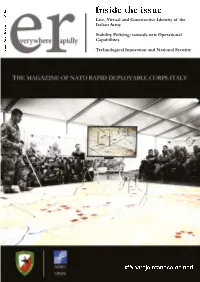
Live, Virtual and Constructive Identity of the Italian Army Stability Policing
6 1 0 LiveInside the issue 2 r e Live, Virtual and Constructive Identity of the b m Italian Army e c e D Stability Policing: towards new Operational - 4 Capabilities 2 e u s s Technological Innovation and National Security I #Wearejointandcombined 瘀攀爀礀眀栀攀爀攀 愀瀀椀搀氀礀 EDITOR’S NOTE by Col. ITA (A) Gianluigi ARCA CONTENTS NRDC-ITA Commander 攀爀 Lt. Gen. Roberto PERRETTI EDITORIAL BOARD FROM THE STAFF Editor in Chief: Col. ITA (A) Gianluigi ARCA • The eNRF Support Concept Seminar at NRDC-ITA 4 Editors : Lt. Col. ITA (A) Vincenzo SCHETTINI, Maj. GBR (A) Christopher • Stability Policing: towards new Operational Capabilities 6 DAVIES • Public Affairs to become independent branch within HQ! 8 Assistant Editor and Graphic Designer: • NRDC-ITA CIS drives NATO technological innovation! 12 Cpl. ITA (A) Chiara MONTI ...................... • Live, Virtual and Constructive Identity of the Italian Army 14 Assistant in Imagery and Post Production: • Technological Innovation and National Security 20 WO1 ITA (A) Francesco CIVITELLI Photographers: Cpl. ITA (A) Raffaele SAN- SEVERINO, Cpl. ITA (A) Mattia RUSSO Web: WO ITA (A) Italo BOATO SPORT BOARD The everywhere rapidly is the autorized offi- ear reader, cial pubblication of NATO Rapid Deploy- able Corps, Italy. All editorial content of the • Exercise Eagle Triglav 28 this issue marks an im- “ER” issue, in fact, is honoured to everywhere rapidly is prepared , edited and • NRDC-ITA Mountain Military Training on Dolomites 30 Dportant and challenging host an article by Maj. Gen. Mau- approved by the NRDC -ITA Commander, period for NRDC-ITA. The Hea- rizio Boni, who as Ce.Si.Va. -
Book Review of “The Story of Vaiont Told by the Geologist Who Discovered the Landslide”
Nat. Hazards Earth Syst. Sci., 11, 485–486, 2011 www.nat-hazards-earth-syst-sci.net/11/485/2011/ Natural Hazards doi:10.5194/nhess-11-485-2011 and Earth © Author(s) 2011. CC Attribution 3.0 License. System Sciences Book Review of “The Story of Vaiont Told by the Geologist Who Discovered the Landslide” F. Guzzetti1 and G. Lollino2 1Istituto di Ricerca per la Protezione Idrogeologica, Consiglio Nazionale delle Ricerche, via Madonna Alta 126, 06128 Perugia, Italy 2Istituto di Ricerca per la Protezione Idrogeologica, Consiglio Nazionale delle Ricerche, Strada delle Cacce 73, 10135 Torino, Italy THE STORY OF VAIONT TOLD BY THE GEOL- jont landslide in August 1959, four years before the catas- OGIST WHO DISCOVERED THE LANDSLIDE, BY: trophic failure. Semenza performed a systematic, large-scale E. SEMENDA, K-FLASH PUBLISHER, FERRARA, 205 geological and geomorphological investigation of the area, PAGES, PRICE: 28.00 C, ISBN 978-88-89288-02-3 and specifically of the site affected by the landslide before the On 9 October 1963, at 10:39 p.m. local time, between 240 slope failed catastrophically. During his fieldwork, Semenza and 300 million cubic meters of sedimentary rocks detached was able to identify and document a number of geological from Mount Toc, in Veneto, northern Italy, and slid into the and morphological features that he correctly interpreted as Vajont Lake. The falling rock mass acted like a huge piston, evidence of the presence of a very large, ancient landslide pushing the water of the lake against Casso and Erto, two deposit. The geomorphological information and geological small villages on the slope in front of the slope that failed, data collected by Semenza remain a brilliant example of a and then over an artificial dam 210 m high. -
Expecting Disaster: the 1963 Landslide of the Vajont Dam
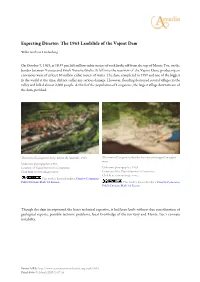
Expecting Disaster: The 1963 Landslide of the Vajont Dam Wilko Graf von Hardenberg On October 9, 1963, at 10:39 pm 260 million cubic meters of rock broke off from the top of Monte Toc, on the border between Veneto and Friuli Venezia Giulia. It fell into the reservoir of the Vajont Dam, producing an enormous wave of at least 50 million cubic meters of water. The dam, completed in 1959 and one of the biggest in the world at the time, did not suffer any serious damage. However, flooding destroyed several villages in the valley and killed almost 2,000 people. A third of the population of Longarone, the largest village downstream of the dam, perished. The town of Longarone, Italy, before the landslide, 1963. The town of Longarone after the dam was overtopped by a giant wave. Unknown photographer, 1963. Courtesy of Vajont Survivor’s Committee. Unknown photographer, 1963. Click here to view image source. Courtesy of the Vajont Survivor’s Committee. Click here to view image source. This work is licensed under a Creative Commons Public Domain Mark 1.0 License . This work is licensed under a Creative Commons Public Domain Mark 1.0 License . Though the dam incorporated the latest technical expertise, it had been built without due consideration of geological reports, possible tectonic problems, local knowledge of the territory and Monte Toc’s connate instability. Source URL: http://www.environmentandsociety.org/node/3401 Print date: 04 March 2020 11:07:46 Hardenberg, Wilko Graf von. "Expecting Disaster: The 1963 Landslide of the Vajont Dam." Arcadia ( 2011), no. -

Misleading Mailings Targeted to Seniors
MISLEADING MAILINGS TARGETED TO SENIORS HEARING BEFORE THE SUBCOMMITTEE ON SOCIAL SECURITY OF THE COMMITTEE ON WAYS AND MEANS HOUSE OF REPRESENTATIVES ONE HUNDRED SEVENTH CONGRESS FIRST SESSION JULY 26, 2001 Serial No. 107–44 Printed for the use of the Committee on Ways and Means ( U.S. GOVERNMENT PRINTING OFFICE 75–753 WASHINGTON : 2001 For sale by the Superintendent of Documents, U.S. Government Printing Office Internet: bookstore.gpo.gov Phone: toll free (866) 512–1800; DC area (202) 512–1800 Fax: (202) 512–2250 Mail: Stop SSOP, Washington, DC 20402–0001 VerDate 11-MAY-2000 10:10 Dec 11, 2001 Jkt 075753 PO 00000 Frm 00001 Fmt 5011 Sfmt 5011 E:\HR\OC\C753.XXX pfrm01 PsN: C753 COMMITTEE ON WAYS AND MEANS BILL THOMAS, California, Chairman PHILIP M. CRANE, Illinois CHARLES B. RANGEL, New York E. CLAY SHAW, JR., Florida FORTNEY PETE STARK, California NANCY L. JOHNSON, Connecticut ROBERT T. MATSUI, California AMO HOUGHTON, New York WILLIAM J. COYNE, Pennsylvania WALLY HERGER, California SANDER M. LEVIN, Michigan JIM MCCRERY, Louisiana BENJAMIN L. CARDIN, Maryland DAVE CAMP, Michigan JIM MCDERMOTT, Washington JIM RAMSTAD, Minnesota GERALD D. KLECZKA, Wisconsin JIM NUSSLE, Iowa JOHN LEWIS, Georgia SAM JOHNSON, Texas RICHARD E. NEAL, Massachusetts JENNIFER DUNN, Washington MICHAEL R. MCNULTY, New York MAC COLLINS, Georgia WILLIAM J. JEFFERSON, Louisiana ROB PORTMAN, Ohio JOHN S. TANNER, Tennessee PHIL ENGLISH, Pennsylvania XAVIER BECERRA, California WES WATKINS, Oklahoma KAREN L. THURMAN, Florida J.D. HAYWORTH, Arizona LLOYD DOGGETT, Texas JERRY WELLER, Illinois EARL POMEROY, North Dakota KENNY C. HULSHOF, Missouri SCOTT MCINNIS, Colorado RON LEWIS, Kentucky MARK FOLEY, Florida KEVIN BRADY, Texas PAUL RYAN, Wisconsin ALLISON GILES, Chief of Staff JANICE MAYS, Minority Chief Counsel SUBCOMMITTEE ON SOCIAL SECURITY E. -

Masculinity and Political Authority 241 7.1 Introduction 241
Durham E-Theses The political uses of identity an enthnography of the northern league Fernandes, Vasco Sérgio Costa How to cite: Fernandes, Vasco Sérgio Costa (2009) The political uses of identity an enthnography of the northern league, Durham theses, Durham University. Available at Durham E-Theses Online: http://etheses.dur.ac.uk/2080/ Use policy The full-text may be used and/or reproduced, and given to third parties in any format or medium, without prior permission or charge, for personal research or study, educational, or not-for-prot purposes provided that: • a full bibliographic reference is made to the original source • a link is made to the metadata record in Durham E-Theses • the full-text is not changed in any way The full-text must not be sold in any format or medium without the formal permission of the copyright holders. Please consult the full Durham E-Theses policy for further details. Academic Support Oce, Durham University, University Oce, Old Elvet, Durham DH1 3HP e-mail: e-theses.admin@dur.ac.uk Tel: +44 0191 334 6107 http://etheses.dur.ac.uk University of Durham The Political Uses of Identity: An Ethnography of the Northern The copyright of this thesis rests with the author or the university to which it was League submitted. No quotation from it, or information derived from it may be published without the prior written consent of the author or university, and any information derived from it should be acknowledged. By Vasco Sergio Costa Fernandes Department of Anthropology April 2009 Thesis submitted in accordance with the requirement for the Degree of Doctor of Philosophy Supervisors: Dr Paul Sant Cassia Dr Peter Collins 2 1 MAY 2009 Abstract This is a thesis about the Northern League {Lega Nord), a regionalist and nationalist party that rose to prominence during the last three decades in the north of Italy Throughout this period the Northern League developed from a peripheral and protest movement, into an important government force. -

Induced Earthquakes
Department of Political Science Bachelor in Politics, Philosophy and Economics Chair in Population Environment and Sustainability THE EFFECTS OF HUMAN ACTIVITIES ON THE EARTH: INDUCED EARTHQUAKES SUPERVISOR Prof. Marcello di Paola CANDIDATE Chiara Ghesini 076572 ACADEMIC YEAR 2016/201 1 INDEX Introduction 3 1.1 Reservoir- Induced Seismicity 5 1.2 Zipingpu Dam 1.3 Vajont Dam 2.0 Underground Open-Pit Mining 9 3.0 Geothermal Energy 11 4.0 Nuclear Activity 13 4.1 Nuclear Events 5.0 Underground Waste Water Injection and Massive Extraction 17 5.1 Praga Oklahoma Earthquake 6.0 State Institutions 21 6.1 Federal Institutions 6.1.2 Environmental Protection Agency 6.1.3 Bureau of Land Management 6.1.4 U.S. Forest Service 6.1.5 United States Geological Survey 6.2 Castor Project 7.0 Considerations 30 Conclusion 32 Bibliography 33 2 Introduction Earthquakes have always been considered natural events in our societies, causing hundreds of victims every year around the entire world. Nowadays the things are changing, due to the increased request of natural sources and the continuous growth of world’s population, more energy and more resources are being required. Our epoch can be perfectly defined with the term “Anthropocene”, referring to the influence that human activities have on our planet, basing the evidence on continuous atmospheric, hydrologic, geologic and biospheric alterations. Starting in the 1950s, this process is damaging the earth with a trend that, if not reversed, is going to leave future generations in a hopeless situation. Having been born in this time period we are used to take many of the utilities we have for granted, not knowing that we obtain them through activities like gas storage, mining and underground water extraction. -

Monografia Che Tenete in Mano
RDM_SantaGiustina_book.indd 1 11/09/19 08:10 Parte Due Content Part Two Santa Giustina Parte Uno 11 Chi siamo Part One About Us RDM Group 12 La nostra Storia Our History 14 La nostra Vision Our Vision 16 I nostri Valori Our Values 18 Together we shape the Future Together we shape the Future Parte Tre 20 Struttura operativa del Gruppo Part Three Group Operations Framework Our People 22 Dove siamo Where we are 24 Modello di Business Business Model 26 I nostri prodotti Our Products 2 RDM_SantaGiustina_book.indd 2 11/09/19 08:10 Parte Due 31 Santa Giustina e RDM Group Content Part Two Santa Giustina and RDM Group Santa Giustina 32 Highlight Highlights 38 Storia dello stabilimento History of the Mill 42 Gli Stakeholder di Santa Giustina The Stakeholders of Santa Giustina 44 I clienti di Santa Giustina The customers of Santa Giustina 46 La sostenibilità per Santa Giustina Sustainability for Santa Giustina Chi siamo About Us 48 Le foto di ieri Yesterday’s Photographs La nostra Storia Our History 80 Le foto di oggi Today’s Photographs La nostra Vision Our Vision 100 I prodotti di Santa Giustina The Products of Santa Giustina I nostri Valori Our Values 108 Certificazioni Certifications Together we shape the Future Together we shape the Future Parte Tre 112 Massimo Marcer Struttura operativa del Gruppo Part Three 116 Gianluca Scaglioni Group Operations Framework Our People 120 Francesco Canal 124 Diana Callegari Dove siamo 128 Dino Dal Pan Where we are 132 Giancarlo De Min Modello di Business 136 Fabrizia Casagrande Business Model 138 Paolo Brugnera Muraro 140 Emilio Dal Zot I nostri prodotti Our Products 142 Fin che ‘l pope gira 3 RDM_SantaGiustina_book.indd 3 11/09/19 08:10 LETTERA DEL CEO Gentili, si dice che gli anniversari vadano sempre festeggiati, penso però che alcuni meritino davvero un’attenzione speciale. -
The Impact of Candidates' Profile and Campaign Decisions In
mathematics Article The Impact of Candidates’ Profile and Campaign Decisions in Electoral Results: A Data Analytics Approach Camilo Campos-Valdés 1,2 , Eduardo Álvarez-Miranda 3,*, Mauricio Morales Quiroga 4 , Jordi Pereira 5 and Félix Liberona Durán 6 1 Doctorado en Sistemas de Ingeniería, Facultad de Ingeniería, Universidad de Talca, Curicó 3340000, Chile; ccamposv@utalca.cl or camilo.campos@uautonoma.cl 2 Facultad de Ingeniería, Universidad Autónoma de Chile, 5 Poniente 1670, Talca 3460000, Chile 3 School of Economics and Business, Universidad de Talca, Talca 3460000, Chile 4 Departamento de Ciencia Política y Administración Pública, Facultad de Ciencias Jurídicas y Sociales, Universidad de Talca, Santiago 8320000, Chile; mmoralesq@utalca.cl 5 Faculty of Engineering and Sciences, Universidad Adolfo Ibáñez, Av. Padre Hurtado 750, Viña del Mar 2520000, Chile; jorge.pereira@uai.cl 6 Escuela de Postgrado, Facultad de Arquitectura y Urbanismo, Universidad de Chile, Santiago 8320000, Chile; fliberona@uchile.cl * Correspondence: ealvarez@utalca.cl; Tel.: +56-950-186-692 Abstract: In recent years, a wide range of techniques has been developed to predict electoral results and to measure the influence of different factors in these results. In this paper, we analyze the influence of the political profile of candidates (characterized by personal and political features) and their campaign effort (characterized by electoral expenditure and by territorial deployment strategies Citation: Campos-Valdés, C.; retrieved from social networks activity) on the electoral results. This analysis is carried out by Álvarez-Miranda, E.; Morales using three of the most frequent data analyitcs algorithms in the literature. For our analysis, we Quiroga, M.; Pereira, J.; consider the 2017 Parliamentary elections in Chile, which are the first elections after a major reform Liberona Durán, F.