Exposing the Lies That Led to Covid-19 Totalitarianism
Total Page:16
File Type:pdf, Size:1020Kb
Load more
Recommended publications
-

Spotlight Briefing Note
Spotlight briefing Responding to the COVID-19 pandemic Ten questions on the next phase of the UK’s COVID-19 response October 2020 Overview • There are a number of questions which remain as to the next phase of the response to the COVID-19 pandemic. • What values have informed the most recent decisions on COVID-19 restrictions? Public health measures involve a number of challenging trade-offs between different rights and interests. Alongside the scientific evidence, it must be made clear which values are guiding decisions about which, and whose, interests take priority, and why. • Is the government considering the use of “immunity certificates” in the next phase of the response? Any approach which relies on a system of ‘immunity certification’ raises a number of ethical questions concerning individual rights versus the public interest, and social justice. If the Government is considering such a system, there must be a robust and open debate now. • How will development of an effective COVID-19 vaccine affect uptake - and what should be done? Issues around the speed of development, changes in regulation, and communication with the public may all affect public trust and uptake of any vaccine. Consideration about how to address these issues should take place now. • What discussions are taking place on setting priorities for vaccine allocation within the UK? There is a range of different values which can be taken into consideration when setting priorities for access to limited doses of a vaccine. What values and interests will guide decision-making in this area must be clearly set out. • How will the UK ensure a sustained commitment to global solidarity? The global nature of the pandemic shows the importance of working as part of a global effort. -

How Covid-19 Changed Community Life in the UK
How Covid-19 changed community CONCLUSION + RECOMMENDATION WEEK 01 + 02: 23RD MARCH OVEWIVEW + KEY INSIGHTS ACKNOWLEDGEMENTS WEEK 04: 13TH APRIL WEEK 05: 20TH APRIL WEEK 06: 27TH APRIL WEEK 03: 6TH APRIL WEEK 08: 11TH MAY WEEK 09: 18TH MAY WEEK 10: 25TH MAY WEEK 12: 8TH JUNE WEEK 11: 1ST JUNE life in the UK WEEK 07: 4TH MAY A week by week archive of life during a pandemic. Understanding the impact on people and communities. 01/2 03 04 05 06 07 08 09 10 11 12 The Young Foundation’s mission is to develop better connected and stronger communities across the UK. As an UKRI accredited research organisation, social CONCLUSION + RECOMMENDATION investor and community practitioner, we offer expert WEEK 01 + 02: 23RD MARCH OVERVIEW + KEY INSIGHTS ACKNOWLEDGEMENTS WEEK 04: 13TH APRIL WEEK 05: 20TH APRIL WEEK 06: 27TH APRIL WEEK 03: 6TH APRIL WEEK 08: 11TH MAY WEEK 09: 18TH MAY WEEK 10: 25TH MAY WEEK 12: 8TH JUNE WEEK 11: 1ST JUNE advice, training and deliver support to: WEEK 07: 4TH MAY Understand Communities Researching in and with communities to increase your understanding of community life today Involve Communities Offering different methods and approaches to involving communities and growing their capacity to own and lead change Innovate with Communities Providing tools and resources to support innovation to tackle the issues people and communities care about For more information visit us at: youngfoundation.org Overview 01/2 03 04 05 06 07 08 09 10 11 12 Introduction About this document Covid-19 has radically changed the way we go about our day-to-day lives. -

Whole Day Download the Hansard
Monday Volume 681 28 September 2020 No. 109 HOUSE OF COMMONS OFFICIAL REPORT PARLIAMENTARY DEBATES (HANSARD) Monday 28 September 2020 © Parliamentary Copyright House of Commons 2020 This publication may be reproduced under the terms of the Open Parliament licence, which is published at www.parliament.uk/site-information/copyright/. HER MAJESTY’S GOVERNMENT MEMBERS OF THE CABINET (FORMED BY THE RT HON. BORIS JOHNSON, MP, DECEMBER 2019) PRIME MINISTER,FIRST LORD OF THE TREASURY,MINISTER FOR THE CIVIL SERVICE AND MINISTER FOR THE UNION— The Rt Hon. Boris Johnson, MP CHANCELLOR OF THE EXCHEQUER—The Rt Hon. Rishi Sunak, MP SECRETARY OF STATE FOR FOREIGN,COMMONWEALTH AND DEVELOPMENT AFFAIRS AND FIRST SECRETARY OF STATE— The Rt Hon. Dominic Raab, MP SECRETARY OF STATE FOR THE HOME DEPARTMENT—The Rt Hon. Priti Patel, MP CHANCELLOR OF THE DUCHY OF LANCASTER AND MINISTER FOR THE CABINET OFFICE—The Rt Hon. Michael Gove, MP LORD CHANCELLOR AND SECRETARY OF STATE FOR JUSTICE—The Rt Hon. Robert Buckland, QC, MP SECRETARY OF STATE FOR DEFENCE—The Rt Hon. Ben Wallace, MP SECRETARY OF STATE FOR HEALTH AND SOCIAL CARE—The Rt Hon. Matt Hancock, MP SECRETARY OF STATE FOR BUSINESS,ENERGY AND INDUSTRIAL STRATEGY—The Rt Hon. Alok Sharma, MP SECRETARY OF STATE FOR INTERNATIONAL TRADE AND PRESIDENT OF THE BOARD OF TRADE, AND MINISTER FOR WOMEN AND EQUALITIES—The Rt Hon. Elizabeth Truss, MP SECRETARY OF STATE FOR WORK AND PENSIONS—The Rt Hon. Dr Thérèse Coffey, MP SECRETARY OF STATE FOR EDUCATION—The Rt Hon. Gavin Williamson CBE, MP SECRETARY OF STATE FOR ENVIRONMENT,FOOD AND RURAL AFFAIRS—The Rt Hon. -

An Affront to Dignity, Inclusion and Equality: Coronavirus and the Impact of Law, Policy and Practice on People with Disabilities in the United Kingdom
Report Recommendations - An Affront to Dignity, Inclusion and Equality: Coronavirus and the impact of law, policy and practice on people with disabilities in the United Kingdom In the following areas our Report urges the government to: On reforming the Coronavirus Act 2020, disability rights and mitigating effects of the pandemic 1. Undertake an immediate review of legislation passed during the coronavirus crisis and communication thereof. In doing so, we ask that the government change this legislation and all related policymaking to meet its duties under the Equality Act 2010, and commitments to the United Nations Convention on the Rights of Persons with Disabilities, and take steps to avoid or mitigate any potential disadvantage for disabled people. 2. Implement recommendations made by the 2016 House of Lords Select Committee Report on the Equality Act 2010 and Disability, and by the Women and Equalities Committee, on enhancing the enforcement of the Equality Act 2010, both by removing deterrents to individuals bringing disability discrimination cases; and by measures which embed the monitoring and enforcement of relevant duties in the work of regulatory and inspection bodies. 3. Undertake an inquiry on the impact of COVID-19 on disabled people to examine why this group has carried such a heavy burden for the pandemic, including the scale of Covid-19 related deaths. 4. Establish a Covid-19 Disability Inclusive Response and Recovery Group, of experts by experience with disabilities and Disabled People’s Organisations, to ensure disabled people are central to decision-making on the economic and social recovery to the pandemic and guidance. 5. -

Letter Tony Nikolic Wrote to New South Wales Minister
4. I am instructed to send this letter to sitting Members of Parliament (State and Federal). 5. The most recent Orders from the NSW State Government on Airport workers at Kingsford Smith Airport (Sydney) has caused a number of airport employees (including pregnant and single wage families/adults) to go on stress leave because they have been given an ultimatum to get the vaccine or potentially lose their positions. The amount of emails and calls from airline industry staff to my office is most concerning and I am instructed to make this representation on their behalf because they believe their elected representatives are not taking notice. 6. We are also mindful that the airport staff, front-line workers, pilots, police, paramedics and medical staff are also seeking the protection of all rights and responsibilities pursuant to Australian and International laws. 7. There are people taking sick leave from airport duties due to the mental health related issues and pressures being placed on them to take a vaccine. We understand that that the Australian Government cannot guarantee the vaccines safety in the short, mid and long term, but yet the NSW Government are issuing Orders for companies to vaccinate all staff, whilst Federal Parliamentarians do not question the validity or acknowledge this growing concern in electorates all over Australia. 8. I am instructed those workers are not allowed on Commonwealth airport property effective as of 6 July 2021 as a result of State Orders. The workers are not only feeling the pressures imposed upon them with speed and stealth at which the Orders were passed, but they are also concerned about being targeted if they speak out. -
Using Antibiotics
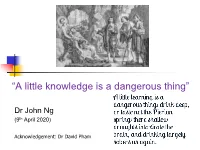
“A little knowledge is a dangerous thing” Dr John Ng (9th April 2020) Acknowledgement: Dr David Pham The Pandemic COVID-19 Coronavirus Disease 2019 Enveloped, positive sense, single-stranded, RNA virus “Crown-like” appearance on electron microscopy Aetiological agent formally designated SARS-CoV-2 COVID-19 chosen to avoid associations with any ethnic group, geographical location or animal species while still being easily pronounceable Wang et al Lancet 2020 Public health emergency of international concern 30/01/20 Pandemic declared by WHO 11/03/2020 1,341,907 confirmed cases 07/04/2020 – www.jhu.edu 74,746 confirmed deaths 07/04/2020 – www.jhu.edu The Infodemic Social media is driving the spread of so much information and misinformation that WHO has described this as an “infodemic” WHO has launched its own information platform specifically to “myth-bust” fake news The Infodemic Media misinformation that consuming alcohol (whiskey) kills COVID-19 resulted in ~300 deaths in Iran and Turkey plus numerous cases of blindness due to methanol poisoning from “bootleg” alcohol Innumerable “scientific” reports are being published in “pre-print” formats such as “medRxiv” without editorial oversight or peer review ie – there is lots of dodgy data! Question 1 What is the sensitivity? Short answer – unknown but a figure of ~75% has been widely promulgated in the media originating from an ED blog called “EMCrit” Question 1 Question 1 Question 1 Dodgy data! “Studies” are both “pre-prints” Both retrospective Both used inappropriate gold -
COVID-19 and the Use and Scrutiny of Emergency Powers
HOUSE OF LORDS Select Committee on the Constitution 3rd Report of Session 2021–22 COVID-19 and the use and scrutiny of emergency powers Ordered to be printed 2 June 2021 and published 10 June 2021 Published by the Authority of the House of Lords HL Paper 15 Select Committee on the Constitution The Constitution Committee is appointed by the House of Lords in each session “to examine the constitutional implications of public bills coming before the House; and to keep under review the operation of the constitution and constitutional aspects of devolution.” Membership The Members of the Constitution Committee are: Baroness Corston Baroness Fookes Lord Sherbourne of Didsbury Baroness Doocey Lord Hennessy of Nympsfield Baroness Suttie Baroness Drake Lord Hope of Craighead Baroness Taylor of Bolton (Chair) Lord Dunlop Lord Howarth of Newport Lord Faulks Lord Howell of Guildford Declarations of interests A full list of Members’ interests can be found in the Register of Lords’ Interests: https://members.parliament.uk/members/lords/interests/register-of-lords-interests/ Publications All publications of the committee are available at: https://committees.parliament.uk/committee/172/constitution-committee/ Parliament Live Live coverage of debates and public sessions of the committee’s meetings are available at: http://www.parliamentlive.tv Further information Further information about the House of Lords and its committees, including guidance to witnesses, details of current inquiries and forthcoming meetings is available at: http://www.parliament.uk/business/lords Committee staff The current staff of the committee are Michael Torrance (Clerk), Ava Mayer (Policy Analyst) and Dan Weedon (Committee Assistant). -

BMJ in the News Is a Weekly Digest of Journal Stories, Plus Any Other News
BMJ in the News is a weekly digest of journal stories, plus any other news about the company that has appeared in the national and a selection of English-speaking international media. A total of 25 journals were picked up in the media last week (21-27 September) - our highlights include: ● Research in The BMJ on excess belly fat and risk of early death was covered widely, including CNN, The Daily Mail and The Daily Telegraph. ● The New York Times ran an op-ed by Peter Doshi, Associate Editor at The BMJ on covid-19 vaccine trials. ● Research in Thorax warning that patients with no symptoms carry as much covid-19 virus as those with symptoms generated global headlines, including NBC News, New York Daily News and The Guardian. BMJ PRESS RELEASES The BMJ | BMJ Open Open Heart | Thorax EXTERNAL PRESS RELEASES BMJ Open | BMJ Open Diabetes Research & Care British Journal of Sports Medicine | Emergency Medicine Journal OTHER COVERAGE The BMJ | Annals of the Rheumatic Diseases Archives of Disease in Childhood | BMJ Evidence-Based Medicine BMJ Global Health | BMJ Nutrition, Prevention & Health BMJ Open Respiratory Research | Frontline Gastroenterology Gut | Heart Injury Prevention | Journal of Epidemiology & Community Health Journal of Medical Ethics | Journal of Neurology, Neurosurgery & Psychiatry Medical Humanities | Occupational & Environmental Medicine Postgraduate Medical Journal | Practical Neurology Vet Record B MJ New Co-Editors-in-Chief for BMJ Quality -
A Leader's Guide: Communicating with Teams, Stakeholders, and Communities During COVID-19 Exhibit 1 of 1
Organization Practice A leader’s guide: Communicating with teams, stakeholders, and communities during COVID-19 COVID-19’s speed and scale breed uncertainty and emotional disruption. How organizations communicate about it can create clarity, build resilience, and catalyze positive change. by Ana Mendy, Mary Lass Stewart, and Kate VanAkin © Ewg3D/Getty Images April 2020 Crises come in different intensities. As a “land- communicators, those whose words and actions scape scale” event,1 the coronavirus has created comfort in the present, restore faith in the long great uncertainty, elevated stress and anxiety, and term, and are remembered long after the crisis has prompted tunnel vision, in which people focus only been quelled. on the present rather than toward the future. During such a crisis, when information is unavailable or So we counsel this: pause, take a breath. The good inconsistent, and when people feel unsure about news is that the fundamental tools of effective what they know (or anyone knows), behavioral communication still work. Define and point to science points to an increased human desire for long-term goals, listen to and understand your transparency, guidance, and making sense out of stakeholders, and create openings for dialogue. Be what has happened. proactive. But don’t stop there. In this crisis leaders can draw on a wealth of research, precedent, and At such times, a leader’s words and actions can experience to build organizational resilience through help keep people safe, help them adjust and an extended period of uncertainty, and even turn a cope emotionally, and finally, help them put their crisis into a catalyst for positive change. -
COVID-19: Implementation of Easements
COVID-19: Implementation of Easements This resource has been prepared for tri.x customers. Its purpose is to support practitioners and managers on the frontline when the local authority has decided to implement some or all of the easements to the Care Act 2014 set out in sections 14 and 15 of the Coronavirus Act 2020. It provides information about carrying out revised adult care and support duties and functions, and which procedures this is likely to have an impact upon. Use the Contents list on the following page to find the information you are looking for. Updated 13.10.20 NOTE: If your local authority is managing to sustain all duties under the Care Act this guidance does not apply. Key decision makers should see Care Act easements: guidance for local authorities for guidance on deciding whether/when to apply the easements. Contents 1. Making Decisions-key section to be read by all 2. General Responsibilities of the Care Act 3. Safeguarding and Risk Assessment 4. Referrals and Assessment 5. Eligibility 6. Meeting Needs 7. Review/Revision of Plans 8. Transition 9. Financial Assessment & Charging 10. NHS Continuing Healthcare 11. Hospital Discharge 12. Continuity of Care Arrangements 13. Protecting Moveable Property and Belongings 14. End of Life 15. No Recourse to Public Funds 16. AHMP Appendix 1: Government Guidance Links 1. Making Decisions Local authorities will still be expected to do as much as they can to comply with their powers to meet needs during any period of easement and the duty of care they have towards an individual’s risk of serious neglect or harm still remains. -

Passport to Freedom? Immunity Passports for COVID-19 Rebecca C H Brown ,1 Julian Savulescu,1 Bridget Williams,2 Dominic Wilkinson 1
Extended essay J Med Ethics: first published as 10.1136/medethics-2020-106365 on 15 August 2020. Downloaded from Passport to freedom? Immunity passports for COVID-19 Rebecca C H Brown ,1 Julian Savulescu,1 Bridget Williams,2 Dominic Wilkinson 1 1Oxford Uehiro Centre for ABSTRACT One of the reasons such lockdown measures Practical Ethics, University of The COVID-19 pandemic has led a number of countries are deemed necessary is the potential for asymp- Oxford, Oxford, UK 2School of Public Health and to introduce restrictive ’lockdown’ policies on their tomatic infection and spreading of COVID-19. Preventive Medicine, Monash citizens in order to control infection spread. Immunity Estimates vary widely, but the number of people University, Clayton, Victoria, passports have been proposed as a way of easing the who do not experience symptoms when infected Australia harms of such policies, and could be used in conjunction with COVID-19 seems likely to be around 40%.6 with other strategies for infection control. These Research suggests that close to half of all transmis- Correspondence to passports would permit those who test positive for sion events occur before the onset of symptoms, Dr Rebecca C H Brown, Oxford COVID-19 antibodies to return to some of their normal and people are thought to be at their most infec- Uehiro Centre for Practical 7 8 Ethics, University of Oxford, behaviours, such as travelling more freely and returning tious on or before the time of symptom onset. Oxford OX1 1PT, UK; to work. The introduction of immunity passports raises a Viable virus has been detected from patients as rebecca. -

Covid 19 Vaccine Certification
House of Commons Public Administration and Constitutional Affairs Committee Covid-Status Certification Second Report of Session 2021–22 Report, together with formal minutes relating to the report Ordered by the House of Commons to be printed 10 June 2021 HC 42 Published on 12 June 2021 by authority of the House of Commons Public Administration and Constitutional Affairs Committee The Public Administration and Constitutional Affairs Committee is appointed by the House of Commons to examine the reports of the Parliamentary Commissioner for Administration and the Health Service Commissioner for England, which are laid before this House, and matters in connection therewith; to consider matters relating to the quality and standards of administration provided by civil service departments, and other matters relating to the civil service; and to consider constitutional affairs. Current membership William Wragg MP (Conservative, Hazel Grove) (Chair) Ronnie Cowan MP (Scottish National Party, Inverclyde) Jackie Doyle-Price MP (Conservative, Thurrock) Rachel Hopkins MP (Labour, Luton South) David Jones MP (Conservative, Clwyd West) John McDonnell MP (Labour, Hayes and Harlington) David Mundell MP (Conservative, Dumfriesshire, Clydesdale and Tweeddale) Tom Randall MP (Conservative, Gedling) Lloyd Russell-Moyle MP (Labour (Co-op), Brighton, Kemptown) Karin Smyth MP (Labour, Bristol South) John Stevenson MP (Conservative, Carlisle) Powers The committee is a select committee, the powers of which are set out in House of Commons Standing Orders, principally in SO No 146. These are available on the internet via www.parliament.uk. Publication © Parliamentary Copyright House of Commons 2021. This publication may be reproduced under the terms of the Open Parliament Licence, which is published at www.parliament.uk/copyright.