Wild Edible Plants in Karaman (Southern Turkey)
Total Page:16
File Type:pdf, Size:1020Kb
Load more
Recommended publications
-

Turkish Journal of Agriculture - Food Science and Technology, 8(1): 260-265, 2020 DOI
Turkish Journal of Agriculture - Food Science and Technology, 8(1): 260-265, 2020 DOI: https://doi.org/10.24925/turjaf.v8i1.260-265.2959 Turkish Journal of Agriculture - Food Science and Technology Available online, ISSN: 2148-127X | www.agrifoodscience.com | Turkish Science and Technology Evaluation of Agricultural Mechanization Level of Karaman Province Ender Kaya1,a,*, Aykut Örs2,b 1Vocational School of Technical Sciences Karamanoğlu Mehmetbey University, 70100 Karaman, Turkey 2Provincial Coordination Unit, Agriculture and Rural Development Institute, 42110 Konya, Turkey *Corresponding author A R T I C L E I N F O A B S T R A C T The main purpose of this study is to determination of agricultural structure and mechanization Research Article features of agricultural enterprises in Karaman province. The main material of the study is statistical data of Turkish Statistical Institute (TSI) of 2009 – 2018 years for Karaman province. According to the data of Karaman province in 2009 and 2018, the average tractor power is 34.92 kW and 35.33 Received : 15/09/2019 kW; the average tractor power per cultivated areas 2.45 kWha-1 and 1.93 kWha-1; the number of Accepted : 02/12/2019 tractors per 1,000 ha is 52.27 and 40.76; the cultivated area per tractor is 19.13 ha and 24.54 ha, respectively. The number of equipment per tractor is 10.66 and 9.86, and the number of combine harvester per 1,000 ha is 0.47 and 0.55. Keywords: Agricultural structure Combine harvester Mechanization level Tractor Karaman Türk Tarım – Gıda Bilim ve Teknoloji Dergisi, 8(1): 260-265, 2020 Karaman İlinin Tarımsal Mekanizasyon Düzeyinin Değerlendirilmesi M A K A L E B İ L G İ S İ Ö Z Bu çalışmanın amacı; Karaman ilindeki tarım işletmelerinin tarımsal yapı ve mekanizasyon Araştırma Makalesi özelliklerinin belirlenmesidir. -
Haplophyllum Ermenekense (Rutaceae), a New Species
A peer-reviewed open-access journal PhytoKeys 111: 119–131 (2018)Haplophyllum ermenekense (Rutaceae), a new species... 119 doi: 10.3897/phytokeys.111.24241 RESEARCH ARTICLE http://phytokeys.pensoft.net Launched to accelerate biodiversity research Haplophyllum ermenekense (Rutaceae), a new species from Turkey Deniz Ulukuş1, Osman Tugay2 1 Department of Biotechnology, Faculty of Sciences, Selçuk University, Konya, Turkey 2 Department of Phar- maceutical Botany, Faculty of Pharmacy, Selçuk University, Konya, Turkey Corresponding author: Deniz Ulukuş (dulukus@selcuk.edu.tr) Academic editor: M. Appelhans | Received 5 February 2018 | Accepted 24 September 2018 | Published 22 November 2018 Citation: Ulukuş D, Tugay O (2018) Haplophyllum ermenekense (Rutaceae), a new species from Turkey. PhytoKeys 111: 119–131. https://doi.org/10.3897/phytokeys.111.24241 Abstract A new species of Haplophyllum, Haplophyllum ermenekense (Rutaceae) is described and illustrated in line drawing. It grows on stony slopes of Ermenek town, Karaman province, in southern Turkey. It is com- pared with the closely related species H. myrtifolium. H. ermenekense is distinguished from the morpho- logically similar H myrtifolium chiefly by sepal shape, petal size, capsule size, presence of capsule hair and appendage form. On the other hand, the seed coat and pollen grains surface of H. ermenekense and H. myrtifolium are demonstrated in SEM photographs. In addition to the detailed description, the illus- tration, distribution map, conservation status and ecology of the new species are also provided. Keywords Endemic, Haplophyllum, Karaman, Rutaceae, taxonomy Introduction With its 69 species, Haplophyllum Jussieu is one of the richest genera in the Rutaceae fam- ily (Townsend 1986, Navarro et al. -

Industriall Global Union Letter to Turkish Legislators 29-10-2014[1]
Geneva, 29 October 2014 To: All Members of the Grand National Assembly of Turkey IndustriALL Global Union calls on legislators of Turkey to ratify and implement ILO C176 on Safety in Mines Dear Respected Member of the Grand National Assembly of Turkey, I am writing to you on behalf of IndustriALL Global Union, which represents more than 50 million workers in mining, energy and manufacturing industries in some 141 countries, to strongly urge you to support and pursue the ratification and implementation of International Labour Organization Convention 176 on safety and health in mines by the Turkish Parliament. This renewed call comes as hopes are fading today for at least eighteen miners trapped by flooding 300 metres underground in the Has Sekerler coalmine near the town of Ermenek in Karaman province. Though the cause has not yet been established of the water surging into the mine, it is the strong belief and argument of IndustriALL Global Union that every mine accident is preventable. Turkey’s mineworkers are put under life-threatening danger daily by an unregulated industry. Now it is simply not an option for Turkey’s government to ignore the calls for action on safety and health in mines. We were greatly heartened to note the recent news of the Turkish Cabinet sending a bill to Parliament to ratify ILO C176. Passing of the bill would represent a noble gesture to the grieving families of the 301 mineworkers murdered by a dangerous system in Soma on 13 May. The bill however is still pending on the Parliament’s agenda. -
42 Osm. Ars. Book.Indb
The Causes of Rural Migrations in th Century Ottoman Society* Cengiz Şeker** 18. Yüzyıl Osmanlı Toplumunda Taşra Kaynaklı Göçlerin Nedenleri Öz Devlet tarafından yürütülen güdümlü göçler yanında, Osmanlı toplumunda iradi göçlere de her zaman rastlanmıştır. Kanûnî Sultan Süleyman döneminden itibaren ikinci tür göçü yasaklayan fermanlar çıkarılmışsa da bu nüfus hareketi hiçbir zaman bütünüyle önlenememiştir. 18. yüzyılda gerçekleşen taşra kaynaklı göçler, bu yüzyılda Osmanlı toplumsal ve iktisadi düzeninde gözlenen değişimle yakından ilişkilidir. Ekonominin nakdileşmesi ve merkezi yönetimin zayıflaması şeklinde özetlenebilecek bu süreçte devlet malikâne yöntemini yaygınlaştırmak suretiyle vergi gelirlerini nakit olarak merkezi hazinede toplamaya çalışmıştır. Malikâne uygulamasının yaygınlaşması askeri sınıfla birlikte, askeri sınıfın ortak ve temsilcisi sıfatıyla yerel güç odaklarının siyasi ve iktisadi açıdan güçlenmesine yol açmıştır. 18. yüzyılda taşra kaynaklı göçlerde rol oynayan; taşra teşkilatı görevlilerinin suistimali, kanunsuz tekâlif tahsilatı, güvenliğin zedelenmesi gibi etkenler ise bu gelişmenin sonuçları arasında sayılabilir. Anahtar kelimeler: İradi Göçler, Reaya, Malikâne Sistemi, Askeri Sınıf, Taşra Teşkilatı, Tekâlif Tevzi ve Tahsili 1. Introduction It is known that the Ottoman Empire tried to arrange and control population movements for certain purposes through specific measures. However, it cannot be said that population migration in Ottoman society consisted solely of those movements. From the period of Sulaiman I (1520-1566), imperial orders were issued that prohibited voluntary migrations. This prohibition, however, could not * I am grateful to Seyfi Kenan, Baki Çakır and Cherly Jacklin-Piraino for their valuable suggestions and contributions. ** Ph.D., Economic Historian. Osmanlı Araştırmaları / The Journal of Ottoman Studies, XLII (2013), 207-231 207 THE CAUSES OF RURAL MIGRATIONS prevent population movements; migration from rural areas continued in the 18th century, just as they had under previous rulers. -
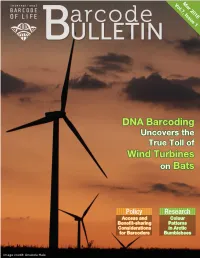
DNA Barcoding Wind Turbines on Bats
Mar 2016 Vol.7, Issue 1 DNA Barcoding Uncovers the True Toll of Wind Turbines on Bats Policy Research Access and Colour Benefit-sharing Patterns Considerations in Arctic for Barcoders Bumblebees Image credit: Amanda Hale ApplicationsBarcode DNA Mini-barcodes for Saffron Identification Written by: Caterina Villa, Joana Costa, Liliana Meira, M. Beatriz P.P. Oliveira, and Isabel Mafra (REQUIMTE-LAQV, University of Porto, Portugal) Crocus sativus L. is the most important crop time-consuming, requires experienced personnel, plant of the Iridaceae family. Saffron, the most and is susceptible to subjective interpretation. expensive spice in the world, consists of the dried stigmas of C. sativus, and they are greatly Among DNA markers, the use of barcodes appreciated in many dishes for their unique has recently been proposed as a powerful color, taste, and aroma. Owing to its high market pharmacognostic tool for the identification of value, saffron has been associated with an medicinal plants and their adulterants at the unrivaled degree of adulteration. species level. However, DNA barcoding entails the amplification and sequencing of relatively Adulterations of both ground and whole stigma large DNA fragments (400-800 bp), which samples have made use of diverse materials represents a major drawback for the analysis of and strategies including colorants, mineral processed/complex matrices. compounds, spices, and parts of other plants, such as flowers of “...saffron has been When analyzing samples with Carthamus tinctorius or stigmas of degraded DNA, such as processed other Crocus spp., with the aim of associated with an plants, poorly preserved plants, and/ increasing the volume and weight of unrivaled degree of or those stored for a long period of commercial lots. -
Table 2. Geographic Areas, and Biography
Table 2. Geographic Areas, and Biography The following numbers are never used alone, but may be used as required (either directly when so noted or through the interposition of notation 09 from Table 1) with any number from the schedules, e.g., public libraries (027.4) in Japan (—52 in this table): 027.452; railroad transportation (385) in Brazil (—81 in this table): 385.0981. They may also be used when so noted with numbers from other tables, e.g., notation 025 from Table 1. When adding to a number from the schedules, always insert a decimal point between the third and fourth digits of the complete number SUMMARY —001–009 Standard subdivisions —1 Areas, regions, places in general; oceans and seas —2 Biography —3 Ancient world —4 Europe —5 Asia —6 Africa —7 North America —8 South America —9 Australasia, Pacific Ocean islands, Atlantic Ocean islands, Arctic islands, Antarctica, extraterrestrial worlds —001–008 Standard subdivisions —009 History If “history” or “historical” appears in the heading for the number to which notation 009 could be added, this notation is redundant and should not be used —[009 01–009 05] Historical periods Do not use; class in base number —[009 1–009 9] Geographic treatment and biography Do not use; class in —1–9 —1 Areas, regions, places in general; oceans and seas Not limited by continent, country, locality Class biography regardless of area, region, place in —2; class specific continents, countries, localities in —3–9 > —11–17 Zonal, physiographic, socioeconomic regions Unless other instructions are given, class -

Agricultural Origins on the Anatolian Plateau PNAS PLUS
Agricultural origins on the Anatolian plateau PNAS PLUS Douglas Bairda,1, Andrew Fairbairnb, Emma Jenkinsc, Louise Martind, Caroline Middletona, Jessica Pearsona, Eleni Asoutia, Yvonne Edwardsd, Ceren Kabukcua, Gökhan Mustafaoglu˘ e, Nerissa Russellf, Ofer Bar-Yosefg, Geraldine Jacobsenh, Xiaohong Wu (吴小红)i, Ambroise Bakerj, and Sarah Elliottk aDepartment of Archaeology, Classics, and Egyptology, University of Liverpool, L697WZ, United Kingdom; bSchool of Social Science, University of Queensland, St. Lucia, Brisbane, QLD 4072, Australia; cDepartment of Archaeology, Anthropology, and Forensic Science, Bournemouth University, BH12 5BB Dorset, United Kingdom; dInstitute of Archaeology, University College London, WC1 0PY London, United Kingdom; eDepartment of Archaeology, Bülent Ecevit University, 67100 Zonguldak, Turkey; fCornell University, Ithaca, NY 14853; gDepartment of Anthropology, Harvard University, Cambridge, MA 02138; hAustralian Nuclear Science and Technology Organisation, Lucas Heights, NSW 2234, Australia; iSchool of Archaeology and Museology, Peking University, 100871 Beijing, People’s Republic of China; jDepartment of Geography, University College London, WC1E 6BT London, United Kingdom; and kDepartment of Archaeology, University of Exeter, EX4 4QE Exeter, United Kingdom Edited by Dolores R. Piperno, Smithsonian Institution, Washington, DC, and approved January 26, 2018 (received for review January 11, 2018) This paper explores the explanations for, and consequences of, the A key region for testing our understanding of the economic, early appearance of food production outside the Fertile Crescent social, and cultural history of food production, as it spread, is the of Southwest Asia, where it originated in the 10th/9th millennia high-altitude Central Anatolian plateau, which has some of the cal BC. We present evidence that cultivation appeared in Central earliest evidence for the development of sedentary and agricul- Anatolia through adoption by indigenous foragers in the mid tural societies beyond the Fertile Crescent. -

World Bank Document
The World Bank Report No: ISR15075 Implementation Status & Results Turkey Turkey Land Registration and Cadastre Modernization Project (P106284) Operation Name: Turkey Land Registration and Cadastre Modernization Project Stage: Implementation Seq.No: 12 Status: ARCHIVED Archive Date: 24-Jun-2014 Project (P106284) Public Disclosure Authorized Country: Turkey Approval FY: 2008 Product Line:IBRD/IDA Region: EUROPE AND CENTRAL ASIA Lending Instrument: Specific Investment Loan Implementing Agency(ies): General Directorate for Land Registry and Cadastre Key Dates Public Disclosure Copy Board Approval Date 01-May-2008 Original Closing Date 30-Sep-2013 Planned Mid Term Review Date 15-Apr-2011 Last Archived ISR Date 31-Dec-2013 Effectiveness Date 13-Aug-2008 Revised Closing Date 31-Dec-2014 Actual Mid Term Review Date 30-May-2011 Project Development Objectives Project Development Objective (from Project Appraisal Document) The overall goal of the project is to contribute to government agenda to improve quality and effectiveness of public services through spreading and making effective e- government applications. The specific objective of the proposed project is to improve the effectiveness and efficiency of the land registry and cadastre services. This objective will be achieved through: (i) renovating and updating cadastre maps to support digital cadastre and land registry information; (ii) making the digital land registry and cadastre information available to public and private entities (iii) improving customer services in land registry and cadastre -

Ethnomedicinal Uses of Iridaceae Taxa in Turkish Traditional Medicine
International Journal of Academic Multidisciplinary Research (IJAMR) ISSN: 2643-9670 Vol. 4, Issue 4, April – 2020, Pages: 37-41 Ethnomedicinal Uses of Iridaceae Taxa in Turkish Traditional Medicine Mustafa Eray Bozyel1*, Elif Merdamert-Bozyel2 1Department of Biology, Faculty of Arts and Science, Çanakkale Onsekiz Mart University, Çanakkale, Turkey 2COVID-19 Diagnostic Center, Kartal Dr. Lütfi Kırdar Education and Research Hospital, Health Institutes of Turkey (TÜSEB), İstanbul, Turkey *Corresponding author: m.eraybozyel@gmail.com Abstract: The Iridaceae is one of the geophyte families in the world. It is generally distributed in the Southern Hemisphere. The family includes some of the most popular ornamental genera such as Freesia, Gladiolus, Iris, Sparaxis, Sisyrinchium and Tigridia. The stigmas of Crocus sativus are called saffron. It is widely used as a coloring agent and to flavor foodstuffs. Orris root is obtained from Iris florentina and used in the production of perfumes and cosmetics. As a result of the study, the authors found that six Crocus, three Gladiolus, and seven Iris taxa are used as herbal remedies in Turkish Traditional Medicine. It has been determined that taxa of the family are mostly used by local people for cold, diuretic, antiurolithiatic, and menstrual irregularity. Keywords: Iridaceae; Crocus; Gladiolus; Iris; Ethnomedicinal uses; Turkish Traditional Medicine Turkey has various geographical, phytogeographical, geological and climatic characteristics; therefore, it is one of 1. INTRODUCTION the countries with the world's richest vegetation. Flora of Since the world existed, mankind has benefited from Turkey has about 12,000 plant taxa [6]. There are plants in many different ways, primarily for food and approximately 12,000 plant taxa spread across the European therapeutic purposes. -

TR52 NUTS 2 REGION (Konya-Karaman) 2023 VISION
TR52 NUTS 2 REGION (Konya-Karaman) 2023 VISION REPORT TABLE OF CONTENTS TABLE OF CONTENTS .................................................................................................................................... 1 TABLE OF CHARTS ......................................................................................................................................... 3 THE PLAN OF FUTURE TOWARDS 2023 ........................................................................................................ 5 Global Trends and Expectations ................................................................................................................... 5 Expected Developments in the Countries of European Union and in the Nearby Regions ......................... 7 The Developments in the European Union .................................................................................................. 7 The Developments in Neighboring Countries .............................................................................................. 9 The Expected Developments at the National Level ................................................................................... 10 The Expected Development in the Regions close to Konya-Karaman ....................................................... 13 AGRICULTURAL SECTOR ............................................................................................................................. 17 BACKGROUND ........................................................................................................................................... -

686-698, 2021 Journal of the Institute of Science and Technology, 11(1): 686-698, 2021 ISSN: 2146-0574, Eissn: 2536-4618
Iğdır Üniversitesi Fen Bilimleri Enstitüsü Dergisi, 11(1): 686-698, 2021 Journal of the Institute of Science and Technology, 11(1): 686-698, 2021 ISSN: 2146-0574, eISSN: 2536-4618 Tarım Ekonomisi / Agricultural Economy DOI: 10.21597/jist.778408 Araştırma Makalesi / Research Article Geliş tarihi / Received: 09-08-2020 Kabul tarihi / Accepted: 24-09-2020 An Analysis on the Perception of Small Ruminant Breeders to Climate Change and The Factors Affecting Adaptation: A Case Study of Karaman Province Murat DEMİRBÜK1* ABSTRACT: Agricultural production relies heavily on the climate, which has been changing constantly in recent years. This study conducted in order to determine small ruminant breeders' perception of climate change, their adaptation strategies and barriers to adaptation. The meteorological data obtained from Karaman Provincial Directorate of Meteorology between 1970-2019 were used to notice the changes in climate. Primary data was obtained through a survey with the members of Sheep and Goat Breeders Union. The sample size, according to the random sampling method, composed 118 breeders the data was analyzed by binary logistic regression method. The dependent variable in the model is adaptation status and 12 independent variables were determined. According to the results of logistic regression analysis, age, experience, attitude towards innovations, believing or not believing in climate change and witnessing extreme weather events in the region were found statistically significant. While the others, gender, educational background, number of animals, farm size, other income, agricultural income and total income, were found statistically insignificant (P<0.05). The usage of concentrate feed, forage crop production, diversity in agricultural production and breeding more resistant species against diseases and droughts were identified as major adaptation practices. -

Molecular Survey of Anaplasma and Ehrlichia Species in Cattle from Karaman of Turkey, Including a Novel Tandem Report of Anaplasma Marginale Msp1a Gene
Ankara Üniv Vet Fak Derg, 66, 255-260, 2019 DOI: 10.33988/auvfd.456594 Molecular survey of Anaplasma and Ehrlichia species in cattle from Karaman of Turkey, including a novel tandem report of Anaplasma marginale msp1a gene Mehmet Fatih AYDIN1a, Sezayi ÖZÜBEK2b, Münir AKTAŞ2c 1Karamanoğlu Mehmetbey University, Faculty of Health Sciences, Karaman; 2Fırat University, Faculty of Veterinary Medicine, Department of Parasitology, Elazığ, Turkey. aORCID: 0000-0002-8325-4887, bORCID: 0000-0001-5231-2258, cORCID: 0000-0002-3188-8757 Corresponding author: veterinermfa@gmail.com Received date: 31.08.2018 - Accepted date: 06.05.2019 Abstract: Tick-borne pathogens cause serious health problems and loss of productivity in domesticated and wild animals. A molecular study was performed to detect the frequency of infection with Anaplasma/Ehrlichia (A/E) in cattle from Karaman province of Turkey. Venous blood samples were taken from 150 apparently healthy cattle in 2016. After amplification the hypervariable V1 region of the 16S rRNA gene of A/E species, a reverse line blot (RLB) assay was performed using species-specific probes. Since some samples gave signal only to A/E catch-all probe, the samples analyzed in terms of major surface proteins (MSPs) of Anaplasma marginale. Genetic diversity and tandem repeat analysis were made for msp1α gene sequences of A. marginale. Anaplasma-like bodies were detected in four (2.66%) animals via microscopic examination. Anaplasma centrale was detected in eight (5.33%) animals via RLB. When the samples were examined in terms of A. marginale msp1a gene with semi-nested PCR, a total of nine (6.00%) animals [six of them (4.00%) were positive for A.