Cataloging Service Bulletin 033, Summer 1986
Total Page:16
File Type:pdf, Size:1020Kb
Load more
Recommended publications
-
Technical User Guide Compiled by the Ministerial ICD-10 Task Team To
USER GUIDE Technical User Guide compiled by the Ministerial ICD-10 Task Team to define standards and guidelines for ICD-10 coding implementation Date: 18 October 2012 Final Version 1.00 Final User Guide ICD-10 Version 18 October 2012 Page 1 of 19 Table of Contents 1. Introduction ........................................................................................................... 4 1.1 Overview and Background ................................................................................... 4 1.2 Objective(s) .................................................................................................... 4 1.3 Definitions, Acronyms and Abbreviations ................................................................. 5 1.4 Acknowledgements ........................................................................................... 5 2. ICD-10 Implementation Phases .................................................................................... 6 3. ICD-10 Terminology Definitions ................................................................................... 7 3.1 Master Industry Table (MIT) ................................................................................. 7 3.2 Coding Definitions ............................................................................................. 8 3.2.1 Primary Diagnosis (PDX) - Morbidity .................................................................... 8 3.2.2 Primary Code ............................................................................................... 8 3.2.3 -

Bibliography
Bibliography Many books were read and researched in the compilation of Binford, L. R, 1983, Working at Archaeology. Academic Press, The Encyclopedic Dictionary of Archaeology: New York. Binford, L. R, and Binford, S. R (eds.), 1968, New Perspectives in American Museum of Natural History, 1993, The First Humans. Archaeology. Aldine, Chicago. HarperSanFrancisco, San Francisco. Braidwood, R 1.,1960, Archaeologists and What They Do. Franklin American Museum of Natural History, 1993, People of the Stone Watts, New York. Age. HarperSanFrancisco, San Francisco. Branigan, Keith (ed.), 1982, The Atlas ofArchaeology. St. Martin's, American Museum of Natural History, 1994, New World and Pacific New York. Civilizations. HarperSanFrancisco, San Francisco. Bray, w., and Tump, D., 1972, Penguin Dictionary ofArchaeology. American Museum of Natural History, 1994, Old World Civiliza Penguin, New York. tions. HarperSanFrancisco, San Francisco. Brennan, L., 1973, Beginner's Guide to Archaeology. Stackpole Ashmore, w., and Sharer, R. J., 1988, Discovering Our Past: A Brief Books, Harrisburg, PA. Introduction to Archaeology. Mayfield, Mountain View, CA. Broderick, M., and Morton, A. A., 1924, A Concise Dictionary of Atkinson, R J. C., 1985, Field Archaeology, 2d ed. Hyperion, New Egyptian Archaeology. Ares Publishers, Chicago. York. Brothwell, D., 1963, Digging Up Bones: The Excavation, Treatment Bacon, E. (ed.), 1976, The Great Archaeologists. Bobbs-Merrill, and Study ofHuman Skeletal Remains. British Museum, London. New York. Brothwell, D., and Higgs, E. (eds.), 1969, Science in Archaeology, Bahn, P., 1993, Collins Dictionary of Archaeology. ABC-CLIO, 2d ed. Thames and Hudson, London. Santa Barbara, CA. Budge, E. A. Wallis, 1929, The Rosetta Stone. Dover, New York. Bahn, P. -
Health Classification Systems - ICD-10 Morbidity Coding
Module 6 – Health Classification Systems - ICD-10 Morbidity Coding Note to users: Exercises in this reference book have been developed for use with the ICD-10 (International Classification of Diseases - Tenth revision), Fifth edition, 2016. To assist the user, the following instructional symbols have been used to highlight important points: indicates extra reading is required indicates an important point to remember indicates reading the relevant section of the classification is required to assist in understanding. Every effort has been made to include the most current information in this reference book at the time of printing. However, it must be noted that clinical classification is dynamic and there are continuous changes. This textbook is designed to provide a basic understanding of how to code diseases using ICD-10. TABLE OF CONTENTS MODULE 1 .................................................................................................................................. 1 INTRODUCTION TO CLINICAL CLASSIFICATION ............................................................................ 1 Brief history of WHO Classifications ...................................................................................... 1 What is clinical classification? ................................................................................................ 3 Purposes and uses of health classifications ........................................................................... 4 Structure of the ICD-10 ......................................................................................................... -
Supplemental Punctuation Range: 2E00–2E7F
Supplemental Punctuation Range: 2E00–2E7F This file contains an excerpt from the character code tables and list of character names for The Unicode Standard, Version 14.0 This file may be changed at any time without notice to reflect errata or other updates to the Unicode Standard. See https://www.unicode.org/errata/ for an up-to-date list of errata. See https://www.unicode.org/charts/ for access to a complete list of the latest character code charts. See https://www.unicode.org/charts/PDF/Unicode-14.0/ for charts showing only the characters added in Unicode 14.0. See https://www.unicode.org/Public/14.0.0/charts/ for a complete archived file of character code charts for Unicode 14.0. Disclaimer These charts are provided as the online reference to the character contents of the Unicode Standard, Version 14.0 but do not provide all the information needed to fully support individual scripts using the Unicode Standard. For a complete understanding of the use of the characters contained in this file, please consult the appropriate sections of The Unicode Standard, Version 14.0, online at https://www.unicode.org/versions/Unicode14.0.0/, as well as Unicode Standard Annexes #9, #11, #14, #15, #24, #29, #31, #34, #38, #41, #42, #44, #45, and #50, the other Unicode Technical Reports and Standards, and the Unicode Character Database, which are available online. See https://www.unicode.org/ucd/ and https://www.unicode.org/reports/ A thorough understanding of the information contained in these additional sources is required for a successful implementation. -
Characters for Classical Latin
Characters for Classical Latin David J. Perry version 13, 2 July 2020 Introduction The purpose of this document is to identify all characters of interest to those who work with Classical Latin, no matter how rare. Epigraphers will want many of these, but I want to collect any character that is needed in any context. Those that are already available in Unicode will be so identified; those that may be available can be debated; and those that are clearly absent and should be proposed can be proposed; and those that are so rare as to be unencodable will be known. If you have any suggestions for additional characters or reactions to the suggestions made here, please email me at hospes02@scholarsfonts.net . No matter how rare, let’s get all possible characters on this list. Version 6 of this document has been updated to reflect the many characters of interest to Latinists encoded as of Unicode version 13.0. Characters are indicated by their Unicode value, a hexadecimal number, and their name printed IN SMALL CAPITALS. Unicode values may be preceded by U+ to set them off from surrounding text. Combining diacritics are printed over a dotted cir- cle ◌ to show that they are intended to be used over a base character. For more basic information about Unicode, see the website of The Unicode Consortium, http://www.unicode.org/ or my book cited below. Please note that abbreviations constructed with lines above or through existing let- ters are not considered separate characters except in unusual circumstances, nor are the space-saving ligatures found in Latin inscriptions unless they have a unique grammatical or phonemic function (which they normally don’t). -

Phonetics of Sgaw Karen in Thailand
PHONETICS OF SGAW KAREN IN THAILAND: AN ACOUSTIC DESCRIPTION PONGPRAPUNT RATTANAPORN MASTER OF ARTS IN ENGLISH THE GRADUATE SCHOOL CHIANG MAI UNIVERSITY SEPTEMBER 2012 PHONETICS OF SGAW KAREN IN THAILAND: AN ACOUSTIC DESCRIPTION PONGPRAPUNT RATTANAPORN AN INDEPENDENT STUDY SUBMITTED TO THE GRADUATE SCHOOL IN PARTIAL FULFILLMENT OF THE REQUIREMENTS FOR THE DEGREE OF MASTER OF ARTS IN ENGLISH THE GRADUATE SCHOOL CHIANG MAI UNIVERSITY SEPTEMBER 2012 PHONETICS OF SGAW KAREN IN THAILAND: AN ACOUSTIC DESCRIPTION PONGPRAPUNT RATTANAPORN THIS INDEPENDENT STUDY HAS BEEN APPROVED TO BE A PARTIAL FULFILLMENT OF THE REQUIREMENTS FOR THE DEGREE OF MASTER OF ARTS IN ENGLISH 26 September 2012 © Copyright by Chiang Mai University iii ACKNOWLEDGEMENT I would like to express my gratitude to everybody who contributed to this research. Firstly, my deepest thanks go to both of my supervisors, Dr. Preeya Nokaew (Chiang Mai University) and Dr. Paul Sidwell (Australian National University), for their excellent support from when I first started until I finished this research. Secondly, my thanks go to the examining committee, Dr. Peter Freeouf and Dr. Sudarat Hatfield, for their useful comments. Thirdly, I would like to express my thanks to Assoc. Prof. Suphanee Jancamai and Asst. Prof. Panit Boonyavatana and all the teachers in the graduate program. Also a special thanks to Dr. Phinnarat Akharawatthanakun (Payap University) for her valuable advice. This research would not have been successful without the assistance of the Dujeto’s, Mr. Thaworn Kamponkun and all the informants and my friends Ey, Sprite, Mike, Chris, Darwin, Oh, Jay, Rose and Yrrah. Last but not least, I appreciate everybody in my family for their love, encouragement and financial support. -

Unified English Braille (UEB) General Symbols and Indicators
Unified English Braille (UEB) General Symbols and Indicators UEB Rulebook Section 3 Published by International Council on English Braille (ICEB) space (see 3.23) ⠣ opening braille grouping indicator (see 3.4) ⠹ first transcriber‐defined print symbol (see 3.26) ⠫ shape indicator (see 3.22) ⠳ arrow indicator (see 3.2) ⠳⠕ → simple right pointing arrow (east) (see 3.2) ⠳⠩ ↓ simple down pointing arrow (south) (see 3.2) ⠳⠪ ← simple left pointing arrow (west) (see 3.2) ⠳⠬ ↑ simple up pointing arrow (north) (see 3.2) ⠒ ∶ ratio (see 3.17) ⠒⠒ ∷ proportion (see 3.17) ⠢ subscript indicator (see 3.24) ⠶ ′ prime (see 3.11 and 3.15) ⠶⠶ ″ double prime (see 3.11 and 3.15) ⠔ superscript indicator (see 3.24) ⠼⠡ ♮ natural (see 3.18) ⠼⠣ ♭ flat (see 3.18) ⠼⠩ ♯ sharp (see 3.18) ⠼⠹ second transcriber‐defined print symbol (see 3.26) ⠜ closing braille grouping indicator (see 3.4) ⠈⠁ @ commercial at sign (see 3.7) ⠈⠉ ¢ cent sign (see 3.10) ⠈⠑ € euro sign (see 3.10) ⠈⠋ ₣ French franc sign (see 3.10) ⠈⠇ £ pound sign (pound sterling) (see 3.10) ⠈⠝ ₦ naira sign (see 3.10) ⠈⠎ $ dollar sign (see 3.10) ⠈⠽ ¥ yen sign (Yuan sign) (see 3.10) ⠈⠯ & ampersand (see 3.1) ⠈⠣ < less‐than sign (see 3.17) ⠈⠢ ^ caret (3.6) ⠈⠔ ~ tilde (swung dash) (see 3.25) ⠈⠼⠹ third transcriber‐defined print symbol (see 3.26) ⠈⠜ > greater‐than sign (see 3.17) ⠈⠨⠣ opening transcriber’s note indicator (see 3.27) ⠈⠨⠜ closing transcriber’s note indicator (see 3.27) ⠈⠠⠹ † dagger (see 3.3) ⠈⠠⠻ ‡ double dagger (see 3.3) ⠘⠉ © copyright sign (see 3.8) ⠘⠚ ° degree sign (see 3.11) ⠘⠏ ¶ paragraph sign (see 3.20) -
Math Symbol Tables
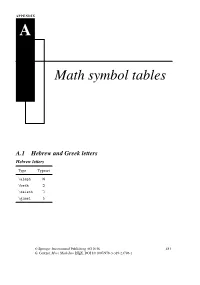
APPENDIX A Math symbol tables A.1 Hebrew and Greek letters Hebrew letters Type Typeset \aleph ℵ \beth ℶ \daleth ℸ \gimel ℷ © Springer International Publishing AG 2016 481 G. Grätzer, More Math Into LATEX, DOI 10.1007/978-3-319-23796-1 482 Appendix A Math symbol tables Greek letters Lowercase Type Typeset Type Typeset Type Typeset \alpha \iota \sigma \beta \kappa \tau \gamma \lambda \upsilon \delta \mu \phi \epsilon \nu \chi \zeta \xi \psi \eta \pi \omega \theta \rho \varepsilon \varpi \varsigma \vartheta \varrho \varphi \digamma ϝ \varkappa Uppercase Type Typeset Type Typeset Type Typeset \Gamma Γ \Xi Ξ \Phi Φ \Delta Δ \Pi Π \Psi Ψ \Theta Θ \Sigma Σ \Omega Ω \Lambda Λ \Upsilon Υ \varGamma \varXi \varPhi \varDelta \varPi \varPsi \varTheta \varSigma \varOmega \varLambda \varUpsilon A.2 Binary relations 483 A.2 Binary relations Type Typeset Type Typeset < < > > = = : ∶ \in ∈ \ni or \owns ∋ \leq or \le ≤ \geq or \ge ≥ \ll ≪ \gg ≫ \prec ≺ \succ ≻ \preceq ⪯ \succeq ⪰ \sim ∼ \approx ≈ \simeq ≃ \cong ≅ \equiv ≡ \doteq ≐ \subset ⊂ \supset ⊃ \subseteq ⊆ \supseteq ⊇ \sqsubseteq ⊑ \sqsupseteq ⊒ \smile ⌣ \frown ⌢ \perp ⟂ \models ⊧ \mid ∣ \parallel ∥ \vdash ⊢ \dashv ⊣ \propto ∝ \asymp ≍ \bowtie ⋈ \sqsubset ⊏ \sqsupset ⊐ \Join ⨝ Note the \colon command used in ∶ → 2, typed as f \colon x \to x^2 484 Appendix A Math symbol tables More binary relations Type Typeset Type Typeset \leqq ≦ \geqq ≧ \leqslant ⩽ \geqslant ⩾ \eqslantless ⪕ \eqslantgtr ⪖ \lesssim ≲ \gtrsim ≳ \lessapprox ⪅ \gtrapprox ⪆ \approxeq ≊ \lessdot -
Special Symbols in Graphs: Multiple Solutions Abhinav Srivastva, Gilead Sciences
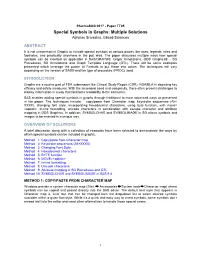
PharmaSUG 2017 - Paper TT05 Special Symbols in Graphs: Multiple Solutions Abhinav Srivastva, Gilead Sciences ABSTRACT It is not uncommon in Graphs to include special symbols at various places like axes, legends, titles and footnotes, and practically anywhere in the plot area. The paper discusses multiple ways how special symbols can be inserted as applicable in SAS/GRAPH®, Graph Annotations, ODS Graphics® - SG Procedures, SG Annotations and Graph Template Language (GTL). There will be some examples presented which leverage the power of Formats to put these into action. The techniques will vary depending on the version of SAS® and the type of procedure (PROC) used. INTRODUCTION Graphs are a routine part of FDA submission like Clinical Study Report (CSR), NDA/BLA in depicting key efficacy and safety measures. With the increased need and complexity, there often present challenges to display information in a way that facilitates readability to the consumer. SAS enables adding special symbols in graphs through traditional to more advanced ways as presented in the paper. The techniques include – copy/paste from Character map, keystroke sequences (Alt+ XXXX), changing font style, incorporating hexadecimal characters, using byte function, with move= <option>, In-line formatting, unicode characters in combination with escape character and attribute mapping in ODS Graphics. In addition, SYMBOLCHAR and SYMBOLIMAGE in SG allows symbols and images to be inserted in a unique way. OVERVIEW OF SOLUTIONS A brief discussion along with a collection of examples -

Adobe Framemaker 9 Character Sets
ADOBE®® FRAMEMAKER 9 Character Sets © 2008 Adobe Systems Incorporated. All rights reserved. Adobe® FrameMaker® 9 Character Sets for Windows® If this guide is distributed with software that includes an end-user agreement, this guide, as well as the software described in it, is furnished under license and may be used or copied only in accordance with the terms of such license. Except as permitted by any such license, no part of this guide may be reproduced, stored in a retrieval system, or trans- mitted, in any form or by any means, electronic, mechanical, recording, or otherwise, without the prior written permission of Adobe Systems Incorporated. Please note that the content in this guide is protected under copyright law even if it is not distributed with software that includes an end-user license agreement. The content of this guide is furnished for informational use only, is subject to change without notice, and should not be construed as a commitment by Adobe Systems Incorpo- rated. Adobe Systems Incorporated assumes no responsibility or liability for any errors or inaccuracies that may appear in the informational content contained in this guide. Please remember that existing artwork or images that you may want to include in your project may be protected under copyright law. The unauthorized incorporation of such material into your new work could be a violation of the rights of the copyright owner. Please be sure to obtain any permission required from the copyright owner. Any references to company names in sample templates are for demonstration purposes only and are not intended to refer to any actual organization. -

UK LINGUISTICS OLYMPIAD ROUND ONE, ADVANCED LEVEL, February 2011
UK LINGUISTICS OLYMPIAD ROUND ONE, ADVANCED LEVEL, February 2011 [Questions 1 and 2 are not used at Advanced level.] Question 3 Doubling in Caterpillar Country (11 marks) Arrernte is an Australian Aboriginal language, spoken mainly in the centre of the country, in and around Alice Springs. It is one of the largest Aboriginal languages, spoken by both adults and children and taught in schools such as the Yipirinya 1 School in Alice Springs. When written, Arrernte uses the same alphabet we use for English. Some combinations of letters signal special sounds, in the same way that English 'th' represents a sound that is not a combination of the 't' and 'h' sounds. For example, 'rr' represents the single sound of a rolled r and 'th' indicates a t-like sound with the tongue further forward, touching the back of the upper teeth. Use the (slightly simplified) examples of Arrernte verbs in the following table to answer the questions below, writing your answers in the answer sheet . Arrernte English gloss Arrernte English gloss atherreme 'is laughing' areme 'is looking' atherreke 'was laughing' areke 'was looking' atherreperreme 'keeps laughing' arelpareme 'starts to look' atheme 'is grinding' atakeme 'demolish’ atheke 'was grinding' atakepakeme 'keeps demolishing' athelpatheme 'starts to grind' atelpatakeme 'starts to demolish’ mpwareme 'is making' untheme 'is going along' mpwareke 'was making' unthepuntheme 'keeps going along' mpwarepareme 'keeps making' unthepuntheke 'kept going along' mpwelpempwareme 'starts to make' 3.1 (1 mark) What meaning is expressed by the ending -eme or -eke? 3.2 (3 marks) Arrernte speakers show that an action is frequent ('keeps on doing X') by adding extra elements (‘affixes’) to the verb and by doubling selected vowels and consonants in the word’s basic form (its ‘stem’). -

Transcription of Foreign Tongues
V.-TRANSCRIPTION OF FOREIGN TONGUES. By L. C. WHARTOK. [Read at the dleeting of the Philological rSociety on Friday, Dee. 4, 1925.1 TRANSCRIPTIONis made necessary for one sole reason, the absence of a single universally accepted alphabet, which would obviate all but a small portion of the problem which we have before us. How, for instance, is anyone to refer to events in world-history even in the most cursory and popular way if he is to avoid con- fusing his readers by using forms like “ Meer JaEer ” when quoting Macaulay and “ Mir Dschaffir ” when citing a German contemporary of Macaulay’s. Compare Erskine and Areskine with their nltmerous variants. How, too, is Hertzen, the son of the great Russian writer Iskender (Aleksandr Gertsen) to be perceived to belong to the same family as his father ? I have so far avoided quoting anything in foreign scripts and hope to avoid it in this the first part of my paper, reserving the bulk of it for the critical part. There are, then, certain purposes for which transcription is necessary; I group these under the following five heads, first remarking that I am quite deliberately postponing to a later stage the discussion of the distinction between transliteration and transcription. Now these five groups are as follows:- (a) bibliographical, (b) connected with library catalogues, (c) similarly connected with documentation, (d) connected with historical and other scientific (e.g. phonetic) research, and lastly (e) commercial. If I may, I will justify the addition of this last group first, though some may wish to classify my illustration under Documentation.