Lachnagrostis Adamsonii (Vickery) Swljacobs
Total Page:16
File Type:pdf, Size:1020Kb
Load more
Recommended publications
-
Muelleria Vol 32, 2014
Muelleria 33: 85–95 Published online in advance of the print edition, 21 April 2015. Nomenclature, variation and hybridisation in Rough Blown-grass (Poaceae: Lachnagrostis) Austin J. Brown National Herbarium of Victoria, Royal Botanic Gardens Melbourne, Birdwood Avenue, South Yarra 3141, Victoria, Australia; tel: +61 3 9252 2300; e-mail: austinjamesbrown@gmail.com Introduction Abstract Variation in Rough Blown-grass (also known as Ruddy, Even or Meagre The name Lachnagrostis scabra ‘(P. Blown-grass) has been previously examined by Brown (2006) with the Beauv.) Nees ex Steud.’ for Rough Blown-grass is found to be a result that Lachnagrostis aequata (Nees) S.W.L.Jacobs (syn. Agrostis misapplication of Lachnagrostis scabra aequata Nees) and L. scabra ‘(P.Beauv.) Nees ex Steud.’ (syn. Agrostis scabra Nees ex Steud. (currently known R.Br. non Willd.) were considered to be the same taxon. In addition, it was as Agrostis pilosula Trin.): an Asiatic found that the name L. aequata had been misapplied to a Tasmanian taxon not found in Australia. The montane taxon, which was subsequently described as L. morrisii A.J.Br. correct name for Rough Blown-grass is Lachnagrostis rudis (Roem. & Schult.) Recent doubt expressed in Tropicos (2014) and APC (2014) concerning Trin. A dwarf form of the species the status of Vilfa scabra P.Beauv. as a new name or a new combination from Flinders Island is described as for A. scabra Willd. or A. scabra R.Br. respectively, has initiated a closer L. rudis subsp. nana A.J.Br., based examination of the name L. scabra Nees ex Steud. -

Vascular Plant Survey of Vwaza Marsh Wildlife Reserve, Malawi
YIKA-VWAZA TRUST RESEARCH STUDY REPORT N (2017/18) Vascular Plant Survey of Vwaza Marsh Wildlife Reserve, Malawi By Sopani Sichinga (sksichinga@gmail.com) September , 2019 ABSTRACT In 2018 – 19, a survey on vascular plants was conducted in Vwaza Marsh Wildlife Reserve. The reserve is located in the north-western Malawi, covering an area of about 986 km2. Based on this survey, a total of 461 species from 76 families were recorded (i.e. 454 Angiosperms and 7 Pteridophyta). Of the total species recorded, 19 are exotics (of which 4 are reported to be invasive) while 1 species is considered threatened. The most dominant families were Fabaceae (80 species representing 17. 4%), Poaceae (53 species representing 11.5%), Rubiaceae (27 species representing 5.9 %), and Euphorbiaceae (24 species representing 5.2%). The annotated checklist includes scientific names, habit, habitat types and IUCN Red List status and is presented in section 5. i ACKNOLEDGEMENTS First and foremost, let me thank the Nyika–Vwaza Trust (UK) for funding this work. Without their financial support, this work would have not been materialized. The Department of National Parks and Wildlife (DNPW) Malawi through its Regional Office (N) is also thanked for the logistical support and accommodation throughout the entire study. Special thanks are due to my supervisor - Mr. George Zwide Nxumayo for his invaluable guidance. Mr. Thom McShane should also be thanked in a special way for sharing me some information, and sending me some documents about Vwaza which have contributed a lot to the success of this work. I extend my sincere thanks to the Vwaza Research Unit team for their assistance, especially during the field work. -
The 2014 Golden Gate National Parks Bioblitz - Data Management and the Event Species List Achieving a Quality Dataset from a Large Scale Event
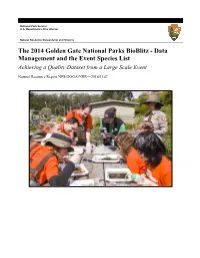
National Park Service U.S. Department of the Interior Natural Resource Stewardship and Science The 2014 Golden Gate National Parks BioBlitz - Data Management and the Event Species List Achieving a Quality Dataset from a Large Scale Event Natural Resource Report NPS/GOGA/NRR—2016/1147 ON THIS PAGE Photograph of BioBlitz participants conducting data entry into iNaturalist. Photograph courtesy of the National Park Service. ON THE COVER Photograph of BioBlitz participants collecting aquatic species data in the Presidio of San Francisco. Photograph courtesy of National Park Service. The 2014 Golden Gate National Parks BioBlitz - Data Management and the Event Species List Achieving a Quality Dataset from a Large Scale Event Natural Resource Report NPS/GOGA/NRR—2016/1147 Elizabeth Edson1, Michelle O’Herron1, Alison Forrestel2, Daniel George3 1Golden Gate Parks Conservancy Building 201 Fort Mason San Francisco, CA 94129 2National Park Service. Golden Gate National Recreation Area Fort Cronkhite, Bldg. 1061 Sausalito, CA 94965 3National Park Service. San Francisco Bay Area Network Inventory & Monitoring Program Manager Fort Cronkhite, Bldg. 1063 Sausalito, CA 94965 March 2016 U.S. Department of the Interior National Park Service Natural Resource Stewardship and Science Fort Collins, Colorado The National Park Service, Natural Resource Stewardship and Science office in Fort Collins, Colorado, publishes a range of reports that address natural resource topics. These reports are of interest and applicability to a broad audience in the National Park Service and others in natural resource management, including scientists, conservation and environmental constituencies, and the public. The Natural Resource Report Series is used to disseminate comprehensive information and analysis about natural resources and related topics concerning lands managed by the National Park Service. -
Improved Conservation Plant Materials Released by NRCS and Cooperators Through December 2014
Natural Resources Conservation Service Improved Conservation Plant Materials Released by Plant Materials Program NRCS and Cooperators through December 2014 Page intentionally left blank. Natural Resources Conservation Service Plant Materials Program Improved Conservation Plant Materials Released by NRCS and Cooperators Through December 2014 Norman A. Berg Plant Materials Center 8791 Beaver Dam Road Building 509, BARC-East Beltsville, Maryland 20705 U.S.A. Phone: (301) 504-8175 prepared by: Julie A. DePue Data Manager/Secretary Julie.DePue@md.usda.gov John M. Englert Plant Materials Program Leader John.Englert@wdc.usda.gov January 2015 Visit our Website: http://Plant-Materials.nrcs.usda.gov TABLE OF CONTENTS Topics Page Introduction ...........................................................................................................................................................1 Types of Plant Materials Releases ........................................................................................................................2 Sources of Plant Materials ....................................................................................................................................3 NRCS Conservation Plants Released in 2013 and 2014 .......................................................................................4 Complete Listing of Conservation Plants Released through December 2014 ......................................................6 Grasses ......................................................................................................................................................8 -
Genetic Diversity and Phylogeny in Hystrix (Poaceae, Triticeae) and Related Genera Inferred from Giemsa C-Banded Karyotypes
Genetics and Molecular Biology, 32, 3, 521-527 (2009) Copyright © 2009, Sociedade Brasileira de Genética. Printed in Brazil www.sbg.org.br Research Article Genetic diversity and phylogeny in Hystrix (Poaceae, Triticeae) and related genera inferred from Giemsa C-banded karyotypes Hai-Qin Zhang1,2, Rui-Wu Yang3, Li Zhang3, Chun-Bang Ding3, Jian Zeng1 and Yong-Hong Zhou1,2 1Triticeae Research Institute, Sichuan Agricultural University, Sichuan, China. 2Key Laboratory of Crop Genetic Resources and Improvement, Ministry of Education, Sichuan Agricultural University, Sichuan, China. 3College of Biology and Science, Sichuan Agricultural University, Sichuan, China. Abstract The phylogenetic relationships of 15 taxa from Hystrix and the related genera Leymus (NsXm), Elymus (StH), Pseudoroegneria (St), Hordeum (H), Psathyrostachys (Ns), and Thinopyrum (E) were examined by using the Giemsa C-banded karyotype. The Hy. patula C-banding pattern was similar to those of Elymus species, whereas C-banding patterns of the other Hystrix species were similar to those of Leymus species. The results suggest high genetic diversity within Hystrix, and support treating Hy. patula as E. hystrix L., and transferring Hy. coreana, Hy. duthiei ssp. duthiei and Hy. duthiei ssp. longearistata to the genus Leymus. On comparing C-banding patterns of Elymus species with their diploid ancestors (Pseudoroegneria and Hordeum), there are indications that certain chro- mosomal re-arrangements had previously occurred in the St and H genomes. Furthermore, a comparison of the C-banding patterns of the Hystrix and Leymus species with the potential diploid progenitors (Psathyrostachys and Thinopyrum) suggests that Hy. coreana and some Leymus species are closely related to the Ns genome of Psathyrostachys, whereas Hy. -
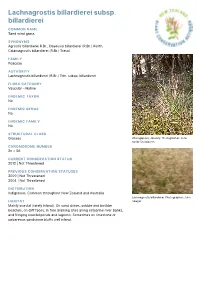
Lachnagrostis Billardierei Subsp. Billardierei
Lachnagrostis billardierei subsp. billardierei COMMON NAME Sand wind grass SYNONYMS Agrostis billardierei R.Br., Deyeuxia billardierei (R.Br.) Kunth, Calamagrostis billardierei (R.Br.) Steud. FAMILY Poaceae AUTHORITY Lachnagrostis billardierei (R.Br.) Trin. subsp. billardierei FLORA CATEGORY Vascular – Native ENDEMIC TAXON No ENDEMIC GENUS No ENDEMIC FAMILY No STRUCTURAL CLASS Grasses Whangapoua, January. Photographer: John Smith-Dodsworth CHROMOSOME NUMBER 2n = 56 CURRENT CONSERVATION STATUS 2012 | Not Threatened PREVIOUS CONSERVATION STATUSES 2009 | Not Threatened 2004 | Not Threatened DISTRIBUTION Indigenous. Common throughout New Zealand and Australia Lachnagrostis billardierei. Photographer: John HABITAT Sawyer Mainly coastal (rarely inland). On sand dunes, cobble and boulder beaches, on cliff faces, in free draining sites along estuarine river banks, and fringing coastal ponds and lagoons. Sometimes on limestone or calcareous sandstone bluffs well inland. FEATURES Stiffly tufted, glaucous to bluish-green perennial grass, 100-600 mm tall, with capillary-branched panicles sometimes overtopped by leaves. Branching intravaginal. Leaf-sheath papery, with wide membranous margins, closely striate, smooth but sometimes scaberulous above on nerves, light brown to amber. Ligule 1.0-4.5 mm, tapered above, entire to erose, undersides scabrid. Leaf-blade 50-240 x 2.5-10.0 mm, flat, harsh, scaberulous on ribs and on margins throughout, more or less abruptly narrowed to firm, more or less blunt, more or less cucullate apex. Culm 40-400 mm, erect, or decumbent at base, included within uppermost leaf-sheath, internodes densely finely scabrid. Panicle 60-240 x 100-240 mm, purple-green to wine-red, lax, with long, whorled, ascending branches, later spreading and panicle becoming as broad as long; rachis and branches scaberulous, spikelets single at tips of ultimate panicle branchlets, on pedicels thickened above. -

National Parks and Wildlife Act 1972.PDF
Version: 1.7.2015 South Australia National Parks and Wildlife Act 1972 An Act to provide for the establishment and management of reserves for public benefit and enjoyment; to provide for the conservation of wildlife in a natural environment; and for other purposes. Contents Part 1—Preliminary 1 Short title 5 Interpretation Part 2—Administration Division 1—General administrative powers 6 Constitution of Minister as a corporation sole 9 Power of acquisition 10 Research and investigations 11 Wildlife Conservation Fund 12 Delegation 13 Information to be included in annual report 14 Minister not to administer this Act Division 2—The Parks and Wilderness Council 15 Establishment and membership of Council 16 Terms and conditions of membership 17 Remuneration 18 Vacancies or defects in appointment of members 19 Direction and control of Minister 19A Proceedings of Council 19B Conflict of interest under Public Sector (Honesty and Accountability) Act 19C Functions of Council 19D Annual report Division 3—Appointment and powers of wardens 20 Appointment of wardens 21 Assistance to warden 22 Powers of wardens 23 Forfeiture 24 Hindering of wardens etc 24A Offences by wardens etc 25 Power of arrest 26 False representation [3.7.2015] This version is not published under the Legislation Revision and Publication Act 2002 1 National Parks and Wildlife Act 1972—1.7.2015 Contents Part 3—Reserves and sanctuaries Division 1—National parks 27 Constitution of national parks by statute 28 Constitution of national parks by proclamation 28A Certain co-managed national -
IAPT Chromosome Data 28
TAXON 67 (6) • December 2018: 1235–1245 Marhold & Kučera (eds.) • IAPT chromosome data 28 IAPT CHROMOSOME DATA IAPT chromosome data 28 Edited by Karol Marhold & Jaromír Kučera DOI https://doi.org/10.12705/676.39 Julio Rubén Daviña & Ana Isabel Honfi* Chromosome numbers counted by L. Delgado and ploidy level estimated by B. Rojas-Andrés and N. López-González; collectors: Programa de Estudios Florísticos y Genética Vegetal, Instituto AA = Antonio Abad, AT = Andreas Tribsch, BR = Blanca Rojas- de Biología Subtropical CONICET-Universidad Nacional de Andrés, DGL = David Gutiérrez Larruscain, DP = Daniel Pinto, JASA Misiones, nodo Posadas, Rivadavia 2370, 3300 Posadas, Argentina = José Ángel Sánchez Agudo, JPG = Julio Peñas de Giles, LMC = * Author for correspondence: ahonfi@gmail.com Luz Mª Muñoz Centeno, MO = M. Montserrat Martínez-Ortega, MS = María Santos Vicente, NLG = Noemí López-González, NPG = This study was supported by Agencia Nacional de Promoción Nélida Padilla-García, SA = Santiago Andrés, SB = Sara Barrios, VL Científica y Técnica (ANPCyT) grant nos. PICT-2014-2218 and PICT- = Víctor Lucía, XG = Ximena Giráldez. 2016-1637, and Consejo Nacional de Investigaciones Científicas y Técnicas (CONICET). This work has been supported by the Spanish Ministerio de Economía y Competitividad (projects CGL2009-07555, CGL2012- All materials CHN; collectors: D = J.R. Daviña, H = A.I. Honfi, 32574, Flora iberica VIII [CGL2008-02982-C03-02/CLI], Flora L = B. Leuenberger. iberica IX [CGL2011-28613-C03-03], Flora iberica X [CGL2014- 52787-C3-2-P]); the Spanish Ministerio de Ciencia e Innovación AMARYLLIDACEAE (Ph.D. grants to BR and NLG), and the University of Salamanca Habranthus barrosianus Hunz. -

KEY GRASS SPECIES in VEGETATION UNIT Gm 11: Rand Highveld Grassland in MPUMALANGA PROVINCE, SOUTH AFRICA
IDENTIFICATION OF KEY GRASS SPECIES IN VEGETATION UNIT Gm 11: Rand Highveld Grassland IN MPUMALANGA PROVINCE, SOUTH AFRICA Winston S.W. Trollope & Lynne A. Trollope 22 River Road, Kenton On Sea, 6191, South Africa Cell; 082 200 33373 Email: winfire@procomp.co.za INTRODUCTION Veld condition refers to the condition of the vegetation in relation to some functional characteristic/s (Trollope, et.al., 1990) and in the case of both livestock production and wildlife management based on grassland vegetation, comprises the potential of the grass sward to produce forage for grazers and its resistance to soil erosion as influenced by the basal and aerial cover of the grass sward. The following procedure was used for developing a key grass species technique for assessing veld condition in the vegetation type Gm 11: Rand Highveld Grassland (Mucina & Rutherford, 2006) in Mpumalanga Province – see Figure 1. Rand Highveld Grassland: Gm11 Figure 1: The Rand Highveld Grassland Gm11 vegetation type located in the highveld area east of Pretoria in Mpumalanga Province (Mucina & Rutherford, 2006). The identification of the key grass species is based on the procedure developed by Trollope (1990) viz.. Step 1: Identify and list all the grass species occurring in the study area noting their identification characteristics for use in the field. Step 2: Based on careful observations in the field and consultations with local land users, subjectively classify all the known grass species in the area into Decreaser and Increaser species according to their reaction to a grazing gradient i.e. from high to low grazing intensities, as follows: DECREASER SPECIES: Grass & herbaceous species that decrease when veld is under or over grazed; 2 INCREASER I SPECIES: Grass & herbaceous species that increase when veld is under grazed or selectively grazed; INCREASER II SPECIES: Grass & herbaceous species that increase when veld is over grazed. -

Do Weeds Hinder the Establishment of Native Plants on a Reclaimed North American Boreal Mine Site?
diversity Article Do Weeds Hinder the Establishment of Native Plants on a Reclaimed North American Boreal Mine Site? Kaitlyn E. Trepanier *, Brea Burton and Bradley D. Pinno * Department of Renewable Resources, University of Alberta, 442 Earth Sciences Building, Edmonton, AB T6G 2E3, Canada; brea@ualberta.ca * Correspondence: ktrepani@ualberta.ca (K.E.T.); bpinno@ualberta.ca (B.D.P.) Abstract: The majority of plant diversity in the boreal forest of northern Alberta, Canada is comprised of native understory plant species that are continuously facing competition from other species, including both undesirable native and weedy species. In oil sands mine reclamation, cover soils rich in organic matter are used to cap overburden materials. The aim of this study is to understand the role of weeds on different reclamation cover soils (forest floor-mineral mix and peat-mineral mix) and determine if they hinder the establishment of the native plant community. This study was conducted four growing seasons after site establishment in June 2019. At that time, both soil types had approximately 45% total cover, had 21 species per plot, and were composed of mainly native vegetation. Competition from non-native forbs (11% average cover, mainly Sonchus arvensis and Melilotus alba) did not seem to impact the development of the native vegetation community on either soil type given the high cover and richness of native forbs. However, native graminoids (predominantly Calamagrostis canadensis) were associated with reduced native forb cover and richness at graminoid cover greater than 17%. Overall, non-native forbs appeared to have little impact on the native forb community on either soil type while native graminoids had a negative influence. -

Vegetation Survey of Mount Gorongosa
VEGETATION SURVEY OF MOUNT GORONGOSA Tom Müller, Anthony Mapaura, Bart Wursten, Christopher Chapano, Petra Ballings & Robin Wild 2008 (published 2012) Occasional Publications in Biodiversity No. 23 VEGETATION SURVEY OF MOUNT GORONGOSA Tom Müller, Anthony Mapaura, Bart Wursten, Christopher Chapano, Petra Ballings & Robin Wild 2008 (published 2012) Occasional Publications in Biodiversity No. 23 Biodiversity Foundation for Africa P.O. Box FM730, Famona, Bulawayo, Zimbabwe Vegetation Survey of Mt Gorongosa, page 2 SUMMARY Mount Gorongosa is a large inselberg almost 700 sq. km in extent in central Mozambique. With a vertical relief of between 900 and 1400 m above the surrounding plain, the highest point is at 1863 m. The mountain consists of a Lower Zone (mainly below 1100 m altitude) containing settlements and over which the natural vegetation cover has been strongly modified by people, and an Upper Zone in which much of the natural vegetation is still well preserved. Both zones are very important to the hydrology of surrounding areas. Immediately adjacent to the mountain lies Gorongosa National Park, one of Mozambique's main conservation areas. A key issue in recent years has been whether and how to incorporate the upper parts of Mount Gorongosa above 700 m altitude into the existing National Park, which is primarily lowland. [These areas were eventually incorporated into the National Park in 2010.] In recent years the unique biodiversity and scenic beauty of Mount Gorongosa have come under severe threat from the destruction of natural vegetation. This is particularly acute as regards moist evergreen forest, the loss of which has accelerated to alarming proportions. -
Plant Species Associated with Some Asteraceae Plant and Edaphic Factor Effect Yasser A
DOI: 10.21276/sajb.2017.5.3.2 Scholars Academic Journal of Biosciences (SAJB) ISSN 2321-6883 (Online) Sch. Acad. J. Biosci., 2017; 5(3):125-147 ISSN 2347-9515 (Print) ©Scholars Academic and Scientific Publisher (An International Publisher for Academic and Scientific Resources) www.saspublisher.com Original Research Article Plant Species Associated with Some Asteraceae Plant and Edaphic Factor Effect Yasser A. El-Amier1,*, Sulaiman M. Alghanem2, Abd El-Nasser S. Al Borki3 1Botany Department, Faculty of Science, Mansoura University, Mansoura, Egypt 2Biology Department, Faculty of Science, Tabuk University, Tabuk, KSA 3Botany Department, Faculty of Science and Arts, Benghazi University, Agdabia, Libya. *Corresponding author Yasser A. El-Amier Email: yasran@mans.edu.eg Abstract: The family Asteraceae is the largest and the most cosmopolitan of the world particularly in semiarid region of the tropics and subtropics. In this present study investigate the ecology and edaphic factor effect of five species namely: Nauplius graveolens (Forssk.) Wiklund, Picris asplenioides L., Reichardia tingitana (L) Roth, Sonchus oleraceus L. and Urospermum picroides (L.) F.W. Schmidt. The study area is located in some selected governorates in the northern part of Nile Delta and Eastern Desert regions of Egypt. The total number of the recorded plant species in the present study was 182 species belonging to 144 genera and related to 37 families. Asteraceae contributing 18.13%, of all recorded species in the study area, followed by Poaceae, Chenopodiaceae, Fabaceae and Brassicaceae. The vegetation structure was classified by TWINSPAN classification into four groups. Group I was dominated by Retama raetam, group II was codominated by Diplotaxis harra and Bassia muricata, these groups represent the vegetation type of the inland desert.