In Recent Marine Molluscan Provinces
Total Page:16
File Type:pdf, Size:1020Kb
Load more
Recommended publications
-
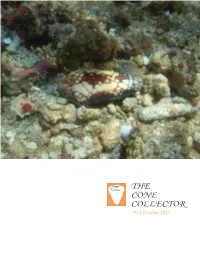
The Cone Collector N°23
THE CONE COLLECTOR #23 October 2013 THE Note from CONE the Editor COLLECTOR Dear friends, Editor The Cone scene is moving fast, with new papers being pub- António Monteiro lished on a regular basis, many of them containing descrip- tions of new species or studies of complex groups of species that Layout have baffled us for many years. A couple of books are also in André Poremski the making and they should prove of great interest to anyone Contributors interested in Cones. David P. Berschauer Pierre Escoubas Our bulletin aims at keeping everybody informed of the latest William J. Fenzan developments in the area, keeping a record of newly published R. Michael Filmer taxa and presenting our readers a wide range of articles with Michel Jolivet much and often exciting information. As always, I thank our Bernardino Monteiro many friends who contribute with texts, photos, information, Leo G. Ros comments, etc., helping us to make each new number so inter- Benito José Muñoz Sánchez David Touitou esting and valuable. Allan Vargas Jordy Wendriks The 3rd International Cone Meeting is also on the move. Do Alessandro Zanzi remember to mark it in your diaries for September 2014 (defi- nite date still to be announced) and to plan your trip to Ma- drid. This new event will undoubtedly be a huge success, just like the two former meetings in Stuttgart and La Rochelle. You will enjoy it and of course your presence is indispensable! For now, enjoy the new issue of TCC and be sure to let us have your opinions, views, comments, criticism… and even praise, if you feel so inclined. -

Maizeuianjusellm
MAizeuianJusellm PUBLISHED BY THE AMERICAN MUSEUM OF NATURAL HISTORY CENTRAL PARK WEST AT 79TH STREET, NEW YORK 24, N.Y. NUMBER 2202 DECEMBER I5, I964 Results of the Puritan-American Museum of Natural History Expedition to Western Mexico 20. The Recent Mollusks: Gastropoda: Harpidae, Vasidae, and Volutidae BY WILLIAM K. EMERSON' INTRODUCTION The present paper continues a study of the Recent marine mollusks collected in west Mexican waters during the course of the expedition. Previous reports considered the family Conidae (Emerson and Old, 1962), the superfamily Cypraeacea (Emerson and Old, 1963a), and the super- families Strombacea, Tonnacea, and Cymatiacea (Emerson and Old, 1963b). The present report treats the gastropod families Harpidae, Vasi- dae, and Volutidae. Specimens were taken by shore and intertidal collecting, by skin div- ing, and by dredging from a small skiff and from the schooner "Puritan." Dredging operations were restricted to depths no greater than 50 fathoms. The itinerary and descriptions of the collecting stations were recorded in the general account of the expedition (Emerson, 1958). The present collection contains three of the four eastern Pacific species that represent the families covered by this paper. An attempt is made to 1 Chairman, Department of Living Invertebrates, the American Museum of Natural His- tory. 2 AMERICAN MUSEUM NOVITATES NO. 2202 determine for the west Mexican region the modern and fossil distributions ofthese species. A new species of Vasum is described from the Pliocene de- posits of the Imperial formation of Imperial County, California. I am indebted to several people for assistance in the completion ofthis report. Dr. R. -
Opportunistic Suspension Feeding in the Intertidal Gastropod Olivella Columellaris and Its Implications for the Regulation of Tidal Migrations
Ciencias Marinas (2016), 42(4): 289–294 Research Note/Nota de Investigación http://dx.doi.org/10.7773/cm.v42i4.2640 C M Opportunistic suspension feeding in the intertidal gastropod Olivella columellaris and its implications for the regulation of tidal migrations Alimentación suspensívora oportunista del gasterópodo intermareal Olivella columellaris y sus implicaciones en la regulación de las migraciones mareales Aaron P Morse1, Winfried S Peters2, 3* 1 Department of Geosciences, Indiana/Purdue University Fort Wayne, 2101 East Coliseum Boulevard, Fort Wayne, IN 46805, USA. 2 Department of Biology, Indiana/Purdue University Fort Wayne, 2101 East Coliseum Boulevard, Fort Wayne, IN 46805, USA. 3 Goldring-Gund Marine Biology Station, Playa Grande, Santa Cruz, Guanacaste, Costa Rica. * Corresponding author. E-mail: petersw@ipfw.edu ABSTRACT. The gastropod Olivella columellaris inhabits sandy beaches of the Tropical East Pacific. These snails perform tidal migrations for continuous suspension feeding in the moving backwash zone, possibly controlled by an endogenous circatidal clock. However, O. columellaris readily modifies its circatidal behavior, for example when flow channels develop below natural and artificial tide pools at ebb tide. Suspension feeding continues in such channels while water is running, delaying tidal migration. Such behavioral plasticity questions the significance of endogenous rhythms for the regulation of tidal migrations in O. columellaris. Key words: Olivella columellaris, sandy beach intertidal zone, underwater sailing locomotion, endogenous clock, tidal migration. RESUMEN. El gasterópodo Olivella columellaris habita las playas arenosas del Pacífico Oriental Tropical. Estos caracoles suelen realizar migraciones mareales ya que se alimentan de partículas en suspensión en la zona de resaca que se mueve con la marea. -
What Can We Learn from Confusing Olivella Columellaris and O
Biota Neotrop., vol. 12, no. 2 What can we learn from confusing Olivella columellaris and O. semistriata (Olivellidae, Gastropoda), two key species in panamic sandy beach ecosystems? Alison I. Troost1, Samantha D. Rupert1, Ariel Z. Cyrus1,. Frank V Paladino1,2, Benjamin F. Dattilo3 & Winfried S. Peters1,2,4 1Department of Biology, Indiana/Purdue University Fort Wayne, 2101 East Coliseum Boulevard, Fort Wayne, IN 46805‑1499, USA 2Goldring Marine Biology Station, Playa Grande, Santa Cruz, Guanacaste, Costa Rica 3Department of Geosciences, Indiana/Purdue University Fort Wayne, 2101 East Coliseum Boulevard, Fort Wayne, IN 46805‑1499, USA 4Corresponding author: Winfried S. Peters, e‑mail: peters@ipfw.edu TROOST, A.I., RUPERT, S.D., CYRUS, A.Z., PALADINO, F.V., DATTILO, B.F. & PETERS, W.S. What can we learn from confusing Olivella columellaris and O. semistriata (Olivellidae, Gastropoda), two key species in panamic sandy beach ecosystems? Biota Neotrop. 12(2): http://www.biotaneotropica.org.br/v12n2/ en/abstract?article+bn02112022012 Abstract: Olivella columellaris (Sowerby 1825) and O. semistriata (Gray 1839) are suspension‑feeding, swash‑surfing snails on tropical sandy beaches of the east Pacific. While they often are the numerically dominant macrofaunal element in their habitats, their biology is poorly understood; the two species actually have been confused in all of the few publications that address their ecology. Frequent misidentifications in publications and collections contributed also to an overestimation of the geographic overlap of the two species. To provide a sound taxonomic basis for further functional, ecological, and evolutionary investigations, we evaluated the validity of diagnostic traits in wild populations and museum collections, and defined workable identification criteria. -

Morphology of Two Deep-Sea Olivella from the Southwestern Atlantic, with a Record of a Radula-Less Olivellinae Species (Neogastropoda: Olivoidea: Olividae)
Archiv für Molluskenkunde 150 (1) 31–43 Frankfurt am Main, 30 June 2021 Morphology of two deep-sea Olivella from the southwestern Atlantic, with a record of a radula-less Olivellinae species (Neogastropoda: Olivoidea: Olividae) Alexandre Dias Pimenta1 & Luiz Ricardo Lopes Simone2 1 Departamento de Invertebrados, Museu Nacional, Universidade Federal do Rio de Janeiro, Quinta da Boa Vista, São Cristóvão, 20940-040, Rio de Janeiro, Brazil (alexpim@mn.ufrj.br). https://orcid.org/0000-0001-7001-5820 2 Museu de Zoologia da Universidade de São Paulo, Avenida Nazaré, 481, Ipiranga, 04263-000, São Paulo, Brazil (lrsimone@usp.br). https://orcid.org/0000-0002-1397-9823 • Corresponding author: A.D. Pimenta. Abstract. Two deep-sea species from southeast Brazil, originally assigned to different subgenera ofOli - vella, are anatomically described. Olivella (Olivina) klappenbachi and Olivella (Anasser) careorugula, both described by Absalão & Pimenta (2003), present typical Olivellinae anatomy, with internal absorp tion of the shell wall and a non-spiralized visceral mass, the absence of a valve of Leiblein and gland of Leiblein, and a large cuticularized and muscular stomach. Olivella klappenbachi presents the typical radular morphology of Olivellinae, while Olivella careorugula lacks a radula and odontophore, which is unique among known olivids. A well-founded phylogenetic classification of Olivella at the generic/ subgeneric level is still lacking, and the numerous proposed subgenera are mostly based on the structure of the pillar. A broader taxonomic -

PREY PREFERENCE and PREDATORY BEHAVIOR of Aurantilaria Aurantiaca (MOLLUSCA: GASTROPODA: FASCIOLARIIDAE)
PREY PREFERENCE AND PREDATORY BEHAVIOR OF Aurantilaria aurantiaca (MOLLUSCA: GASTROPODA: FASCIOLARIIDAE) Preferência de presa e comportamento predatório de Aurantilaria aurantiaca (MOLLUSCA: GASTROPODA: Arquivos de Ciências do Mar FASCIOLARIIDAE) Carlos Augusto Oliveira de Meirelles1,3, Helena Matthews-Cascon1,2 RESUMO A família Fasciolariidae é formada por espécies carnívoras que usualmente predam outros gastrópodes e bivalves. Geralmente utilizam como estratégia de predação, o lascamento de concha, meio pelo qual o predador pode alcançar as partes moles da presa. Os objetivos desse trabalho foram determinar as possíveis presas de Aurantilaria aurantiaca da Praia do Pacheco (Caucaia-CE-Brasil) e a sua preferência alimentar em condições de laboratório. As presas observadas foram os gastrópodes Pisania pusio, Tegula viridula e Stramonita brasiliensis. O experimento de preferência de presa foi executado acondicionando um predador em um aquário de 5 litros com um indivíduo de cada presa, sendo observado durante 60 dias (replicado 10 vezes). Para a determinação do tempo de manipulação da presa, um predador foi acondicionado em uma caixa plástica mergulhada em um aquário de 80 litros juntamente com uma espécie de presa, sendo anotado o tempo de predação por duas 2 horas, durante 30 dias (replicado 10 vezes para cada espécie de presa). Aurantilaria aurantiaca mostrou preferência por Stramonita brasiliensis, o qual teve o mais baixo tempo de manipulação da presa. Pisania pusio e Tegula viridula não apresentaram resultados estatisticamente significativos (p = 0.7235 e 0.2499, respectivamente). O comportamento predatório mostrou 2 estratégias: penetração direta da probóscide e sufocamento. Não houve registro de lascamento de concha. Aurantilaria aurantiaca apresentou-se como um predador generalista, onde a variação de tempo de manipulação da presa mostrou que o predador passou por um processo de aprendizagem. -

Epibiotic Community of Tegula Viridula (Gastropoda: Trochidae) in Southeastern Brazil
Strombus 18(1-2): 1-14, Jan-dez. 2011 ISSN 1415-2827 (print edition) www.conchasbrasil.org.br/strombus/ Strombus Copyright © 2011 Conquiliologistas do Brasil ISSN 1983-2214 (online edition) Epibiotic community of Tegula viridula (Gastropoda: Trochidae) in southeastern Brazil Vanessa Fontoura-da-Silva¹; Jéssica B. Carneiro¹,² & Carlos H. S. Caetano¹ ¹Universidade Federal do Estado do Rio de Janeiro, Laboratório de Zoologia de Invertebrados Marinhos, Departamento de Zoologia, Av. Pasteur, 458, sala 309, Urca, Rio de Janeiro, RJ, 22290-240. ²Universidade do Estado do Rio de Janeiro, Laboratório de Malacologia Límnica e Terrestre, Departamento de Zoologia, Rua São Francisco Xavier, 524, Pav. Haroldo Lisboa da Cunha, sala 525/2. Rio de Janeiro, RJ, 20550-900.e-mail: vanessa_fontoura@globo.com Abstract In this investigation, we present data on composition, frequency of occurrence, volume and weight of the epibiotic community on the snail Tegula viridula (Gmelin, 1791) from Flexeiras beach, Itacuruçá Island, Rio de Janeiro, Brazil. Epibionts found were algae, bryozoans, barnacles, polyplacophorans, polichaete worm tubes, and oysters. Epibionts were found on 82.17% of T. viridula individuals examined, barnacles being the most frequent (64%), followed by polychaetes, algae and oysters. The months of June (2010) and January (2011) had the highest percentages of epibioses recorded: 95.35% and 93.68%, respectively. The percentage of epibionts was positively correlated to the length of the shell. Types of epibionts changed according to length variation of shells. Epibionts also significantly increased the weight and volume of shells. Keywords: Epibiosis, Incrustation, Mollusca, Sepetiba Bay. Resumo Neste trabalho apresentamos dados da composição, frequência de ocorrência, volume e peso da comunidade de epibiontes do caramujo Tegula viridula (Gmelin, 1791) na praia das Flexeiras, Ilha de Itacuruçá, Rio de Janeiro, Brasil. -

Diversidade De Moluscos Marinhos Do Litoral Piauiense
Vol. 1 | nº 1 | ID 76 DIVERSIDADE DE MOLUSCOS MARINHOS DO LITORAL PIAUIENSE LIMA, Mariana Soares1; GONÇALVES, José Nilton de Araújo2; ROCHA, Wáldima Alves da3 RESUMO Os moluscos são animais pertencentes ao filo Mollusca e estão presentes em quase todos os ambientes do globo terrestre, eles estão distribuídos em oito classes, a saber: Gastropoda, Bivalvia, Cephalopoda, Monoplacophora, Polyplacophora, Scaphopoda, Solenogaster e Caudofoveata. Além de serem considerados bioindicadores de poluição em ambientes aquáticos, estes animais são indispensáveis para o bem estar e saúde do ser humano por diversas razões, dentre elas é possível citar o fornecimento de material para alimentícios e fármacos, e a realização de serviços ecossistêmicos imprescindíveis para o funcionamento adequado do planeta. Este trabalho teve por objetivo conhecer a fauna de moluscos do litoral do Piaui. As coletas do material foram realizadas nos anos de 2017 e 2019, durante cinco dias de coletas cada, em dois pontos distintos do litoral Piauiense: a Praia do Coqueiro (município de Luis Correia) e a Praia de Barra Grande (município de Cajueiro da Praia). Os moluscos foram coletados manualmente em horários de maré baixa. Foram fixados com formaldeído a 10%, preservados em álcool 70% e levados para o Laboratório de Zoologia da Universidade Federal do Piauí, Campus Senador Helvídio Nunes de Barros, onde o material foi triado e identificado de acordo com a literatura específica. Até o momento já foram identificadas 18 espécies distribuídas entre as classes Polyplacophora -

Comparative Anatomy of the Fasciolariids Pustulatirus Ogum and Hemipolygona Beckyae from Brazil (Gastropoda: Buccinoidea: Peristerniinae)
SCIENTIA MARINA 79(1) March 2015, 000-000, Barcelona (Spain) ISSN-L: 0214-8358 doi: http://dx.doi.org/10.3989/scimar.04144.08A Comparative anatomy of the fasciolariids Pustulatirus ogum and Hemipolygona beckyae from Brazil (Gastropoda: Buccinoidea: Peristerniinae) Diogo R. Couto 1, Luiz R. L. R. Simone 1, Alexandre D. Pimenta 2 1 Laboratório de Malacologia, Museu de Zoologia da Universidade de São Paulo. Avenida Nazaré, 481, Ipiranga. CEP 04263-000 São Paulo, SP, Brazil. E-mail: diogoaut@gmail.com 2 Setor de Malacologia, Departamento de Invertebrados, Museu Nacional, Universidade Federal do Rio de Janeiro. Quinta da Boa Vista s/n, São Cristóvão. CEP 20940-040 Rio de Janeiro, RJ, Brazil. Summary: The Brazilian species Pustulatirus ogum and Hemipolygona beckyae were examined, and certain morphologi- cal characters were described. Both species were originally assigned to the genus Latirus, considered as a heterogeneous complex. The radulae of both species are like that which characterizes Latirus, in which the innermost cusp of the rachidian tooth is well developed but always smaller than the other cusps. This feature differs from Leucozonia, in which this cusp is reduced or absent. The penis tapers terminally, and the tapered part may be long (more than half the total penis length), as in H. beckyae, or very short (less than half the total penis length), as in P. ogum. The anatomical data observed in both species are discussed under the framework of fasciolariid systematics and they appear to be widespread among other fasciolariid spe- cies. For this reason, to date, the soft-part features here provided and those known from previously studied species of Latirus are not useful for delineating precise generic diagnoses. -

A New Species of Enaeta (Gastropoda:Volutidae) from the Mio-Pliocene of Northwestern Ecuador William D
A NEW SPECIES OF ENAETA (GASTROPODA:VOLUTIDAE) FROM THE MIO-PLIOCENE OF NORTHWESTERN ECUADOR WILLIAM D. PITT 1 ·~ and LOIS J. PITT<! ABSTRACT Brazil; E. guildingi (Sowerby, 1844, p. Two species of Enaeta occur in the Re 151), Antilles to Brazil; and E. reevei (Dall, cent fauna of the Tropical East Pacific: E. 1907, p. 353), Cuba to Honduras. There are cumingii (Broderip, 1832), and E. barnesii two species in the Recent Tropical East (Gray, 1825). The fossil record from the Pacific: E. cumingii (Broderip, 1832, p. Tropical East Pacific is represented by E. 33), and E. barnesii (Gray, 1825, p. 511); barnesii from the Pleistocene of Panama, both occur from the Gulf of California to and a new species, E. propecumingii from Peru. the Miocene Angostura Formation and the Enaeta propecumingii, n. sp., from the Pliocene Esmeraldas beds, Onzole Forma Late Miocene Angostura Formation of tion, of northwestern Ecuador. The oc northwestern Ecuador, is the earliest currence of E. propecumingii in the Angos known fossil record of the genus Enaeta in tura Formation is the oldest known fossil the Tropical East Pacific. The genus Lyria record of the genus Enaeta in the Tropical s.s. is known from older formations in the East Pacific. eastern Pacific, as far north as the state of Washington (Weaver, 1942) but not in the INTRODUCTION Tropical East Pacific. The genus Enaeta Adams and Adams, In the geological record there are more 1853, which has sometimes been consi species of the genus Enaeta in the western dered a subgenus of Lyria (Keen, 1971, p. -

A Review of Biogeography and Biodiversity of Western Atlantic Mollusks by Edward J
ISSN 2325-1808 (PRINT) 2325-1840 (ONLINE) http://conchologia.com NumbER Thirteen 4 june 2013 A review of Biogeography and biodiversity of western Atlantic mollusks by Edward J. Petuch. Richard E. Petit 806 Saint Charles Road North Myrtle Beach, SC 29582 r.e.petit@att.net Biogeography and biodiversity of western Atlan- methodologies” must refer to the “algorithms” tic mollusks by Edward J. Petuch used to determine the percentage of endemism in 2013. CRC Press/Taylor & Francis Group the groups selected. This will be discussed later in Boca Raton, Florida. xvii + 234 pp. $159.95 this review. Introduction One chapter is devoted to each of fifteen subprovinces, some of them newly named or re- This work introduces a new biogeographic sys- fined. There are two appendices. Appendix 1 lists tem for western Atlantic mollusks based on quan- the taxa used in the provincial and subprovincial titative analysis of endemism in selected families analyses and Appendix 2 contains descriptions of of gastropods. The blurb on the back cover states: eleven new genera and subgenera and thirty-one “[This is] the first book to use quantitative meth- new species and subspecies. odologies to define marine molluscan biogeographical patterns” and “the author’s algo- As this review will show, although some intri- rithms demonstrate that the bulk of molluscan guing ideas are presented in this work it is rid- biodiversity is concentrated in forty separate cen- dled with errors that cast doubt on its reliability ters of speciation, ranging from Cape Hatteras, as does the fact that it is based entirely on large North Carolina, south to Argentina.” The author gastropods, which constitute only a small per- reviews prior biogeographic treatments and di- centage of the total western Atlantic molluscan vides the tropical western Atlantic fauna into fauna. -

Florida Keys Species List
FKNMS Species List A B C D E F G H I J K L M N O P Q R S T 1 Marine and Terrestrial Species of the Florida Keys 2 Phylum Subphylum Class Subclass Order Suborder Infraorder Superfamily Family Scientific Name Common Name Notes 3 1 Porifera (Sponges) Demospongia Dictyoceratida Spongiidae Euryspongia rosea species from G.P. Schmahl, BNP survey 4 2 Fasciospongia cerebriformis species from G.P. Schmahl, BNP survey 5 3 Hippospongia gossypina Velvet sponge 6 4 Hippospongia lachne Sheepswool sponge 7 5 Oligoceras violacea Tortugas survey, Wheaton list 8 6 Spongia barbara Yellow sponge 9 7 Spongia graminea Glove sponge 10 8 Spongia obscura Grass sponge 11 9 Spongia sterea Wire sponge 12 10 Irciniidae Ircinia campana Vase sponge 13 11 Ircinia felix Stinker sponge 14 12 Ircinia cf. Ramosa species from G.P. Schmahl, BNP survey 15 13 Ircinia strobilina Black-ball sponge 16 14 Smenospongia aurea species from G.P. Schmahl, BNP survey, Tortugas survey, Wheaton list 17 15 Thorecta horridus recorded from Keys by Wiedenmayer 18 16 Dendroceratida Dysideidae Dysidea etheria species from G.P. Schmahl, BNP survey; Tortugas survey, Wheaton list 19 17 Dysidea fragilis species from G.P. Schmahl, BNP survey; Tortugas survey, Wheaton list 20 18 Dysidea janiae species from G.P. Schmahl, BNP survey; Tortugas survey, Wheaton list 21 19 Dysidea variabilis species from G.P. Schmahl, BNP survey 22 20 Verongida Druinellidae Pseudoceratina crassa Branching tube sponge 23 21 Aplysinidae Aplysina archeri species from G.P. Schmahl, BNP survey 24 22 Aplysina cauliformis Row pore rope sponge 25 23 Aplysina fistularis Yellow tube sponge 26 24 Aplysina lacunosa 27 25 Verongula rigida Pitted sponge 28 26 Darwinellidae Aplysilla sulfurea species from G.P.