11O Διεθνές Σεμινάριο-Συνάντηση Για Το Ρεμπέτικο 11Th International
Total Page:16
File Type:pdf, Size:1020Kb
Load more
Recommended publications
-

“Aman Aman !” the Music of the Turkish & Greek Café
DÜNYA presents “Aman Aman !” The Music of the Turkish & Greek Café directed by Mehmet Ali Sanlıkol and George Lernis featuring DÜNYA and Pharos ensembles with Panos Aivazidis, kanun, Beth Bahia Cohen, violin, Burcu Güleç, voice, Vasilis Kostas, laouto, George Lernis, percussion, Mehmet Ali Sanlıkol, voice, ud, saz, and Eirini Tornesaki, voice October 30, 2018, 7:30pm, MIT Bartos Theatre I Our program is designed to take it’s audiences on a musical journey where they will be introduced to the Turkish coffeehouse and the Greek Kafe Aman repertoires. The tittle “Aman Aman !” was thoughtfully chosen since “Aman” is an expression that is commonly used in daily life by Turks and Greeks and can indicate a number of moods/feelings including gratitude, surprise, joy and sorrow. Furthermore, this expression is used by audiences to acknowledge the craftsmanship of musicians during an instrumental or vocal improvisation as well. In fact, particularly among Greek people, a vocal improvisation is called an “Amane”. Our repertoire includes late classical Ottoman/Turkish music, urban folk songs from Turkey, songs representing the Kafe Aman style from mainland Greece as well as early Rembetika songs. PROGRAM Part I: The Ottoman Kahvehane with DÜNYA Ensemble BAŞ TAKSİM (opening instrumental improvisation) Rast Peşrev (instrumental prelude) by Tatyos Efendi (1858-1913) Nihansın dideden by Hacı Faik Bey (1831-1891) Bakmıyor çeşm-i siyah by Hacı Arif Bey (1831-1885) ARA TAKSİM (improvisational interlude) Sigaramın dumanı Anonymous Bağlamamın düğümü Anonymous -

Markos Vamvakaris : the Man and the Bouzouki
Markos Vamvakaris : The Man and the Bouzouki. Autobiography PDF Author: Noonie Minogue Pages: 320 pages ISBN: 9780993263309 Markos Vamvakaris, born in 1905 in Syros was a pioneer of rebetiko, the urban folk music of Greece. The bouzouki was a disreputable instrument but he paved its path to glory. He spent many years, first as a stevedore in the port of Piraeus and then as a butcher in the slaughterhouse. During this time he fell in love with a tigress, his first wife, he learnt to smoke hashish and to play the 'sacred' instrument: 'I had a great passion. My life was all bouzouki. It took me over - but it also took me up in the world, way up ...' This is the first ever translation into English of the autobiography compiled by Angeliki Vellou Keil in 1972. It opens a window onto a time of extraordinary creativity in the history of Greek music, an explosion of songwriting in the interwar period. Its composers wrote about themselves and each other, the rituals of hashish smoking and the landmarks of a now vanished city. Markos the repentant sinner and living legend, looks back at childhood idylls in Syros, the arrival of the Asia Minor refugees, the terrible years of the Nazi Occupation, the ceaseless love affairs and disappointments, and the triumphs of the bouzouki. He offers a rare insight into the lives of toiling workers and the lowlife of one of the world's most ancient ports, where East meets West. Out of this melting pot he produced the classic songs that Greeks of all ages still love and know by heart. -
VINICIO CAPOSSELA from Tefteri: a Settling of Scores
VINICIO CAPOSSELA From Tefteri: A Settling of Scores (non- fiction) Translated from the Italian by Elettra Pauletto Athens, March 2012 The word “crisis” comes from the Greek kríno, which means to sep- arate, sort, divide. Crisis is a concept that lends itself well to rebetiko— a type of music born of separation—and to Greece, from which Europe is pulling away, driven by the disdain that lies at the root of all rejection. People often speak of Greece with language that evokes tragedy, which, as a genre, was invented there. The word “tragedy” comes from the Greek tragudi, or song, and at its root is tragos, which means goat. Tragodia, song of the goat. Once the cultural mother of Europe, Greece has become a scapegoat for her sins. Europa, daughter to a king of Crete, seduced by Zeus. Europa of the “wide eyes,” land of the west, ever facing the setting sun. Since ancient times, Greek creations have been permeated with a sense of universality. Taken together, this body of work tells the story of man, the anthropos. And it tells the story of man and destiny, of what is happening to Westerners in this moment of “crisis,” of choices. Let’s travel there, a small tool in hand— a thyrsus, perhaps— and accompanied by music born of catastrophe. Greeks still use the word Katastrofis to describe the Greco- Turkish war of 1922, the destruction of Smyrna, and the exodus of the Greeks from Asia Minor. These million and a half refugees were the ones who, following the treaty of Lausanne, returned destitute to a motherland that no longer wanted them; brought back with them the music and customs of other places; and gathered in suburban neighborhoods, changing the social fabric of 1920s Athens (then dubbed the “Paris of the Eastern Mediterranean” by the young Greek state, which wanted to westernize Greek culture). -
Festival Nous Sommes Grecs
MUSIQUE DU MONDE FESTIVAL NOUS SOMMES GRECS 2ème ÉDITION MUSIQUE CINÉMA DANSE Du JE. 9 au DI. 12 JUIN 2016 © David Prudhomme éditeur responsable : Colette Njomgang - Fonkeu 18 avenue du Maelbeek - 1040 Bruxelles 18 avenue Colette Njomgang - Fonkeu éditeur responsable : MUSIQUE DU MONDE Nous revoilà ! Vous aimez la musique, la danse, le théâtre d’ombre, le documentaire… l’ouzo et les petits mezzes ? Pour sa deuxième édition, Nous Sommes Grecs continue à marier traditions et créations contemporaines. En collaboration avec le Senghor, il vous présente des personnalités venant d’horizons divers, pas toujours grecques d’ailleurs, qui vous feront découvrir de nouvelles sonorités. Exposition et musiques vivantes animeront le bar du Senghor tandis que théâtre d’ombre, documentaires, workshops et musique se partageront les salles. © David Prudhomme Jeudi 9 juin 20h : Ross Daly & Kelly Thoma / Efren Lopez & Michalis Kouloumis ROSS DALY Longtemps nomade, l'irlandais Ross Daly s'est fixé en Grèce au milieu des années 70 en épousant les contours et les profondeurs de la riche culture musicale de ce pays sans jamais cesser d'être un artiste profondément original. Près d’Héraklion, Ross Daly a monté un centre où il organise des concerts, des master class et un musée d’instruments de musique. Sa curiosité le pousse à travailler avec des musiciens de tous horizons, comme la famille de percussions iraniennes Chemirani, le chanteur breton Erik Marchand, le joueur de sarangui indien Dhruba Ghosh ou les musiciens chamanes de la république de Tuva Huun Huur Tuu. En 2004, il fut le directeur artistique du programme culturel des jeux olympiques à Heraklion. -

The Rembetiko Music
The Rembetiko Music Rembetiko music is a very popular genre of Greek Folk music. It is often called the Greek form of blues music, because it was merely formed in the same social background. Although it is not played that much anymore, its melodies, harmonies and scales have been a big influence for Greek music since. That is why I chose to do a popular, not only in Greece, but around the world too. research on its history and on its particular musical characteristics, that made it so Definition of Rembetiko Rembetiko is the music played by the mbe Although musicologists are not logy, they describe there so-tes. as vagrant, tainted, marginalsure about thepeople, terms oretymo people from the underworld.called Theyrembetes were mostly people who gathered in small cafes and tekes to smoke hashish, drink alcohol and play songs, in order to ex The ensembles occurring from those cafes would look somethingpress theirlike the lifes picture suffering. on the right (Photo ). The most significant rempetologist was Elias Petropoulos. of the Rembetes of Karaiskaki taken in Peiraious 19 History and evolution of Rembetiko Rembetiko started in the so-called aman-cafis and the tekedes (places where people gathered to smoke hashish) in Greece but mainly in Asia Minor. Those were cafes, that started appearing in 1873 and in which there was live music. The main form amanedes , which were turkish, often improvised and highly melismatic songs, in which or something (usually about hashish, narghiles andof music love-stories) were is expressed. Ensembles, consisting of a combination of the folowing instruments : santouris,the singers ouds, suffering laouds, flutesf or violins, were accompanying the singers. -
Dissertation / Doctoral Thesis
DISSERTATION / DOCTORAL THESIS Titel der Dissertation /Title of the Doctoral Thesis „Karagiozis – Schattenspiel und Politik: Der griechische Karagiozisspieler Sotiris Spatharis“ verfasst von / submitted by Mag. Fatma Peri Efe angestrebter akademischer Grad / in partial fulfilment of the requirements for the degree of Doktorin der Philosophie (Dr. Phil.) Wien, 2017 / Vienna 2017 Studienkennzahl lt. Studienblatt / A 092 383 degree programme code as it appears on the student record sheet: Dissertationsgebiet lt. Studienblatt / Byzantinistik und Neogräzistik field of study as it appears on the student record sheet: Betreut von / Supervisor: Univ. Prof. Dr. Maria A. Stassinopoulou DANKSAGUNG Die Vorbereitungen für diese Arbeit, zu denen auch einige Publikationen zum Thema gehörten, erstreckten sich über eine lange Periode, die Niederschrift meiner Dissertation hingegen erfolgte binnen eines Jahres und fiel, wie ich leider sagen muss, in eine schwere Zeit. Die Probleme in meinem Land machten es mir mitunter schwer, mich auf meine Arbeit zu konzentrieren und ließen des Öfteren Zweifel an der Sinnhaftigkeit dieses Unterfangens aufkommen. Dass ich die Arbeit schließlich doch zu Ende führen konnte, liegt daran, dass es Menschen gab, die mir außerordentlich viel Unterstützung, Hilfe und Zuspruch zuteil werden ließen. Ihnen möchte ich an dieser Stelle meinen herzlichen Dank aussprechen. An erster Stelle seien meine Betreuerin Univ. Prof. Dr. Maria A. Stassinopoulou und meine Begutachterin Ao. Prof. Dr. Claudia Römer genannt. Prof. Stassinopoulou, die mir mit viel Geduld und Verständnis zur Seite stand, danke ich für ihre wertvollen Kommentare und Gedanken und ihr Interesse an dem Thema meiner Arbeit. Bei Prof. Römer bedanke ich mich dafür, dass sie mich den gesamten Entstehungsprozess hindurch sowohl persönlich als auch wissenschaftlich, durch ihre Ermutigung und ihre Hilfsbereitschaft, immer unterstützt hat. -
Composer and Lyricist
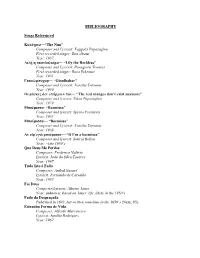
BIBLIOGRAPHY Songs Referenced Καλόγρια—“The Nun” Composer and Lyricist: Vaggelis Papazoglou First recorded singer: Rita Abatzi Year: 1937 Λιλή η σκανδαλιάρα— “Lily the Reckless” Composer and Lyricist: Panagiotis Tountas First recorded singer: Roza Eskenazi Year: 1931 Γκιούλµπαχαρ— “Gioulbahar” Composer and Lyricist: Vassilis Tsitsanis Year: 1950 Οι µάγκες δεν υπάρχουν πια— “The real manges don’t exist anymore” Composer and lyricist: Nikos Papazoglou Year: 1979 Μποέµισσα- “Boemissa” Composer and lyricist: Spyros Peristeris Year: 1933 Μποέµισσα— “Boemissa” Composer and Lyricist: Vassilis Tsitsanis Year: 1938 Αν είµ’εγώ µποέµισσα— “If I’m a boemissa” Composer and lyricist: Sotiria Bellou Year: ~late 1950’s Que Deus Me Perdoe Composer: Frederico Valério Lyricist: João da Silva Tavares Year: 1967 Tudo Isto é Fado Composer: Aníbal Nazaré Lyricist: Fernando de Carvalho Year: 1957 Foi Deus Composer/Lyricist: Alberto Janes Year: unknown; based on Janes’ life, likely in the 1950’s Fado da Desgraçada Published in 1893, but written sometime in the 1850’s (Nery, 85). Estranha Forma de Vida Composer: Alfredo Marceneiro Lyricist: Amália Rodrigues Year: 1967 Works Referenced Adimidou, Sofia (Αδαμίδου, Σοφία). 1998. Σωτηρία Μπέλλου, Πότε ντόρτια, πότε εξάρες. Αθήνα: Νέα Σύνορα / Α. Α. Λιβάνη. Bakhtin Michail Michajlovič., and Iswolsky Hélène. 1984. Rabelais and His World. Indiana University Press. Butler, Judith. 1990. “Gender Trouble.” In Norton Anthology of Theory and Criticism, edited by Vincent B. Leitch, 2485-2501. Norton & Company Limited, W.W., 2018. Cook, Manuela. 2003. “The Woman in Portuguese Fado-Singing.” International Journal of Iberian Studies, vol. 16, no. 1, Intellect, , pp. 19–32, doi:10.1386/ijis.16.1.19/0. Colvin, Michael. -

Music, Image, and Identity: Rebetiko and Greek National Identity
Universiteit van Amsterdam Graduate School for Humanities Music, Image, and Identity: Rebetiko and Greek National Identity Alexia Kallergi Panopoulou Student number: 11655631 MA Thesis in European Studies, Identity and Integration track Name of supervisor: Dr. Krisztina Lajosi-Moore Name of second reader: Prof. dr. Joep Leerssen September 2018 2 Table of Contents Introduction ......................................................................................................................... 4 Chapter 1 .............................................................................................................................. 6 1.1 Theory and Methodology ........................................................................................................ 6 Chapter 2. ........................................................................................................................... 11 2.1 The history of Rebetiko ......................................................................................................... 11 2.1.1 Kleftiko songs: Klephts and Armatoloi ............................................................................... 11 2.1.2 The Period of the Klephts Song .......................................................................................... 15 2.2 Rebetiko Songs...................................................................................................................... 18 2.3 Rebetiko periods .................................................................................................................. -

Syra of Markos Vamvakaris He Municipality of Syros - Er- Moupolis and the Cyclades Tchamber, Proudly Present the 3Rd Rembetiko Festival «Syra of Markos Vamvakaris»
Syros - Culture 2018 3rd Rembetiko Festival Syra of Markos Vamvakaris he Municipality of Syros - Er- moupolis and the Cyclades TChamber, proudly present the 3rd Rembetiko Festival «Syra of Markos Vamvakaris». As in previous years, the 3rd Rebetiko his year’s event is taking place folk character, its direct connection to Festival of 2018 includes a full program under the support and aegis of both local language and dance, the of events on popular urban music («rebe- T the Greek Culture and Sports development evolution and eventually tiko»), highlighting the relation between Ministry, in recognition of its organiza- its establishment as a cultural expres- Markos Vamvakaris and Syros. tional competence and its contribution sion. It is a kind of music with broad to the preservation and promotion of public appeal and a strong symbol of “Markos Syrianos” is a distinctive figure. the intangible cultural heritage of the identity and ideology for the Greek His songs and his “taximia - makams”, region. folk music tradition. are distilled from his insubordination, Something that Markos knows and It is noteworthy that “rebetiko” song In the file submitted to UNESCO, his full of passion life and Syra the we do not. was registered in the National Index of Syros is referred to as one of the cities «rock» where he was born,. Intangible Cultural Heritage in 2015 closely connected to rebetiko, our folk But what is this that makes every- This year, for first time, the festival and in the UNESCO List of Intangible music that we treat as something that one from every corner of this world is reaching abroad, with the participa- Cultural Heritage of Humankind in is still active and up to date and not “enchanted” when listening to Marko tion of artists from Italy and Cyprus, 2017 on the basis of its urban and as a museum exhibit. -

Rebetiki Istoria” Comes to Ann Arbor! by Yonastamatis
University of Michigan/Department of Classical Studies Winter 2009 Newsletter MODERNGreek Program “Rebetiki Istoria” Comes to Ann Arbor! by YONAStamatis his is a tale of discovery of the finest reminded me of the original version I Kyriaki” (Cloudy Sunday) by Vasilis rebetika musicians in Athens and an knew so well, recorded in 1948 by the Tsitsanis and “Frankosyriani” (Franco- Tinvitation to attend their first and two greatest rebetiko singers of all time, Syrian girl) by Markos Vamvakaris, as only U.S. appearance on Saturday, Prodromos Tsaousakis and Sotiria Bellou. well as a selection of extremely unusual April 25, 2009 at the Stamps Auditorium With a sinking heart, I spent the rest of and difficult rebetika songs rarely in the new Walgreen Drama Center on the summer combing the city for rebetika performed today, including “Tis Arizonas U-M’s North Campus here in Ann Arbor. performed in the original style. ta vouna” (The Mountains of Arizona) by Giorgos Katsaros and “Ta mallia mou After settling into my Athens apartment Frustrated and disappointed and about ginan griza” (My Hair has Turned Gray) Mark your calendars last June, I rushed off to the Metropolis to give up hope, my luck suddenly by Babis Bakalis. I will preface the for a FREE concert music store in Omonia Square. I had just changed in mid-September, when a concert with a short commentary on the arrived in Greece in order to start my friend, U-M Lecturer in Modern Greek history of rebetika and on Rebetiki Istoria, “Rebetiki Istoria” dissertation research on contemporary Panagiotis Pafilis, recommended including my experience performing Sat., April 25, 2009 rebetika performance, and I was eager I visit Rebetiki Istoria [Rebetika violin and tzoura (small-sized bouzouki) at 8pm to find recordings by current rebetika History], the oldest and best- with the group for a full eight-month musicians. -

MELA Notes 82 (2009)
Number 82 (2009) MELA NOTES Journal of Middle Eastern Librarianship Number 82 (2009) ISSN 03642410 PUBLISHED BY THE MIDDLE EAST LIBRARIANS ASSOCIATION EDITOR REVIEW EDITOR Marlis J. Saleh Rachel Simon University of Chicago Princeton University OFFICERS OF THE MIDDLE EAST LIBRARIANS ASSOCIATION Omar Khalidi, MIT President, 20082009 Joan Biella, Lib. of Congress PastPresident, 20082009 Anchi Ho, Lib. of Congress VicePres./Program Chair, 20082009 PresidentElect, 20082009 William Kopycki, Lib. of Congress, Cairo Sec.Treasurer, 20072010 Marlis J. Saleh, University of Chicago Editor, 20072010 Roberta L. Dougherty, Univ. of Texas Webmaster, 20072010 Kristen Wilson, UCLA MELANETL List Manager, 20072010 Connie Lamb, Brigham Young Univ. Memberatlarge, 20072009 Andras Riedlmayer, Harvard Univ. Memberatlarge, 20092011 MELA Notes is published once a year. It is distributed to members of the Association and subscribers. Membership dues of US $30.00 bring the Notes and other mailings. Subscriptions are US $30.00 per calendar year, or US $16.00 per issue for most back numbers. Address correspondence regarding subscriptions, dues, or membership information to: William Kopycki, SecretaryTreasurer MELA American Embassy—Box 2600 Unit 7700 DPO AE 098432600 Address articles and other notices to: Address books for review to: Marlis J. Saleh Rachel Simon Editor, MELA Notes Review Editor, MELA Notes University of Chicago Library Catalog Division 1100 East 57th Street Princeton Univ. Library Chicago, IL 60637 1 Washington Road Email: msaleh@uchicago.edu Princeton, NJ 08544 Phone: (773) 7028425 Email: rsimon@Princeton.EDU Fax: (773) 7530569 http://www.mela.us/MELANotes/MELANotesIntro.html Articles and reviews must be submitted both in printed format by post and in electronic format by email attachment or disk. -

2/2018 Numero 84
2/2018 numero 84 ➢ Pontos to Kolhis -festivaali ➢ Kreikka-viikot Hyvinkäällä ➢ Rebetika-musiikki ➢ Kosmopoliitti Kazantzakis ➢ Kreikan Ystävät, Kuopio, 40v 1 PUHEENJOHTAJALTA Sisältö: Puheenjohtajalta 2 Pontos to Kolhis -festivaali 3-7 Kreikka -viikot Hyvinkäällä 8-10 Rebetika-musiikkia 11-15 Kosmopoliitti Kazantzakis 16-17 Kreikan ystävät, Kuopio 18-19 Kokoukset 8.9.2018 20 Kuuman kesän jälkeen Jäsenyhdistykset 21 Liitto ja liittohallitus 22 Tämä kesä muistetaan vielä pitkään varsinaisena hellekesänä. Jo toukokuussa saatiin useita hellepäiviä ja heinäkuu oli ennätyksellisen kuuma ja kuiva. Mökkiläistä tämä luonnollisesti riemastutti, kun laajan Kansikuva: ja syvän Päijänteenkin pintavesi oli parhaimmillaan 27 astetta. Viime Polykarpos Pavlidis ja Pontoksen kesän sateissa vesi lämpeni vain 16 asteeseen. Haittana oli kuitenkin lyra (Y.V.) erityisesti maanviljelystä vaivannut kuivuus. Julkaisija: Kun meillä hikoiltiin 30 asteen helteissä, Kreikassa lämpötilat ylittivät pitkään 40 astetta. Tällainen kuumuus tuntuu jo tukalalta useimmista turisteistakin, mutta pahimpia olivat rutikuivassa maastossa raivoisasti levinneet tulipalot. Niissä oli Ateenan alueella elokuun puoliväliin men- nessä menehtynyt lähes 100 ihmistä. Toista tuhatta kotia oli tuhoutu- nut ja aineelliset vahingot olivat valtavat. Suomessakin järjestettiin useita tapahtumia avun saamiseksi palojen uhreille. Kesän kuumuu- della saattoi olla vielä keskeinen rooli syyskuisessa Zorba-myrskyssä- Toimitus : kin. Kaikesta huolimatta kotimaassamme on jo alkavassa viileydessä Kaija Kivikoski (K.K.) siirrytty odottamaan syksyn tapahtumia. Yrjö Viinikka (Y.V.) Mikko Piironen (M.P.) Alkavalla syyskaudella on Helsingissä kaksikin merkittävää konsert- titapahtumaa: Purpura-yhtye esiintyy 19.10.teatteri Savoyssa ja Yhteystiedot: 20.10. Berghyddanissa sekä 26.11. kuulemme Musiikkitalossa Mikis Hiekkakivenkuja 3 Theodorakis Orchestraa, jota johtaa Mikiksen tytär ja erikoisvie- 01700 Vantaa, Finland raana on Arja Saijonmaa. Tervetuloa nauttimaan kreikkalaisesta mu- Tel.