A Systematic Look at Chromium Isotopes in Modern Shells – Implications for Paleo- Environmental Reconstructions
Total Page:16
File Type:pdf, Size:1020Kb
Load more
Recommended publications
-

Download Book (PDF)
M o Manual on IDENTIFICATION OF SCHEDULE MOLLUSCS From India RAMAKRISHN~~ AND A. DEY Zoological Survey of India, M-Block, New Alipore, Kolkota 700 053 Edited by the Director, Zoological Survey of India, Kolkata ZOOLOGICAL SURVEY OF INDIA KOLKATA CITATION Ramakrishna and Dey, A. 2003. Manual on the Identification of Schedule Molluscs from India: 1-40. (Published : Director, Zool. Surv. India, Kolkata) Published: February, 2003 ISBN: 81-85874-97-2 © Government of India, 2003 ALL RIGHTS RESERVED • No part of this publication may be reproduced, stored in a retrieval system or transmitted, in any from or by any means, electronic, mechanical, photocopying, recording or otherwise without the prior permission of the publisher. • -This book is sold subject to the condition that it shall not, by way of trade, be lent, resold hired out or otherwise disposed of without the publisher's consent, in any form of binding or cover other than that in which it is published. • The correct price of this publication is the price printed on this page. Any revised price indicated by a rubber stamp or by a sticker or by any other means is incorrect and should be unacceptable. PRICE India : Rs. 250.00 Foreign : $ (U.S.) 15, £ 10 Published at the Publication Division by the Director, Zoological Survey of India, 234/4, AJ.C. Bose Road, 2nd MSO Building (13th Floor), Nizam Palace, Kolkata -700020 and printed at Shiva Offset, Dehra Dun. Manual on IDENTIFICATION OF SCHEDULE MOLLUSCS From India 2003 1-40 CONTENTS INTRODUcrION .............................................................................................................................. 1 DEFINITION ............................................................................................................................ 2 DIVERSITY ................................................................................................................................ 2 HA.B I,.-s .. .. .. 3 VAWE ............................................................................................................................................ -
Annual Report 2001-2002, in Which Multiple Activities of Agricultural Research, Education and Extension Are Highlighted
DARE/ICARDARE/ICAR AnnualAnnual ReportReport 2001-20022001-2002 Department of Agricultural Research Indian Council of and Education Agricultural Research Ministry of Agriculture New Delhi Government of India Indian Council of Agricultural Research President Shri Nitish Kumar (Up to 22.7.2001) Minister of Agriculture Shri Ajit Singh (Since 23.7.2001) Minister of Agriculture Vice-President Dr Debendra Pradhan (Up to 1.9.2001) Minister of State (AH&D & DARE) Director-General Dr R S Paroda (Up to 14.8.2001) Secretary Department of Agricultural Research and Education Shri J N L Srivastava (15.8.2001 to 3.10.2001) Secretary, Ministry of Agriculture Dr Panjab Singh (Since 4.10.2001) Secretary Department of Agricultural Research and Education Secretary Smt Shashi Misra (Since 22.2.2001) Additional Secretary Department of Agricultural Research and Education Financial Adviser Shri R S Prasad (Up to 7.6.2001) Joint Secretary and FA Department of Agricultural Research and Education Shri P Sinha (Since 7.6.2001) Additional Secretary and FA Department of Agricultural Research and Education iii OVERVIEW Foreword The National Agricultural Research System (NARS) with the Indian Council of Agricultural Research (ICAR) as an apex body is striving for the holistic development of agriculture at the national level through planning, promoting, conducting and coordinating research, education and extension and training on all aspects of agriculture for ensuring optimal utilization of land, water and plant and animal genetic resources. India has achieved worldwide acclaim in the field of agricultural research, education and extension by achieving more than four-fold increase in foodgrains production besides significant increases in the milk, oilseeds, fruits, vegetables and fish production since independence. -

The Roles of Endolithic Fungi in Bioerosion and Disease in Marine Ecosystems. II. Potential Facultatively Parasitic Anamorphic A
View metadata, citation and similar papers at core.ac.uk brought to you by CORE provided by University of Dundee Online Publications University of Dundee The roles of endolithic fungi in bioerosion and disease in marine ecosystems. II. Potential facultatively parasitic anamorphic ascomycetes can cause disease in corals and molluscs Gleason, Frank H.; Gadd, Geoffrey M.; Pitt, John I.; Larkum, Anthony W.D. Published in: Mycology DOI: 10.1080/21501203.2017.1371802 Publication date: 2017 Document Version Publisher's PDF, also known as Version of record Link to publication in Discovery Research Portal Citation for published version (APA): Gleason, F. H., Gadd, G. M., Pitt, J. I., & Larkum, A. W. D. (2017). The roles of endolithic fungi in bioerosion and disease in marine ecosystems. II. Potential facultatively parasitic anamorphic ascomycetes can cause disease in corals and molluscs. Mycology, 8(3), 216-227. https://doi.org/10.1080/21501203.2017.1371802 General rights Copyright and moral rights for the publications made accessible in Discovery Research Portal are retained by the authors and/or other copyright owners and it is a condition of accessing publications that users recognise and abide by the legal requirements associated with these rights. • Users may download and print one copy of any publication from Discovery Research Portal for the purpose of private study or research. • You may not further distribute the material or use it for any profit-making activity or commercial gain. • You may freely distribute the URL identifying the publication in the public portal. Mycology An International Journal on Fungal Biology ISSN: 2150-1203 (Print) 2150-1211 (Online) Journal homepage: http://www.tandfonline.com/loi/tmyc20 The roles of endolithic fungi in bioerosion and disease in marine ecosystems. -

Eumarcia Paupercula (Bivalvia: Veneridae) from Maputo Bay, Mozambique
Western Indian Ocean JOURNAL OF Marine Science Volume 16 | Issue 2 | Jul – Dec 2017 | ISSN: 0856-860X Chief Editor José Paula Western Indian Ocean JOURNAL OF Marine Science Chief Editor José Paula | Faculty of Sciences of University of Lisbon, Portugal Copy Editor Timothy Andrew Editorial Board Lena GIPPERTH Joseph MAINA Sweden Australia Serge ANDREFOUËT France Johan GROENEVELD Aviti MMOCHI South Africa Tanzania Ranjeet BHAGOOLI Mauritius Issufo HALO Nyawira MUTHIGA Salomão BANDEIRA South Africa/Mozambique Kenya Mozambique Christina HICKS Brent NEWMAN Betsy Anne BEYMER-FARRIS Australia/UK South Africa USA/Norway Johnson KITHEKA Jan ROBINSON Jared BOSIRE Kenya Seycheles Kenya Kassim KULINDWA Sérgio ROSENDO Atanásio BRITO Tanzania Portugal Mozambique Louis CELLIERS Thierry LAVITRA Melita SAMOILYS South Africa Madagascar Kenya Pascale CHABANET Blandina LUGENDO Max TROELL Reunion (France) Tanzania Sweden Published biannually Aims and scope: The Western Indian Ocean Journal of Marine Science provides an avenue for the wide dissem- ination of high quality research generated in the Western Indian Ocean (WIO) region, in particular on the sustainable use of coastal and marine resources. This is central to the goal of supporting and promoting sustainable coastal development in the region, as well as contributing to the global base of marine science. The journal publishes original research articles dealing with all aspects of marine science and coastal manage- ment. Topics include, but are not limited to: theoretical studies, oceanography, marine biology and ecology, fisheries, recovery and restoration processes, legal and institutional frameworks, and interactions/relationships between humans and the coastal and marine environment. In addition, Western Indian Ocean Journal of Marine Science features state-of-the-art review articles and short communications. -
Studies on Molluscan Shells: Contributions from Microscopic and Analytical Methods
Micron 40 (2009) 669–690 Contents lists available at ScienceDirect Micron journal homepage: www.elsevier.com/locate/micron Review Studies on molluscan shells: Contributions from microscopic and analytical methods Silvia Maria de Paula, Marina Silveira * Instituto de Fı´sica, Universidade de Sa˜o Paulo, 05508-090 Sa˜o Paulo, SP, Brazil ARTICLE INFO ABSTRACT Article history: Molluscan shells have always attracted the interest of researchers, from biologists to physicists, from Received 25 April 2007 paleontologists to materials scientists. Much information is available at present, on the elaborate Received in revised form 7 May 2009 architecture of the shell, regarding the various Mollusc classes. The crystallographic characterization of Accepted 10 May 2009 the different shell layers, as well as their physical and chemical properties have been the subject of several investigations. In addition, many researches have addressed the characterization of the biological Keywords: component of the shell and the role it plays in the hard exoskeleton assembly, that is, the Mollusca biomineralization process. All these topics have seen great advances in the last two or three decades, Shell microstructures expanding our knowledge on the shell properties, in terms of structure, functions and composition. This Electron microscopy Infrared spectroscopy involved the use of a range of specialized and modern techniques, integrating microscopic methods with X-ray diffraction biochemistry, molecular biology procedures and spectroscopy. However, the factors governing synthesis Electron diffraction of a specific crystalline carbonate phase in any particular layer of the shell and the interplay between organic and inorganic components during the biomineral assembly are still not widely known. This present survey deals with microstructural aspects of molluscan shells, as disclosed through use of scanning electron microscopy and related analytical methods (microanalysis, X-ray diffraction, electron diffraction and infrared spectroscopy). -
Microstructural Differences in the Reinforcement of a Gastropod Shell Against Predation
MARINE ECOLOGY PROGRESS SERIES Vol. 323: 159–170, 2006 Published October 5 Mar Ecol Prog Ser Microstructural differences in the reinforcement of a gastropod shell against predation Renee Avery, Ron J. Etter* Biology Department, University of Massachusetts, 100 Morrissey Boulevard, Boston, Massachusetts 02125, USA ABSTRACT: Gastropod shells are important antipredator structures that vary morphologically in response to predation risk, often increasing in thickness when the risk of predation is greater. Because the shell is composed of different microstructures that vary in energetic cost and strength, shell thickness may be increased in different ways. We tested whether the common intertidal snail Nucella lapillus differs in microstructure between shores with different predation risk, and whether any differences in microstructure affect shell strength. Predation risk varies with degree of wave exposure, so we compared shell microstructure and strength between snails from different exposure regimes. N. lapillus shells are made of a strong but energetically expensive crossed lamellar microstructure and a weaker but less energetically expensive homogeneous microstructure. Inde- pendent of exposure regime, the homogeneous microstructure was used to thicken the shell as snails increase in size. The thickness of the stronger crossed-lamellar microstructure changes little with snail size or predator risk. Whelks from wave-protected shores, where predation risk is high, have much thicker shells than conspecifics from exposed shores, where predation risk is low. The greater thickness is largely due to a disproportionate increase in the thickness of the homogeneous layer, and this increase translates into a much stronger shell. The advantage of using the weaker microstructure may lie in the fact that it is energetically cheaper and can be deposited more quickly, allowing snails to grow more rapidly to a size refuge. -

Shelled Molluscs
Encyclopedia of Life Support Systems (EOLSS) Archimer http://www.ifremer.fr/docelec/ ©UNESCO-EOLSS Archive Institutionnelle de l’Ifremer Shelled Molluscs Berthou P.1, Poutiers J.M.2, Goulletquer P.1, Dao J.C.1 1 : Institut Français de Recherche pour l'Exploitation de la Mer, Plouzané, France 2 : Muséum National d’Histoire Naturelle, Paris, France Abstract: Shelled molluscs are comprised of bivalves and gastropods. They are settled mainly on the continental shelf as benthic and sedentary animals due to their heavy protective shell. They can stand a wide range of environmental conditions. They are found in the whole trophic chain and are particle feeders, herbivorous, carnivorous, and predators. Exploited mollusc species are numerous. The main groups of gastropods are the whelks, conchs, abalones, tops, and turbans; and those of bivalve species are oysters, mussels, scallops, and clams. They are mainly used for food, but also for ornamental purposes, in shellcraft industries and jewelery. Consumed species are produced by fisheries and aquaculture, the latter representing 75% of the total 11.4 millions metric tons landed worldwide in 1996. Aquaculture, which mainly concerns bivalves (oysters, scallops, and mussels) relies on the simple techniques of producing juveniles, natural spat collection, and hatchery, and the fact that many species are planktivores. Keywords: bivalves, gastropods, fisheries, aquaculture, biology, fishing gears, management To cite this chapter Berthou P., Poutiers J.M., Goulletquer P., Dao J.C., SHELLED MOLLUSCS, in FISHERIES AND AQUACULTURE, from Encyclopedia of Life Support Systems (EOLSS), Developed under the Auspices of the UNESCO, Eolss Publishers, Oxford ,UK, [http://www.eolss.net] 1 1. -
Phylum Mollusca: Macroevolution Module Instructor’S Guide Lesson by Kevin Goff
Phylum Mollusca: Macroevolution Module Instructor’s Guide Lesson by Kevin Goff Overview: Through a sequence of engaging laboratory investigations coupled with vivid segments from the acclaimed Shape of Life video series, students explore the fascinating structural and behavioral adaptations of modern molluscs. But rather than study these animals merely as interesting in the here-and-now, students learn to view them as products of a 550 million year evolution. Students interpret their diverse adaptations as solutions to the challenges of life in a dangerous world. They use the Phylum Mollusca to undersand three major macroevolutionary patterns: divergent evolution, convergent evolution and coevolution. Grades: 7-12. There are high and middle school versions of each lab activity. Subjects: Biology, earth science, ecology, paleontology, evolutionary science Standards: See at the end of this document. Instructional Approach: In general, these lessons use an “explore-before-explain” pedagogy, in which students make and interpret observations for themselves as a prelude to formal explanations and the cultivation of key scientific concepts. There are exercises in inquiry and the scientific process using authentic data, where students are pressed to think at higher cognitive levels. Instruction is organized around three unifying themes – the macroevolutionary patterns of divergence, convergence, and coevolution – and students learn to interpret diverse biological examples of these patterns. Suggested Lesson Sequence: This module comprises four lessons. Each is written so that it can be used either as a stand-alone lesson, or as a piece in a longer unit. Logistics and other details for each lesson are provided in separate instructor’s guides. To do the full unit, follow this sequence: 1. -
Farming Bivalve Molluscs: Methods for Study and Development by D
Advances in World Aquaculture, Volume 1 Managing Editor, Paul A. Sandifer Farming Bivalve Molluscs: Methods for Study and Development by D. B. Quayle Department of Fisheries and Oceans Fisheries Research Branch Pacific Biological Station Nanaimo, British Columbia V9R 5K6 Canada and G. F. Newkirk Department of Biology Dalhousie University Halifax, Nova Scotia B3H 471 Canada Published by THE WORLD AQUACULTURE SOCIETY in association with THE INTERNATIONAL DEVELOPMENT RESEARCH CENTRE The World Aquaculture Society 16 East Fraternity Lane Louisiana State University Baton Rouge, LA 70803 Copyright 1989 by INTERNATIONAL DEVELOPMENT RESEARCH CENTRE, Canada All rights reserved. No part of this publication may be reproduced, stored in a retrieval system or transmitted in any form by any means, electronic, mechanical, photocopying, recording, or otherwise, without the prior written permission of the publisher, The World Aquaculture Society, 16 E. Fraternity Lane, Louisiana State University, Baton Rouge, LA 70803 and the International Development Research Centre, 250 Albert St., P.O. Box 8500, Ottawa, Canada K1G 3H9. ; t" ary of Congress Catalog Number: 89-40570 tI"624529-0-4 t t lq 7 i ACKNOWLEDGMENTS The following figures are reproduced with permission: Figures 1- 10, 12, 13, 17,20,22,23, 32, 35, 37, 42, 45, 48, 50 - 54, 62, 64, 72, 75, 86, and 87 from the Fisheries Board of Canada; Figures 11 and 21 from the United States Government Printing Office; Figure 15 from the Buckland Founda- tion; Figures 18, 19,24 - 28, 33, 34, 38, 41, 56, and 65 from the International Development Research Centre; Figures 29 and 30 from the Journal of Shellfish Research; and Figure 43 from Fritz (1982). -

Molecular Mechanisms of Biomineralization in Marine Invertebrates Melody S
© 2020. Published by The Company of Biologists Ltd | Journal of Experimental Biology (2020) 223, jeb206961. doi:10.1242/jeb.206961 REVIEW Molecular mechanisms of biomineralization in marine invertebrates Melody S. Clark* ABSTRACT biodiversity (Box 1). They are also important in global carbon Much recent marine research has been directed towards cycling. For example, our recent geological history has seen the ’ understanding the effects of anthropogenic-induced environmental world s oceans become a significant net sink of anthropogenic CO2, ’ change on marine biodiversity, particularly for those animals with with the estimation that the world s continental shelves (see −1 heavily calcified exoskeletons, such as corals, molluscs and urchins. Glossary) alone absorb 0.4 Pg carbon year (see Glossary) This is because life in our oceans is becoming more challenging for (known as blue carbon) (Bauer et al., 2013). The process whereby these animals with changes in temperature, pH and salinity. In the our oceans absorb CO2 is an important buffer for future increases in future, it will be more energetically expensive to make marine atmospheric CO2 and therefore an important weapon in global skeletons and the increasingly corrosive conditions in seawater are resilience to anthropogenic climate change. Previous estimates of expected to result in the dissolution of these external skeletons. blue carbon have concentrated on calculating the carbon assimilated However, initial predictions of wide-scale sensitivity are changing as by microscopic biomineralizers that live in the water column, such we understand more about the mechanisms underpinning skeletal as the coccolithophore Emiliania huxleyi (Balch et al., 2007). production (biomineralization). These studies demonstrate the However, there is increasing recognition that the invertebrate complexity of calcification pathways and the cellular responses of macrofauna, such as echinoderms and coralline algae, play animals to these altered conditions. -
ASFIS ISSCAAP Fish List February 2007 Sorted on Scientific Name
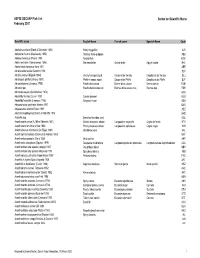
ASFIS ISSCAAP Fish List Sorted on Scientific Name February 2007 Scientific name English Name French name Spanish Name Code Abalistes stellaris (Bloch & Schneider 1801) Starry triggerfish AJS Abbottina rivularis (Basilewsky 1855) Chinese false gudgeon ABB Ablabys binotatus (Peters 1855) Redskinfish ABW Ablennes hians (Valenciennes 1846) Flat needlefish Orphie plate Agujón sable BAF Aborichthys elongatus Hora 1921 ABE Abralia andamanika Goodrich 1898 BLK Abralia veranyi (Rüppell 1844) Verany's enope squid Encornet de Verany Enoploluria de Verany BLJ Abraliopsis pfefferi (Verany 1837) Pfeffer's enope squid Encornet de Pfeffer Enoploluria de Pfeffer BJF Abramis brama (Linnaeus 1758) Freshwater bream Brème d'eau douce Brema común FBM Abramis spp Freshwater breams nei Brèmes d'eau douce nca Bremas nep FBR Abramites eques (Steindachner 1878) ABQ Abudefduf luridus (Cuvier 1830) Canary damsel AUU Abudefduf saxatilis (Linnaeus 1758) Sergeant-major ABU Abyssobrotula galatheae Nielsen 1977 OAG Abyssocottus elochini Taliev 1955 AEZ Abythites lepidogenys (Smith & Radcliffe 1913) AHD Acanella spp Branched bamboo coral KQL Acanthacaris caeca (A. Milne Edwards 1881) Atlantic deep-sea lobster Langoustine arganelle Cigala de fondo NTK Acanthacaris tenuimana Bate 1888 Prickly deep-sea lobster Langoustine spinuleuse Cigala raspa NHI Acanthalburnus microlepis (De Filippi 1861) Blackbrow bleak AHL Acanthaphritis barbata (Okamura & Kishida 1963) NHT Acantharchus pomotis (Baird 1855) Mud sunfish AKP Acanthaxius caespitosa (Squires 1979) Deepwater mud lobster Langouste -

IJF Front Pages 55-1
EDITORIAL BOARD Dr. S. Ayyappan, Deputy Director General, Dr. Dilip Kumar, Director Indian Council of Agricultural Research, Central Institute of Fisheries Education, Fisheries Division, Krishi Anusandhan Bhavan-II, Jaiprakash Road, Seven Bungalows, Versova, Pusa, New Delhi-110 012. Mumbai-400 061, Maharashtra. Dr. G. Syda Rao Director, Dr. W. S. Lakra, Director Central Marine Fisheries Research Institute, National Bureau of Fish Genetic Resources, P.B. No. 1603, Ernakulam North P.O., Canal Ring Road, Cochin - 682 018, Kerala. P.O. Dilkusha, Lucknow - 226 002, Uttar Pradesh. Dr. K. Devadasan, Director, Central Institute of Fisheries Technology, Dr. A. G. Ponniah, Director Matsyapuri, P.O., Willingdon Island, Cochin - 682 029, Kerala. Central Institute of Brackishwater Aquaculture, 75, Santhome High Road, R.A. Puram, Dr. A. E. Eknath, Director Chennai - 600 028, Tamil Nadu. Central Institute of Freshwater Aquaculture, Dhauli P.O., Kausalyaganga, Dr. K. K. Vass, Director Bhubaneswar - 751 002, Orissa. Central Inland Fisheries Research Institute, Dr. P. C. Mahanta, Director Barrackpore, Kolkata - 743 101, National Research Centre on Cold Water Fisheries, Bhimtal - 263 136, West Bengal. Haldwani, Nainital Dt., Uttar Pradesh. Managing Editor Dr. G. Syda Rao Director, CMFRI, Cochin Editor Dr. Rani Mary George CMFRI, Cochin Sub-Editors Dr. K. S. Sobhana Dr. K. Vinod CMFRI, Cochin CMFRI, Cochin N. Venugopal V. Edwin Joseph CMFRI, Cochin CMFRI, Cochin Publication Committee Dr. N. G. K. Pillai Dr. Rani Mary George Dr. B. Meenakumari CMFRI, Cochin - Member CMFRI, Cochin - Member CIFT, Cochin - Member C. V. Jayakumar CMFRI, Cochin - Member Secretary INDIAN JOURNAL OF FISHERIES Volume 55 : Numbers 1 & 2 January - June 2008 CENTRAL MARINE FISHERIES RESEARCH INSTITUTE (Indian Council of Agricultural Research) COCHIN - 682 018 INDIA Published by The Director, Central Marine Fisheries Research Institute Cochin - 682 018, India On behalf of The Indian Council of Agricultural Research New Delhi - 110 001, India Inland Foreign Annual Subscription Rs.