From Robert L. Scheina, Latin America's Wars
Total Page:16
File Type:pdf, Size:1020Kb
Load more
Recommended publications
-

Comparison of Spanish Colonization—Latin America and the Philippines
Title: Comparison of Spanish Colonization—Latin America and the Philippines Teacher: Anne Sharkey, Huntley High School Summary: This lesson took part as a comparison of the different aspects of the Spanish maritime empires with a comparison of Spanish colonization of Mexico & Cuba to that of the Philippines. The lessons in this unit begin with a basic understanding of each land based empire of the time period 1450-1750 (Russia, Ottomans, China) and then with a movement to the maritime transoceanic empires (Spain, Portugal, France, Britain). This lesson will come after the students already have been introduced to the Spanish colonial empire and the Spanish trade systems through the Atlantic and Pacific. Through this lesson the students will gain an understanding of Spanish systems of colonial rule and control of the peoples and the territories. The evaluation of causes of actions of the Spanish, reactions to native populations, and consequences of Spanish involvement will be discussed with the direct correlation between the social systems and structures created, the influence of the Christian missionaries, the rebellions and conflicts with native populations between the two locations in the Latin American Spanish colonies and the Philippines. Level: High School Content Area: AP World History, World History, Global Studies Duration: Lesson Objectives: Students will be able to: Compare the economic, political, social, and cultural structures of the Spanish involvement in Latin America with the Spanish involvement with the Philippines Compare the effects of mercantilism on Latin America and the Philippines Evaluate the role of the encomienda and hacienda system on both regions Evaluate the influence of the silver trade on the economies of both regions Analyze the creation of a colonial society through the development of social classes—Peninsulares, creoles, mestizos, mulattos, etc. -
DOWNLOAD Primerang Bituin
A publication of the University of San Francisco Center for the Pacific Rim Copyright 2006 Volume VI · Number 1 15 May · 2006 Special Issue: PHILIPPINE STUDIES AND THE CENTENNIAL OF THE DIASPORA Editors Joaquin Gonzalez John Nelson Philippine Studies and the Centennial of the Diaspora: An Introduction Graduate Student >>......Joaquin L. Gonzalez III and Evelyn I. Rodriguez 1 Editor Patricia Moras Primerang Bituin: Philippines-Mexico Relations at the Dawn of the Pacific Rim Century >>........................................................Evelyn I. Rodriguez 4 Editorial Consultants Barbara K. Bundy Hartmut Fischer Mail-Order Brides: A Closer Look at U.S. & Philippine Relations Patrick L. Hatcher >>..................................................Marie Lorraine Mallare 13 Richard J. Kozicki Stephen Uhalley, Jr. Apathy to Activism through Filipino American Churches Xiaoxin Wu >>....Claudine del Rosario and Joaquin L. Gonzalez III 21 Editorial Board Yoko Arisaka The Quest for Power: The Military in Philippine Politics, 1965-2002 Bih-hsya Hsieh >>........................................................Erwin S. Fernandez 38 Uldis Kruze Man-lui Lau Mark Mir Corporate-Community Engagement in Upland Cebu City, Philippines Noriko Nagata >>........................................................Francisco A. Magno 48 Stephen Roddy Kyoko Suda Worlds in Collision Bruce Wydick >>...................................Carlos Villa and Andrew Venell 56 Poems from Diaspora >>..................................................................Rofel G. Brion -

Independence and Turmoil
PART INDEPENDENCE I AND TURMOIL Clayton-New History Of Modern Latin America.indd 1 07/04/17 10:00 PM 2 Independence and Turmoil Latin America passed through one of its most important historical eras in the first half of the nineteenth century. In a tumultuous twenty-year span, from about 1806 to 1826, almost all of the Spanish and Portuguese colonies broke off from their colonizers and became independent nations. The path that each nation followed to independence was often complicated and marked by fits and starts, periods of intense political confusion, sharp military conflicts, inter- ludes of peace, more battles, and by ethnic and political divisions within the revolutionary movements that defy easy or clear analysis. In the largest context, the Wars of Independence marked a continuation of the same forces that drove the American, French, and Haitian revolutions of the late eighteenth century, all lumped together into something known as the Age of Democratic Revolutions. In the simplest terms, the old forms of govern- ment and rule, largely monarchies across the Western World, were overthrown for republican forms of government. But, as in America, France, and Haiti, the seemingly simple becomes more complex as one probes beneath the surface of these wars in Latin America. For example, while most of the new nations overthrew the king and replaced political authority with a republic, Brazil did not. It replaced a monarch with another monarch and glided into the nineteenth century without the cataclys- mic battles and campaigns that characterized the wars in the Spanish colonies. Other forces at work in the Spanish colonies, especially economic and com- mercial ones, argued for separating from the crown and getting rid of the monopolies and restrictions long set in place by the monarchy to regulate the colonies. -

Spain's Empire in the Americas
ahon11_sena_ch02_S2_s.fm Page 44 Friday, October 2, 2009 10:41 AM ahon09_sena_ch02_S2_s.fm Page 45 Friday, October 26, 2007 2:01 PM Section 2 About a year later, Cortés returned with a larger force, recaptured Step-by-Step Instruction Tenochtitlán, and then destroyed it. In its place he built Mexico City, The Indians Fear Us the capital of the Spanish colony of New Spain. Cortés used the same methods to subdue the Aztecs in Mexico SECTION SECTION The Indians of the coast, because of some fears “ that another conquistador, Francisco Pizarro, used in South America. of us, have abandoned all the country, so that for Review and Preview 2 Pizarro landed on the coast of Peru in 1531 to search for the Incas, thirty leagues not a man of them has halted. ” who were said to have much gold. In September 1532, he led about Students have learned about new 170 soldiers through the jungle into the heart of the Inca Empire. contacts between peoples of the Eastern —Hernando de Soto, Spanish explorer and conqueror, report on Pizarro then took the Inca ruler Atahualpa (ah tuh WAHL puh) pris- and Western hemispheres during the expedition to Florida, 1539 oner. Although the Inca people paid a huge ransom to free their ruler, Age of Exploration. Now students will Pizarro executed him anyway. By November 1533, the Spanish had focus on Spain’s early success at estab- defeated the leaderless Incas and captured their capital city of Cuzco. lishing colonies in the Americas. Why the Spanish Were Victorious How could a few � Hernando de Soto hundred Spanish soldiers defeat Native American armies many Vocabulary Builder times their size? Several factors explain the Spaniards’ success. -

Veracruzanos En La Independencia Y La Revolución
Veracruzanos en la Independencia y la Revolución COMISIÓN ORGANIZADORA DEL ESTADO DE VERACRUZ DE IGNACIO DE LA LLAVE PARA LA CONMEMORACIÓN DEL BICENTENARIO DE LA INDEPENDENCIA NACIONAL Y DEL CENTENARIO DE LA REVOLUCIÓN MEXICANA Mtro. Fidel Herrera Beltrán Gobernador Constitucional del Estado Dip. Leopoldo Torres García Presidente de la Mesa Directiva del H. Congreso del Estado Magdo. Reynaldo Madruga Picazzo Presidente del Tribunal Superior de Justicia s CONSEJO CONSULTIVO Dr. Enrique Florescano Presidente Ejecutivo Dr. Porfirio Carrillo Castilla Secretario Ejecutivo Lic. Domingo Alberto Martínez Reséndiz Secretario Ejecutivo Lic. Reynaldo Escobar Pérez Lic. Sergio Villasana Delfín Secretario de Gobierno Director del Instituto Veracruzano de Cultura Dr. Víctor Arredondo Álvarez Dip. Fernando González Arroyo Secretario de Educación Representante del Poder Legislativo C. Ángel Álvaro Peña Magdo. Alejandro Hernández Viveros Secretario de Turismo y Cultura Representante del Poder Judicial Lic. Salvador Sánchez Estrada Gral. Sergio Ayón Rodríguez Secretario de Finanzas y Planeación Representante de la Secretaría de la Defensa Nacional Lic. Ranulfo Márquez Hernández Vicealm. C.G. DEM. Sergio Javier Lara Montellano Secretario de Desarrollo Social y Medio Ambiente Representante de la Secretaría de Marina Dr. Raúl Arias Lovillo Dr. Carlos Luna Escudero Rector de la Universidad Veracruzana Representante del Sector Empresarial Dra. Olivia Domínguez Pérez Profr. Romeo Ramírez Jiménez Directora del Archivo General del Estado Representante Social s SUBCOMISIONES Lic. Miguel Limón Rojas Educación y Cultura Dr. Arturo Gómez-Pompa Recuperación y Salvaguarda del Patrimonio Natural, Histórico y Cultural Mtro. Francisco Arredondo e Ing. Miguel Hernández Conservación y Desarrollo del Espacio Público Lic. Dionisio Pérez-Jácome y Arq. Miguel Ehrenzweig Obras y Proyectos Antrop. -

Great Work Everyone! I Am Very Proud of Our Final Products!
GREAT WORK EVERYONE! I AM VERY PROUD OF OUR FINAL PRODUCTS! Why did the Creoles lead the fight for Latin American Independence? Partial Essay- 1st Hour Global HIPPOS Between 1500-1800 CE, the Spanish established colonies across the world including Latin America. With the age of the Enlightenment, inspired by the ideas of Locke (life, liberty, property) and Voltaire (Freedom of speech, religion), people of the lower classes were encouraged to revolt. With the success of the American and Haitian Revolutions, and the courage of the fighting French in the French Revolution, Latin American Creoles were inspired to gain control in the country of their birth. During the early 1800’s, the Creoles (also known as the second class citizens) fought for Latin American Independence from the Spanish. The Creoles wanted to establish control over the Spanish dominated economy, to gain political authority over the peninsulares, and settle social unrest in the region. During this time Spain dominated Latin America’s economy. “We in America are perhaps the first to be forced by our own government to sell our products at artificially low prices and buy what we need at artificially high prices,” (Doc. C). Due to Spain’s mercantilist ideals, the country controlled all aspects of Latin America’s economy in order to benefit the mother country. Spain regulated the colonies goods that were imported and exported, causing the daily detriment of the colonists. In “An Open Letter to America,” Juan Pablo Viscardo, a Creole, encouraged Latin American colonies to acknowledge their economic oppression and revolt against the Spanish. -
Latin American Peoples Win Independence MAIN IDEA WHY IT MATTERS NOW TERMS & NAMES
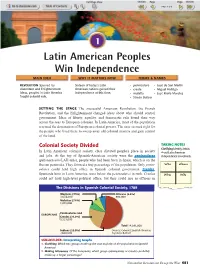
1 Latin American Peoples Win Independence MAIN IDEA WHY IT MATTERS NOW TERMS & NAMES REVOLUTION Spurred by Sixteen of today’s Latin • peninsulare •José de San Martín discontent and Enlightenment American nations gained their • creole •Miguel Hidalgo ideas, peoples in Latin America independence at this time. •mulatto •José María Morelos fought colonial rule. • Simón Bolívar SETTING THE STAGE The successful American Revolution, the French Revolution, and the Enlightenment changed ideas about who should control government. Ideas of liberty, equality, and democratic rule found their way across the seas to European colonies. In Latin America, most of the population resented the domination of European colonial powers. The time seemed right for the people who lived there to sweep away old colonial masters and gain control of the land. Colonial Society Divided TAKING NOTES Clarifying Identify details In Latin American colonial society, class dictated people’s place in society about Latin American and jobs. At the top of Spanish-American society were the peninsulares independence movements. (peh•neen•soo•LAH•rehs), people who had been born in Spain, which is on the Iberian peninsula. They formed a tiny percentage of the population. Only penin- WhoWh WhereWh sulares could hold high office in Spanish colonial government. Creoles, Spaniards born in Latin America, were below the peninsulares in rank. Creoles When Why could not hold high-level political office, but they could rise as officers in The Divisions in Spanish Colonial Society, 1789 Mestizos (7.3%) Africans (6.4%) 1,034,000 902,000 Mulattos (7.6%) 1,072,000 Peninsulares and EUROPEANS Creoles (22.9%) {3,223,000 Total 14,091,000 Indians (55.8%) Source: Colonial Spanish America, 7,860,000 by Leslie Bethell SKILLBUILDER: Interpreting Graphs 1. -

CENTRAL AMERICA and TEXAS, 1821-1836 By
MEXICO’S BREAK UP: MEXICO CITY'S MISCONCEPTIONS AND MISMANAGEMENT OF ITS PERIPEHERIES: CENTRAL AMERICA AND TEXAS, 1821-1836 by KYLE CARPENTER Presented to the Faculty of the Graduate School of The University of Texas at Arlington in Partial Fulfillment of the Requirements for the Degree of MASTER OF ARTS IN HISTORY THE UNIVERSITY OF TEXAS AT ARLINGTON MAY 2013 Copyright © by Kyle Carpenter 2013 All Rights Reserved ACKNOWLEDGEMENTS I cannot thank my committee enough. Dr. Sam Haynes, the committee chair, remained unflinchingly supportive from the very beginning. He took on this project in its infant stages and allowed it to change and evolve as necessary. His support and trust in me were unbelievable. Dr. David Narrett read every draft so carefully and responded with such detailed commentary. Dr. John Garrigus kept this project alive through his advice and guidance at a critical time in its development. The entire committee was indispensable to this thesis and I cannot thank them enough. While working on this project, I relied on the support of so many people. The person who deserves the most gratitude is my wife, Mickey. She patiently supported me through all the research, all the writing, and all the editing that went into this thesis. I could not have done it without her. I also extend my thanks to everyone who helped me in the massive research campaign this thesis required. The staff at the University of Texas at Arlington Library Special Collections deserves special thanks. Additionally, I received great assistance from the staffs at the Nettie Lee Benson Library and the Bancroft Library. -

Militares Y Marinos.Pdf
ÍNDICE General Guadalupe Victoria 1 (Elaborada por el C. Cap. 1/o. Hist. Antonio Aguilar Razo) General Anastasio Bustamante 15 (Elaborada por el C. Sgto. 1/o. Aux. Hist. César Iván Rodríguez Calderón) General Vicente Guerrero 25 (Elaborada por el C. Cap. 1/o. Hist. Antonio Aguilar Razo) General Nicolás Bravo Rueda 43 (Elaborada por la C. Sbtte. Hist. María Luisa Alavez Cataño) General Pedro Maria Anaya 51 (Elaborada por el Sgto. 1/o. Aux. Hist. César Iván Rodríguez Calderón) General José Joaquín de Herrera Ricardos 61 (Elaborada por la C. Sbtte. Hist. María Luisa Alavez Cataño) General Felipe Ángeles Ramírez 71 (Elaborada por el C. Capitán 2/o. Hist. Sergio Martinez Torres) General Alberto Leopoldo Salinas Carranza 83 (Elaborada por el C. Cap. 2/o. FACV. DEMA Tomás Segoviano Ibarra) General Salvador Alvarado Rubio 93 Coronel Juan Davis Bradburn 187 (Elaborada por el C. Cap. 2/o. Hist. Sergio Martinez Torres) (Elaborada por los CC. Almirante IM.DEM. (Ret.) Pedro Raúl Castro Álvarez y Lic. Mario Óscar Flores López) General Gustavo Adolfo Salinas Camiña 105 Capitán Pedro Sainz de Baranda y Borreyro 197 (Elaborada por el C. Cap. 2/o. FACV. DEMA Tomas Segoviano Ibarra) (Elaborada por la C. Mtra. Maria Delta Kuri Trujeque) General Lucio Blanco Fuentes 117 Capitán Blas Godínez Brito 207 (Elaborada por el C. Tte. Hist. Antero Naranjo Lara) (Elaborada por los CC. Lic. Mario Oscar Flores López y Lic. Ángel Amador Martínez) General Roberto Fierro Villalobos 129 Contraalmirante Tómas Francisco de Paula Marín Zabalza 217 (Elaborada por el C. Cap. 2/o. FACV. DEMA Tomas Segoviano Ibarra) (Elaborada por los CC. -

Land of Abundance: a History of Settler Colonialism in Southern California
California State University, San Bernardino CSUSB ScholarWorks Electronic Theses, Projects, and Dissertations Office of aduateGr Studies 6-2020 LAND OF ABUNDANCE: A HISTORY OF SETTLER COLONIALISM IN SOUTHERN CALIFORNIA Benjamin Shultz Follow this and additional works at: https://scholarworks.lib.csusb.edu/etd Part of the Cultural History Commons, Latin American History Commons, Social History Commons, and the United States History Commons Recommended Citation Shultz, Benjamin, "LAND OF ABUNDANCE: A HISTORY OF SETTLER COLONIALISM IN SOUTHERN CALIFORNIA" (2020). Electronic Theses, Projects, and Dissertations. 985. https://scholarworks.lib.csusb.edu/etd/985 This Thesis is brought to you for free and open access by the Office of aduateGr Studies at CSUSB ScholarWorks. It has been accepted for inclusion in Electronic Theses, Projects, and Dissertations by an authorized administrator of CSUSB ScholarWorks. For more information, please contact scholarworks@csusb.edu. LAND OF ABUNDANCE: A HISTORY OF SETTLER COLONIALISM IN SOUTHERN CALIFORNIA A Thesis Presented to the Faculty of California State University, San Bernardino In Partial Fulfillment of the Requirements for the Degree Master of Arts in Social Sciences and Globalization by Benjamin O Shultz June 2020 LAND OF ABUNDANCE: A HISTORY OF SETTLER COLONIALISM IN SOUTHERN CALIFORNIA A Thesis Presented to the Faculty of California State University, San Bernardino by Benjamin O Shultz June 2020 Approved by: Thomas Long, Committee Chair, History Teresa Velasquez, Committee Member, Anthropology Michal Kohout, Committee Member, Geography © 2020 Benjamin O Shultz ABSTRACT The historical narrative produced by settler colonialism has significantly impacted relationships among individuals, groups, and institutions. This thesis focuses on the enduring narrative of settler colonialism and its connection to American Civilization. -

L 1762. August 12, 13, 14 17 1770 3 L 788. (1788-1794)
MEXICAN DOCUMENTS Chronological Order l 1762. August 12, 13, 14 and October 17 HAVANA Capitulation. Manuscriptpt. 39 pages Title Page: Oficio del Governador de la Havana con inclusión de las capitulaciones y di ligencias en su vista practicadas. No. 1. 1762. Capitulación de la Habana. Letter fom Juan del Prado, Governor of Havana, to Fr. Pedro Agust{n Morel, Bishop of Cuba enclosing a concurrent copy of the Spanish version of the treaty between Havana and Great Britain detailing the procedures and conditions of the surrender of Havana to Great Britain. The surrender treaty was accepted and signed by Count Albermarle and John J. Pocock, representing the British Empire, and by Juan del Prado, Governor of Cuba Also attached is a copy of' October 1762 edict.from Bishop Morel stating the concurrence of the Church in the terms of the twenty three articles and explaining the procedures for the appointment of Church and Civil officials. On August first the British occupied Havana and opened the port to unrestricted com- merce. Havana was returned to Spain a year laterin exchange for the Floridas) 2 1770 CAPITAN DOMINNTO CAYETANO DE CARDENAS Capitán de Milicias en Yucatán y Defensor Gene- ral de los naturales por su majestad y Encomendero de Tekax, Motul, Ticum, Tixuytun, Tzucacab y Polyuc. __Manuscript. Title page: 1770 Copia del Testamento que hicieron por poder que les corifiri6 D. Domingo Cayetano de Cárdenas a su viuda Felipa Díaz y demás tres que en el/ se expresan. 19 pages. Will of Domingo Cayetano de Cárdenas made at his request by his wife, Felipa Díaz Col. -

El Héroe De Tampico": De Caudillo Regional a Presidente De La República
"El héroe de Tampico": de caudillo regional a presidente de la República. La propaganda santanista, 1822 - 1835. Alejandro Torres Páramo 1 2 "El héroe de Tampico": de caudillo regional a presidente de la República. La propaganda santanista, 1822 - 1835. Introducción ...................................................................................................................................................... 6 PRIMERAS APARICIONES DE SANTA ANNA EN LA PRENSA ............................ 14 De administrador de provincias a gobernador de Yucatán (1822-1826) ................................................... 15 Santa Anna en la prensa después del Pan de Iguala .................................................................................... 23 El levantamiento de diciembre de 1822 ........................................................................................................ 30 La escala en San Luis Potosí, 1823 ................................................................................................................ 39 Santa Anna, el gobernador en la prensa: Yucatán y Campeche ................................................................ 46 CONCLUSIONES DEL CAPÍTULO ........................................................................................................... 53 DE TAMPICO A LA PRESIDENCIA, UN CAUDILLO NACIONAL (1829-1832) ... 56 El regreso a Veracruz ..................................................................................................................................... 57 Los conflictos