Athena Nike Athena Promachos
Total Page:16
File Type:pdf, Size:1020Kb
Load more
Recommended publications
-

Greek Art in Motion Studies in Honour of Sir John Boardman On the Occasion of His 90Th Birthday
Greek Art in Motion Studies in honour of Sir John Boardman on the occasion of his 90th birthday edited by Rui Morais, Delfim Leão, Diana Rodríguez Pérez with Daniela Ferreira Archaeopress Archaeology © Archaeopress and the authors, 2019. Archaeopress Publishing Ltd Summertown Pavilion 18-24 Middle Way Summertown Oxford OX2 7LG www.archaeopress.com ISBN 978 1 78969 023 1 ISBN 978 1 78969 024 8 (e-Pdf) © Archaeopress and the individual authors 2019 Cover: Head of Alexander in profile. Tourmaline intaglio, 25 x 25 mm, Ashmolean (1892.1499) G.J. Chester Bequest. Photo: C. Wagner. All rights reserved. No part of this book may be reproduced, or transmitted, in any form or by any means, electronic, mechanical, photocopying or otherwise, without the prior written permission of the copyright owners. Printed in England by Oxuniprint, Oxford This book is available direct from Archaeopress or from our website www.archaeopress.com © Archaeopress and the authors, 2019. Contents Preface ����������������������������������������������������������������������������������������������������������������������������������������������������������������������������������1 John Boardman and Greek Sculpture �����������������������������������������������������������������������������������������������������������������������������������3 Olga Palagia Sanctuaries and the Hellenistic Polis: An Architectural Approach �����������������������������������������������������������������������������������14 Milena Melfi ‘Even the fragments, however, merit scrutiny’: Ancient -
Athenians and Eleusinians in the West Pediment of the Parthenon
ATHENIANS AND ELEUSINIANS IN THE WEST PEDIMENT OF THE PARTHENON (PLATE 95) T HE IDENTIFICATION of the figuresin the west pedimentof the Parthenonhas long been problematic.I The evidencereadily enables us to reconstructthe composition of the pedimentand to identify its central figures.The subsidiaryfigures, however, are rath- er more difficult to interpret. I propose that those on the left side of the pediment may be identifiedas membersof the Athenian royal family, associatedwith the goddessAthena, and those on the right as membersof the Eleusinian royal family, associatedwith the god Posei- don. This alignment reflects the strife of the two gods on a heroic level, by referringto the legendary war between Athens and Eleusis. The recognition of the disjunctionbetween Athenians and Eleusinians and of parallelism and contrastbetween individualsand groups of figures on the pedimentpermits the identificationof each figure. The referenceto Eleusis in the pediment,moreover, indicates the importanceof that city and its majorcult, the Eleu- sinian Mysteries, to the Athenians. The referencereflects the developmentand exploitation of Athenian control of the Mysteries during the Archaic and Classical periods. This new proposalfor the identificationof the subsidiaryfigures of the west pedimentthus has critical I This article has its origins in a paper I wrote in a graduateseminar directedby ProfessorJohn Pollini at The Johns Hopkins University in 1979. I returned to this paper to revise and expand its ideas during 1986/1987, when I held the Jacob Hirsch Fellowship at the American School of Classical Studies at Athens. In the summer of 1988, I was given a grant by the Committeeon Research of Tulane University to conduct furtherresearch for the article. -
Parthenon 1 Parthenon
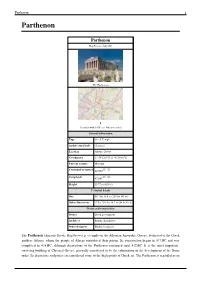
Parthenon 1 Parthenon Parthenon Παρθενών (Greek) The Parthenon Location within Greece Athens central General information Type Greek Temple Architectural style Classical Location Athens, Greece Coordinates 37°58′12.9″N 23°43′20.89″E Current tenants Museum [1] [2] Construction started 447 BC [1] [2] Completed 432 BC Height 13.72 m (45.0 ft) Technical details Size 69.5 by 30.9 m (228 by 101 ft) Other dimensions Cella: 29.8 by 19.2 m (98 by 63 ft) Design and construction Owner Greek government Architect Iktinos, Kallikrates Other designers Phidias (sculptor) The Parthenon (Ancient Greek: Παρθενών) is a temple on the Athenian Acropolis, Greece, dedicated to the Greek goddess Athena, whom the people of Athens considered their patron. Its construction began in 447 BC and was completed in 438 BC, although decorations of the Parthenon continued until 432 BC. It is the most important surviving building of Classical Greece, generally considered to be the culmination of the development of the Doric order. Its decorative sculptures are considered some of the high points of Greek art. The Parthenon is regarded as an Parthenon 2 enduring symbol of Ancient Greece and of Athenian democracy and one of the world's greatest cultural monuments. The Greek Ministry of Culture is currently carrying out a program of selective restoration and reconstruction to ensure the stability of the partially ruined structure.[3] The Parthenon itself replaced an older temple of Athena, which historians call the Pre-Parthenon or Older Parthenon, that was destroyed in the Persian invasion of 480 BC. Like most Greek temples, the Parthenon was used as a treasury. -

The Art and Archaeology of Ancient Greece Judith M
Cambridge University Press 978-1-107-00123-7 - The Art and Archaeology of Ancient Greece Judith M. Barringer Frontmatter More information The Art and This richly illustrated, color textbook introduces the art and Archaeology of archaeology of ancient Greece, from the Bronze Age through the Roman conquest. Suitable for students with no prior knowledge of Ancient Greece ancient art, this book reviews the main objects and monuments of the ancient Greek world, emphasizing the context and function of these artefacts in their particular place and time. Students are led to a rich understanding of how objects were meant to be perceived, what “messages” they transmitted, and how the surrounding environment shaped their meaning. The book includes more than 500 illustrations (with over 400 in color), including specially commissioned photographs, maps, fl oorplans, and reconstructions. Judith Barringer examines a variety of media, including marble and bronze sculpture, public and domestic architecture, painted vases, coins, mosaics, terracotta fi gurines, reliefs, jewelry, armor, and wall paintings. Numerous text boxes, chapter summaries, and timelines, complemented by a detailed glossary, support student learning. • More than 500 illustrations, with over 400 in color, including specially commissioned photographs, maps, plans, and reconstructions • Includes text boxes, chapter summaries and timelines, and detailed glossary • Looks at Greek art from the perspectives of both art history and archaeology, giving students an understanding of the historical and everyday context of art objects Judith M. Barringer is Professor of Greek Art and Archaeology in Classics at the University of Edinburgh. Her areas of specialization are Greek art and archaeology and Greek history, myth, and religion. -

Chapter 5 Th a F a I G E Art of Ancient Greece (Iron Age)
Chapter 5 The Art of A nci ent G reece (Iron Age) Famous Greeks: Playwriters: Aeschylus (“father of Greek tragedy”), Sophocles (Antigone, Oedipus), Euripides, Aristophanes (Comedies. Lysistrata) Philosophers: Heraclitus (“You can never step into the same river twice”) Plato,,, Socrates, Aristotles Mathematicians and scientists: Archimedes, Pythagoras, Aristotles, Euclid Authors and poets: Homer (Odyssey and Iliad), Sappho of Lesbos, Aesop Historians: Herodotus ("The Father of History,"). Thucydides The Greek World GtiPid(9Geometric Period (9-8th c. BCE) Early Geometric Krater. C. 800 BCE Krater A bowl for mixing wine and water Greek key or Meander An ornament consisting of interlocking geometric motifs. An ornamental pattern of contiguous straight lines joined usually at right angles. Geometric krater, from the Dipylon cemetery, Athens, Greece, ca. 740 BCE. Approx. 3’ 4 1/2” high. Metropolitan Museum of Art, New York. Geometric krater, from the Dipylon cemetery. Detail. Hero and Centaur (Herakles and Nessos? Achilles and Chiron?) ca. 750–730 BCE. Bron ze, a pprox. 4 1/2” high. Metropolitan Museum of Art, New York. Geometric krater, from the Dipylon cemetery, Athens, Greece, ca. 740 BCE. Approx. 3’ 4 1/2” high. Hero and Centaur (Herakles and Nessos? Achilles and Chiron?) ca. 750–730 BCE. Bronze, approx. 4 1/2” high. Greek Vase Painting Orientalizing Period (7th c. BCE) Pitcher (olpe) Corinth, c. 600 BCE Ceramic with black-figure decoration, height 11½ " British Mus . London Rosette: A round or oval ornament resembling a rose Comppyarison: Assyrian.. Lamassu, ca. 720–705 BCE. Pitcher (olpe) Corinth, c. 600 BCE Ceramic with black-figure decoration, height 11½" British Mus. -

Mechanical Miracles: Automata in Ancient Greek Religion
Mechanical Miracles: Automata in Ancient Greek Religion Tatiana Bur A thesis submitted in fulfillment of the requirements for the degree of Master of Philosophy Faculty of Arts, University of Sydney Supervisor: Professor Eric Csapo March, 2016 Statement of Originality This is to certify that to the best of my knowledge, the content of this thesis is my own work. This thesis has not been submitted for any degree or other purposes. I certify that the intellectual content of this thesis is the product of my own work and that all the assistance received in preparing this thesis and sources have been acknowledged. Tatiana Bur, March 2016. Table of Contents ACKNOWLEDGMENTS ....................................................................................................... 1 A NOTE TO THE READER ................................................................................................... 2 INTRODUCTION ................................................................................................................ 3 PART I: THINKING ABOUT AUTOMATION .......................................................................... 9 CHAPTER 1/ ELIMINATING THE BLOCAGE: ANCIENT AUTOMATA IN MODERN SCHOLARSHIP ................. 10 CHAPTER 2/ INVENTING AUTOMATION: AUTOMATA IN THE ANCIENT GREEK IMAGINATION ................. 24 PART II: AUTOMATA IN CONTEXT ................................................................................... 59 CHAPTER 3/ PROCESSIONAL AUTOMATA ................................................................................ -

Ritual Surprise and Terror in Ancient Greek Possession-Dromena
Kernos Revue internationale et pluridisciplinaire de religion grecque antique 2 | 1989 Varia Ritual Surprise and Terror in Ancient Greek Possession-Dromena Ioannis Loucas Electronic version URL: http://journals.openedition.org/kernos/242 DOI: 10.4000/kernos.242 ISSN: 2034-7871 Publisher Centre international d'étude de la religion grecque antique Printed version Date of publication: 1 January 1989 Number of pages: 97-104 ISSN: 0776-3824 Electronic reference Ioannis Loucas, « Ritual Surprise and Terror in Ancient Greek Possession-Dromena », Kernos [Online], 2 | 1989, Online since 02 March 2011, connection on 21 April 2019. URL : http:// journals.openedition.org/kernos/242 ; DOI : 10.4000/kernos.242 Kernos Kernos, 2 (1989), p. 97-104. RITUAL SURPRISE AND TERROR INANCIENT GREEK POSSESSION·DROMENA The daduch of the Eleusinian mysteries Themistokles, descendant of the great Athenian citizen of the 5th century RC'!, is honoured by a decree of 20/19 RC.2 for «he not only exhibits a manner of life worthy of the greatest honour but by the superiority of his service as daduch increases the solemnity and dignity of the cult; thereby the magnificence of the Mysteries is considered by all men to be ofmuch greater excitement (ekplexis) and to have its proper adornment»3. P. Roussel4, followed by K. Clinton5, points out the importance of excitement or surprise (in Greek : ekplexis) in the Mysteries quoting analogous passages from the Eleusinian Oration of Aristides6 and the Platonic Theology ofProclus7, both writers of the Roman times. ln Greek literature one of the earlier cases of terror connected to any cult is that of the terror-stricken priestess ofApollo coming out from the shrine of Delphes in the tragedy Eumenides8 by Aeschylus of Eleusis : Ah ! Horrors, horrors, dire to speak or see, From Loxias' chamber drive me reeling back. -
Lucy What Were Ancient Statues For?
Lucy What were ancient statues for? Ancient statues were generally made for religious or political purposes which could include making a statue for worshipping a God or to show the power that the emperor has over the people which can be seen in various examples which will be discussed later. The purpose of Greek and Roman statues differs slightly because the ways in which the statues of the Ancient Greeks and Romans are made are slightly different but do have some similarities for example, in most sculptures Greeks and Romans use the same materials as bronze and marble, and the Greeks occasionally used wood. However, they are different because during the middle of the first century BC the Romans started to look for their own identity when sculptors tried to capture light and shadow to make the sculptures look more realistic which eventually lead to impressionism using light to create more abstract forms and sculptures. Firstly, from studying statues in Ancient Greece we can see that they generally took inspiration from Egyptian and Nera Eastern monumental art around 800 to 300 BCE, which then started to develop over centuries and eventually evolved into a uniquely Greek vision of sculpture. This can be seen in the sculpture of Aphrodite of Knidos by Praxiteles of Athens which was built around the 4th century BCE. Even though the original Greek sculpture is no longer in existence, there are many surviving Roman copies of this influential work of art. Around the mid-4th century BCE, the Greek sculptor Praxiteles was commissioned to sculpt the Goddess Aphrodite by the island if Kos. -

GREEK RELIGION Walter Burkert
GREEK RELIGION Walter Burkert Translated by John Raffan r Harvard University Press Cambridge, Massachusetts THINGS’ ANIMAL SACRIFICE II t . I ‘WORKING SACRED 55 diverted activity for the apathy which remains transfixed in reality; it lays claim to the highest seriousness, to the absolute. II When considered from the point of view of the goal, ritual behaviour appears as magic. For a science of religion which regards only instrumental 4 since acts action as meaningful, magic must be seen as the origin of religion, Ritual and Sanctuary which seek to achieve a given goal in an unclear but direct way are magical. The goal then appears to be the attainment of all desirable boons and the elimination of possible impediments: there is rain magic, fertility magic, love magic, and destructive magic. The conception of ritual as a kind of language, however, leads beyond this constraining artifice; magic is present only insofar as ritual is consciously placed in the service of some end — which may then undoubtedly affect the form of the ritual. Religious ritual is given as a collective institution; the individual participates within the framework of social communication, with the strongest motivating force being the need not in the study of religion which came to be generally acknowledged to stand apart. Conscious magic is a matter for individuals, for the few, and An insight are more important and end of the last century is that rituals is developed accordingly into a highly complicated pseudo-science. In early towards the ancient religions than are instructive for the understanding of the Greece, where the cult belongs in the communal, public sphere, the more is no longer seen in myths.’ With this recognition, antiquity importance of magic is correspondingly minimal. -

Archaic and Classical Cult Statues in Greece
ARCHAIC AND CLASSICAL CULT STATUES IN GREECE THE SETTING AND DISPLAY OF CULT IMAGES IN THE ARCHAIC AND CLASSICAL PERIODS IN GREECE By SHERR! DAWSON, B.A. A Thesis Submitted to the School of Graduate Studies In Partial Fulfilment of the Requirements For the Degree Master of Arts McMaster Uni versity © Copyright by Sherri Dawson, June 2002 MASTER OF ARTS (2002) McMaster University (Classical Studies) Hamilton, Ontario TITLE: The Setting and Display of Cult Images in the Archaic and Classical Peri ods in Greece. AUTHOR: Sherri Dawson, B. A. (Uni versity of Alberta) SUPERVISOR: Dr. Gretchen Umholtz NUMBER OF PAGES: xii, 257. 11 ABSTRACT The focus of this thesis is on ancient archaic and classical Greek cult statues and how their placement reflects both the role of the statues themselves and the continuity in worship. Greek sanctuaries generally exhibited a strong continuity of cult in terms of building successive temples directly on top of the remains of their predecessors. The sanctuary of Hera on Samos and the sanctuary of Apollo at Didyma are two such sanctuaries in Asia Minor that exhibit this type of continuity even though their early temples were replaced by large superstructures. The temple of Athena Nike in Athens is another example of continuity, since the larger Classical temple was built on the same site as the archaic one. The Athenian Parthenon, the temple of Zeus at Olympia, the Classical Heraion at Argos and the Classical temple of Dionysos on the south slope in Athens, however, were not built on the same site as the archaic temples. -
Evaluate the Significance of Spartan Architecture As an Expression Of
Evaluate the significance of Spartan architecture as an expression of their culture 19/20. The Spartan civilisation was distinctive in the annals of ancient Greek city-states. Spartan society was not solely distinguished by its unique code of law, underpinned by eunomia, enshrined in the Great Rhetra, and crafted by Sparta’s ancestral lawgiver, Lykourgos, but its architecture also contrasted starkly with the rest of Greece. Although little tangible evidence has survived of the ordinary Spartiate home, there are significant archaeological remains of Sparta’s religious structures. The Amyklaion, Menelaion and Sanctuary of Artemis Orthia were all buildings representative of Spartan cultural life; one typified by fervent religiousness. The religious devoutness inherent in Sparta is best reflected in the architecture of the Amyklaion temple. Standing around five kilometres south of the Spartan polis at the Amyklai, the Amyklaion temple was not merely a monument to the Greek god Apollo, but also the location where the legendary warrior, Hyakinthos, was interred. Constructed by the Ionian architect, Bathykles, the Amyklaion served as the physical manifestation of Spartan dedication to Apollo, with a wooden cult statue or xoanon of this god rising approximately fourteen metres high, lined with bronze plates and depicted with a helmet, spear and bow. Although historically the subject of considerable debate in the archaeological community, it was generally believed, especially by Nineteenth Century archaeologists like Frenchmen Quatreme de Quincy (1755 - 1849) that situated at the statue’s base was the thronos. The thronos was configured like a block to act as a pedestal to Apollo, where offerings venerating his dominion regularly took place and as an altar to Hyakinthos, over whose entombed remains the structure stood. -

7 Domesticating Artemis
7 Domesticating Artemis at the margins The action of Euripides’ Iphigeneia among the Taurians is set far away from the Aegean, on the northern coast of the Black Sea.1 When Orestes arrives on a mission to fetch from this place a portable image of Artemis, a crisis is generated by the local Taurian custom requiring any stranger ar- riving on these shores to be sacrificed to Artemis. Unknown to Orestes, his sister Iphigeneia (whom he believes is dead) is living here in service to Artemis, and she is expected to officiate at her own brother’s death. This is avoided when each learns the true identity of the other, but the crisis (how to appease a goddess who demands the death of strangers) cannot be re- solved without the intervention of Athena. In a show-stopping epiphany towards the end of the play, Athena announces Athenian ritual as the so- lution, directing that Orestes install a statue of Artemis at one sanctuary of Attika (Halai) and that Iphigeneia take up service to Artemis at another (Brauron). In imitation of the Taurian rite, the sacrifice at Halai would re- quire not death but merely a show of human blood. Athena announces to Iphigeneia that, as priestess of Artemis at Brauron, she would one day have her tomb in the sanctuary “at the Brauranian steps,” where she would re- ceive the garments left behind by women who died in childbirth: . and they will dedicate as ornament for you the fine-webbed woven garments that women Copyright © 2004. University of California Press.