Johannes Vermeer (Delft 1632 – 1675 Delft)
Total Page:16
File Type:pdf, Size:1020Kb
Load more
Recommended publications
-

Interiors and Interiority in Vermeer: Empiricism, Subjectivity, Modernism
ARTICLE Received 20 Feb 2017 | Accepted 11 May 2017 | Published 12 Jul 2017 DOI: 10.1057/palcomms.2017.68 OPEN Interiors and interiority in Vermeer: empiricism, subjectivity, modernism Benjamin Binstock1 ABSTRACT Johannes Vermeer may well be the foremost painter of interiors and interiority in the history of art, yet we have not necessarily understood his achievement in either domain, or their relation within his complex development. This essay explains how Vermeer based his interiors on rooms in his house and used his family members as models, combining empiricism and subjectivity. Vermeer was exceptionally self-conscious and sophisticated about his artistic task, which we are still laboring to understand and articulate. He eschewed anecdotal narratives and presented his models as models in “studio” settings, in paintings about paintings, or art about art, a form of modernism. In contrast to the prevailing con- ception in scholarship of Dutch Golden Age paintings as providing didactic or moralizing messages for their pre-modern audiences, we glimpse in Vermeer’s paintings an anticipation of our own modern understanding of art. This article is published as part of a collection on interiorities. 1 School of History and Social Sciences, Cooper Union, New York, NY, USA Correspondence: (e-mail: bbinstock@gmail.com) PALGRAVE COMMUNICATIONS | 3:17068 | DOI: 10.1057/palcomms.2017.68 | www.palgrave-journals.com/palcomms 1 ARTICLE PALGRAVE COMMUNICATIONS | DOI: 10.1057/palcomms.2017.68 ‘All the beautifully furnished rooms, carefully designed within his complex development. This essay explains how interiors, everything so controlled; There wasn’t any room Vermeer based his interiors on rooms in his house and his for any real feelings between any of us’. -

Girl with a Pearl Earring by Tracy Chevalier
2 Go Girl with a Pearl Earring by Tracy Chevalier Discussion Questions 1. Do you think Griet was typical of other girls her age? In what ways? How did she differ? Did you find her compassionate or selfish? Giving or judgmental? 2. In many ways, the primary relationship in this novel appears to be between Griet and Vermeer. Do you think this is true? How do you feel about Vermeer's relationship with his wife? How does that come into play? 3. Peering into 17th century Delft shows a small, self-sufficient city. Where do you think the many-pointed star at the city's center pointed toward? What was happening elsewhere at that time? 4. Discuss the ways religion affected Griet's relationship with Vermeer. His wife? Maria Thins? Mount Laurel Library 100 Walt Whitman Ave., Mount Laurel, NJ 08054 856-234-7319 www.mtlaurel.lib.nj.us Girl with a Pearl Earring by Tracy Chevalier Discussion Questions continued 5. Maria Thins obviously understood Vermeer's art more than his wife did. Why do you think this was the case? Do you think she shared Griet's talents? 6. Do you think Griet made the right choice when she married the butcher's son? Did she have other options? 7. How is Delft different to or similar to your town or city? Are the social structures comparable? 8. Though Girl with a Pearl Earring appears to be about one man and woman, there are several relationships at work. Which is the most difficult relationship? Which is the most promising? Questions taken permission from ReadingGroupGuides.com. -
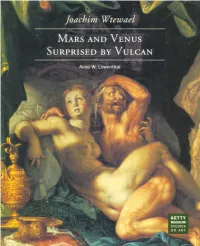
Mars and Venus Surprised by Vulcan
Joachim Wtewael MARS AND VENUS SURPRISED BY VULCAN Joachim Wtewael MARS AND VENUS SURPRISED BY VULCAN Anne W. Lowenthal GETTY MUSEUM STUDIES ON ART Malibu, California Christopher Hudson, Publisher Cover: Mark Greenberg, Managing Editor Joachim Wtewael (Dutch, 1566-1638). Cynthia Newman Bohn, Editor Mars and Venus Surprised by Vulcan, Amy Armstrong, Production Coordinator circa 1606-1610 [detail]. Oil on copper, Jeffrey Cohen, Designer 20.25 x 15.5 cm (8 x 6/8 in.). Malibu, J. Paul Getty Museum (83.PC.274). © 1995 The J. Paul Getty Museum 17985 Pacific Coast Highway Frontispiece: Malibu, California 90265-5799 Joachim Wtewael. Self-Portrait, 1601. Oil on panel, 98 x 74 cm (38^ x 29 in.). Utrecht, Mailing address: Centraal Museum (2264). P.O. Box 2112 Santa Monica, California 90407-2112 All works of art are reproduced (and photographs provided) courtesy of the owners unless otherwise Library of Congress indicated. Cataloging-in-Publication Data Lowenthal, Anne W. Typography by G & S Typesetting, Inc., Joachim Wtewael : Mars and Venus Austin, Texas surprised by Vulcan / Anne W. Lowenthal. Printed by C & C Offset Printing Co., Ltd., p. cm. Hong Kong (Getty Museum studies on art) Includes bibliographical references and index. ISBN 0-89236-304-5 i. Wtewael, Joachim, 1566-1638. Mars and Venus surprised by Vulcan. 2. Wtewael, Joachim, 1566-1638 — Criticism and inter- pretation. 3. Mars (Roman deity)—Art. 4. Venus (Roman deity)—Art. 5. Vulcan (Roman deity)—Art. I. J. Paul Getty Museum. II. Title. III. Series. ND653. W77A72 1995 759-9492-DC20 94-17632 CIP CONTENTS Telling the Tale i The Historical Niche 26 Variations 47 Vicissitudes 66 Notes 74 Selected Bibliography 81 Acknowledgments 88 TELLING THE TALE The Sun's loves we will relate. -
Light and Sight in Ter Brugghen's Man Writing by Candlelight
Volume 9, Issue 1 (Winter 2017) Light and Sight in ter Brugghen’s Man Writing by Candlelight Susan Donahue Kuretsky sukuretsky@vassar.edu Recommended Citation: Susan Donahue Kuretsky, “Light and Sight in ter Brugghen’s Man Writing by Candlelight,” JHNA 9:1 (Winter 2017) DOI: 10.5092/jhna.2017.9.1.4 Available at https://jhna.org/articles/light-sight-ter-brugghens-man-writing-by-candlelight/ Published by Historians of Netherlandish Art: https://hnanews.org/ Republication Guidelines: https://jhna.org/republication-guidelines/ Notes: This PDF is provided for reference purposes only and may not contain all the functionality or features of the original, online publication. This PDF provides paragraph numbers as well as page numbers for citation purposes. ISSN: 1949-9833 JHNA 7:2 (Summer 2015) 1 LIGHT AND SIGHT IN TER BRUGGHEN’S MAN WRITING BY CANDLELIGHT Susan Donahue Kuretsky Ter Brugghen’s Man Writing by Candlelight is commonly seen as a vanitas tronie of an old man with a flickering candle. Reconsideration of the figure’s age and activity raises another possibility, for the image’s pointed connection between light and sight and the fact that the figure has just signed the artist’s signature and is now completing the date suggests that ter Brugghen—like others who elevated the role of the artist in his period—was more interested in conveying the enduring aliveness of the artistic process and its outcome than in reminding the viewer about the transience of life. DOI:10.5092/jhna.2017.9.1.4 Fig. 1 Hendrick ter Brugghen, Man Writing by Candlelight, ca. -

Cornelis Cornelisz, Who Himself Added 'Van Haarlem' to His Name, Was One of the Leading Figures of Dutch Mannerism, Together
THOS. AGNEW & SONS LTD. 6 ST. JAMES’S PLACE, LONDON, SW1A 1NP Tel: +44 (0)20 7491 9219. www.agnewsgallery.com Cornelis Cornelisz van Haarlem (Haarlem 1562 – 1638) Venus, Cupid and Ceres Oil on canvas 38 x 43 in. (96.7 x 109.2 cm.) Signed with monogram and dated upper right: ‘CH. 1604’ Provenance Private collection, New York Cornelis Cornelisz, who himself added ‘van Haarlem’ to his name, was one of the leading figures of Dutch Mannerism, together with his townsman Hendrick Goltzius and Abraham Bloemaert from Utrecht. He was born in 1562 in a well-to-do Catholic family in Haarlem, where he first studied with Pieter Pietersz. At the age of seventeen he went to France, but at Rouen he had to turn back to avoid an outbreak of the plague and went instead to Antwerp, where he remained for a year with Gilles Coignet. The artist returned to Haarlem in 1581, and two years later, in 1583, he received his first important commission for a group portrait of a Haarlem militia company (now in the Frans Hals Museum, Haarlem). From roughly 1586 to 1591 Cornelis, together with Goltzius and Flemish émigré Karel van Mander formed a sort of “studio brotherhood” which became known as the ‘Haarlem Academy’. In the 1590’s he continued to receive many important commissions from the Municipality and other institutions. Before 1603, he married the daughter of a Haarlem burgomaster. In 1605, he inherited a third of his wealthy father-in-law’s estate; his wife died the following year. From an illicit union with Margriet Pouwelsdr, Cornelis had a daughter Maria in 1611. -

Leiden Gallery Site
How To Cite Ilona van Tuinen, "Lot and His Daughters", (AB-100), in The Leiden Collection Catalogue, Arthur K. Wheelock Jr., Ed., New York, 2017 http://www.theleidencollection.com/archive/ This page is available on the site's Archive. PDF of every version of this page is available on the Archive, and the Archive is managed by a permanent URL. Archival copies will never be deleted. New versions are added only when a substantive change to the narrative occurs. The prospect of human extinction can drive people to desperate measures. The morally charged story of Lot and his daughters, recounted in Genesis 19, demonstrates just how far people will go to ensure the continuance of their lineage. The old, righteous Lot, one of Abraham’s nephews, lived in the doomed city of Sodom among its immoral citizenry. As a reward for his virtue, God spared Lot, along with his wife and two daughters, from Sodom’s destruction. During their flight, however, Lot’s wife defied God’s Fig 1. Lucas van Leyden,Lot and His Daughters, 1530, command and looked back. As punishment, she was turned into a pillar of engraving, 18.9 x 24.6 cm, Rijksprentenkabinet, salt. Lot eventually settled inside a cave with his daughters. The elder Rijksmuseum, Amsterdam, inv. RP-P-OB-1587 © 2017 Leiden Gallery Lot and His Daughters Page 2 of 10 sister, convinced that there was “no man left on the earth” (Gen. 19:31), devised a scheme to intoxicate Lot, enabling the two women to sleep with the old man on consecutive nights in order to “preserve the seed of their father” (Gen. -

Johannes Vermeer : a Generative Artist ? So What ? Courchia Jean Paul, MD Saint Joseph’S Hospital, Dpt of Ophthalmology
Johannes Vermeer : A generative artist ? So What ? Courchia Jean Paul, MD Saint Joseph’s Hospital, Dpt of Ophthalmology. Marseille. France e-mail : courchia@numericable.fr Guigui Sarah Department of Internal Medicine, North Shore LIJ at Forest Hills Hospital. Courchia Emmanuel Department of Psychology, Queens College at CUNY. Johannes Vermeer was a Dutch artist born in Delft (the Netherlands) on October 31th 1632, and died on December 16th 1675 at the age of 43 years old. Over the course of his life he was a successful painter locally around Delft and The Hague, but this modest celebrity was soon forgotten after his death. He painted only few paintings of which only 36 are known to date. His paintings are often thought to be small but in reality are of varying sizes from 160 cm to 20 cm in greatest dimension. What is interesting is that they are sometimes at the same (or almost) dimensions. Especially in the series of interiors with the light coming through a window on the left, it is possible that the size’s choice is not only linked to the fact that Vermeer use standard sizes. It is not until 1866 that Vermeer becomes familiar with global fame. Thanks to Theophile Thore-Burger, a French journalist, whose art critic column propelled Vermeer onto the international scene. In 1842 when he saw the View of Delft in the Mauritshuis of The Hague and became an instant fan of the duct painter. He helped Vermeer’s notoriety by publishing an essay attributing 66 works to the painter although 34 are universally attributed to him. -
Supported by the Vereniging Rembrandt
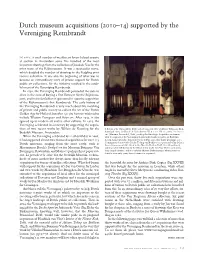
FEB.SUP.VerenigingRembrandtB_ma.nov.coop/plaz.pp.corr 16/01/2015 11:55 Page 141 Dutch museum acquisitions (2010–14) supported by the Vereniging Rembrandt IN 1883, A small number of wealthy art lovers helped acquire at auction in Amsterdam some five hundred of the most important drawings from the collection of Jacob de Vos for the print room of the Rijksmuseum. It was a spectacular move, which doubled the number of drawings in the fledgling print room’s collection. It was also the beginning of what was to become an extraordinary story of private support for Dutch public art collections, for the initiative resulted in the estab- lishment of the Vereniging Rembrandt. In 1892, the Vereniging Rembrandt persuaded the state to share in the costs of buying a first Vermeer for the Rijksmus- eum, and in similar fashion it sponsored in 1900 the acquisition of the Rijksmuseum’s first Rembrandt. The early history of the Vereniging Rembrandt is very much about this matching of private and public money to collect the art of the Dutch Golden Age for Holland, but after 1914 its horizon widened to include Western European and Asian art. After 1945, it also opened up to modern art and to other cultures. In 1983, the Vereniging celebrated its centenary by supporting the acquis- ition of two recent works by Willem de Kooning for the I. Interior of the Nieuwe Kerk, Delft, with the memorial tablet of Adriaen Teding van Berk- Stedelijk Museum, Amsterdam. hout (1576–1620), by Hendrick Cornelisz van Vliet. 1661. Oil on canvas, 100 by 112 cm. -
Editors' Introduction
Editors’ Introduction This second volume of Fictional Traces (Fictional Traces II) contains four- teen articles dealing with the reception of the ancient novel in literature and art. These articles are revised versions of papers originally presented at the Fourth International Conference on the Ancient Novel (ICAN IV), which took place at the Fundação Calouste Gulbenkian, in Lisbon, on July 21-26, 2008. The papers are assembled in four groups according to a thematic ar- rangement. The first group contains two studies on the reception of the an- cient novel in the visual tradition; the second includes essays that discuss the echoes of Apuleius’ Metamorphoses in art and literature; the third category brings together papers involving the reception of Petronius’ Satyrica; and finally the essays of the fourth section are unified by their focus on the re- ception of the ancient novel in the performative arts. Hugh Mason’s paper introduces the first series of two papers that illu- strate the repercussions of the ancient novel in visual arts, in secular writing and in popular narrative. In “Charikleia at the Mauritshuis” Mason uses as an example of such influence a painting by Abraham Bloemaert in the Maurits- huis, the 17th century town house in Den Haag which is home to the (Dutch) Royal Collection of Paintings, that depicts Theagenes receiving the price at the Pythia from Charicleia. This painting, inspired by Ethiopica 4, 4, com- memorated the wedding in 1625 of Amalia von Solms (1602-1675), and Frederik Hendrik of Orange (1584-1647), the third Stadhouder of the United Provinces of the Netherlands. -
Vermeer As Aporia: Indeterminacy, Divergent Narratives, and Ways of Seeing
Munn Scholars Awards Undergraduate Research 2020 Vermeer as Aporia: Indeterminacy, Divergent Narratives, and Ways of Seeing Iain MacKay Follow this and additional works at: https://researchrepository.wvu.edu/munn Part of the History of Art, Architecture, and Archaeology Commons Vermeer as Aporia: Indeterminacy, Divergent Narratives, and Ways of Seeing Iain MacKay Senior Thesis Written in partial fulfillment of the Bachelor of Arts in Art History April 23, 2020 Copyright 2020, Iain MacKay ABSTRACT Vermeer as Aporia: Indeterminacy, Divergent Narratives, and Ways of Seeing Iain MacKay Although Johannes Vermeer’s paintings have long been labelled “ambiguous” in the canon of Western Art History, this research aims to challenge the notion of ambiguity. By shifting the conception of Vermeer’s works from ambiguity to indeterminacy, divergent narratives emerge which inform a more complex understanding of Vermeer’s oeuvre. These divergent narratives understand Vermeer’s paintings as turning points in stories that extend beyond the canvas; moments where the possibilities of a situation diverge in different directions. Thus, a myriad of narratives might be contained in a single painting, all of which simultaneously have the possibility of existing, but not the actuality. This interpretation of Vermeer takes evidence from seventeenth-century ways of seeing and the iconographic messages suggested by the paintings within paintings that occur across Vermeer’s oeuvre. Here for the first time, an aporetic approach is utilized to explore how contradictions and paradoxes within a system serve to contribute to holistic meaning. By analyzing four of Vermeer’s paintings – The Concert, Woman Holding a Balance, The Music Lesson, and Lady Seated at a Virginal – through an aporetic lens, an alternative to ambiguity can be constructed using indeterminacy and divergent narratives that help explain compositional and iconographical choices. -

Studies of the Head of a Young Woman, Legs and Hands and the Bust of a Woman
Abraham BLOEMAERT (Gorinchem 1564 - Utrecht 1651) Studies of the Head of a Young Woman, Legs and Hands and the Bust of a Woman Red chalk and black chalk, heightened with touches of white chalk, with framing lines in brown ink. Laid down. Numbered 125 at the upper right. 178 x 158 mm. (7 x 6 1/4 in.) Sheets of studies such as the present sheet were an integral part of Abraham Bloemaert’s working method. While in some cases the different studies on a sheet – of heads, hands, arms, draperies, legs and so forth - were simply exercises, at other times the artist seems to have been working towards a painting, with the drawing intended to prepare different parts of a single multifigural composition. As Stijn Alsteens has noted of Bloemaert’s study sheets, ‘The dating of these drawings is difficult; it can be assumed that many were made from life, with a model posing. Some studies are preparatory for Bloemaert’s painted compositions or print designs…In most study sheets, however, the artist seems to have had no specific…narrative in mind, and these collages of heads, limbs and drapery should be considered as part of the tradition of model sheets…However, it cannot be excluded that Bloemaert made them to accommodate collectors with a taste for such examples of pure, and superior, draftsmanship.’ This sheet of studies is likely to be a relatively late work by the artist. Both the facial type and the distinctive hairstyle of the two studies of the head of a woman in the lower part of the drawing occur in numerous paintings by Bloemaert of the late 1620s and 1630s. -
Art and New Media: Vermeer's Work Under Different Semiotic Systems
Vieira Art and New Media: Vermeer’s Work under Different Semiotic Systems Vieira 2 Miriam de Paiva Vieira Art and New Media: Vermeer’s Work under Different Semiotic Systems Submitted in partial fulfillment of the requirements for the degree of "Mestre em Letras: Estudos Literários". Area: Literatures in English Line of Research: Literature and other semiotic systems Thesis Advisor: Prof. Dra. Thaïs Flores Nogueira Diniz Belo Horizonte Faculdade de Letras Universidade Federal de Minas Gerais 2007 Vieira, Miriam de Paiva. V658a Art and new media [manuscrito] : Vermeer’s work under different semiotic systems / Miriam de Paiva Vieira. – 2007. 116 f., enc. : il. color., p&b, tab. Orientadora : Thaïs Flores Nogueira Diniz. Área de concentração: Literaturas de Expressão Inglesa. Linha de Pesquisa: Literatura e outros Sistemas Semióticos. Dissertação (mestrado) – Universidade Federal de Minas Gerais, Faculdade de Letras. Bibliografia : f. 110-116. 1. Vermeer, Johannes, 1632-1675 – Crítica e interpretação – Teses. 2. Arte e literatura – Teses. 3. Adaptações para o cinema – Teses. 4. Semiótica e artes – Teses. 5. Semiótica e literatura – Teses. 6. Intermedialidade – Teses. 7. Transtextualidade – Teses. I. Diniz, Thaïs Flores Nogueira. II. Universidade Federal de Minas Gerais. Faculdade de Letras. III. Título. CDD : 809.93357 Vieira 3 I dedicate this work to the new reason of my life: Débora. Vieira 4 ACKNOWLEDGEMENTS To my dear nephew Guilherme and all the late snacks brainstorming over the kitchen’s table. To my good friend James and his thoughtful revisions. To my sister Maria Teresa for making me laugh at the most difficult times. To my colleague, and now good friend, Patrícia Lane for all the sharing.