Ented. Since an Extensive 4Gt of Suggestions
Total Page:16
File Type:pdf, Size:1020Kb
Load more
Recommended publications
-

Gift Exchanges During Marriage Rituals Among the Italian Jews in the Early Modern Period: a Historic-Anthropological Reading
GIFT EXCHANGES DURING MARRIAGE RITUALS 485 Roni WEINSTEIN Pisa University, Dept. of Modern and Contemporary History Università di Pisa, Dipartimento di Storia, Sezione Moderna e Contemporanea GIFT EXCHANGES DURING MARRIAGE RITUALS AMONG THE ITALIAN JEWS IN THE EARLY MODERN PERIOD: A HISTORIC-ANTHROPOLOGICAL READING RÉSUMÉ De la fin du XVe siècle au milieu du XVIIe, les communautés juives d’Italie furent le lieu d’un débat halakhique sur les présents du fiancé à sa promise. À l’arrière-plan de ce débat figurait la règle talmudique selon laquelle le fondement du mariage ré- side dans le don que fait le fiancé d’un bien à sa future épouse. Les aspects légaux de cette question n’expliquent toutefois qu’en partie la durée et l’âpreté de ce débat. La pérennité de cette coutume, parmi les juifs italiens, en dépit des résistances non moins durables des juifs venus d’ailleurs, est liée à la fonction des présents dans les rituels locaux du mariage. L’étude des écrits consacrés à cette question — ouvrages classiques ou actuels d’inspiration anthropologique — confirment le lien étroit de cette pratique avec les divers aspects de la culture locale: conceptions relatives à la richesse et à la propriété, à l’honneur et à l’identité; contrôle communautaire sur les rituels du mariage et sur l’ensemble de la vie familiale. SUMMARY From late 15th century to mid 17th century an Halakhic debate — about gifts con- ferred from the groom to the bride — was conducted in Jewish-Italian communi- ties. The background for this debate was the Talmudic ruling that marriage was ba- sically created by conferring some property from a man to a woman, his intended wife. -

Excluded, for God's Sake: Gender Segregation and the Exclusion of Women in Public Space in Israel
Excluded, For God’s Sake: Gender Segregation and the Exclusion of Women in Public Space in Israel המרכז הרפורמי לדת ומדינה -לוגו ללא מספר. Third Annual Report – December 2013 Israel Religious Action Center Israel Movement for Reform and Progressive Judaism Excluded, For God’s Sake: Gender Segregation and the Exclusion of Women in Public Space in Israel Third Annual Report – December 2013 Written by: Attorney Ruth Carmi, Attorney Ricky Shapira-Rosenberg Consultation: Attorney Einat Hurwitz, Attorney Orly Erez-Lahovsky English translation: Shaul Vardi Cover photo: Tomer Appelbaum, Haaretz, September 29, 2010 – © Haaretz Newspaper Ltd. © 2014 Israel Religious Action Center, Israel Movement for Reform and Progressive Judaism Israel Religious Action Center 13 King David St., P.O.B. 31936, Jerusalem 91319 Telephone: 02-6203323 | Fax: 03-6256260 www.irac.org | irac@irac.org Acknowledgement In loving memory of Dick England z"l, Sherry Levy-Reiner z"l, and Carole Chaiken z"l. May their memories be blessed. With special thanks to Loni Rush for her contribution to this report IRAC's work against gender segregation and the exclusion of women is made possible by the support of the following people and organizations: Kathryn Ames Foundation Claudia Bach Philip and Muriel Berman Foundation Bildstein Memorial Fund Jacob and Hilda Blaustein Foundation Inc. Donald and Carole Chaiken Foundation Isabel Dunst Naomi and Nehemiah Cohen Foundation Eugene J. Eder Charitable Foundation John and Noeleen Cohen Richard and Lois England Family Jay and Shoshana Dweck Foundation Foundation Lewis Eigen and Ramona Arnett Edith Everett Finchley Reform Synagogue, London Jim and Sue Klau Gold Family Foundation FJC- A Foundation of Philanthropic Funds Vicki and John Goldwyn Mark and Peachy Levy Robert Goodman & Jayne Lipman Joseph and Harvey Meyerhoff Family Richard and Lois Gunther Family Foundation Charitable Funds Richard and Barbara Harrison Yocheved Mintz (Dr. -
Hebrew Names and Name Authority in Library Catalogs by Daniel D
Hebrew Names and Name Authority in Library Catalogs by Daniel D. Stuhlman BHL, BA, MS LS, MHL In support of the Doctor of Hebrew Literature degree Jewish University of America Skokie, IL 2004 Page 1 Abstract Hebrew Names and Name Authority in Library Catalogs By Daniel D. Stuhlman, BA, BHL, MS LS, MHL Because of the differences in alphabets, entering Hebrew names and words in English works has always been a challenge. The Hebrew Bible (Tanakh) is the source for many names both in American, Jewish and European society. This work examines given names, starting with theophoric names in the Bible, then continues with other names from the Bible and contemporary sources. The list of theophoric names is comprehensive. The other names are chosen from library catalogs and the personal records of the author. Hebrew names present challenges because of the variety of pronunciations. The same name is transliterated differently for a writer in Yiddish and Hebrew, but Yiddish names are not covered in this document. Family names are included only as they relate to the study of given names. One chapter deals with why Jacob and Joseph start with “J.” Transliteration tables from many sources are included for comparison purposes. Because parents may give any name they desire, there can be no absolute rules for using Hebrew names in English (or Latin character) library catalogs. When the cataloger can not find the Latin letter version of a name that the author prefers, the cataloger uses the rules for systematic Romanization. Through the use of rules and the understanding of the history of orthography, a library research can find the materials needed. -

Greater Jerusalem” Has Jerusalem (Including the 1967 Rehavia Occupied and Annexed East Jerusalem) As Its Centre
4 B?63 B?466 ! np ! 4 B?43 m D"D" np Migron Beituniya B?457 Modi'in Bei!r Im'in Beit Sira IsraelRei'ut-proclaimed “GKharbrathae al Miasbah ter JerusaBeitl 'Uer al Famuqa ” D" Kochav Ya'akov West 'Ein as Sultan Mitzpe Danny Maccabim D" Kochav Ya'akov np Ma'ale Mikhmas A System of Settler-Colonialism and Apartheid Deir Quruntul Kochav Ya'akov East ! Kafr 'Aqab Kh. Bwerah Mikhmas ! Beit Horon Duyuk at Tahta B?443 'Ein ad D" Rafat Jericho 'Ajanjul ya At Tira np ya ! Beit Liq Qalandi Kochav Ya'akov South ! Lebanon Neve Erez ¥ ! Qalandiya Giv'at Ze'ev D" a i r Jaba' y 60 Beit Duqqu Al Judeira 60 B? a S Beit Nuba D" B? e Atarot Ind. Zone S Ar Ram Ma'ale Hagit Bir Nabala Geva Binyamin n Al Jib a Beit Nuba Beit 'Anan e ! Giv'on Hahadasha n a r Mevo Horon r Beit Ijza e t B?4 i 3 Dahiyat al Bareed np 6 Jaber d Aqbat e Neve Ya'akov 4 M Yalu B?2 Nitaf 4 !< ! ! Kharayib Umm al Lahim Qatanna Hizma Al Qubeiba ! An Nabi Samwil Ein Prat Biddu el Almon Har Shmu !< Beit Hanina al Balad Kfar Adummim ! Beit Hanina D" 436 Vered Jericho Nataf B? 20 B? gat Ze'ev D" Dayr! Ayyub Pis A 4 1 Tra Beit Surik B?37 !< in Beit Tuul dar ! Har A JLR Beit Iksa Mizpe Jericho !< kfar Adummim !< 21 Ma'ale HaHamisha B? 'Anata !< !< Jordan Shu'fat !< !< A1 Train Ramat Shlomo np Ramot Allon D" Shu'fat !< !< Neve Ilan E1 !< Egypt Abu Ghosh !< B?1 French Hill Mishor Adumim ! B?1 Beit Naqquba !< !< !< ! Beit Nekofa Mevaseret Zion Ramat Eshkol 1 Israeli Police HQ Mesilat Zion B? Al 'Isawiya Lifta a Qulunyia ! Ma'alot Dafna Sho'eva ! !< Motza Sheikh Jarrah !< Motza Illit Mishor Adummim Ind. -

Israeli Settler-Colonialism and Apartheid Over Palestine
Metula Majdal Shams Abil al-Qamh ! Neve Ativ Misgav Am Yuval Nimrod ! Al-Sanbariyya Kfar Gil'adi ZZ Ma'ayan Baruch ! MM Ein Qiniyye ! Dan Sanir Israeli Settler-Colonialism and Apartheid over Palestine Al-Sanbariyya DD Al-Manshiyya ! Dafna ! Mas'ada ! Al-Khisas Khan Al-Duwayr ¥ Huneen Al-Zuq Al-tahtani ! ! ! HaGoshrim Al Mansoura Margaliot Kiryat !Shmona al-Madahel G GLazGzaGza!G G G ! Al Khalsa Buq'ata Ethnic Cleansing and Population Transfer (1948 – present) G GBeGit GHil!GlelG Gal-'A!bisiyya Menara G G G G G G G Odem Qaytiyya Kfar Szold In order to establish exclusive Jewish-Israeli control, Israel has carried out a policy of population transfer. By fostering Jewish G G G!G SG dGe NG ehemia G AGl-NGa'iGmaG G G immigration and settlements, and forcibly displacing indigenous Palestinians, Israel has changed the demographic composition of the ¥ G G G G G G G !Al-Dawwara El-Rom G G G G G GAmG ir country. Today, 70% of Palestinians are refugees and internally displaced persons and approximately one half of the people are in exile G G GKfGar GB!lGumG G G G G G G SGalihiya abroad. None of them are allowed to return. L e b a n o n Shamir U N D ii s e n g a g e m e n tt O b s e rr v a tt ii o n F o rr c e s Al Buwayziyya! NeoG t MG oGrdGecGhaGi G ! G G G!G G G G Al-Hamra G GAl-GZawG iyGa G G ! Khiyam Al Walid Forcible transfer of Palestinians continues until today, mainly in the Southern District (Beersheba Region), the historical, coastal G G G G GAl-GMuGftskhara ! G G G G G G G Lehavot HaBashan Palestinian towns ("mixed towns") and in the occupied West Bank, in particular in the Israeli-prolaimed “greater Jerusalem”, the Jordan G G G G G G G Merom Golan Yiftah G G G G G G G Valley and the southern Hebron District. -
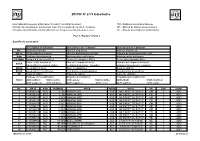
BR IFIC N° 2779 Index/Indice
BR IFIC N° 2779 Index/Indice International Frequency Information Circular (Terrestrial Services) ITU - Radiocommunication Bureau Circular Internacional de Información sobre Frecuencias (Servicios Terrenales) UIT - Oficina de Radiocomunicaciones Circulaire Internationale d'Information sur les Fréquences (Services de Terre) UIT - Bureau des Radiocommunications Part 1 / Partie 1 / Parte 1 Date/Fecha 30.09.2014 Description of Columns Description des colonnes Descripción de columnas No. Sequential number Numéro séquenciel Número sequencial BR Id. BR identification number Numéro d'identification du BR Número de identificación de la BR Adm Notifying Administration Administration notificatrice Administración notificante 1A [MHz] Assigned frequency [MHz] Fréquence assignée [MHz] Frecuencia asignada [MHz] Name of the location of Nom de l'emplacement de Nombre del emplazamiento de 4A/5A transmitting / receiving station la station d'émission / réception estación transmisora / receptora 4B/5B Geographical area Zone géographique Zona geográfica 4C/5C Geographical coordinates Coordonnées géographiques Coordenadas geográficas 6A Class of station Classe de station Clase de estación Purpose of the notification: Objet de la notification: Propósito de la notificación: Intent ADD-addition MOD-modify ADD-ajouter MOD-modifier ADD-añadir MOD-modificar SUP-suppress W/D-withdraw SUP-supprimer W/D-retirer SUP-suprimir W/D-retirar No. BR Id Adm 1A [MHz] 4A/5A 4B/5B 4C/5C 6A Part Intent 1 114095204 AUS 3.1665 MANGALORE AUS 146°E04'37'' 26°S47'13'' AM 1 ADD 2 114095209 -

Israel a History
Index Compiled by the author Aaron: objects, 294 near, 45; an accidental death near, Aaronsohn family: spies, 33 209; a villager from, killed by a suicide Aaronsohn, Aaron: 33-4, 37 bomb, 614 Aaronsohn, Sarah: 33 Abu Jihad: assassinated, 528 Abadiah (Gulf of Suez): and the Abu Nidal: heads a 'Liberation October War, 458 Movement', 503 Abandoned Areas Ordinance (948): Abu Rudeis (Sinai): bombed, 441; 256 evacuated by Israel, 468 Abasan (Arab village): attacked, 244 Abu Zaid, Raid: killed, 632 Abbas, Doa: killed by a Hizballah Academy of the Hebrew Language: rocket, 641 established, 299-300 Abbas Mahmoud: becomes Palestinian Accra (Ghana): 332 Prime Minister (2003), 627; launches Acre: 3,80, 126, 172, 199, 205, 266, 344, Road Map, 628; succeeds Arafat 345; rocket deaths in (2006), 641 (2004), 630; meets Sharon, 632; Acre Prison: executions in, 143, 148 challenges Hamas, 638, 639; outlaws Adam Institute: 604 Hamas armed Executive Force, 644; Adamit: founded, 331-2 dissolves Hamas-led government, 647; Adan, Major-General Avraham: and the meets repeatedly with Olmert, 647, October War, 437 648,649,653; at Annapolis, 654; to Adar, Zvi: teaches, 91 continue to meet Olmert, 655 Adas, Shafiq: hanged, 225 Abdul Hamid, Sultan (of Turkey): Herzl Addis Ababa (Ethiopia): Jewish contacts, 10; his sovereignty to receive emigrants gather in, 537 'absolute respect', 17; Herzl appeals Aden: 154, 260 to, 20 Adenauer, Konrad: and reparations from Abdul Huda, Tawfiq: negotiates, 253 Abdullah, Emir: 52,87, 149-50, 172, Germany, 279-80, 283-4; and German 178-80,230, -

Page Zero of Torah Tidbits 847
Page Zero of Torah Tidbits 847 Lead Tidbit cont. from page 1 (below) And, the WOW kind of miracles • especially the Splitting of the Sea • are powerful enough, impressive enough, convincing enough to bring the people to VAYAAMINU BASHEM UVMOSHE AVDO, and they believed in G•d and in His servant Moshe. Up to a point. One of the most sobering passages in the Torah is the one right after the Song of the Sea that tells us what happened a mere three days after having witnessed the spectacular events at the Sea. We complained and we yelled. What happened to VAYAAMINU? Okay, thirst can do things to a person, but • as people say: BEH•EMET! Really... WOW miracles are... WOW • but we aren't supposed to live by them. It's the NOW miracles by which we live. It's the NOW miracles that we must believe in, appreciate, and thank G•d for. We don't wake in the morning with MN scattered all over, there for the collecting. We plant and cultivate, tend and reap and we perceive G•d's hand in every stalk of wheat, every grape, every blade of grass. We don't get the sun and the moon to stand still • a magnificent one•time event. We get a sunrise every morning and a sunset every evening • and we appreciate them and try to teach our children how to appreciate the miracles of nature. He created the world once • but He continually renews the work of creation day after day. It takes a more sophisticated level of belief, but it's the NOW miracles that mean so much to us. -

President's Report 2018
VISION COUNTING UP TO 50 President's Report 2018 Chairman’s Message 4 President’s Message 5 Senior Administration 6 BGU by the Numbers 8 Building BGU 14 Innovation for the Startup Nation 16 New & Noteworthy 20 From BGU to the World 40 President's Report Alumni Community 42 2018 Campus Life 46 Community Outreach 52 Recognizing Our Friends 57 Honorary Degrees 88 Board of Governors 93 Associates Organizations 96 BGU Nation Celebrate BGU’s role in the Israeli miracle Nurturing the Negev 12 Forging the Hi-Tech Nation 18 A Passion for Research 24 Harnessing the Desert 30 Defending the Nation 36 The Beer-Sheva Spirit 44 Cultivating Israeli Society 50 Produced by the Department of Publications and Media Relations Osnat Eitan, Director In coordination with the Department of Donor and Associates Affairs Jill Ben-Dor, Director Editor Elana Chipman Editorial Staff Ehud Zion Waldoks, Jacqueline Watson-Alloun, Angie Zamir Production Noa Fisherman Photos Dani Machlis Concept and Design www.Image2u.co.il 4 President's Report 2018 Ben-Gurion University of the Negev - BGU Nation 5 From the From the Chairman President Israel’s first Prime Minister, David Ben–Gurion, said:“Only Apartments Program, it is worth noting that there are 73 This year we are celebrating Israel’s 70th anniversary and Program has been studied and reproduced around through a united effort by the State … by a people ready “Open Apartments” in Beer-Sheva’s neighborhoods, where acknowledging our contributions to the State of Israel, the the world and our students are an inspiration to their for a great voluntary effort, by a youth bold in spirit and students live and actively engage with the local community Negev, and the world, even as we count up to our own neighbors, encouraging them and helping them strive for a inspired by creative heroism, by scientists liberated from the through various cultural and educational activities. -
Architecture for Positive Peace: the Role of Architecture in the Process of Peacebuilding Within Conflict and Postwar Contexts
ARCHITECTURE FOR POSITIVE PEACE: THE ROLE OF ARCHITECTURE IN THE PROCESS OF PEACEBUILDING WITHIN CONFLICT AND POSTWAR CONTEXTS A Dissertation Presented to the Faculty of the Graduate School of the University of Cincinnati The School of Architecture and Interior Design Of the College of Design, Architecture, Art and Planning In Partial Fulfillment of the Requirements for the Degree of Doctor of Philosophy in Architecture By Venus Suleiman Akef March 2019 i ARCHITECTURE FOR POSITIVE PEACE: THE ROLE OF ARCHITECTURE IN THE PROCESS OF PEACEBUILDING WITHIN CONFLICT AND POSTWAR CONTEXTS Venus Suleiman Akef University of Cincinnati 2019 ABSTRACT This dissertation introduces architecture as an active platform in the process of structural conflict transformation for positive peace in post-war and conflict contexts. It is an interdisciplinary research in which architecture operationalizes the theories of peace and peacebuilding. Architecture for/of positive peace is also a response to the United Nations’ objectives in its 2030 agenda for sustainable development through a subject as distinct as architecture and relates it to the process of conflict transformation and sustainable peacebuilding. This research is initiated by questioning whether architecture can be employed as an active platform for positive peace. Further, it considers the role of architecture in the process of peacebuilding, its key devices, and operating characteristics. This dissertation analyzes both the existing discourses of ‘architecture and war’ and ‘architecture and peace’ to derive a set of themes and implications that reveal the role of architecture in the process of peacebuilding in post-war and conflict contexts. The research emphasizes theories of peace and peacebuilding, specifically the propositions of Johan Galtung and John Paul Lederach from the discipline of peace studies, in the aim of building a theoretical ii framework for peacebuilding through which it is possible to activate the role of architecture for positive peace. -

Integrating the Arab-Palestinian Minority in Israeli Society: Time for a Strategic Change Ephraim Lavie
Integrating the Arab-Palestinian Minority in Israeli Society: Time for a Strategic Change Ephraim Lavie Contributors: Meir Elran, Nadia Hilou, Eran Yashiv, Doron Matza, Keren Aviram, Hofni Gartner The Tami Steinmetz Center for Peace Research Integrating the Arab-Palestinian Minority in Israeli Society: Time for a Strategic Change Ephraim Lavie Contributors: Meir Elran, Nadia Hilou, Eran Yashiv, Doron Matza, Keren Aviram, Hofni Gartner This book was written within the framework of the research program on the Arabs in Israel and was published thanks to the generous financial support of Bank Hapoalim and Joseph and Jeanette Neubauer of Philadelphia, Penn. Institute for National Security Studies The Institute for National Security Studies (INSS), incorporating the Jaffee Center for Strategic Studies, was founded in 2006. The purpose of the Institute for National Security Studies is first, to conduct basic research that meets the highest academic standards on matters related to Israel’s national security as well as Middle East regional and international security affairs. Second, the Institute aims to contribute to the public debate and governmental deliberation of issues that are – or should be – at the top of Israel’s national security agenda. INSS seeks to address Israeli decision makers and policymakers, the defense establishment, public opinion makers, the academic community in Israel and abroad, and the general public. INSS publishes research that it deems worthy of public attention, while it maintains a strict policy of non-partisanship. The opinions expressed in this publication are the authors’ alone, and do not necessarily reflect the views of the Institute, its trustees, boards, research staff, or the organizations and individuals that support its research. -

Understanding Israeli Interests in the E1 Area: Contiguity, Security, and Jerusalem Nadav Shragai
STRATEGICSTRATEGIC PERSPECTIVESPERSPECTIVES NumberNumber 129 •• 20122013 The wreckage of an Israeli bus in which 22 This study discusses the E1 plan, its greatpeople importancedied and scores were for injuredthe State on of Israel, and its vicissitudes over the years. It Octoberrefutes 19, the 1994, claim in one that of Tel Aviv’sthe plan busiest would hinder the two-state solution, or preventstreets. linkage(AP Photo, betweenJerome Delay) the populations of the northern and southern West Bank. It describes the longstanding consensus in Israel about the future of Maale Adumim and the vital link between Jerusalem and Maale Adumim, of which the E1 plan is an integral aspect; the place of the Adumim bloc in the concept of metropolitan Jerusalem; and the place of that concept in Israel’s approach to security and settlement. Yehiya Ayyash, the mastermind of Palestinian suicide bus bombings, who was killed on January 5, 1995, by explosives The study also explains why avoidingplanted building in a cellphone in E1 isthat dangerous he answered. to Israel’s interests, and likely to result in(AP Maale Photo) Adumim and Jerusalem being severed from each other. At the same time, the report strongly criticizes the Israeli authorities’ failure over the years to eradicate the phenomenon of illegal Palestinian building in the area between Maale Adumim and Jerusalem. While this stems from concern for the reaction of the international community, it is gradually constricting Israel’s options in an area so vital for its future integrity.Waving Hamas flags, mourners carry the coffin with the remains of Yehiya Ayyash during his funeral procession on January 6, 1996.