Fourth National Communication of Armenia
Total Page:16
File Type:pdf, Size:1020Kb
Load more
Recommended publications
-

Nationally Determined Contribution 2021-2030 of the Republic of Armenia to Paris Agreement
Draft DECISION OF THE GOVERNMENT OF THE REPUBLIC OF ARMENIA [Date, N…] ON APPROVAL OF THE NATIONALLY DETERMINED CONTRIBUTION 2021-2030 OF THE REPUBLIC OF ARMENIA TO PARIS AGREEMENT Based on the Article 146 of the Constitution of the Republic of Armenia and taking into consideration paragraphs 2, 3, 4 and 8 of Article 4 of the Paris Agreement, the Government of the Republic of Armenia decides to: 1. Approve the Nationally determined contribution 2021-2030 of the Republic of Armenia to the Paris Agreement. 2. This decision enters into force the next day following its official publication. Prime Minister of the Republic of Armenia N. Pashinyan [Date] 1 Annex to the Government Decision N xxx dated xxx NATIONALLY DETERMINED CONTRIBUTION 2021-2030 OF THE REPUBLIC OF ARMENIA TO THE PARIS AGREEMENT 1. The Republic of Armenia ratified the United Nations Framework Convention on Climate Change in May 1993. In December 2002, Armenia ratified the Kyoto Protocol, and in February 2017, it ratified the Doha Amendment to the Kyoto Protocol and the Paris Agreement. In May 2019, the Republic of Armenia ratified the Kigali Amendment to the Montreal Protocol, undertaking a commitment to phase down HFCs1. Armenia remains committed to multilateral process addressing the climate change; 2. The Republic of Armenia submitted its Intended Nationally Determined Contribution (INDC) to the UNFCCC Secretariat in September 2015. The INDC started with a preparatory period 2015-2019, following with a next phase from 2020, with a horizon to 2050; 3. With the ratification of the Paris Agreement in February 2017, the INDC of Armenia became its nationally determined contribution (NDC) for the period of 2015 – 2050; 4. -

Environmental Assessment Report Armenia: North-South Road
Environmental Assessment Report Environmental Impact Assessment (EIA) Document Stage: Draft Sub-project Number: 42145 August 2010 Armenia: North-South Road Corridor Investment Program Tranches 2 & 3 Prepared by Ministry of Transport and Communications (MOTC) of Armenia for Asian Development Bank The environmental impact assessment is a document of the borrower. The views expressed herein do not necessarily represent those of ADB’s Board of Directors, Management, or staff, and may be preliminary in nature. Armenia: North-South Road Corridor Investment Program Tranches 2 & 3 – Environmental Impact Assessment Report ABBREVIATIONS ADB Asian Development Bank AARM ADB Armenian Resident Mission CO2 carbon dioxide EA executing agency EARF environmental assessment and review framework EIA environmental impact assessment EMP environmental management and monitoring plan IUCN International Union for Conservation of Nature LARP Land Acquisition and Resettlement Plan MFF multi-tranche financing facility MNP Ministry of Nature Protection MOC Ministry of Culture MOH Ministry of Health MOTC Ministry of Transport and Communication NGO nongovernment organization NO2 nitrogen dioxide NO nitrogen oxide MPC maximum permissible concentration NPE Nature Protection Expertise NSS National Statistical Service PAHs polycyclic aromatic hydrocarbons PMU Project Management Unit PPTA Project Preparatory Technical Assistance RA Republic of Armenia RAMSAR Ramsar Convention on Wetlands REA Rapid Environmental Assessment (checklist) SEI State Environmental Inspectorate -
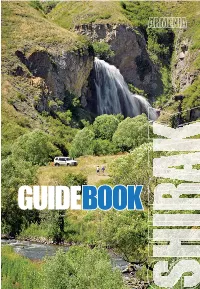
Shirak Guidebook
Wuthering Heights of Shirak -the Land of Steppe and Sky YYerevanerevan 22013013 1 Facts About Shirak FOREWORD Mix up the vast open spaces of the Shirak steppe, the wuthering wind that sweeps through its heights, the snowcapped tops of Mt. Aragats and the dramatic gorges and sparkling lakes of Akhurian River. Sprinkle in the white sheep fl ocks and the cry of an eagle. Add churches, mysterious Urartian ruins, abundant wildlife and unique architecture. Th en top it all off with a turbulent history, Gyumri’s joi de vivre and Gurdjieff ’s mystical teaching, revealing a truly magnifi cent region fi lled with experi- ences to last you a lifetime. However, don’t be deceived that merely seeing all these highlights will give you a complete picture of what Shirak really is. Dig deeper and you’ll be surprised to fi nd that your fondest memories will most likely lie with the locals themselves. You’ll eas- ily be touched by these proud, witt y, and legendarily hospitable people, even if you cannot speak their language. Only when you meet its remarkable people will you understand this land and its powerful energy which emanates from their sculptures, paintings, music and poetry. Visiting the province takes creativity and imagination, as the tourist industry is at best ‘nascent’. A great deal of the current tourist fl ow consists of Diasporan Armenians seeking the opportunity to make personal contributions to their historic homeland, along with a few scatt ered independent travelers. Although there are some rural “rest- places” and picnic areas, they cater mainly to locals who want to unwind with hearty feasts and family chats, thus rarely providing any activities. -

In-Depth Review of the Investment Climate and Market Structure in the Energy Sector of the REPUBLIC of ARMENIA
In-depth review of the investment climate and market structure in the energy sector of THE REPUBLIC OF ARMENIA ENERGY CHARTER SECRETATIAT 22 January 2015 In-depth review of the investment climate and market structure in the energy sector of THE REPUBLIC OF ARMENIA ENERGY CHARTER SECRETATIAT 22 January 2015 About the Energy Charter The Energy Charter Secretariat is the permanent office based in Brussels supporting the Energy Charter Conference in the implementation of the Energy Charter Treaty. The Energy Charter Treaty and the Energy Charter Protocol on Energy Efficiency and Related Environmental Aspects were signed in December 1994 and entered into legal force in April 1998. To date, the Treaty has been signed or acceded to by fifty-two states, the European Community and Euratom (the total number of its members is therefore fifty-four). The fundamental aim of the Energy Charter Treaty is to strengthen the rule of law on energy issues, by creating a level playing field of rules to be observed by all participating governments, thereby mitigating risks associated with energy-related investment and trade. In a world of increasing interdependence between net exporters of energy and net importers, it is widely recognised that multilateral rules can provide a more balanced and efficient framework for international cooperation than is offered by bilateral agreements alone or by non-legislative instruments. The Energy Charter Treaty therefore plays an important role as part of an international effort to build a legal foundation for energy security, based on the principles of open, competitive markets and sustainable development. The Treaty was developed on the basis of the 1991 Energy Charter. -

Ra Shirak Marz
RA SHIRAK MARZ 251 RA SHIRAK MARZ Marz center – Gyumri town Territories - Artik, Akhuryan, Ani, Amasia and Ashotsk Towns - Gyumri, Artik, Maralik RA Shirak marz is situated in the north-west of the republic. In the West it borders with Turkey, in the North it borders with Georgia, in the East – RA Lori marz and in the South – RA Aragatsotn marz. Territory 2681 square km. Territory share of the marz in the territory of RA 9 % Urban communities 3 Rural communities 116 Towns 3 Villages 128 Population number as of January 1, 2006 281.4 ths. persons including urban 171.4 ths. persons rural 110.0 ths. persons Share of urban population size 60.9 % Share of marz population size in RA population size, 2005 39.1 % Agricultural land 165737 ha including - arable land 84530 ha Being at the height of 1500-2000 m above sea level (52 villages of the marz are at the height of 1500-1700 m above sea level and 55 villages - 2000 m), the marz is the coldest region 0 of Armenia, where the air temperature sometimes reaches -46 C in winter. The main railway and automobile highway connecting Armenia with Georgia pass through the marz territory. The railway and motor-road networks of Armenia and Turkey are connected here. On the Akhuryan river frontier with Turkey the Akhuryan reservoir was built that is the biggest in the country by its volume of 526 mln. m3. Marzes of the Republic of Armenia in figures, 1998-2002 252 The leading branches of industry of RA Shirak marz are production of food, including beverages and production of other non-metal mineral products. -
Development of a River Basin Management Plan for Hrazdan River Basin
European Union Water Initiative Plus for Eastern Partnership Countries (EUWI+) Results 2 & 3 DEVELOPMENT OF A RIVER BASIN MANAGEMENT PLAN FOR HRAZDAN RIVER BASIN CONSULTATION ON THE PROGRAMME OF MEASURES APPENDIX 1 ANALYSIS OF QUESTIONNAIRES FOR LOCAL SELF-GOVERNMENT BODIES Version 1, 28 September 2020 APPENDIX 1 ANALYSIS OF THE HRAZDAN BASIN PUBLIC CONSULTATION QUESTIONNAIRES FOR LOCAL SELF-GOVERNMENT BODIES EUWI+ PROJECT: "COMMUNICATION ASSISTANCE TO SUPPORT THE IMPLEMENTATION OF THE ACTION PLAN FOR PARTICIPATIVE RBM PLANNING IN ARMENIA" Within the framework of the European Union Water Initiative Plus (EUWI+) programme, the process of developing Hrazdan and Sevan basin management plans started in 2018. The process of public discussion and consultation of the Hrazdan Basin Management Plan took place from 20 June to 20 August 2020. The Water Basin Management Plan is a guidance document developed as a result of collaboration between different stakeholders, offering common solutions to meet the needs of all water users, taking into account also the needs of the environment. Public participation plays a key role in the management plan development process. Questionnaires were used as a key tool in the public discussion and consulting process, through which expert opinions and information were collected to make additions to the water basin management plan. The questionnaires were disseminated through Gegharkunik Marzpetaran, the official website of the Ministry of Environment of the RA, the official website of EUWI+, the social networks of the CWP, as well as various CSO networks. The questionnaire was filled in by local self-government bodies (LSGB) representing 52 communities (57 questionnaires) and by non-governmental stakeholders in the basin – 134 questionnaires .A total of 191 questionnaires were completed. -
Stocktaking Exercise to Identify Legal, Institutional, Vulnerability Assessment and Adaptation Gaps and Barriers in Water Resour
“National Adaptation Plan to advance medium and long-term adaptation planning in Armenia” UNDP-GCF Project Stocktaking exercise to identify legal, institutional, vulnerability assessment and adaptation gaps and barriers in water resources management under climate change conditions Prepared by “Geoinfo” LLC Contract Number: RFP 088/2019 YEREVAN 2020 Produced by GeoInfo, Ltd., Charents 1, Yerevan, Armenia Action coordinated by Vahagn Tonoyan Date 11.06.2020 Version Final Produced for UNDP Climate Change Program Financed by: GCF-UNDP “National Adaptation Plan to advance medium and long-term adaptation planning in Armenia” project Authors National experts: Liana Margaryan, Aleksandr Arakelyan, Edgar Misakyan, Olympia Geghamyan, Davit Zakaryan, Zara Ohanjanyan International consultant: Soroosh Sorooshian 2 Content List of Abbreviations ............................................................................................................................... 7 Executive Summary ............................................................................................................................... 12 CHAPTER 1. ANALYSIS OF POLICY, LEGAL AND INSTITUTIONAL FRAMEWORK OF WATER SECTOR AND IDENTIFICATION OF GAPS AND BARRIERS IN THE CONTEXT OF CLIMATE CHANGE ............................. 19 Summary of Chapter 1 .......................................................................................................................... 19 1.1 The concept and criteria of water resources adaptation to climate change ................................. -

Biodiversity Action Plan for Amulsar, Armenia Prepared For: Lydian
Biodiversity Action Plan for Amulsar, Armenia Prepared for: Lydian International By: Chancery Cottage, Kentisbeare, Cullompton, Devon, EX15 2DS, UK. Tel. +44 (0)1884 266694. www.treweek.co.uk. CONTENTS 1 INTRODUCTION .................................................................................................................... 3 1.1 PURPOSE OF THIS DOCUMENT .............................................................................................. 3 1.2 GOALS AND OBJECTIVES ...................................................................................................... 3 1.3 LEGISLATIVE, REGULATORY AND POLICY FRAMEWORK ......................................................... 4 1.3.1 ARMENIAN LAW ............................................................................................................... 4 1.3.2 LENDER POLICIES, REQUIREMENTS AND STANDARDS ........................................................ 5 1.3.3 LYDIAN POLICY ................................................................................................................ 5 1.3.4 OTHER GUIDELINES AND STANDARDS ............................................................................... 5 1.4 OVERVIEW OF BIODIVERSITY AFFECTED BY THE PROJECT ..................................................... 5 1.5 THE BAP AND ITS RELATIONSHIP WITH OTHER DOCUMENTS ................................................. 6 2 BIODIVERSITY ACTION PLAN ................................................................................................ 8 APPENDICES APPENDIX 1 -

Agriculture and Food Processing in Armenia
SAMVEL AVETISYAN AGRICULTURE AND FOOD PROCESSING IN ARMENIA YEREVAN 2010 Dedicated to the memory of the author’s son, Sergey Avetisyan Approved for publication by the Scientifi c and Technical Council of the RA Ministry of Agriculture Peer Reviewers: Doctor of Economics, Prof. Ashot Bayadyan Candidate Doctor of Economics, Docent Sergey Meloyan Technical Editor: Doctor of Economics Hrachya Tspnetsyan Samvel S. Avetisyan Agriculture and Food Processing in Armenia – Limush Publishing House, Yerevan 2010 - 138 pages Photos courtesy CARD, Zaven Khachikyan, Hambardzum Hovhannisyan This book presents the current state and development opportunities of the Armenian agriculture. Special importance has been attached to the potential of agriculture, the agricultural reform process, accomplishments and problems. The author brings up particular facts in combination with historic data. Brief information is offered on leading agricultural and processing enterprises. The book can be a useful source for people interested in the agrarian sector of Armenia, specialists, and students. Publication of this book is made possible by the generous fi nancial support of the United States Department of Agriculture (USDA) and assistance of the “Center for Agribusiness and Rural Development” Foundation. The contents do not necessarily represent the views of USDA, the U.S. Government or “Center for Agribusiness and Rural Development” Foundation. INTRODUCTION Food and Agriculture sector is one of the most important industries in Armenia’s economy. The role of the agrarian sector has been critical from the perspectives of the country’s economic development, food safety, and overcoming rural poverty. It is remarkable that still prior to the collapse of the Soviet Union, Armenia made unprecedented steps towards agrarian reforms. -
Recent Problems of Developing a National Program on the Use Raw
Environment and Ecology Research 7(1): 7-11, 2019 http://www.hrpub.org DOI: 10.13189/eer.2019.070102 Recent Problems of Developing a National Program on the Use Raw Mineral Resources and Environmental Safety Protection in the Republic of Armenia (Lesser Caucasus Segment of Geo-ecologycal Systems of the Black Sea Region) Karapet Mouradian1,*, Aida Hayrapetyan1, Lusine Muradyan2 1Laboratory Ore Deposits, Institute of Geological Sciences, National Academy of Sciences of Armenia, Republic of Armenia 2National Institute of Health MH, Scientific- training Center, Republic of Armenia Copyright©2019 by authors, all rights reserved. Authors agree that this article remains permanently open access under the terms of the Creative Commons Attribution License 4.0 International License Abstract The article considers recent problems of 1 . Introduction developing a national program on the use of raw mineral resources and environmental protection in the Republic of The purposeful use of non-renewable resources in the Armenia. These issues have many perspectives and are Republic of Armenia and ensuring of the protection and discussed in various aspects. The need for these studies is improvement of the environment - are the priority issues of obvious in connection with the restoration of promising strategic importance for public and state governance in branches of the mining industry in the RA and terms of the prospective development of new administrative-territorial economy in the 21st century[1-9]. development of the national and scientifically sound Armenian Highland and its northeastern part of the market programs for the Safety of Global environmental Republic of Armenia naturally occurring in the central part protection management. -

Armenian Tourist Attraction
Armenian Tourist Attractions: Rediscover Armenia Guide http://mapy.mk.cvut.cz/data/Armenie-Armenia/all/Rediscover%20Arme... rediscover armenia guide armenia > tourism > rediscover armenia guide about cilicia | feedback | chat | © REDISCOVERING ARMENIA An Archaeological/Touristic Gazetteer and Map Set for the Historical Monuments of Armenia Brady Kiesling July 1999 Yerevan This document is for the benefit of all persons interested in Armenia; no restriction is placed on duplication for personal or professional use. The author would appreciate acknowledgment of the source of any substantial quotations from this work. 1 von 71 13.01.2009 23:05 Armenian Tourist Attractions: Rediscover Armenia Guide http://mapy.mk.cvut.cz/data/Armenie-Armenia/all/Rediscover%20Arme... REDISCOVERING ARMENIA Author’s Preface Sources and Methods Armenian Terms Useful for Getting Lost With Note on Monasteries (Vank) Bibliography EXPLORING ARAGATSOTN MARZ South from Ashtarak (Maps A, D) The South Slopes of Aragats (Map A) Climbing Mt. Aragats (Map A) North and West Around Aragats (Maps A, B) West/South from Talin (Map B) North from Ashtarak (Map A) EXPLORING ARARAT MARZ West of Yerevan (Maps C, D) South from Yerevan (Map C) To Ancient Dvin (Map C) Khor Virap and Artaxiasata (Map C Vedi and Eastward (Map C, inset) East from Yeraskh (Map C inset) St. Karapet Monastery* (Map C inset) EXPLORING ARMAVIR MARZ Echmiatsin and Environs (Map D) The Northeast Corner (Map D) Metsamor and Environs (Map D) Sardarapat and Ancient Armavir (Map D) Southwestern Armavir (advance permission -

Հկտ 30 Report-On-Training-In-Azatan 22
Report on training Training days: 22.06.2013 Training theme: “Legal regulations of economic activity: RA law for sole entrepreneurs” Training place: Azatan FVSC/BDIC, Shirak Marz 1. Aims and objectives of the training This training was organized based on the BDIC services need assessment done in Shirak Marz. The report showed that people in Shirak Marz would like to have training on “RA law for private entrepreneurs”. Therefore, BDIC organized training on the mentioned theme for the community members. The aim of the training was to present and inform the training participants about the regulations in the sphere of Private Entrepreneurship, to tell about the rights and obligations of the PE, about the contract and agreement types, etc. 2. Training participants Farmers, small entrepreneurs, vets and other people from Azatan, Yerazgavors, Bayandur, Getq, Gharibjanyan, Arevik, Beniamin villages of Akhuryan community took participation in the training. The total number of the training participants was 16, from which 7 were women. For more details, please, see the list of the participants in the Annex 1. 3. Training Theme and Methodology As already mentioned above, the training theme was selected according to the BDIC services Need Assessment results. For the provision of the training we have invited a specialized consultant lawyer Artak Garoyan for presenting the topic (you may see the Terms of Reference in the Annex 6). The trainer conducted training through the presentation and discussion methods. All the training materials and PPTs were distributed to the training participants (see the handouts in the Annex 2). 4. Challenges and Solutions Nothing challenging happened during the training.