The Cincinnati & Lake Erie and the Great
Total Page:16
File Type:pdf, Size:1020Kb
Load more
Recommended publications
-

PRR CHRONOLGY 1854 March 2005 Edition Fall 1853-1854 General
PRR CHRONOLGY 1854 March 2005 Edition fall 1853-1854 General credit crisis; shortage of funds causes many railroad projects to suspend or restrict operations. see 7/54 below? Jan. 1, 1854 William A. Wright resigns to become Chief Engineer of Memphis & Charleston Railroad, leaving Thomas W. Seabrook sole engineer on Western Division. (Watkins - not in MB) Jan. 1, 1854 Madison & Indianapolis Railroad consolidated with the Peru & Indianapolis Railroad (Indianapolis-Kokomo - later part of Lake Erie & Western) to form Madison, Indianapolis & Peru Railroad under agreement of Sep. 7, 1853; E.W.H. Ellis of P&I replaces John Brough of M&I as president of merged company. ( - Church has eff. Oct. 1, 1853 under agreements of 9/6 and 9/28) Jan. 2, 1854 Camden & Philadelphia Steam Boat Ferry Company conveys a half interest in the Windmill Island Canal to the West Jersey Ferry Company. (Val) Jan. 3, 1854 British and French fleets enter the Black Sea to protect the Turkish coast from the Russian advance, starting the Crimean War; effects of war include price disturbances and diversion of British capital from American railroad projects. Jan. 4, 1854 Legal Dept. created with appointment of William A. Stokes as separate solicitor for the Western Division. (MB) Jan. 4, 1854 PRR Telegraph Committee recommends use of Morse system; to build immediately between Pittsburgh and Altoona and make contract with existing Morse line between Altoona and Philadelphia. (MB) Jan. 4, 1854 Gov. Bigler issues message to Pa. Legislature on Erie Riots stating that the Legislature never intended there be a railroad west from Erie towards Cleveland, that the state has a right to use its natural advantages for its own benefit, and that having the break of gauge at Buffalo will harm or kill the commerce of Erie Harbor. -

Federal Register/Vol. 65, No. 183/Wednesday
56988 Federal Register / Vol. 65, No. 183 / Wednesday, September 20, 2000 / Notices Application Modification of No. Docket No. Applicant exemption 8013±M .... ................................. Praxair, Inc., Danbury, CT 1 ..................................................................................................... 8013 10501±M .. ................................. Semi-Bulk Systems, Inc., Fenton, MO 2 .................................................................................. 10501 10985±M .. ................................. Georgia-Pacific Corporation, Atlanta, GA 3 .............................................................................. 10985 11749±M .. ................................. Union Tank Car Company, E. Chicago, IN 4 ........................................................................... 11749 12499±M .. RSPA±2000±7650 M & M Service Company, Carlinville, IL 5 ............................................................................... 12499 12504±M .. RSPA±2000±7652 Radian International, Research Triangle Park, NC 6 ............................................................... 12504 1 To modify the exemption to allow for the use of DOT 4E240 specification cylinders having a capacity up to 2,642 cubic inches to be used ex- clusively for sampling purposes. 2 To modify the exemption to update reference language concerning Flexible Intermediate Bulk Container reuse provisions and repair proce- dures. 3 To modify the exemption to authorize the transportation of Class 8 materials in tank cars which remain -
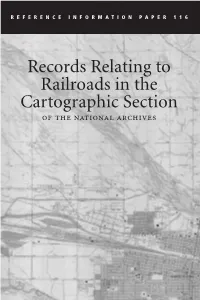
Records Relating to Railroads in the Cartographic Section of the National Archives
REFERENCE INFORMATION PAPER 116 Records Relating to Railroads in the Cartographic Section of the national archives 1 Records Relating to Railroads in the Cartographic Section of the National Archives REFERENCE INFORMATION PAPER 116 National Archives and Records Administration, Washington, DC Compiled by Peter F. Brauer 2010 United States. National Archives and Records Administration. Records relating to railroads in the cartographic section of the National Archives / compiled by Peter F. Brauer.— Washington, DC : National Archives and Records Administration, 2010. p. ; cm.— (Reference information paper ; no 116) includes index. 1. United States. National Archives and Records Administration. Cartographic and Architectural Branch — Catalogs. 2. Railroads — United States — Armed Forces — History —Sources. 3. United States — Maps — Bibliography — Catalogs. I. Brauer, Peter F. II. Title. Cover: A section of a topographic quadrangle map produced by the U.S. Geological Survey showing the Union Pacific Railroad’s Bailey Yard in North Platte, Nebraska, 1983. The Bailey Yard is the largest railroad classification yard in the world. Maps like this one are useful in identifying the locations and names of railroads throughout the United States from the late 19th into the 21st century. (Topographic Quadrangle Maps—1:24,000, NE-North Platte West, 1983, Record Group 57) table of contents Preface vii PART I INTRODUCTION ix Origins of Railroad Records ix Selection Criteria xii Using This Guide xiii Researching the Records xiii Guides to Records xiv Related -

Newyel Newyellow Line Connector FAQS
New Yellow Line Connector New Yellow Line Connector FAQS How will the New Yellow Line Connector impact your commute? The Yellow Line Connector will be operated by the both the Interurban Trolley and Transpo, with a new connection point at the Mishawaka Transfer Center. Existing Transpo Route 9 will end at the Mishawaka Transfer Center. 30 minute service will be provided along 30 MONDAY the whole route between downtown Min to FRIDAY Mishawaka and downtown Elkhart Monday through Friday. This equates to a doubling of service, during the weekdays, on the route east of Bittersweet Road. Existing Service Up to 41 minutes at South Street Up to 35 minutes at Elkhart UpStation to 15 minutes or Twin at Branch Transfer Center South Street Station or Mishawaka TC 15 minutes at 5 minutes at Riders will see a reduction in waiting time Mishawaka Elkhart Proposed Service Transfer Transfer for transfers during the weekday. Center Center 0 10 20 30 40 50 60 70 80 Wait Time (minutes) For additional resources, visit www.interurbantrolley.com/yellow_line New Yellow Line Connector FAQS FAQS How will the fare structure change? Interurban Trolley and Transpo reduced fares will be available at all times, even peak hour. $3 day passes for either the Interurban Trolley or Transpo system will be oered on all Yellow Line Connector buses. All Interurban Trolley or Transpo Bus Passes will be accepted on the Yellow Line Connector Route If a rider plans to continue their transit trip past downtown Elkhart or Mishawaka, an additional fare may be needed. Children under 4 years old ride free on the Yellow Line Connector, and all Interurban Trolley buses. -

Airport Transportation
Airport Transportation This is a selection of services that provide transportation between Detroit Metropolitan Airport and Ann Arbor. The Office of New Student Programs provides this list as a convenience to students and parents, and does not endorse or promote any particular service. Please note: Rates are subject to change. Shuttle Services Accent Transportation Service provides A2 MetroRide provides taxi service for up to 4 private sedan service and airport pickup. 24 passengers and shuttle service for individuals. hour advance reservation is recommended to Airport pick-up is available. secure time and choice of vehicle. Phone: 734.709.1204 Phone: 800.346.9884 Price: Taxi rates are $50 one way; shuttle Web: www.atsride.com rates are $40 per person Price: $55 from airport, $45 to airport Hours: 4:30 am – 11 pm Hours: 24 Hour Service Argus Cab provides private taxi service for up Amazing Blue Taxi provides taxi service for up to 4 passengers. Reservations should be made to four passengers. Reservations are required 24 hours before travel if possible. for airport pickups and reserving in advance Phone: 734.741.9000 guarantees transportation to airport. Price: $50 to airport, $60 from airport Phone: 734.846.0007 Hours: 24 Hour Service Web: www.amazingbluetaxi.com Price: $50 to airport; $60 from airport Campus Cars provides private taxi service and Hours: 24 Hour Service airport shuttle, 24 hour notice preferred Phone: 734.444.5354 Ann Arbor Airport Shuttle Inc. provides door E-Mail: campuscars@comcast.net to door shuttle service and vans for groups up Price: $39 one way to nine passengers. -
Mi0747data.Pdf
DETROIT'S MILWAUKEE JUNCTION SURVEY HAER MI-416 Milwaukee Junction HAER MI-416 Detroit Michigan WRITTEN HISTORICAL AND DESCRIPTIVE DATA FIELD RECORDS HISTORIC AMERICAN ENGINEERING RECORD National Park Service U.S. Department of the Interior 1849 C Street NW Washington, DC 20240-0001 HISTORIC AMERICAN ENGINEERING RECORD DETROIT’S MILWAUKEE JUNCTION SURVEY HAER MI-416 Location: Milwaukee Junction, Detroit, Michigan The survey boundaries are Woodward Avenue on the west and St. Aubin on the east. The southern boundary is marked by the Grand Trunk Western railroad line, which runs just south of East Baltimore from Woodward past St. Aubin. The northern boundary of the survey starts on the west end at East Grand Boulevard, runs east along the boulevard to Russell, moves north along Russell to Euclid, and extends east along Euclid to St. Aubin. Significance: The area known as Milwaukee Junction, located just north of Detroit’s city center, was a center of commercial and industrial activity for more than a century. Milwaukee Junction served, if not as the birthplace of American automobile manufacturing, then as its nursery. In addition to the Ford Motor Company and General Motors, many early auto manufacturers and their support services (especially body manufacturers like the Fisher Brothers, C.R. Wilson, and Trippensee Auto Body) were also located in the area, probably because of the proximity of the railroads. Historians: Kenneth Shepherd and Richard Sucré, 2003 Project Information: The Historic American Engineering Record conducted a survey of Detroit’s Milwaukee Junction, a center of auto and related industrial production, in summer 2003. The City of Detroit and the city’s Historic Designation Advisory Board sponsored the survey. -

IMMEDIATE NEEDS ASSESSMENT of Railroad Infrastructure in the Youngstown-Warren Mahoning Valley Region
WRPA Immediate Needs Rail Assessment – Page 1 IMMEDIATE NEEDS ASSESSMENT Of railroad infrastructure in the Youngstown-Warren Mahoning Valley region For the May 31, 2012 Conducted by with Excelsior Transportation Management WRPA Immediate Needs Rail Assessment – Page 2 Table of Contents Table of Contents . 2 Executive Summary . 3 Background . 4 Study Process . 8 Overview Rail Maps . 10 Project Scorecards . 12 Scorecard Criteria Descriptions . 12 1. Ohio Commerce Center, track improvements . 15 2. CSX/Ohio Central RR Ohio Junction rail yard expansion . 17 3. CASTLO/Lally rail service yard repairs/rehab . 20 4. Warren Steel Holdings & West Warren track connection . 23 5. AC&J RR Carson, Jefferson transload expansions . 25 6. Cleveland direct rail to Mahoning Valley via Kent . 27 7. Hubbard Trans-Rail America transload facilities . 29 8. Campbell-Darlington track/capacity enhancements . 31 9. Cleveland direct rail to Mahoning Valley via Kent Bypass . 33 10. Cleveland direct rail to Mahoning Valley via Mantua . 35 11. Ohio River NS Direct Track Connection at Alliance . 37 12. Reactivate State Line ROW from Lowellville to Hillsville . 39 13. Ohio River Y&S corridor restoration Negley to Glasgow . 41 SUMMARY – Rail Project Assessment Table . 43 Funding Options . 44 Conclusion . 48 WRPA Immediate Needs Rail Assessment – Page 3 Executive Summary In February 2012, the Board of Trustees of the Western Reserve Port Authority requested assistance in determining if it should build its organizational capacity to aid or otherwise develop railroad infrastructure projects in the Youngstown-Warren Mahoning Valley region. WRPA engaged RESTORE (Rail Enhancements = Sustainable Transportation, Opportunity, Revitalization & Employment), a rail freight infrastructure research arm of the nonprofit educational organization All Aboard Ohio, to help it determine what might be the best way to build its rail development capacity. -

The Wabash—The Gould Downfall
THE WABASH—THE GOULD DOWNFALL THOMAS C. CAMPBELL, JR.1 Wabash- Pittsburgh Terminal Railway, known to THEmany people of Western Pennsylvania as the old Wabash Railroad, was constructed in the period from 1901 to 1904 by George Gould, the son of Jay Gould. This was not the first of the Gould railway ventures, nor the greatest finan- cially, but none of the others received more publicity. In1867, Jay Gould along with "Jim" Fisk and Daniel Drew decided to obtain control of the Erie Railroad through pur- chasing a majority of the outstanding stock. Commodore Cornelius Vanderbilt of the New York Central was at that same time planning to control the Erie as it was one of the New York Central's greatest competitors. Gould, Fisk, and Drew were directors of the Erie, and the Commodore de- sired to relieve them of their duties after purchasing a ma- jority of the Erie stock. He ordered his brokers to: "Buy the Erie. Buy it at the lowest figure you can, but buy it." The brokers in carrying out the orders discovered that they had bought more Erie stock than was legally in existence. After carefully examining the newly purchased stock, some of it appeared to have been printed on new paper with the ink hardly dry. The three Erie directors had been printing illegal issues of stock to sell to the brokers. Fisk's response was : "Give us enough rag paper, and we'll hammer the ever- lasting tar out of the mariner from Staten Island." Drew, in speaking of the incident, said: "It was goodnight for the Commodore, because there is no limit to blank shares a print- ing press can turn out. -
Pa-Railroad-Shops-Works.Pdf
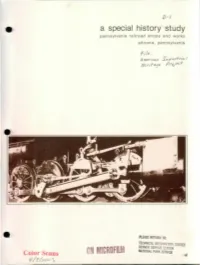
[)-/ a special history study pennsylvania railroad shops and works altoona, pennsylvania f;/~: ltmen~on IndvJ·h·;4 I lferifa5e fJr4Je~i Pl.EASE RETURNTO: TECHNICAL INFORMATION CENTER DENVER SERVICE CE~TER NATIONAL PARK SERVICE ~ CROFIL -·::1 a special history study pennsylvania railroad shops and works altoona, pennsylvania by John C. Paige may 1989 AMERICA'S INDUSTRIAL HERITAGE PROJECT UNITED STATES DEPARTMENT OF THE INTERIOR I NATIONAL PARK SERVICE ~ CONTENTS Acknowledgements v Chapter 1 : History of the Altoona Railroad Shops 1. The Allegheny Mountains Prior to the Coming of the Pennsylvania Railroad 1 2. The Creation and Coming of the Pennsylvania Railroad 3 3. The Selection of the Townsite of Altoona 4 4. The First Pennsylvania Railroad Shops 5 5. The Development of the Altoona Railroad Shops Prior to the Civil War 7 6. The Impact of the Civil War on the Altoona Railroad Shops 9 7. The Altoona Railroad Shops After the Civil War 12 8. The Construction of the Juniata Shops 18 9. The Early 1900s and the Railroad Shops Expansion 22 1O. The Railroad Shops During and After World War I 24 11. The Impact of the Great Depression on the Railroad Shops 28 12. The Railroad Shops During World War II 33 13. Changes After World War II 35 14. The Elimination of the Older Railroad Shop Buildings in the 1960s and After 37 Chapter 2: The Products of the Altoona Railroad Shops 41 1. Railroad Cars and Iron Products from 1850 Until 1952 41 2. Locomotives from the 1860s Until the 1980s 52 3. Specialty Items 65 4. -

HUD PD&R Housing Market Profiles: Detroit-Warren-Dearborn, Michigan
HUD PD&R Housing Market Profiles Detroit-Warren-Dearborn, Michigan Quick Facts About Detroit-Warren- Dearborn By Gabe Labovitz | As of February 1, 2018 Current sales market conditions: balanced. Current apartment market conditions: balanced. Overview The Detroit-Warren-Dearborn (hereafter, Detroit) metropolitan area The city of Detroit became the largest municipal is coterminous with the Detroit-Warren-Dearborn, MI Metropolitan bankruptcy in U.S. history, by debt and popula Statistical Area. It includes six counties in southeastern Michigan— tion affected, when it filed under Chapter 9 during Lapeer, Livingston, Macomb, Oakland, St. Clair, and Wayne 2013. After negotiations with creditors, the city Counties. Wayne County includes the city of Detroit. The first mile exited bankruptcy in December 2014 and has of paved concrete road in the nation was installed on Woodward since posted three consecutive balanced bud Avenue in Detroit in 1909, slightly north of the Ford Model T plant. gets. The General Motors Company (formerly Henry Ford produced his first automobile in Detroit in 1896, and the General Motors Corporation) and FCA US, currently three of the four largest employers in the metropolitan LLC (formerly Chrysler), two of the four largest area are Ford Motor Company, General Motors, and FCA US. As employers in the Detroit metropolitan area, each of September 2017, the metropolitan area had a concentration of filed for Chapter 11 bankruptcy and emerged jobs in the transportation equipment manufacturing industry more during 2009. than five times the national average, and jobs in this industry rose an average of 5.3 percent annually from a recent low of 74,950 jobs during 2010 to 102,300 jobs during 2016 (Quarterly Census of Employment and Wages). -

Fermi 2 DTE Energy 6400 N. Dixie Hwy. Newport, MI 48166
Visitor Guide Fermi 2 - DTE Energy Fermi 2 DTE Energy 6400 N. Dixie Hwy. Newport, MI 48166 1 Welcome Monroe County is just miles from the Michigan/Ohio border, Monroe, Michigan serves as the gateway to the Great Lakes. Monroe is located 45 minutes away from the larger metropolitan areas of Detroit, Ann Arbor and Toledo. Local residents and visitors share the advantages of small town charm together with easy access to the array of services and opportunities offered by large cities. This visitor guide will provide you with directions to our Fermi 2 site, as well as, places and stay and eat in the area. Brief History Construction of Fermi 2 began in 1968 when DTE Energy announced plans to build a light water reactor power plant along the Western shore of Lake Erie in Frenchtown Township. The plant was constructed to meet the fast growing, local demand for electricity and to provide the region with a diverse fuel mix. The plant opened in January, 1988. Fermi 2's electric generating capacity is nearly 1,200 megawatts at 22,000 volts, which produces about 15 percent of the power generated by Detroit Edison. Fermi 2 Facts: " Fermi 2 normally produces enough electricity to serve a city of about one million people. " Fermi 2 was the 93 rd nuclear power plant to be licensed in the United States. " Fermi 2 contains 300,000 cubic yards of concrete, 20,000 tons of steel, 1,200 miles of electric wire and 70 miles of conduit. " The plant's cooling system is a "closed system" to prevent thermal or other pollution in Lake Erie. -

The Urban Rail Development Handbook
DEVELOPMENT THE “ The Urban Rail Development Handbook offers both planners and political decision makers a comprehensive view of one of the largest, if not the largest, investment a city can undertake: an urban rail system. The handbook properly recognizes that urban rail is only one part of a hierarchically integrated transport system, and it provides practical guidance on how urban rail projects can be implemented and operated RAIL URBAN THE URBAN RAIL in a multimodal way that maximizes benefits far beyond mobility. The handbook is a must-read for any person involved in the planning and decision making for an urban rail line.” —Arturo Ardila-Gómez, Global Lead, Urban Mobility and Lead Transport Economist, World Bank DEVELOPMENT “ The Urban Rail Development Handbook tackles the social and technical challenges of planning, designing, financing, procuring, constructing, and operating rail projects in urban areas. It is a great complement HANDBOOK to more technical publications on rail technology, infrastructure, and project delivery. This handbook provides practical advice for delivering urban megaprojects, taking account of their social, institutional, and economic context.” —Martha Lawrence, Lead, Railway Community of Practice and Senior Railway Specialist, World Bank HANDBOOK “ Among the many options a city can consider to improve access to opportunities and mobility, urban rail stands out by its potential impact, as well as its high cost. Getting it right is a complex and multifaceted challenge that this handbook addresses beautifully through an in-depth and practical sharing of hard lessons learned in planning, implementing, and operating such urban rail lines, while ensuring their transformational role for urban development.” —Gerald Ollivier, Lead, Transit-Oriented Development Community of Practice, World Bank “ Public transport, as the backbone of mobility in cities, supports more inclusive communities, economic development, higher standards of living and health, and active lifestyles of inhabitants, while improving air quality and liveability.