Hambledon Conservation Area Technical
Total Page:16
File Type:pdf, Size:1020Kb
Load more
Recommended publications
-

The Virtual Wisdener
No 35: March 26 2021. The Virtual Wisdener The Newsletter of the Wisden Collectors’ Club Crisis over, all is well, everyone calm down, We have 20 copies of the latest ediHon of Wisden Cricket Monthly stop panicking - Jonny Bairstowe has to give away - completely free - honest-a-goodness-Guv, no strings reassured us all that ‘any side in the world amached, all-above-board me luvlies - by answering, correctly, the would miss Joe Root’ a>er the person who is following quesHon. Captain of the England team, yes the Who is the current England Test Team Coach: Captain, was rested a>er playing a few Tests 1: His Former Royal Highness Prince Harry of Hollywood against India. 2: Julie the delivery driver who got the job because the word Thank you Jonny for an insigh;ul and deeply ‘delivery’ was on her CV. thought-provoking behind-the-scenes look at 3: Chris Silverwood. things. Such intelligence and analysis means 4: Johnny Depp because of his experience in having failed appeals. that he has a career on SKY beckoning the day Please email your answers - email address on page and once he reHres from the internaHonal side - the again, Libby will randomly choose 20 winners . same day he probably stops playing for Yorkshire too. feel is right. Unless the content or menHon of the Five On the same day the headline crickeHng story was Cricketers of The Year are officially released by the Bairstowe’s comment we also had Ben Stokes telling publishers then the content remains out of bounds. Jofra Archer to get his elbow sorted out and, sorry to The 2021 will have 1,248 pages - for obvious reasons it menHon this, but we had this headline on the BBC is slightly thinner than usual. -

Cricket Memorabilia Society Postal Auction Closing at Noon 10
CRICKET MEMORABILIA SOCIETY POSTAL AUCTION CLOSING AT NOON 10th JULY 2020 Conditions of Postal Sale The CMS reserves the right to refuse items which are damaged or unsuitable, or we have doubts about authenticity. Reserves can be placed on lots but must be agreed with the CMS. They should reflect realistic values/expectations and not be the “highest price” expected. The CMS will take 7% of the price realised, the vendor 93% which will normally be paid no later than 6 weeks after the auction. The CMS will undertake to advertise the memorabilia for auction on its website no later than 3 weeks prior to the closing date of the auction. Bids will only be accepted from CMS members. Postal bids must be in writing or e-mail by the closing date and time shown above. Generally, no item will be sold below 10% of the lower estimate without reference to the vendor.. Thus, an item with a £10-15 estimate can be sold for £9, but not £8, without approval. The incremental scale for the acceptance of bids is as follows: £2 increments up to £20, then £20/22/25/28/30 up to £50, then £5 increments to £100 and £10 increments above that. So, if there are two postal bids at £25 and £30, the item will go to the higher bidder at £28. Should there be two identical bids, the first received will win. Bids submitted between increments will be accepted, thus a £52 bid will not be rounded either up or down. Items will be sent to successful postal bidders the week after the auction and will be sent by the cheapest rate commensurate with the value and size of the item. -
Gazetteer.Doc Revised from 10/03/02
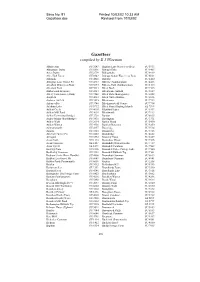
Save No. 91 Printed 10/03/02 10:33 AM Gazetteer.doc Revised From 10/03/02 Gazetteer compiled by E J Wiseman Abbots Ann SU 3243 Bighton Lane Watercress Beds SU 5933 Abbotstone Down SU 5836 Bishop's Dyke SU 3405 Acres Down SU 2709 Bishopstoke SU 4619 Alice Holt Forest SU 8042 Bishops Sutton Watercress Beds SU 6031 Allbrook SU 4521 Bisterne SU 1400 Allington Lane Gravel Pit SU 4717 Bitterne (Southampton) SU 4413 Alresford Watercress Beds SU 5833 Bitterne Park (Southampton) SU 4414 Alresford Pond SU 5933 Black Bush SU 2515 Amberwood Inclosure SU 2013 Blackbushe Airfield SU 8059 Amery Farm Estate (Alton) SU 7240 Black Dam (Basingstoke) SU 6552 Ampfield SU 4023 Black Gutter Bottom SU 2016 Andover Airfield SU 3245 Blackmoor SU 7733 Anton valley SU 3740 Blackmoor Golf Course SU 7734 Arlebury Lake SU 5732 Black Point (Hayling Island) SZ 7599 Ashlett Creek SU 4603 Blashford Lakes SU 1507 Ashlett Mill Pond SU 4603 Blendworth SU 7113 Ashley Farm (Stockbridge) SU 3730 Bordon SU 8035 Ashley Manor (Stockbridge) SU 3830 Bossington SU 3331 Ashley Walk SU 2014 Botley Wood SU 5410 Ashley Warren SU 4956 Bourley Reservoir SU 8250 Ashmansworth SU 4157 Boveridge SU 0714 Ashurst SU 3310 Braishfield SU 3725 Ash Vale Gravel Pit SU 8853 Brambridge SU 4622 Avington SU 5332 Bramley Camp SU 6559 Avon Castle SU 1303 Bramshaw Wood SU 2516 Avon Causeway SZ 1497 Bramshill (Warren Heath) SU 7759 Avon Tyrrell SZ 1499 Bramshill Common SU 7562 Backley Plain SU 2106 Bramshill Police College Lake SU 7560 Baddesley Common SU 3921 Bramshill Rubbish Tip SU 7561 Badnam Creek (River -

Paris to Hayling Reunion Bike Ride
Hayling Cycle Ride Practice Ride From The Ship Langstone to The Shoe, Exton and back From The Ship turn right. Just before roundabout turn left into Langstone Technology Park. Turn right into the car park and go to the end and take the footpath on the right-hand side. Join footpath and go left, towards Portsmouth. At end turn right into Brookside Road. Zero mileage here 0.1 At roundabout turn right into Brockhampton Road 0.2 Straight over roundabout 0.5 At T junction (Prince of Wales Pub) turn left into Bedhampton Road. Go over Bedhampton level crossing to join main road. Straight over at traffic lights 1.1 At roundabout take 2nd exit onto Portsdown Hill Road. Up and over motorway and straight on; go past The George and The Churchillian 5.4 Turn Right into Pigeon House Lane (before the Southwick roundabout) WARNING – Fast descent with loose gravel Take Care crossing The Ford – you can dismount and use the bridge 6.2 Bear Left after The Ford 8.1 Turn Left – sign Denmead 2 8.4 Turn Left – sign Denmead 8.9 At T Junction go Straight On (cycle path only) Mead End Road 9.1 Straight On into Mill Road 9.3 Turn Right on Anmore Road – sign Clanfield 5 10.8 Bear Left – sign Hinton Daubney 11.5 Turn Left down Old Mill Lane – sign Denmead Mill 12.0 Turn Right on Old Mill Lane – sign Bat and Ball 13.7 Turn Left at the crossroads in front of the Bat and Ball pub 13.9 Turn 1st Right (just after the trees) – sign Chidden 15.1 Bear Left at the end of the descent – sign Hambledon Follow road to Meonstoke and Droxford 16.8 Turn Right – sign East Meon and Coombe 16.9 Straight on at Crossroads – sign Corhampton 18.6 Bear Left onto Shavards Lane – sign South Downs Way 18.9 At A32 junction go straight across into Beacon Hill Lane – WARNING this is a busy road 19.0 The Shoe is our lunch stop for today. -

JW Mckenzie Cricket Books
J.J W. W. M. Mc KcKenenzizei e J. W. McKenzie CaCtaltoalgougeu e2 0230 3 Catalogue 203 Item No. 3 Item No. 3 Item No. 3 Item No. 6 Item No. 22 Item No. 85 Item No. 6 Item No. 22 Item No. 85 Item No. 6 Item No. 22 Item No. 85 Item No. 123 Item No. 125 Item No. 149 Item No. 123 Item No. 125 Item No. 149 Item No. 123 Item No. 125 Item No. 149 Item No. 1007 Item No. 1008 Item No. 1010 Item No. 1007 Item No. 1008 Item No. 1010 Item No. 1007 Item No. 1008 Item No. 1010 Item No. 1011 Item No. 1014 Item No. 1029 Item No. 1011 Item No. 1014 Item No. 1029 Item No. 1011 Item No. 1014 Item No. 1029 Item No. 1179 Item No. 1166 Item No. 1179 Item No. 1166 Item No. 1179 Item No. 1166 Printed by Joshua Horgan, Oxford Item No. 1204 Item No. 1215 Item No. 1204 Item No. 1215 Item No. 1204 Item No. 1215 Item No. 1218 Item No. 1199 Item No. 1218 Item No. 1199 Item No. 1218 Item No. 1199 Item No. 1190 Item No. 1190 Item No. 1190 A warm hello to all our customers All of us at J W McKenzie are pleased to be sending you our latest catalogue. We hope that this finds you safe and well during these unusual and difficult times. Thank you for your continued support. Visitors We are now pleased to again welcome visitors to the shop Due to the layout of the premises we feel it appropriate at present to have only two visitors at a time. -

Globalizing Cricket: Englishness, Empire and Identity
Malcolm, Dominic. "The Emergence of Cricket." Globalizing Cricket: Englishness, Empire and Identity. London: Bloomsbury Academic, 2013. 14–29. Globalizing Sport Studies. Bloomsbury Collections. Web. 25 Sep. 2021. <http://dx.doi.org/10.5040/9781849665605.ch-001>. Downloaded from Bloomsbury Collections, www.bloomsburycollections.com, 25 September 2021, 08:42 UTC. Copyright © Dominic Malcolm 2013. You may share this work for non-commercial purposes only, provided you give attribution to the copyright holder and the publisher, and provide a link to the Creative Commons licence. 1 The Emergence of Cricket n Jamaica, on 29 January 1998, a test match between England and the West IIndies was abandoned after just fi fty-six minutes of play.1 During that time the England team’s physiotherapist had treated injured batsmen on six separate occasions. Ultimately the umpires, in consultation with the team captains and the match referee, decided that the unevenness of the wicket made the ball’s bounce too unpredictable and thus that play posed an unacceptable risk to batters’ safety. An editorial in The Times stated that ‘Somebody could have been killed. Test cricket is not a game for the faint hearts. But neither should it be turned into an intimidatory dice of death’ (30 January 1998). Remarkably this was the fi rst time that this had occurred in 122 years of test cricket. The perception of cricket as a genteel game is inextricably linked to the cricket-Englishness couplet. To examine this relationship more fully we need to appreciate how the modern sport we now call cricket emerged. Who was responsible for drawing up cricket’s laws and what specifi c choices did they make? How did this process relate to the broader social context of which it was a part? From folk game to modern sport As Major notes, ‘the search for the birth of cricket has been as fruitless as the hunt for the holy grail’ (2007: 17). -

Winchester Museums Service Historic Resources Centre
GB 1869 AA2/110 Winchester Museums Service Historic Resources Centre This catalogue was digitised by The National Archives as part of the National Register of Archives digitisation project NRA 41727 The National Archives ppl-6 of the following report is a list of the archaeological sites in Hampshire which John Peere Williams-Freeman helped to excavate. There are notes, correspondence and plans relating to each site. p7 summarises Williams-Freeman's other papers held by the Winchester Museums Service. William Freeman Index of Archaeology in Hampshire. Abbots Ann, Roman Villa, Hampshire 23 SW Aldershot, Earthwork - Bats Hogsty, Hampshire 20 SE Aldershot, Iron Age Hill Fort - Ceasar's Camp, Hampshire 20 SE Alton, Underground Passage' - Theddon Grange, Hampshire 35 NW Alverstoke, Mound Cemetery etc, Hampshire 83 SW Ampfield, Misc finds, Hampshire 49 SW Ampress,Promy fort, Hampshire 80 SW Andover, Iron Age Hill Fort - Bagsbury or Balksbury, Hampshire 23 SE Andover, Skeleton, Hampshire 24 NW Andover, Dug-out canoe or trough, Hampshire 22 NE Appleshaw, Flint implement from gravel pit, Hampshire 15 SW Ashley, Ring-motte and Castle, Hampshire 40 SW Ashley, Earthwork, Roman Building etc, Hampshire 40 SW Avington, Cross-dyke and 'Ring' - Chesford Head, Hampshire 50 NE Barton Stacey, Linear Earthwork - The Andyke, Hampshire 24 SE Basing, Park Pale - Pyotts Hill, Hampshire 19 SW Basing, Motte and Bailey - Oliver's Battery, Hampshire 19 NW Bitterne (Clausentum), Roman site, Hampshire 65 NE Basing, Motte and Bailey, Hampshire 19 NW Basingstoke, Iron -
Playing Pitch Strategy Appendices
Appendix 2 : Club Feedback WINCHESTER/SUB AREA 1 (covering Sub Areas 1 (Winchester), 2 (Kingsworthy) and 4 (Winchester Rural) Comments on demand Overall there is some perception that adult grass football is in decline. Whilst this may be the case with Saturday league football, and more teams now playing small sided games on artificial and indoor pitches, there is still a healthy Sunday football culture within and around Winchester and burgeoning youth teams. Saturday league sides – not a problem in accommodating these on Saturdays. One Saturday league team playing on school/education land at Sparsholt College Clubs in south of league often playing at Fleming Park and Fair Oak (Lansdown Park) but many cancellations with Southampton league and pitches so often end up coming up to Winchester and KGV for pitches. e.g.Grantham Arms – usually at Chandlers Ford but come up to use KGV. In summary the issues are identified as: There are a number of shared grounds, notably King George V, where early cessation of football pitches means difficulties in completing the season, especially for cup ties and meeting demand from postponed matches With only two floodlit surfaces in Winchester, meeting demand for midweek training is very difficult. There is expressed demand for additional floodlit synthetic surfaces and indoor training facilities. There is some conflict over the intensification of use of grass and hard surfaces with local residents, who object to floodlighting. The Strategy highlights the need for certain sites to be designated as being of importance to the pitch sports, where intensification (floodlighting, improved changing facilities) will be supported through the planning system. -

Bowled Over by the Village Where Cricket Was Born
The Sunday Telegraph Sunday 26 May 2019 *** 5 GREAT BRITISH GETAWAYS simply Divine The Church of St Peter & St Paul in Hambledon HAMBLEDON Bowled over by the village where cricket was born DOESN’T HAMBLEDON SO WHAT’S THE CLUB HAVE SOMETHING TO LIKE TODAY? DO WITH CRICKET? The club is now based at Ridge Meadow, just down the road from Ah yes, you must know your duck Broadhalfpenny Down. You’ll still from your rabbit and will likely be spot men in cricket whites and excitedly anticipating the England v hear cries of “owzat” and the patter of South Africa game that will launch polite applause on a summer’s day, us into the Cricket World Cup but the team are nowhere near as on Thursday. Indeed, the formidable as they once were. unassuming village of If you want to find out all Hambledon is considered Hambledon the details of the history, KNOW BEFORE YOU GO the birthplace of the Cricket Club was then head to the PHOTOS FLICKR/DENMEAD GETTY; ALAMY; noble sport as we founded nearby Bat & Ball Inn, a distinctly know it (please do not in 1750 which is where the rules 2 miles BRitish sense WHERE DO I SOP stove. For a small extra cost Alex will offend aficionados by for the game were drawn of fun shuttle you to Petersfield train claiming that it’s where the up (bats the width of the The Hambledon UP THE FIZZ? station, to save on your carbon sport originated, rather it’s wicket were outlawed!) and Hilly is one of the The aforementioned Bat & Ball has an footprint, and provide you with maps where the rules of the provides refreshments for toughest 10k appealing menu of classic English of the best walking routes in the modern game were players to this day. -

Hambledon Brass Band (Hampshire) – a Tale of Three Bands, Cricket Origins, and Peter Warlock
Hambledon Brass Band (Hampshire) – a tale of three bands, cricket origins, and Peter Warlock Gavin Holman, 6 June 2020 Some years ago, I received the Attendance Book for the Hambledon Brass Band, which covers the period from the beginning of 1920 through to September 1925. A mark is made against each member’s name for each rehearsal together with the occasional annotation or additional information. As a historical record, if one were to analyse the attendance records, I am sure you could make reach interesting conclusions, but (at least at the present) life is too short for that! However, the book has been digitised and is appended to this paper, if you are interested. This band was the second brass band in Hambledon, the first being active in the 1840’s to the 1880’s. A third band existed in the village in the 1980’s, but very little is known about it. Hambledon is a small village in Hampshire, about 10 miles north of Portsmouth. Its main claim to fame is being the “cradle of cricket” – more on that topic later – and also the home of a vineyard, producing excellent English wines. Hambledon Brass Band (1) - Active from 1842 to 1882. • Led the procession of the Bishops Waltham Union Friendly Society’s 30th anniversary celebrations on 16 May 1842 • Led the parade of the Bishops Waltham Benefit Society’s anniversary celebrations on 13 May 1845 • Led the parade of the Upham Benefit Society’s anniversary celebrations on 28 June 1847 • Led the parade of the Hambledon Loyal Britons Friendly Society’s 42nd anniversary parade on 6 July 1849 • Took part in the Hambledon Friendly Society’s 49th anniversary parade in July 1856 • Helped to celebrate the return of Mr Caley, of Caley & Boardman the enterprising builders of Hambledon, with his bride after their marriage tour, on 1 May 1858 • They accompanied the Hand in Hand Club of Bishops Waltham at their annual fete on 25 May 1858. -

Hawkins Jillian
UNIVERSITY OF WINCHESTER FACULTY OF HUMANITIES AND SOCIAL SCIENCES The significance of the place-name element *funta in the early middle ages. JILLIAN PATRICIA HAWKINS Thesis for the degree of Doctor of Philosophy July 2011 UNIVERSITY OF WINCHESTER ABSTRACT FACULTY OF HUMANITIES AND SOCIAL SCIENCES Thesis for the degree of Doctor of Philosophy The significance of the place-name element *funta in the early middle ages. Jillian Patricia Hawkins The Old English place-name element *funta derives from Late Latin fontāna, “spring”, and is found today in 21 place-names in England. It is one of a small group of such Latin-derived elements, which testify to a strand of linguistic continuity between Roman Britain and early Anglo- Saxon England. *funta has never previously been the subject of this type of detailed study. The continued use of the element indicates that it had a special significance in the interaction, during the fifth and sixth centuries, between speakers of British Latin and speakers of Old English, and this study sets out to assess this significance by examining the composition of each name and the area around each *funta site. Any combined element is always Old English. The distribution of the element is in the central part of the south- east lowland region of England. It does not occur in East Anglia, East Kent, west of Warwickshire or mid-Wiltshire or north of Peterborough. Seven of the places whose names contain the element occur singly, the remaining fourteen appearing to lie in groups. The areas where *funta names occur may also have other pre-English names close by. -
A Place-Name Survey Introduction
© Kelly Kilpatrick 2014. This research is made freely available and may be used without permission, provided that acknowledgement is made of the author, title and web-address. Saxons in the Meon Valley: A Place-Name Survey Dr Kelly A. Kilpatrick Institute for Name-Studies, University of Nottingham Introduction The Meon Valley in southern Hampshire is defined by the River Meon, a chalk river, which rises at the village of East Meon and flows to the Solent at Titchfield Haven. The Meon Valley area contains the parishes of East and West Meon, Warnford, Exton, Corhampton, Meonstoke, Droxford, Soberton, Wickham and Fareham (for Titchfield); also associated with this region are the parishes of Shedfield, Swanmore, Privett, Froxfield, Steep, Langrish and East and West Tisted. Place-names preserve information about topographic, linguistic and cultural conditions at the time of their formation, and therefore are a useful resource for investigating the past. The toponymic survey presented below is intended to compliment the ‘Story of the Saxons in the Meon Valley’ project, and to provide a general synopsis of the region’s Anglo-Saxon history through place- name evidence. This survey covers the geographical scope of the field-work carried out in the project. Firstly, an introduction to the Jutes of southern Hampshire is presented, followed by a discussion of the Meon River and the Meonware. The following toponymic survey adheres to the structure of the English Place-Name Society county survey volumes. The place-names are organised hierarchically by hundreds, then parishes. Major settlements are discussed first in each parish, followed by minor names of etymological interest arranged alphabetically.