Geraldton Sandplain 3 (GS3 - Lesueur Sandplain Subregion)
Total Page:16
File Type:pdf, Size:1020Kb
Load more
Recommended publications
-

Their Botany, Essential Oils and Uses 6.86 MB
MELALEUCAS THEIR BOTANY, ESSENTIAL OILS AND USES Joseph J. Brophy, Lyndley A. Craven and John C. Doran MELALEUCAS THEIR BOTANY, ESSENTIAL OILS AND USES Joseph J. Brophy School of Chemistry, University of New South Wales Lyndley A. Craven Australian National Herbarium, CSIRO Plant Industry John C. Doran Australian Tree Seed Centre, CSIRO Plant Industry 2013 The Australian Centre for International Agricultural Research (ACIAR) was established in June 1982 by an Act of the Australian Parliament. ACIAR operates as part of Australia's international development cooperation program, with a mission to achieve more productive and sustainable agricultural systems, for the benefit of developing countries and Australia. It commissions collaborative research between Australian and developing-country researchers in areas where Australia has special research competence. It also administers Australia's contribution to the International Agricultural Research Centres. Where trade names are used this constitutes neither endorsement of nor discrimination against any product by ACIAR. ACIAR MONOGRAPH SERIES This series contains the results of original research supported by ACIAR, or material deemed relevant to ACIAR’s research and development objectives. The series is distributed internationally, with an emphasis on developing countries. © Australian Centre for International Agricultural Research (ACIAR) 2013 This work is copyright. Apart from any use as permitted under the Copyright Act 1968, no part may be reproduced by any process without prior written permission from ACIAR, GPO Box 1571, Canberra ACT 2601, Australia, aciar@aciar.gov.au Brophy J.J., Craven L.A. and Doran J.C. 2013. Melaleucas: their botany, essential oils and uses. ACIAR Monograph No. 156. Australian Centre for International Agricultural Research: Canberra. -

Museum of Economic Botany, Kew. Specimens Distributed 1901 - 1990
Museum of Economic Botany, Kew. Specimens distributed 1901 - 1990 Page 1 - https://biodiversitylibrary.org/page/57407494 15 July 1901 Dr T Johnson FLS, Science and Art Museum, Dublin Two cases containing the following:- Ackd 20.7.01 1. Wood of Chloroxylon swietenia, Godaveri (2 pieces) Paris Exibition 1900 2. Wood of Chloroxylon swietenia, Godaveri (2 pieces) Paris Exibition 1900 3. Wood of Melia indica, Anantapur, Paris Exhibition 1900 4. Wood of Anogeissus acuminata, Ganjam, Paris Exhibition 1900 5. Wood of Xylia dolabriformis, Godaveri, Paris Exhibition 1900 6. Wood of Pterocarpus Marsupium, Kistna, Paris Exhibition 1900 7. Wood of Lagerstremia parviflora, Godaveri, Paris Exhibition 1900 8. Wood of Anogeissus latifolia , Godaveri, Paris Exhibition 1900 9. Wood of Gyrocarpus jacquini, Kistna, Paris Exhibition 1900 10. Wood of Acrocarpus fraxinifolium, Nilgiris, Paris Exhibition 1900 11. Wood of Ulmus integrifolia, Nilgiris, Paris Exhibition 1900 12. Wood of Phyllanthus emblica, Assam, Paris Exhibition 1900 13. Wood of Adina cordifolia, Godaveri, Paris Exhibition 1900 14. Wood of Melia indica, Anantapur, Paris Exhibition 1900 15. Wood of Cedrela toona, Nilgiris, Paris Exhibition 1900 16. Wood of Premna bengalensis, Assam, Paris Exhibition 1900 17. Wood of Artocarpus chaplasha, Assam, Paris Exhibition 1900 18. Wood of Artocarpus integrifolia, Nilgiris, Paris Exhibition 1900 19. Wood of Ulmus wallichiana, N. India, Paris Exhibition 1900 20. Wood of Diospyros kurzii , India, Paris Exhibition 1900 21. Wood of Hardwickia binata, Kistna, Paris Exhibition 1900 22. Flowers of Heterotheca inuloides, Mexico, Paris Exhibition 1900 23. Leaves of Datura Stramonium, Paris Exhibition 1900 24. Plant of Mentha viridis, Paris Exhibition 1900 25. Plant of Monsonia ovata, S. -

Vegetation of Durokoppin and Kodj Kodjin Nature Reserves
II VEGETATION OF DUROKOPPIN AND KODJ KODJIN NATURE RESERVES B.G. MUIR INTRODUCfION Durokoppin Reserve (DR) and Kodj Kodjin Reserve (KKR) both fall within the Avon district of the South-west Botanical Province of Gardner and Bennetts (1956) and the vegetation of the Reserves largely conforms to that generally found throughout this region. Abbreviated vegetation descriptions of DR appear in Appendix 1 and of KKR in Appendix 3. Full descriptions of the vegetation following the format presented in Muir (1977a) have been lodged in the Archives of Western Australian Museum; details are available on request from the Librarian. A description of the road verge connecting DR and KKR is given at the end of Appendix 1. Methodology The vegetation of DR and KKR was mapped at Level 2 of the reliability scale set out in Muir (1977a). Each vegetation formation discernible on the air photographs was examined on the ground; this information was then extrapolated to adjacent formations. Uncleared land contiguous to the Reserves but not included within them was mapped at formation level directly from the photographs (Level 3). Level 2 locations, shown on vegetation Maps 1 and 2 represent 'sample areas' where the vegetation was examined and described using the classifica tion shown in Table 1 and discussed in detail in Muir (1977a). The following prefix numbers of the locations represent basic formation types. 1 woodland formations 5 lithic complexes 2 mallee formations 6 breakaway complexes 3 shrubland formations 7 salt complexes 4 heaths 8 other Level 3 locations are shown on the maps prefixed by: W = woodland formations M = mallee formations The methods used in classifying formations, coding habitat data, preparing plant lists, classifying litter and describing soils are those of Muir (1977a). -

Download a Brochure on Eco Trails Walks in the Shire of Moora
Walks in the Shire of Moora Eco Trails Come Explore Moore Front cover: Moora Carnaby’s Black Cockatoo walk trail Inside front: Wheatbin Road Reserve/Old Reserve, Moora Inside back: Candy’s Bush Reserve, Moora Back cover: Price’s Road wildflowers Welcome to Walks When exploring the bush remember to: in the Shire of Moora Be sun smart. Cover up, wear a hat, and take plenty of water. The Shire of Moora is situated This differing geology has led to two Wear good shoes which enclose feet. approximately 2hrs north of Perth very different botanical districts with and features a wonderful array of the Shire of Moora being home to 2364 remnant native vegetation amongst species of plants and animals. The the Wheatbelt arable landscape. Stay towering Salmon Gums and Wandoo a-while and explore Moore ! trees are iconic of the eastern Shire Watch for snakes Leave only footprints, Geologically, the Shire features two whilst heading west takes you in to the colourful Banksia woodland and (Dugites & Western take only photographs. main distinct soil types separated by the Browns especially) and It is illegal to remove any Kwongan heathlands. The endangered Darling Fault. This fault runs north-south other potentially harmful native flora and fauna. through Moora and is marked by the Carnaby’s Black Cockatoo can be seen in animals. Watch out for course of the Moore River. To the east the western half of the Shire utilising the broken glass and dumped lies very ancient (over 2 billion years remaining native vegetation as breeding rubbish. Carry a 1st aid kit. -

Swan Coastal Plain 1 (SWA1 – Dandaragan Plateau Subregion)
Swan Coastal Plain 1 Swan Coastal Plain 1 (SWA1 – Dandaragan Plateau subregion) ANTHONY DESMOND NOVEMBER 2001 Subregional description and biodiversity (xi) UCL and Crown reserves and (xiv) roads and other easements (0.43 % combined). values Continental Stress Class Description and area The Continental Stress Class for SWA1 is 2. The plateau is bordered by Derby and Dandaragan Known special values in relation to landscape, Faults. Cretaceous marine sediments are mantled by sands and laterites. Characterised by Banksia low ecosystem, species and genetic values woodland, Jarrah - Marri woodland, Marri woodland, and by scrub-heaths on laterite pavement and on gravelly Rare Features: • sandplains. The climate is Warm Mediterranean and The rare vertebrates found in SWA1 include annual rainfall is 700 mm and the subregional area is Peregrine Falcon (Falco peregrinus), Malleefowl 447,862 ha. (Leipoa ocellata), Carnaby’s Cockatoo (Calyptorhynchus latirostris), Baudin’s Cockatoo (Calyptorhynchus baudinii), Chuditch (Dasyurus Dominant land use geoffroii), and Carpet Python (Morelia spilota (see Appendix B, key b) imbricata). • Large numbers of rare flora are recorded from the Dominant land use is mainly (iv) dry-land agriculture area. (92.6%), with lesser areas of (xiii) conservation (6.78%), Ecosystem Types That Have at Least 85% of Their Total Extent Confined to SWA1 Subregion: Beard Veg Assoc Description 1015 Mosaic: Shrublands; scrub-heath on the Swan Coastal Plain 1 Shrublands; dryandra heath 1040 Medium woodland; York gum & Casuarina obesa 1036 Low woodland; Banksia prionotes 1027 Mosaic: Medium open woodland, jarrah & marri, with low woodland; banksia/Medium sparse woodland; jarrah & marri 1019 Medium sparse woodland; jarrah & marri 1020 Mosaic: Medium forest; jarrah-marri 1 Medium woodland; marri-wandoo 1038 Medium open woodland, eucalypts (e2?), with low woodland; Banksia attenuata & B. -

Eg the Short Range-Endemics of the Pilbara Bioregion
Appendix 3 Supporting Technical Studies Earl Grey Lithium Project SRE and Subterranean Fauna Desktop Assessment Prepared for: Covalent Lithium January 2019 Final Report May 2017 Earl Grey SRE & Subterranean Fauna Kidman Resources Ltd Earl Grey Lithium Project SRE and Subterranean Fauna Desktop Assessment Bennelongia Pty Ltd 5 Bishop Street Jolimont WA 6014 P: (08) 9285 8722 F: (08) 9285 8811 E: info@bennelongia.com.au ABN: 55 124 110 167 Report Number: 298 Report Version Prepared by Reviewed by Submitted to Client Method Date Draft Anton Mittra Stuart Halse Email 31 May 2017 Final Stuart Halse Email 24 November 17 Final V2 Anton Mittra Email 14 January 2019 BEC_Mt Holland_SRE_final_V2_10i2019.docx This document has been prepared to the requirements of the Client and is for the use by the Client, its agents, and Bennelongia Environmental Consultants. Copyright and any other Intellectual Property associated with the document belongs to Bennelongia Environmental Consultants and may not be reproduced without written permission of the Client or Bennelongia. No liability or responsibility is accepted in respect of any use by a third party or for purposes other than for which the document was commissioned. Bennelongia has not attempted to verify the accuracy and completeness of information supplied by the Client. © Copyright 2015 Bennelongia Pty Ltd. i Earl Grey SRE & Subterranean Fauna Kidman Resources Ltd EXECUTIVE SUMMARY Covalent Lithium proposes to mine lithium at the Earl Grey deposit (the Proposal) approximately 100 km southeast of Southern Cross in Western Australia. This desktop review examines the likelihood that short-range endemic (SRE) invertebrates and listed terrestrial invertebrate species occur in the Proposal area and whether these species are likely to be impacted by proposed development. -

Corporate Template
Nursery propagation and seed biology of threatened flora for translocation. S. R. Turner 1, 2, 3 1 Kings Park Science, Department of Biodiversity Conservation and Attractions, Kings Park 6005, Western Australia 2The University of Western Australia, Stirling Hwy, Crawley, 6009, Western Australia 3Curtin University of Technology, Kent Street, Bentley, 6102, Western Australia Kings Park Science has utilised an integrated conservation approach for many threatened species including: • Grevillea scapigera (Proteaceae) • Symonanthus bancroftii (Solanaceae) • Eremophila resinosa (Scrophulariaceae) • Darwinia masonii (Myrtaceae) • Lepidosperma gibsonii (Cyperaceae) • Androcalva perlaria (Malvaceae) • Ricinocarpos brevis (Euphorbiaceae) • Tetratheca erubescens (Elaeocarpaceae) Propagation & seed research integral components Plant production for translocation Summary of main approaches Equipment & Time frame for Propagation facility Cost field ready Advantages Disadvantages Example method support plants needed Low Only practical when seed is (basic available & seed biology Short Greenstock with strong Seeds Low accredited understood Acacia woodmaniorum (4 - 8 m) root systems nursery i.e. seed quality, dormancy & facilities) germination requirements Overcomes seed Plants may not perform as well Short Low to bottlenecks due to weaker root systems, Darwinia masonii Cuttings Low-medium (4 - 12 m) medium Produces semi mature not all plants strike from cuttings, plants slower than seeds. Can work well with Slow to establish, takes up a large Short - medium Low to rhizomatous plants, Lepidosperma gibsonii Division Medium amount of space, only applicable (6 -24 m) medium overcomes seed to a niche group of plants bottlenecks Small amount of material Many potential bottlenecks i.e Tissue Medium-long required, overcomes seed High High multiplication, root induction, Synaphea quartzitica culture (>12 m) & other bottlenecks, large deflasking rates of multiplication Plant production cont. -
To Name Those Lost: Assessing Extinction Likelihood in the Australian Vascular Flora J.L
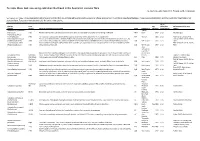
To name those lost: assessing extinction likelihood in the Australian vascular flora J.L. SILCOCK, A.R. FIELD, N.G. WALSH and R.J. FENSHAM SUPPLEMENTARY TABLE 1 Presumed extinct plant taxa in Australia that are considered taxonomically suspect, or whose occurrence in Australia is considered dubious. These require clarification, and their extinction likelihood is not assessed here. Taxa are sorted alphabetically by family, then species. No. of Species EPBC1 Last collections References and/or pers. (Family) (State)2 Notes on taxonomy or occurrence State Bioregion/s collected (populations) comms Trianthema cypseleoides Sydney (Aizoaceae) X (X) Known only from type collection; taxonomy needs to be resolved prior to targeted surveys being conducted NSW Basin 1839 1 (1) Steve Douglas Frankenia decurrens (Frankeniaceae) X (X) Very close to F.cinerea and F.brachyphylla; requires taxonomic work to determine if it is a good taxon WA Warren 1850 1 (1) Robinson & Coates (1995) Didymoglossum exiguum Also occurs in India, Sri Lanka, Thailand, Malay Peninsula; known only from type collection in Australia by Domin; specimen exists, but Field & Renner (2019); Ashley (Hymenophyllaceae) X (X) can't rule out the possibility that Domin mislabelled some of these ferns from Bellenden Ker as they have never been found again. QLD Wet Tropics 1909 1 (1) Field Hymenophyllum lobbii Domin specimen in Prague; widespread in other countries; was apparently common and good precision record, so should have been Field & Renner (2019); Ashley (Hymenophyllaceae) X (X) refound by now if present QLD Wet Tropics 1909 1 (1) Field Avon Wheatbelt; Esperance Known from four collections between 1844 and 1892; in her unpublished conspectus of Hemigenia, Barbara Rye included H. -

Mammals of the Avon Region
Mammals of the Avon Region By Mandy Bamford, Rowan Inglis and Katie Watson Foreword by Dr. Tony Friend R N V E M E O N G T E O H F T W A E I S L T A E R R N A U S T 1 2 Contents Foreword 6 Introduction 8 Fauna conservation rankings 25 Species name Common name Family Status Page Tachyglossus aculeatus Short-beaked echidna Tachyglossidae not listed 28 Dasyurus geoffroii Chuditch Dasyuridae vulnerable 30 Phascogale calura Red-tailed phascogale Dasyuridae endangered 32 phascogale tapoatafa Brush-tailed phascogale Dasyuridae vulnerable 34 Ningaui yvonnae Southern ningaui Dasyuridae not listed 36 Antechinomys laniger Kultarr Dasyuridae not listed 38 Sminthopsis crassicaudata Fat-tailed dunnart Dasyuridae not listed 40 Sminthopsis dolichura Little long-tailed dunnart Dasyuridae not listed 42 Sminthopsis gilberti Gilbert’s dunnart Dasyuridae not listed 44 Sminthopsis granulipes White-tailed dunnart Dasyuridae not listed 46 Myrmecobius fasciatus Numbat Myrmecobiidae vulnerable 48 Chaeropus ecaudatus Pig-footed bandicoot Peramelinae presumed extinct 50 Isoodon obesulus Quenda Peramelinae priority 5 52 Species name Common name Family Status Page Perameles bougainville Western-barred bandicoot Peramelinae endangered 54 Macrotis lagotis Bilby Peramelinae vulnerable 56 Cercartetus concinnus Western pygmy possum Burramyidae not listed 58 Tarsipes rostratus Honey possum Tarsipedoidea not listed 60 Trichosurus vulpecula Common brushtail possum Phalangeridae not listed 62 Bettongia lesueur Burrowing bettong Potoroidae vulnerable 64 Potorous platyops Broad-faced -
Flora and Vegetation Of
__________________________________________________________________________________________ FLORA AND VEGETATION OF AVIVA LEASE AREA Prepared for: URS Australia Pty Ltd on behalf of Aviva Corporation Ltd Prepared by: Mattiske Consulting Pty Ltd February 2009 MATTISKE CONSULTING PTY LTD URS0808/195/08 MATTISKE CONSULTING PTY LTD __________________________________________________________________________________________ TABLE OF CONTENTS Page 1. SUMMARY ................................................................................................................................................ 1 2. INTRODUCTION ...................................................................................................................................... 3 2.1 Location .............................................................................................................................................. 3 2.2 Climate ................................................................................................................................................ 3 2.3 Landforms and Soils ........................................................................................................................... 4 2.4 Vegetation ........................................................................................................................................... 4 2.5 Declared Rare, Priority and Threatened Species ................................................................................. 4 2.6 Threatened Ecological Communities (TEC’s) ................................................................................... -
Technical Report
A STRATEGIC FRAMEWORK FOR BIODIVERSITY CONSERVATION Report B: For practitioners of conservation planning Copyright text 2012 Southwest Australia Ecoregion Initiative. All rights reserved. Author: Danielle Witham, WWF-Australia First published: 2012 by the Southwest Australia Ecoregion Initiative. Any reproduction in full or in part of this publication must mention the title and credit the above-mentioned publisher as the copyright Cover Image: ©Richard McLellan Design: Three Blocks Left Design Printed by: SOS Print & Media Printed on Impact, a 100% post-consumer waste recycled paper. For copies of this document, please contact SWAEI Secretariat, PO Box 4010, Wembley, Western Australia 6913. This document is also available from the SWAEI website at http://www.swaecoregion.org SETTING THE CONTEXT i CONTENTS EXECUTIVE SUMMARY 1 ACKNOWLEDGEMENTS 2 SETTING THE CONTEXT 3 The Southwest Australia Ecoregion Initiative SUMMARY OF THE PROJECT METHODOLOGY 5 STEP 1. IDENTIFYING RELEVANT STAKEHOLDERS AND CLARIFYING ROLES 7 Expert engagement STEP 2. DEFINING PROJECT BOUNDARY 9 The boundary of the Southwest Australia Ecoregion STEP 3. APPLYING PLANNING UNITS TO PROJECT AREA 11 STEP 4. PREPARING AND CHOOSING SOFTWARE 13 Data identification 13 Conservation planning software 14 STEP 5. IDENTIFYING CONSERVATION FEATURES 16 Choosing conservation features 16 Fauna conservation features 17 Flora conservation features 21 Inland water body conservation features 22 Inland water species conservation features 27 Other conservation features 27 Threatened and Priority Ecological communities (TECs and PECs) 31 Vegetation conservation features 32 Vegetation connectivity 36 STEP 6. APPLYING CONSERVATION FEATURES TO PLANNING UNITS 38 STEP 7. SETTING TARGETS 40 Target formulae 40 Special formulae 42 STEP 8. IDENTIFYING AND DEFINING LOCK-INS 45 STEP 9. -

The Riparian Flora and Plant Communities of the Pilbara Region Of
DOI: 10.18195/issn.0313-122x.78(2).2015.485-513 Records of the Western Australian Museum, Supplement 78: 485–513 (2015). The riparian fl ora and plant communities of the Pilbara region of Western Australia M.N. Lyons Department of Parks and Wildlife, Science and Conservation Division, Kieran McNamara Conservation Science Centre, Locked Bag 104, Bentley Delivery Centre, Western Australia 6983, Australia. Email: mike.lyons@dpaw.wa.gov.au Abstract – A survey of riparian fl ora and plant communities was undertaken at 98 wetlands and rivers in the Pilbara region of Western Australia. Sampling was quadrat-based, with fl oristics, surface soils and wetland attributes recorded. Selected sites captured the full range of Pilbara wetland types including springs, river pools, claypans, salt marshes and rock pools. A total of 455 taxa was recorded from the survey sites, representing ca. 25% of the known fl ora of the Pilbara bioregion. The fl ora is dominated by taxa with Eremaean and tropical affi nities, with only six taxa endemic in the region. Of recorded taxa known from four or fewer bioregions, most are shared with the adjacent Carnarvon and Gascoyne bioregions rather than the adjoining internally draining deserts. Sixteen taxa of conservation signifi cance were documented, with claypans, the Fortescue Marsh, and Millstream and Karijini National Park sites dominating occurrences of rare species. Eight major groups were defi ned by classifying wetlands in terms of species presence/absence data. Floristic patterning was strongly aligned with the major wetland types (geomorphic/hydrological) used in the primary sampling stratifi cation. A combination of wetland morphology/hydrological setting, site edaphic attributes and distance to the coast were dominant variables related to riparian fl oristic composition.