The Peace Sign As a Fashion Icon
Total Page:16
File Type:pdf, Size:1020Kb
Load more
Recommended publications
-
'Art of a Second Order': the First World War from the British Home Front Perspective
‘ART OF A SECOND ORDER’ The First World War From The British Home Front Perspective by RICHENDA M. ROBERTS A Thesis Submitted to The University of Birmingham For The Degree of DOCTOR OF PHILOSOPHY Department of Art History, Film and Visual Studies School of Languages, Art History and Music College of Arts and Law The University of Birmingham September 2012 University of Birmingham Research Archive e-theses repository This unpublished thesis/dissertation is copyright of the author and/or third parties. The intellectual property rights of the author or third parties in respect of this work are as defined by The Copyright Designs and Patents Act 1988 or as modified by any successor legislation. Any use made of information contained in this thesis/dissertation must be in accordance with that legislation and must be properly acknowledged. Further distribution or reproduction in any format is prohibited without the permission of the copyright holder. Abstract Little art-historical scholarship has been dedicated to fine art responding to the British home front during the First World War. Within pre-war British society concepts of sexual difference functioned to promote masculine authority. Nevertheless in Britain during wartime enlarged female employment alongside the presence of injured servicemen suggested feminine authority and masculine weakness, thereby temporarily destabilizing pre-war values. Adopting a socio-historical perspective, this thesis argues that artworks engaging with the home front have been largely excluded from art history because of partiality shown towards masculine authority within the matrices of British society. Furthermore, this situation has been supported by the writing of art history, which has, arguably, followed similar premise. -
Tyranny Could Not Quell Them
ONE SHILLING , By Gene Sharp WITH 28 ILLUSTRATIONS , INCLUDING PRISON CAM ORIGINAL p DRAWINGS This pamphlet is issued by FOREWORD The Publications Committee of by Sigrid Lund ENE SHARP'S Peace News articles about the teachers' resistance in Norway are correct and G well-balanced, not exaggerating the heroism of the people involved, but showing them as quite human, and sometimes very uncertain in their reactions. They also give a right picture of the fact that the Norwegians were not pacifists and did not act out of a sure con viction about the way they had to go. Things hap pened in the way that they did because no other wa_v was open. On the other hand, when people acted, they The International Pacifist Weekly were steadfast and certain. Editorial and Publishing office: The fact that Quisling himself publicly stated that 3 Blackstock Road, London, N.4. the teachers' action had destroyed his plans is true, Tel: STAmford Hill 2262 and meant very much for further moves in the same Distribution office for U.S.A.: direction afterwards. 20 S. Twelfth Street, Philadelphia 7, Pa. The action of the parents, only briefly mentioned in this pamphlet, had a very important influence. It IF YOU BELIEVE IN reached almost every home in the country and every FREEDOM, JUSTICE one reacted spontaneously to it. AND PEACE INTRODUCTION you should regularly HE Norwegian teachers' resistance is one of the read this stimulating most widely known incidents of the Nazi occu paper T pation of Norway. There is much tender feeling concerning it, not because it shows outstanding heroism Special postal ofler or particularly dramatic event§, but because it shows to new reuders what happens where a section of ordinary citizens, very few of whom aspire to be heroes or pioneers of 8 ~e~~ 2s . -
The Commune Movement During the 1960S and the 1970S in Britain, Denmark and The
The Commune Movement during the 1960s and the 1970s in Britain, Denmark and the United States Sangdon Lee Submitted in accordance with the requirements for the degree of Doctor of Philosophy The University of Leeds School of History September 2016 i The candidate confirms that the work submitted is his own and that appropriate credit has been given where reference has been made to the work of others. This copy has been supplied on the understanding that it is copyright material and that no quotation from the thesis may be published without proper acknowledgement ⓒ 2016 The University of Leeds and Sangdon Lee The right of Sangdon Lee to be identified as Author of this work has been asserted by him in accordance with the Copyright, Designs and Patents Act 1988 ii Abstract The communal revival that began in the mid-1960s developed into a new mode of activism, ‘communal activism’ or the ‘commune movement’, forming its own politics, lifestyle and ideology. Communal activism spread and flourished until the mid-1970s in many parts of the world. To analyse this global phenomenon, this thesis explores the similarities and differences between the commune movements of Denmark, UK and the US. By examining the motivations for the communal revival, links with 1960s radicalism, communes’ praxis and outward-facing activities, and the crisis within the commune movement and responses to it, this thesis places communal activism within the context of wider social movements for social change. Challenging existing interpretations which have understood the communal revival as an alternative living experiment to the nuclear family, or as a smaller part of the counter-culture, this thesis argues that the commune participants created varied and new experiments for a total revolution against the prevailing social order and its dominant values and institutions, including the patriarchal family and capitalism. -

In My Lifetime - the Film’S Mission
1 In My Lifetime - The Film’s Mission http://thenuclearworld.org/category/in-my-lifetime/ This film is meant to be a wakeup call for humanity, to help develop an understanding of the realities of the nuclear weapon, to explore ways of presenting the answers for “a way beyond” and to facilitate a dialogue moving towards resolution of this Gordian knot of nuclear weapons gripping the world. The documentary’s characters are the narrative voices, interwoven with highly visual sequences of archival and contemporary footage and animation. The story is a morality play, telling the struggle waged over the past six and half decades with the last act yet to be determined, of trying to find what is “the way beyond?” Director’s Statement “In My Lifetime” takes on the complex realities of “the nuclear world”, and searches internationally for an answer to the question is there a Way Beyond? This documentary is part wake up call, part challenge for people to engage with the issue of ridding the world of the most destructive weapon ever invented. In February 2008, I began a journey to film and report on the story of the inner workings of the nuclear world. There has been a re-emergence of the realization that a world with nuclear weapons, including a proliferation of fissile nuclear materials, is a very dangerous place. Of course this realization has been known since the creation of the atomic bomb. It continues to be a struggle which has not been resolved. 2 This is a very complex issue with many voices, speaking from many perspectives, representing the forces and entrenched institutions in the nuclear states, not to speak of the rest of the world’s nations some of them with nuclear power capable of producing their own fissile materials and now there is the danger of so called “non-state actors”, who want to get their hands on the nuclear fissile materials necessary to create nuclear weapons. -
Chapter 15: How Effective Are Peace Movements
Chapter 12: How Effective are Peace Movements? On 10 July 1997 Bob Overy made a presentation about the effectiveness - or otherwise - of peace movements. It was based on a booklet he had published in the early 1980s which members of the group read, or re-read, prior to the meeting. Present were: Christina Arber, John Brierley, Howard Clark, Annie Harrison, Yolanda Juarros Barcenilla, Bob Overy, Michael Randle, Carol Rank, Andrew Rigby. Presentation - Bob Overy Bob explained that he had written the original text with that title back in 1980-81 while he was doing his Ph.D at Peace Studies. It had subsequently been published as a booklet in 1982 by a Canadian publisher, who had, however, added ideas of his own to the Preface and Postscript - some of which Bob did not even agree with! - and somewhat revamped it with the second UN Special Session on Disarmament in mind. But Bob was mainly responsible for the middle bit. He was not planning to use the analysis he had made some 15 years ago to talk about the present. Instead he would summarise the main points, and it would be up to the group to consider whether or not it provided any useful ways of looking at today's movements and issues. The catalyst for the study was a review by A.J.P.Taylor, eminent historian and member of CND Executive, of a book by the war historian, Michael Howard. Taylor, concurring with the author's view, said that the attempt to abolish war was a vain and useless enterprise, but that he was proud to be associated with the peace movement when it was trying to stop particular wars. -

Close to Midnight CND General Secretary Kate Hudson Writes on How the US’ Nuclear Policy Is Taking Us Closer to War
caTHE MAGAZINmE OF THE CAMPAIGN pFOR NUCLEAR DaISARMAMENT igFEBRUARY 2018 n Close to midnight CND General Secretary Kate Hudson writes on how the US’ nuclear policy is taking us closer to war. AST MONTH the Bulletin of Atomic of Evil. It also revisited some of the ideas Scientists moved us half a minute closer of the early 1990s, calling for the Lto Midnight. At two minutes to, it’s development of bunker-busters and mini- the closest since the height of the Cold War. nukes for use in ‘regional conflicts’, The reasons cited are increasing nuclear understood at that time – in the aftermath risk, climate change and potentially harmful of the first Gulf War and the developing emerging technologies. But nuclear takes narrative around oil and resources – to centre stage: reckless language and provoca - mean the Middle East. tive action by both US and North Korea. The advent of President Obama To make matters worse, the latest US temporarily knocked the project on the nuclear posture review has just been head. His 2010 review ruled out the released. These reviews can be a powerful development of new nuclear weapons, indicator of a president’s intentions and this including bunker-busters. It also renounced one will, no doubt, be a taste of things to nuclear weapons use against non-nuclear come. The 2002 version included President states that the US considered compliant Bush’s demand for contingency plans for with the nuclear Non-Proliferation Treaty. the use of nuclear weapons against at least At the time we hoped for more, after seven countries, including the so-called Axis Obama’s passionate Prague speech in 2009, Campaign for Nuclear Disarmament, CND 60th celebration at Aldermaston 162 Holloway Rd, London N7 8DQ 1st April, assemble at 12 020 7700 2393 noon. -

Download the Newsletter
P.E.A.C.E. News for January 2021 Peace Educators Allied for Children Everywhere, Inc. (P.E.A.C.E., Inc.) Please contribute to our future as we support the peaceful world we and the children need to thrive. • Donate Now • Please keep using your mask, with social distancing & hand washing, until we’re all safe again. ACTION ALERTS! DEY Guidelines for Talking with Young Children About the Insurrection at the US Capitol On January 6, the world witnessed an unprecedented assault on democracy when a violent mob, incited by President Trump, invaded the Capitol building in Washington, DC to disrupt the certification of Joe Biden and Kamala Harris as the next President and Vice-President of the United States. Threatening the safety of members of Congress, Hill staff, and the Capitol’s everyday working people, all trapped inside and terrorized while this mob ransacked the People’s Building. Watching this unfold was shocking to many adults and, despite their best efforts to shield young children from this reality, they may have been exposed to this despicable event anyway, whether through the media, siblings, friends, or overhear-ing adults’ conversations. This can undermine their sense of safety as well as their social and emotional well-being. While young children are not able to comprehend complicated concepts like an attack on our democracy or the meaning of an attempt-ed coup, they will undoubtedly be frightened and confused by the violent images of the mob as well as the deep and obvious concerns of the adults around them. Defending the Early Years (DEY) offers guidelines for implementing an age-appropriate, meaningful, and caring approach to help young children deal with this shocking event: ● Protect young children from exposure to news on TV, radio, social media, or hearing adults talk about it as much as possible. -
Introduction
Notes Introduction 1. Michael Gove, 15 November 2010, Hansard Parliamentary Debates,column 634, www.publications.parliament.uk/pa/cm201011. 2. Ofsted made a statement to this effect on 11 July 2004 which was reported on by the BBC (http://news.bbc.co.uk/1/hi/education/3884087.stm) and The Telegraph (www.telegraph.co.uk/education/educationnews). 3. There is a growing literature on the Falklands War, most of which does not contextualise the conflict in terms of the British Empire despite the jingoistic use of imperial ideology during the conflict. 4. Bill Schwarz (2011) The White Man’s World, Memories of Empire, 1 (Oxford University Press), p. 6. 5. Avner Offer (1993) ‘The British Empire, 1870–1914: A Waste of Money?’, The Economic History Review 46, no. 2, 215–38. 6. Bernard Porter (2004) The Absent-Minded Imperialists: Empire, Society, and Culture in Britain (Oxford University Press); John M. MacKenzie (1984) Pro- paganda and Empire: The Manipulation of British Public Opinion, 1880–1960 (Manchester University Press). 7. Alan Sked (1987) Britain’s Decline: Problems and Perspectives (Oxford: Basil Blackwell). 8. Catherine Hall and Sonya Rose (2006) ‘Introduction: Being at Home with the Empire’, in Catherine Hall and Sonya O. Rose (eds), At Home with the Empire: Metropolitan Culture and the Imperial World (Cambridge University Press). 9. Bill Schwarz (1996) ‘ “The Only White Man in There”: The Re-Racialisation of England, 1956–1968’, Race and Class 38, no. 1, 65. 10. Stuart Ward (ed.) (2001) British Culture and the End of Empire,Studiesin Imperialism (Manchester University Press). 11. Stuart Ward (2001) ‘Introduction’, in idem (ed.), British Culture and the End of Empire (Manchester University Press), p. -

The Peace Journalist
IN THIS ISSUE • PJ project in Northern Ireland • Dispatches from South Korea, Cameroon, Uganda, Ghana • Jake Lynch: 20 years of peacebuilding media At Park University, discussing Peace Journalism with Prof. Raj Gandhi A publication of the Center for Global Peace Journalism at Park University Vol 8 No. 2 - October 2019 October 2019 October 2019 Contents 3 Gandhi at Park U. 14 U.S. Was Gandhi a peace journalist? Filmmaker meets “The Enemy” Cover photos-- Left and top right by Phyllis Gabauer Park Univ. 16 Worldwide peace stud- The Peace Journalist is a semi- Lynch: 20 yrs of peace media ies student annual publication of the Center Alyssa Williams for Global Peace Journalism at Park 18 South Korea discusses the University in Parkville, Missouri. The Journalists gather to discuss PJ elements of Peace Journalist is dedicated to dis- peace with Prof. seminating news and information 19 Ghana Raj Gandhi. for teachers, students, and Radio as a change agent practitioners of PJ. 6 Gandhi, Hate speech 20 Kashmir Submissions are welcome from all. Gandhian principles combat hate We are seeking shorter submissions Outlet gives voice to youth (300-500 words) detailing peace S. Sudan-Uganda journalism projects, classes, propos- 8 21 Cameroon als, etc. We also welcome longer Network connects communities PJ prize;Community media Prof. Gandhi enlightens Park University submissions (800-1200 words) By Steven Youngblood of our opponents.” Indian Opinion journal, Gandhi said, “I about peace or conflict sensitive 10 Northern Ireland 22 South Sudan When asked to describe Mahatma cannot recall a word in those articles journalism projects or programs, as Project energizes journalists Govmt. -

You'll Never Beat the System by Bombing Number 10
You’ll never beat the system by bombing Number 10 Perceptions of the utility of political violence in anarcho-punk 1977-1987 Rich Cross No Sir, I Won’t: Reconsidering the legacy of Crass and anarcho- punk, Oxford Brookes, 28 June 2013 Contention Anarcho-punk should not be seen simply as a pacifist-punk culture. The culture’s self-identification as ‘peace punk’ was not immediate, and anarcho- punk quickly became diverse in political and cultural ambition, especially concerning the nature of opposition to the state Perceptions of the utility of political violence changed within a few short years, as anarcho-punk responded to a range of pressures and counter-pressures. Changing views of violence reflect shifts in the centre of political gravity within the movement “Boring fucking politics will get us all shot” No Sir, I Won’t: Reconsidering the legacy of Crass and anarcho- punk, Oxford Brookes, 28 June 2013 Airey Neave Blown up in the House of Commons car park by the INLA in March 1979 Warrenpoint and Mountbatten Warrenpoint ambush: PIRA kill 18 soldiers; blow up Lord Mountbatten – August 1979 Inner-city riots -1981 Wave of rioting across British inner-cities in spring of 1981 Falklands War - 1982 Nearly 1,000 killed in war between Britain and Argentina over the Falklands-Malvinas Great Miners’ strike – 1984-85 Widespread, year-long clashes between striking miners, the police (and soldiers in police uniform) Battle of the Beanfield - 1985 Police assault and break-up traveller convoy, to prevent gathering at Stonehenge - June 1985 -
A Life in the Shadow of the Bomb
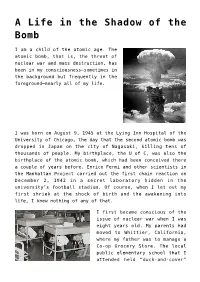
A Life in the Shadow of the Bomb I am a child of the atomic age. The atomic bomb, that is, the threat of nuclear war and mass destruction, has been in my consciousness—sometimes in the background but frequently in the foreground—nearly all of my life. I was born on August 9, 1945 at the Lying Inn Hospital of the University of Chicago, the day that the second atomic bomb was dropped in Japan on the city of Nagasaki, killing tens of thousands of people. My birthplace, the U of C, was also the birthplace of the atomic bomb, which had been conceived there a couple of years before. Enrico Fermi and other scientists in the Manhattan Project carried out the first chain reaction on December 2, 1942 in a secret laboratory hidden in the university’s football stadium. Of course, when I let out my first shriek at the shock of birth and the awakening into life, I knew nothing of any of that. I first became conscious of the issue of nuclear war when I was eight years old. My parents had moved to Whittier, California, where my father was to manage a Co-op Grocery Store. The local public elementary school that I attended held “duck-and-cover” drills and we students had to get under our desks and put our hands over our heads. We were told this would protect us in the event of a nuclear attack. A duck-and-cover pubic service announcement of the era shows, among other scenarios, an elementary school class much like mine. -

The British Peace Movement and Socialist Change*
THE BRITISH PEACE MOVEMENT AND SOCIALIST CHANGE* Richard Taylor In the post-war period the largest, and arguably the most significant, mobilisation of radical forces in Britain has taken place around the issue of nuclear disarmament. From the late-1950s to the mid-1960s, and again from the late-1970s to the time of writing, the peace movement has been a dominant force and has succeeded in bringing together a diverse coalition in opposition to British possession of nuclear weapons. This paper has two primary purposes: first, to examine the politics of the peace movement of 1958 to 1965 and to analyse the reasons for its ultimate failure; second, to argue, on the basis of the experience of that period, that for the peace movement to succeed in the future there must be a linkage at a number of levels between the movement for peace and the movement for specifically socialist change. The focus is thus upon the various political strategies adopted by the earlier movement, but always within the context of the implications this experience has for the contemporary movement. The persistent and fundamental problem of the movement since its inception has been its inability to translate its undoubted popular appeal into real, tangible achievement. Although the movement has had a very considerable impact upon public opinion, and thus, arguably, indirectly upon formal political structures and policies, it is quite clear that its central objectives have not been achieved. Moreover, the deterioration of the Cold War climate in the 1980s and the increasing escalation of the arms race both testify to the movement's lack of success.