The English Trade in Nightingales Ingeborg Zechner
Total Page:16
File Type:pdf, Size:1020Kb
Load more
Recommended publications
-

Du Concert Au Show Business. Le Rôle Des Impréssarios Dans Le Développement International Du Commerce Musical, 1850-1930 Laetitia Corbière
Du concert au show business. Le rôle des impréssarios dans le développement international du commerce musical, 1850-1930 Laetitia Corbière To cite this version: Laetitia Corbière. Du concert au show business. Le rôle des impréssarios dans le développement international du commerce musical, 1850-1930. Histoire. Université de Lille, 2018. Français. NNT : 2018LILUH025. tel-01989103 HAL Id: tel-01989103 https://tel.archives-ouvertes.fr/tel-01989103 Submitted on 22 Jan 2019 HAL is a multi-disciplinary open access L’archive ouverte pluridisciplinaire HAL, est archive for the deposit and dissemination of sci- destinée au dépôt et à la diffusion de documents entific research documents, whether they are pub- scientifiques de niveau recherche, publiés ou non, lished or not. The documents may come from émanant des établissements d’enseignement et de teaching and research institutions in France or recherche français ou étrangers, des laboratoires abroad, or from public or private research centers. publics ou privés. UNIVERSITE LILLE 3 – CHARLES DE GAULLE / UNIVERSITE DE GENEVE ÉCOLE DOCTORALE DES SCIENCES DE L’HOMME ET DE LA SOCIETE Doctorat Histoire Lætitia CORBIERE DU CONCERT AU SHOW BUSINESS. Le rôle des imprésarios dans le développement international du commerce musical, 1850-1930 Thèse dirigée par Sylvie APRILE / Ludovic TOURNES Soutenue le 19 juin 2018 Jury : Philippe DARRIULAT Didier FRANCFORT Michel PORRET Jean-Claude YON 1 2 Du concert au show business. Le rôle des imprésarios dans le développement international du commerce musical, 1850-1930. Résumé : Cette recherche porte sur le développement international des tournées musicales entre 1850 et 1930, période caractérisée par l’affirmation de la fonction d’intermédiation et par une approche commerciale de plus en plus assumée du concert. -
La Traviata Synopsis 5 Guiding Questions 7
1 Table of Contents An Introduction to Pathways for Understanding Study Materials 3 Production Information/Meet the Characters 4 The Story of La Traviata Synopsis 5 Guiding Questions 7 The History of Verdi’s La Traviata 9 Guided Listening Prelude 12 Brindisi: Libiamo, ne’ lieti calici 14 “È strano! è strano!... Ah! fors’ è lui...” and “Follie!... Sempre libera” 16 “Lunge da lei...” and “De’ miei bollenti spiriti” 18 Pura siccome un angelo 20 Alfredo! Voi!...Or tutti a me...Ogni suo aver 22 Teneste la promessa...” E tardi... Addio del passato... 24 La Traviata Resources About the Composer 26 Online Resources 29 Additional Resources Reflections after the Opera 30 The Emergence of Opera 31 A Guide to Voice Parts and Families of the Orchestra 35 Glossary 36 References Works Consulted 40 2 An Introduction to Pathways for Understanding Study Materials The goal of Pathways for Understanding materials is to provide multiple “pathways” for learning about a specific opera as well as the operatic art form, and to allow teachers to create lessons that work best for their particular teaching style, subject area, and class of students. Meet the Characters / The Story/ Resources Fostering familiarity with specific operas as well as the operatic art form, these sections describe characters and story, and provide historical context. Guiding questions are included to suggest connections to other subject areas, encourage higher-order thinking, and promote a broader understanding of the opera and its potential significance to other areas of learning. Guided Listening The Guided Listening section highlights key musical moments from the opera and provides areas of focus for listening to each musical excerpt. -

Grosvenor Prints 19 Shelton Street Covent Garden London WC2H 9JN
Grosvenor Prints 19 Shelton Street Covent Garden London WC2H 9JN Tel: 020 7836 1979 Fax: 020 7379 6695 E-mail: grosvenorprints@btinternet.com www.grosvenorprints.com Dealers in Antique Prints & Books Prints from the Collection of the Hon. Christopher Lennox-Boyd Arts 3801 [Little Fatima.] [Painted by Frederick, Lord Leighton.] Gerald 2566 Robinson Crusoe Reading the Bible to Robinson. London Published December 15th 1898 by his Man Friday. "During the long timer Arthur Lucas the Proprietor, 31 New Bond Street, W. Mezzotint, proof signed by the engraver, ltd to 275. that Friday had now been with me, and 310 x 490mm. £420 that he began to speak to me, and 'Little Fatima' has an added interest because of its understand me. I was not wanting to lay a Orientalism. Leighton first showed an Oriental subject, foundation of religious knowledge in his a `Reminiscence of Algiers' at the Society of British mind _ He listened with great attention." Artists in 1858. Ten years later, in 1868, he made a Painted by Alexr. Fraser. Engraved by Charles G. journey to Egypt and in the autumn of 1873 he worked Lewis. London, Published Octr. 15, 1836 by Henry in Damascus where he made many studies and where Graves & Co., Printsellers to the King, 6 Pall Mall. he probably gained the inspiration for the present work. vignette of a shipwreck in margin below image. Gerald Philip Robinson (printmaker; 1858 - Mixed-method, mezzotint with remarques showing the 1942)Mostly declared pirnts PSA. wreck of his ship. 640 x 515mm. Tears in bottom Printsellers:Vol.II: margins affecting the plate mark. -

1 Prime+Trama TRAVIATA
Parma e le terre di Verdi 1-28 ottobre 2007 La Traviata Musica di GIUSEPPE VERDI Parma e le terre di Verdi 1-28 ottobre 2007 Parma e le terre di Verdi 1-28 ottobre 2007 main sponsor media partner Il Festival Verdi è realizzato anche grazie a e con il sostegno e la collaborazione di Teatro Verdi di Busseto Teatro Comunale di Modena iTeatri di Reggio Emilia Soci fondatori Consiglio di Amministrazione Presidente Pietro Vignali Sindaco di Parma Consiglieri Paolo Cavalieri Maurizio Marchetti Sovrintendente Mauro Meli Direttore musicale Bruno Bartoletti Segretario generale Gianfranco Carra Collegio dei Revisori Giuseppe Ferrazza Presidente Nicola Bianchi Andrea Frattini La Traviata Melodramma in tre atti su libretto di Francesco Maria Piave dal dramma La Dame aux camélias di Alexandre Dumas figlio Musica di GIUSEPPE V ERDI Editore Universal Music Publishing Ricordi srl, Milano Villa Verdi a Sant’Agata La trama dell’opera Atto primo Parigi, alla metà dell’Ottocento. È estate e c’è festa nella casa di Violetta Valéry, una famosa mondana: è un modo per soffocare l’angoscia che la tormenta, perché ella sa che la sua salute è gravemente minata. Un nobile, Gastone, presenta alla padrona di casa il suo amico Alfredo, che l’ammira sinceramente. L’attenzione che Violetta dimostra per la nuova conoscenza non sfugge a Douphol, il suo amante abituale. Mentre Violetta e Alfredo danzano, il giovane le dichiara tutto il suo amore e Violetta gli regala un fiore, una camelia: rivedrà Alfredo solo quando sarà appassita. Alla fine della festa, Violetta deve ammettere di essersi innamorata davvero, per la prima volta. -

Management, Competition and Artistic Policy in London, 1861-70
This electronic thesis or dissertation has been downloaded from the King’s Research Portal at https://kclpure.kcl.ac.uk/portal/ Opera in 'the Donizettian Dark Ages' : management, competition and artistic policy in London, 1861-70. Ringel, Matthew Laurence The copyright of this thesis rests with the author and no quotation from it or information derived from it may be published without proper acknowledgement. END USER LICENCE AGREEMENT Unless another licence is stated on the immediately following page this work is licensed under a Creative Commons Attribution-NonCommercial-NoDerivatives 4.0 International licence. https://creativecommons.org/licenses/by-nc-nd/4.0/ You are free to copy, distribute and transmit the work Under the following conditions: Attribution: You must attribute the work in the manner specified by the author (but not in any way that suggests that they endorse you or your use of the work). Non Commercial: You may not use this work for commercial purposes. No Derivative Works - You may not alter, transform, or build upon this work. Any of these conditions can be waived if you receive permission from the author. Your fair dealings and other rights are in no way affected by the above. Take down policy If you believe that this document breaches copyright please contact librarypure@kcl.ac.uk providing details, and we will remove access to the work immediately and investigate your claim. Download date: 09. Oct. 2021 Opera in 'The Donizettian Dark Ages' Management, Competition and Artistic Policy in London, 186 1-70 Matthew L. Ringel Dissertation submitted for the Ph.D. -

Marie Taglioni, Ballerina Extraordinaire: in the Company of Women
NINETEENTH-CENTURY GENDER STUDIES # ISSUE 6.3 (WINTER 2010) Marie Taglioni, Ballerina Extraordinaire: In the Company of Women By Molly Engelhardt, Texas A&M University—Corpus Christi <1>The nineteenth-century quest for novelty during the 1830s and 40s was nowhere better satisfied than from the stages of the large theatres in London and Paris, which on a tri-weekly basis showcased ballet celebrities and celebrity ballets as top fare entertainment.(1) While few devotees had the means to actually attend ballet performances, the interested majority could read the plots and reviews of the ballets published in print media—emanating from and traversing both sides of the channel—and know the dancers, their personalities and lifestyles, as well as the dangers they routinely faced as stage performers. During a benefit performance in Paris for Marie Taglioni, for example, two sylphs got entangled in their flying harnesses and audiences watched in horror as a stagehand lowered himself from a rope attached to the ceiling to free them. Théophile Gautier writes in his review of the performance that when Paris Opera director Dr. Veron did nothing to calm the crowds, Taglioni herself came to the footlights and spoke directly to the audience, saying “Gentlemen, no one is hurt.”(2) On another occasion a cloud curtain came crashing down unexpectedly and almost crushed Taglioni as she lay on a tombstone in a cloisture scene of Robert le Diable.(3) Reporters wrote that what saved her were her “highly- trained muscles,” which, in Indiana Jones fashion, she used to bound off the tomb just in time. -

This Electronic Thesis Or Dissertation Has Been Downloaded from the King’S Research Portal At
This electronic thesis or dissertation has been downloaded from the King’s Research Portal at https://kclpure.kcl.ac.uk/portal/ Repertory and rivalry : opera and the Second Covent Garden Theatre, 1830-56. Dideriksen, Gabriella The copyright of this thesis rests with the author and no quotation from it or information derived from it may be published without proper acknowledgement. END USER LICENCE AGREEMENT Unless another licence is stated on the immediately following page this work is licensed under a Creative Commons Attribution-NonCommercial-NoDerivatives 4.0 International licence. https://creativecommons.org/licenses/by-nc-nd/4.0/ You are free to copy, distribute and transmit the work Under the following conditions: Attribution: You must attribute the work in the manner specified by the author (but not in any way that suggests that they endorse you or your use of the work). Non Commercial: You may not use this work for commercial purposes. No Derivative Works - You may not alter, transform, or build upon this work. Any of these conditions can be waived if you receive permission from the author. Your fair dealings and other rights are in no way affected by the above. Take down policy If you believe that this document breaches copyright please contact librarypure@kcl.ac.uk providing details, and we will remove access to the work immediately and investigate your claim. Download date: 10. Oct. 2021 Repertory and Rivalry: Opera at the Second Covent Garden Theatre, 1830 to 1856 Gabriella Dlderlksen PhD, Historical Musicology King's College London, University of London June 1997 Abstract Victorian London has hitherto frequently been regarded as an operatic backwater without original musical or theatrical talent, and has accordingly been considered only marginally important to the history of 19th-century opera in general. -

Petite Messe Solennelle : Religiosità Domestica E Solennità Liturgica Guida All’Ascolto a Cura Di Marco Faelli
Petite Messe solennelle : religiosità domestica e solennità liturgica guida all’ascolto a cura di Marco Faelli Il 13 marzo del 1864, in un salone del palazzo della Contessa Louise Pillet Will, a Parigi, viene presentata, ad uno scelto pubblico di invitati, la Petite Messe solennelle . La composizione non è destinata ad un uso liturgico (il pianoforte non è adatto all’acustica di una chiesa), ma ad un ambiente più intimo, domestico. L’organico è quindi essenziale (da qui l’aggettivo Petite , mentre Solennelle indica che tutto il testo è musicato, compreso il Credo ). Scrive Rossini nella partitura autografa: « Douze chanteurs de trois sexes Hommes, Femme et Castres seront suffisants pour sono execution, savoir huit pour les choeurs, quatre pour les solos, total Douze Cherubins »; a questi si aggiungeva il sostegno strumentale di due pianoforti e di un harmonium . Nonostante il desiderio di Rossini (sappiamo quanto rimpiangesse la ormai inevitabile scomparsa dei castrati), il “terzo sesso” non prese parte all’esecuzione: i ruoli femminili vennero infatti sostenuti dalle sorelle Barbara e Carlotta Marchisio, mentre il tenore era Italo Gardoni (primo interprete, tra l’altro, dei Masnadieri di Verdi), e il basso Louis Agniez. Il coro era costituito da studenti del Conservatorio di Parigi, scelti personalmente da Auber, e diretti (alle spalle dei solisti e con tanto di bacchetta) dal maestro Choen. Per la cronaca, al primo pianoforte sedeva un allievo di Chopin, Georges Mathias. La primitiva versione della Petite Messe venne eseguita solo tre volte durante la vita dell’autore: dopo la sua morte entrò in circolazione una versione orchestrale (in cui le parti solistiche e quelle corali rimangono identiche), strumentata dall’autore stesso, anche se malvolentieri. -

Donizetti Il Duca D’Alba
Gaetano Donizetti Il Duca d’Alba Il duca d’Alba - F. Goya - 1795 Huile sur toile ; 195 x 126 - Madrid, Museo del Prado « J’avais surtout caressé le rôle (1) de la femme ; rôle nouveau peut-être au théâtre, un rôle d’action, tandis que presque toujours la femme est passive. Ici, une jeune enthousiaste, aimante, une Jeanne d’Arc. » Gaetano Donizetti, janvier 1842 (1) en français dans le texte Ces quelques mots de Donizetti nous donnent non seulement sa conception de cette héroïne hors du commun, mais révèlent combien il tenait encore à l’œuvre, trois années après le début de la composition de son opéra… qu’il n’achèvera pourtant jamais car malheureusement pour l’Art, le personnage - tout particulier qu’il est, précisément ! - déplaît à la divette régnant alors sur l’Opéra de Les dossiers de Forum Opéra - www.forumopera.com - Il duca d'Alba © Yonel Buldrini - p. 1 Paris (et son directeur). Il sera tout de même créé, mais après quarante années d’attente et quelques essais infructueux. L’actuelle reprise, motivant cet article, aura lieu dans le cadre de la Saison lyrique de Radio France, le 15 avril 2005 *, et il pourrait bien s’agir de la création en France, pays auquel était destiné l’opéra ! En raison de la grève d'une partie des personnels de Radio France, le concert du vendredi 15 avril, au programme duquel était inscrit Il Duca d'Alba de Donizetti, est annulé. (Ndlr) Donizetti et Le Duc d’Albe « Addio mia Bella Napoli ! » Ces premiers mots d’une mélancolique chanson populaire, par la voix tremblotante et nasillarde de Caruso, sortant des impressionnants pavillons des phonographes, pourraient nous donner l’état d’esprit avec lequel Donizetti quitte la Naples de ses succès. -
National Register of Historic Places Multiple Property Documentation Form
NPS Form 10-900-b OMB No. 1024-0018 (March 1992) United States Department of the Interior National Park Service National Register of Historic Places Multiple Property Documentation Form This form is used for documenting multiple property groups relating to one or several historic contexts. See instructions in How to Complete the Multiple Property Documentation Form (National Register Bulletin 16B). Complete each item by entering the requested information. For additional space, use continuation sheets (Form 10-900-a). Use a typewriter, word processor, or computer to complete all items. X New Submission _ Amended Submission A. Name of Multiple Property Listing Historic Theaters and Opera Houses of Kansas B. Associated Historic Contexts (Name each associated historic context, identifying theme, geographical area, and chronological period for each.) The Historical Development of Public Entertainment in Kansas, 18 54-1955 C. Form Prepared by name/title Elizabeth Rosin. Partner, assisted by Dale Nimz, Ph.D., Historian and Kristen Ottesen. Architectural Historian company Historic Preservation Services. LLC street & number 323 West 8th Street, Suite 112___________ telephones 16-221-5133 city or town Kansas City___________________________________ state MO zip code 64105 D. Certification As the designated authority under the National Historic Preservation Act of 1966, as amended, I hereby certify that this documentation form meets the National Register documentation standards and sets forth requirements for the listing of related properties consistent with the National Register criteria. This submission meets the procedural and professional requirements set forth in 36 CFR Part 60 and the Secretary of the Interior's Standards and Guidelines for Archeology and Historic Preservation. -
INTRODUCTION and LITERATURE REVIEW a Subject
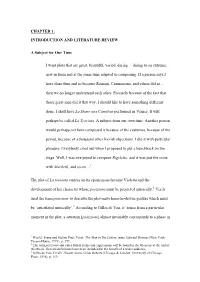
CHAPTER 1: INTRODUCTION AND LITERATURE REVIEW A Subject for Our Time I want plots that are great, beautiful, varied, daring ... daring to an extreme, new in form and at the same time adapted to composing. If a person says I have done thus and so because Romani, Cammarano, and others did so ... then we no longer understand each other. Precisely because of the fact that those great men did it that way, I should like to have something different done. I shall have La Dame aux Camélias performed in Venice. It will perhaps be called La Traviata. A subject from our own time. Another person would perhaps not have composed it because of the costumes, because of the period, because of a thousand other foolish objections. I did it with particular pleasure. Everybody cried out when I proposed to put a hunchback on the stage. Well, I was overjoyed to compose Rigoletto, and it was just the same with Macbeth, and so on ...1 The plot of La traviata centres on its eponymous heroine Violetta and the development of her character whose posizione must be projected musically.2 Verdi used the term posizione to describe the plot-and-character-driven gesture which must be ‘articulated musically’.3 According to Gilles de Van, it ‘arises from a particular moment in the plot; a situation [posizione] almost invariably corresponds to a phase in 1 Werfel, Franz and Stefan, Paul, Verdi: The Man in His Letters, trans. Edward Downes (New York: Vienna House, 1973), p. 373. 2 The term posizione and other Italian terms and expressions will be found in the Glossary at the end of this thesis. -

Volume VI 1988 NINETEENTH-CENTUKY ITALIAN
Volume VI 1988 NINETEENTH-CENTUKY ITALIAN OPERA IN THE CONTEMPORARY PRESS (PART I) Papers from Bologna: the Fourteenth Congress of the International Musicological Society (1987) Introduction H. Robert Cohen (College Park) Marcello Conati (Parma) Italian Opera and the English Press, 1836-1856 Leanne Langley (London) Zur Beurteilung der italienischen Oper in Christoph-Hellmut Mahling 11 der deutschsprachigen Presse zwischen (Mainz) 1815 und 1825 Italian Opera Premieres and Revivals Zoltán Roman 16 in the Hungarian Press, 1864-1894 (Calgary) Nineteenth-Century Italian Opera as Gerald Seaman 21 seen in the Contemporary Russian Press (Auckland) PERIODICA MUSICA Published jointly by: EDITORS Center for Studies in Nineteenth- H. Robert Cohen Century Music, University of Donald Gislason Maryland at College Park, U.S.A. Peter Loeffler Zoltán Roman Centre international de recherche sur la presse musicale, Conservatorio EDITORIAL BOARD di musica "Arrigo Boito," Parma- Comune di Colorno, Italy H. Robert Cohen Marcello Conati MPM operates under the auspices Zoltán Roman of the International Musícological Society and the International B USINES S MANAGER Association of Music Libraries, Archives and Documentation Centres Gaétan Martel ISSN 0822-7594 ©Copyright 1990, The University of Maryland at College Park INTRODUCTION The Fourteenth Congress of the International Musicological Society was held in Bologna, Italy (with additional sessions in Parma and Ferrara) from 27 August to 1 September 1987. Two congress sessions were organized under the auspices of the Repertoire International de la Presse Musicale by H. Robert Cohen and Marcello Conati. The second, which took place in Parma, in the Sala Verdi of the Conservatorio "Arrigo Boito " on Sunday, 30 August from 1 lh30 to 13h, offered an extensive demonstra tion of the computer programs and laser printing techniques developed for the production of RIPM volumes at the Center for Studies in Nineteenth-Century Music of the University of Maryland at College Park.