Sense and Sensibility JANE AUSTEN
Total Page:16
File Type:pdf, Size:1020Kb
Load more
Recommended publications
-

Sense and Sensibility: a Sermon on Living the Examined Life
University of New Orleans ScholarWorks@UNO University of New Orleans Theses and Dissertations Dissertations and Theses Summer 8-9-2017 Sense and Sensibility: A Sermon on Living the Examined Life Sarah J. Mejias University of New Orleans, smejias@uno.edu Follow this and additional works at: https://scholarworks.uno.edu/td Part of the Ancient Philosophy Commons, Christianity Commons, Ethics in Religion Commons, History of Religion Commons, and the Literature in English, British Isles Commons Recommended Citation Mejias, Sarah J., "Sense and Sensibility: A Sermon on Living the Examined Life" (2017). University of New Orleans Theses and Dissertations. 2387. https://scholarworks.uno.edu/td/2387 This Thesis is protected by copyright and/or related rights. It has been brought to you by ScholarWorks@UNO with permission from the rights-holder(s). You are free to use this Thesis in any way that is permitted by the copyright and related rights legislation that applies to your use. For other uses you need to obtain permission from the rights- holder(s) directly, unless additional rights are indicated by a Creative Commons license in the record and/or on the work itself. This Thesis has been accepted for inclusion in University of New Orleans Theses and Dissertations by an authorized administrator of ScholarWorks@UNO. For more information, please contact scholarworks@uno.edu. Sense and Sensibility: A Sermon on Living the Examined Life A Thesis Submitted to the Graduate Faculty of the University of New Orleans in partial fulfillment of the requirements for the degree of Master of Arts In English by Sarah J. -

Marianne Dashwood and Charlotte Lucas (The Christian Ideal of Marriage in Jane Austen)
Not Said But Shown 432 17. Marianne Dashwood and Charlotte Lucas (The Christian Ideal of Marriage in Jane Austen) ----- Marianne Dashwood at seventeen believes in “wholeheartedness.” One should cultivate right feelings as far as one possibly can, and express them frankly and to the full; and all with whom one can relate properly must do the same. One’s feelings should be intense, and the expression of them should be enthusiastic and eloquent. Towards those whose feelings are right, but who cannot achieve this freedom of expression, one must be charitable; but one should avoid all whose thought and behavior is governed by convention. Following convention corrupts one’s “sensibility,” so that one can no longer tell what the truth of natural feeling is. Thus, when Edward Ferrars and Marianne’s sister Elinor become mutually attached, Marianne approves of Edward — and she certainly agrees with her mother, who says, “I have never yet known what it was to separate esteem and love” (SS, I, iii, 16). But she cannot imagine how Elinor can be in love with Edward, because he lacks true “sensibility.” “Edward is very amiable, and I love him tenderly. But . his figure is not striking . His eyes want all that spirit, that fire, which at once announce virtue and intelligence . he has no real taste . I could not be happy with a man whose taste did not in every point coincide with my own . how spiritless, how tame was Edward’s manner in reading to us last night! . it would have broke my heart had I loved him, to hear him read with so little sensibility” (17-8). -

Elinor and Edward's Plans for Lucy Steele
Elinor and Edward’s Plans for Lucy Steele A Novelette and Parody of Jane Austen’s Sense and Sensibility By Mary Lydon Simonsen Quail Creek Publishing, LLC http://marysimonsenfanfiction.blogspot.com Prologue The family of Dashwood had long been settled in Sussex at Norland Park. The manor house was a massive stone edifice of three stories with two wings and an extensive park where sheep nibbled the lawn by day and deer by night. It was home to Henry Dashwood, a kind man and good father, and his wife. Mrs. Dashwood was a good-hearted woman and affectionate mother, who, whether for joy or sorrow, was given to bouts of weeping. They had three daughters: the practical Elinor, a handsome woman of twenty-one years, the romantic Marianne, a beautiful lady of nineteen, and the young Margaret, a pistol of a thirteen-year-old given to eavesdropping and spying on her neighbors. At Norland Park, life was a bowl of cherries. Elinor, being an outdoorsy type person, enjoyed the extensive grounds of woods and meadows, Marianne, being the opposite of her older sister, had her music and poetry, and Margaret, being a combination of her elder sisters, had a tree house with a retractable rope ladder where she would often play her lap harp. From her perch, she watched and reported on all the comings and goings of the inhabitants of the manor house and any visitors to the estate. Little did young Margaret know that on the day she looked through her spyglass and saw Dr. Cureall’s carriage coming down the drive that her world was about to change—and not for the better. -
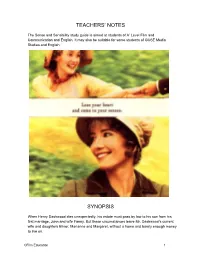
Sense and Sensibility Study Guide Is Aimed at Students of A’ Level Film and Communication and English
TEACHERS’ NOTES The Sense and Sensibility study guide is aimed at students of A’ Level Film and Communication and English. It may also be suitable for some students of GCSE Media Studies and English. SYNOPSIS When Henry Dashwood dies unexpectedly, his estate must pass by law to his son from his first marriage, John and wife Fanny. But these circumstances leave Mr. Dashwood’s current wife and daughters Elinor, Marianne and Margaret, without a home and barely enough money to live on. ©Film Education 1 As Elinor and Marianne struggle to find romantic fulfilment in a society obsessed with financial and social status, they must learn to mix sense with sensibility in their dealings with both money and men. Based on Jane Austen’s first novel, Sense and Sensibility marks the first big-screen adaptation of this classic romantic comedy. Directed by Ang Lee. Certificate: U. Running rime: 135 mins. INTRODUCTION “Jane Austen? Aren’t her novels just old-fashioned romantic stories about love amongst the rich and lazy?” To many people, including students of English Literature, there is a problem penetrating the ‘Mills and Boon’ romantic veneer of Jane Austen's plots to find the subtle analysis of social and moral behaviour that teachers and critics claim is beneath the surface. Even after studying her novels, many students find Austen’s world remote and perhaps rather trivial. READING NOVELS - READING FILMS - READING TEXTS The fact n that there are many film and television adaptations of Jane Austen's novels and this itself is a mark of her popularity as well as her skill as a writer. -

Female Psyche and Empowerment of Jane Austen and Lakshmi's Select
International Journal of Research (IJR) Vol-1, Issue-9 October 2014 ISSN 2348-6848 Female Psyche and Empowerment o f Jane Austen and Lakshmi’s Select Novels Dr. V. Asokkumar, M.A., M.Phil, Ph.D., Associate Professor of English, E.R.K.Arts & Science College, Erumaiyampatti – 636 905 Pappireddipatti (Tk), Dharmapuri (Dt) INDIA. Email: veeraasokkumar@gmail.com ABSTRACT cultures. A nostalgic representative of the th This article aims at analyzing the classical 18 century, Jane Austen was occidental and oriental works of literary poised more in reason rather than art with special reference to the select emotion. Jane Austen wrote about what novels of Jane Austen and Lakshmi. she had experienced in her life. Hers is a Women novelists have a strong foundation world of the country middle class people. of social awareness and concentration on She deals with various aspects of love and family welfare. This article interprets Jane marriage and views them calmly and Austen’s three novels - Sense and dispassionately. She distrusts emotion and Sensibility Pride and Prejudice and describes it only by implication. Mansfield park and two of Lakshmi’s Lakshmi from Tamilnadu is a novels - Penn Manam and Oru Kaveriyai strong flavour of Tamil literature and Pola. This study except the first and the culture in her novels. She has a strong last are significantly titled implying the perception regarding the treatment of different strategies of female predicaments women in the Tamil society and is very amidst which Jane Austen and Lakshmi bold in portraying their emotions have set afloat their women characters kaleidoscopically. -

“—A Very Elegant Looking Instrument—” Musical Symbols And
('-a very elegant looking instrumgnl-"' Musical Symbols and Substance in Films of Jane Austen's Novels KATHRYN L. SHANKS LIBIN Department of Music, Vassar College, Poughkeepsie, NY 12604-0018 The recent flowering of Jane Austen novels on television and film raises fascinating issues of interpretation and authenticity. Great efforts have been made to recreate believable nineteenth-century backgrounds; the houses, furniture, costumes, jewelry, and so forth all show scrupulous historical research and attention to detail. origi- nal musical instruments have likewise been featured in these new visual versions of Jane Austen's texts. However, it is relatively easy to flt an attractive old instrument into its period setting; finding the right tone with the music itself is'a much more complicated problem, und fe* of the film makers involved with Austen's works have demonstrated perfect pitch in this matter. For the problem consists not simply of finding the right musical symbols: the proper instru- ments, or sound, or representative pieces of music that Jane Austen might have known; but of grappling, as well, with the musical substance ofher novels. In certain instances music is an essential plot device; and musical performance reveals key aspects of personality in many of her characters. Jane Austen herself faithfully practiced the piano, and copied out music into notebooks for her own use. Indeed, her music notebooks show that she was an accomplished musician, possessing a firm grasp of the rules and implications of musical notation and, not iurpiisingly, an elegant copyist's hand.' The mere existence of these notibooks, which represent countless hours of devoted labor as well as pleasure, shows the central role that music played in Austen's own life. -
Silence and the Duel in Sense and Sensibility
“He to defend: I to punish”: Silence and the Duel in t Sense and Sensibility :Li VINCE BREWTON Vince Brewton (email: vbrewton@unanov.una.edu) is Assistant Professor of English at the University of North Alabama. He has written for The Southern Quarterly and The Continuum Encyclopedia of American Literature. His ongoing research reflects on the relationship between identity and violence. A t the heart of Sense and Sensibility we find a little-noted duel, an affair of honor conducted between Colonel Brandon and Willoughby, two of the three male principals in the novel. The duel, though heavy with significance for the novel, is interestingly underemphasized in the text itself and largely unacknowledged in critical discussion. A Regency duel is an example of what Peter Gay calls “the cultivation of hatred,” i.e., the sub- limation of raw aggression as well as the deliberately nurtured expression of that same resentment.1 The “hatred” sufficient to provoke a duel arises over Willoughby’s seduction of Brandon’s ward, Eliza, and the duel exists for the reader only because its participants engage in a secondary discur- sive “duel” on the “site” of Elinor Dashwood, each confiding in her his grievance and his justification for his conduct. While the duel is never revealed to us in its details directly or indi- rectly, it is significant as an emblem of the power relations informing the plot of Sense and Sensibility. I want to place the unconsidered duel within the framework of power relations in the work while at the same time undertaking to read the novel in light of the duel’s significance and deter- mine the extent to which it alters or affirms our approach to the text. -

Libre Cours : Jane Austen, Bonne Fée De La Roman
150_159_LIBREcours281_Mise en page 1 16/02/15 17:58 Page150 150 150_159_LIBREcours281_Mise en page 1 16/02/15 17:58 Page151 151 LIBRE COURS Actualité de la recherche sur le livre et la lecture des enfants et des jeunes Qui devinerait que la figure tutélaire de la JANE AUSTEN, littérature sentimentale pour nos adolescentes BONNE FÉE des années 2015 est une vieille fille désar- gentée, morte il y a deux siècles dans la cam- DE LA ROMANCE pagne anglaise? Fabienne Bellier-Toulouzou a fait de cette étonnante question le sujet de ADOLESCENTE ses recherches ; son article vient de recevoir le PAR FABIENNE BELLIER'TOULOUZOU prix de la critique de l’Institut Charles Perrault et nous sommes heureux de le partager avec Fabienne Bellier-Toulouzou vous. vit et travaille au Mans. Passionnée de littérature nrapidetourd’horizondespublica- jeunesse et de littérature tionsrécentesàdestinationdesado- anglo-saxonne, elle prépare lescentes permet de constater que une thèse de doctorat portant sur «l'empreinte de JaneAustenestcitéeenréférence, Jane Austen dans la imitée,voireparodiéedansunnom- romance adolescente Ubreimpressionnantd’ouvragesdisponiblesdela francophone». rentrée2014.DesversionscontemporainesdeNor2 thanger Abbey1 etRaison et sentiments2 sontéditéesoù lesSMSetlesréseauxsociauxremplacentles échangesépistolairesetlesconversationscanca- nièresdessalonsanglais.Lesmaisonsd’édition empruntentl’esperluetted’Orgueil & Préjugés, leplus luetlepluspopulaire3 dessixromansachevésde JaneAustenpourcaractériserdestitrescomme ↖ 4 5 Portrait de Jane Austen par sa -
Spring 2013 Course Descriptions
Spring 2013 English Course Offerings SPECIAL TOPICS COURSES ENGL 190: Harry Potter Section 1: M 4:00-6:45 Dr. Ward ENGL 190: Detective Fiction Section 2: MWF 11:00-11:50 Prof. Baker From Sherlock Holmes to Harry Hole, Sullivan’s Island to Stockholm, soft-spoken to hard-boiled, fictional detectives and their stories enjoy an enduring and seemingly universal appeal. This course examines the history, conventions, and surprising variety of the detective fiction genre. Authors covered include (tentatively): Edgar Allan Poe, Sir Arthur Conan Doyle, Agatha Christie, Dorothy Sayers, Raymond Chandler, Walter Moseley, Ruth Rendell, Elmore Leonard, Ian Rankin, Sue Grafton, Sara Parestky, Jo Nesbo. ENGL 190: Engaging Charleston Section 3: TR 10:50-12:05 Dr. Kelly How is it that we manage to live side by side with total strangers? Did you ever wonder why we’re not strangling each other all the time? These courses combine the study of the two oldest and most complex of human technologies – politics and cities – to figure out how human beings organize themselves. Ride the buses, chart the neighborhoods, study the streets even as you learn the theories that underpin it all. You’ll learn to read in the concrete walls, roads and buildings the ideas of political thinkers from Plato to Hobbes to Marx and the present day. Three hundred and forty years old, the gem of a pre-modern feudal society, the African portal to North America, a nexus of the Atlantic World, Charleston cherished Enlightenment ideals even as it shackled the nation to slavery. In this class you’ll study Charleston’s structures, its people and history, alongside those who have struggled to find answers about justice, equality and freedom. -

Adaptations of Jane Austen's Older Women Hilary Richards Clemson University, Hilaryr@G.Clemson.Edu
Clemson University TigerPrints All Theses Theses 8-2014 Silver Hair on the Silver Screen: Adaptations of Jane Austen's Older Women Hilary Richards Clemson University, hilaryr@g.clemson.edu Follow this and additional works at: https://tigerprints.clemson.edu/all_theses Part of the Film and Media Studies Commons, and the Gender and Sexuality Commons Recommended Citation Richards, Hilary, "Silver Hair on the Silver Screen: Adaptations of Jane Austen's Older Women" (2014). All Theses. 1910. https://tigerprints.clemson.edu/all_theses/1910 This Thesis is brought to you for free and open access by the Theses at TigerPrints. It has been accepted for inclusion in All Theses by an authorized administrator of TigerPrints. For more information, please contact kokeefe@clemson.edu. SILVER HAIR ON THE SILVER SCREEN: ADAPTATIONS OF JANE AUSTEN’S OLDER WOMEN A Thesis Presented to the Graduate School of Clemson University In Partial Fulfillment of the Requirements for the Degree Master of Arts English by Hilary Richards August 2014 Accepted by: Dr. Erin Goss, Committee Chair Dr. Elizabeth Rivlin Dr. Sean Morey ABSTRACT Three adaptations of Jane Austen novels were produced between 1995 and 1999. These late 90s films represented a set of romantic comedies created in the style of heritage cinema. In adapting Sense and Sensibility, Emma, and Mansfield Park, filmmakers reshaped the older women supporting characters in order to better fit the generic conventions of romantic comedies. Romantic comedies of the 1990s relied on a narrow view of the marriage plot whereby the focus in wholly on the courtship process of a predominately affluent, white, heterosexual couple. -

Sense and Sensibility by Kate Hamill Based on the Novel by Jane Austen
SENSE AND SENSIBILITY BY KATE HAMILL BASED ON THE NOVEL BY JANE AUSTEN DRAMATISTS PLAY SERVICE INC. SENSE AND SENSIBILITY Copyright © 2016, Kate Hamill, based on the novel by Jane Austen All Rights Reserved CAUTION: Professionals and amateurs are hereby warned that performance of SENSE AND SENSIBILITY is subject to payment of a royalty. It is fully protected under the copyright laws of the United States of America, and of all countries covered by the International Copyright Union (including the Dominion of Canada and the rest of the British Commonwealth), and of all countries covered by the Pan-American Copyright Convention, the Universal Copyright Convention, the Berne Convention, and of all countries with which the United States has reciprocal copyright relations. All rights, including without limitation professional/amateur stage rights, motion picture, recitation, lecturing, public reading, radio broadcasting, television, video or sound recording, all other forms of mechanical, electronic and digital reproduction, transmission and distribution, such as CD, DVD, the Internet, private and file-sharing networks, information storage and retrieval systems, photocopying, and the rights of translation into foreign languages are strictly reserved. Particular emphasis is placed upon the matter of readings, permission for which must be secured from the Author’s agent in writing. The English language stock and amateur stage performance rights in the United States, its territories, possessions and Canada for SENSE AND SENSIBILITY are controlled exclusively by DRAMATISTS PLAY SERVICE, INC., 440 Park Avenue South, New York, NY 10016. No professional or nonprofessional performance of the Play may be given without obtaining in advance the written permission of DRAMATISTS PLAY SERVICE, INC., and paying the requisite fee. -
"SENSE and SENSIBILITY" Screenplay by Emma Thompson Based on the Novel by Jane Austen EXT. OPEN ROADS
"SENSE AND SENSIBILITY" Screenplay by Emma Thompson Based on the novel by Jane Austen EXT. OPEN ROADS - NIGHT - TITLE SEQUENCE A series of traveling shots. A well-dressed, pompous-looking individual (JOHN DASHWOOD, 35) is making an urgent journey on horseback. He looks anxious. EXT. NORLAND PARK - ENGLAND - MARCH 1800 - NIGHT Silence. Norland Park, a large country house built in the early part of the eighteenth century, lies in the moonlit parkland. INT. NORLAND PARK - MR DASHWOOD'S BEDROOM - NIGHT In the dim light shed by candles we see a bed in which a MAN (MR DASHWOOD, 52) lies his skin waxy, his breathing laboured. Around him two silhouettes move and murmur, their clothing susurrating in the deathly hush. DOCTORS. A WOMAN (MRS DASHWOOD, 50) sits by his side, holding his hand, her eyes never leaving his face. MR DASHWOOD (urgent) Is John not yet arrived? MRS DASHWOOD We expect him at any moment, dearest. MR DASHWOOD looks anguished. MR DASHWOOD The girls--I have left so little. MRS DASHWOOD Shh, hush, Henry. MR DASHWOOD Elinor will try to look after you all, but make sure she finds a good husband. The men are such noodles hereabouts, little wonder none has pleased her. They smile at each other. MRS DASHWOOD is just managing to conceal her fear and grief MRS DASHWOOD But Marianne is sure to find her storybook hero. MR DASHWOOD A romantic poet with flashing eyes and empty pockets? MRS DASHWOOD As long as she loves him, whoever he is. MR DASHWOOD Margaret will go to sea and become a pirate so we need not concern ourselves with her.