Studies in Strindberg
Total Page:16
File Type:pdf, Size:1020Kb
Load more
Recommended publications
-

Frode Grytten CRIME FICTION Floating Bear Flytande Bjørn Samlaget 2005 247 Pages
FICTION Frode Grytten CRIME FICTION Floating Bear Flytande bjørn Samlaget 2005 247 Pages PHOTO: HANS JØRGEN BRUN One June night, in a small town gripped by a sweltering heat wave, a young man is forced off the road and into the river. Robert Bell, a disillusioned local Grytten made his literary début in 1983 with a collection of poems. He has published journalist with a dry sense of humour and an escalating drink problem, leaves several volumes of short stories, novels and behind the banality of his quiet office to investigate the mysterious death. children’s books. His breakthrough novel Simmering racial tensions in the town threaten to boil over and local Serbian Beehive Song (Bikubesong), 1999, earned him the Brage Prize and was nominated for immigrants become the easy targets for blame. Robert's own brother, Frank, is the Nordic Council's Prize for Literature. The the investigating police officer, but they have a problem sharing information. stories were put on stage with considerable And another darker, hidden problem; Robert's in love with the one woman he success in 2003 and 2013. In 2005 Grytten wrote the literary crime Floating Bear can't have: Frank's wife Irene. Their affair continues through the stifling heat (Flytande bjørn) – and with this novel he until one morning Irene vanishes. Is her disappearance somehow linked to the placed himself in the front line among young man's death? Soon Robert is drawn deeper into the desperate hunt for a Norway’s contemporary authors. In 2007 the collection Rooms by the Sea, Rooms in the murderer and, as the storm clouds gather, finds some uncomfortable truths City (Rom ved havet, rom i byen) was about his seemingly quiet community. -

Reykjavík Unesco City of Literature
Reykjavík unesco City of Literature Reykjavík unesco City of Literature Reykjavík unesco City of Literature Reykjavík City of Steering Committee Fridbjörg Ingimarsdóttir Submission writers: Literature submission Svanhildur Konrádsdóttir Director Audur Rán Thorgeirsdóttir, (Committee Chair) Hagthenkir – Kristín Vidarsdóttir Audur Rán Thorgeirsdóttir Director Association of Writers (point person) Reykjavík City of Non-Fiction and Literature Trail: Project Manager Department of Culture Educational Material Reykjavík City Library; Reykjavík City and Tourism Kristín Vidarsdóttir and Department of Culture Esther Ýr Thorvaldsdóttir Úlfhildur Dagsdóttir and Tourism Signý Pálsdóttir Executive Director Tel: (354) 590 1524 Head of Cultural Office Nýhil Publishing Project Coordinator: bokmenntaborgin@reykjavik.is Reykjavík City Svanhildur Konradsdóttir audur.ran.thorgeirsdottir Department of Culture Gudrún Dís Jónatansdóttir @reykjavík.is and Tourism Director Translator: Gerduberg Culture Centre Helga Soffía Einarsdóttir Kristín Vidarsdóttir Anna Torfadóttir (point person) City Librarian Gudrún Nordal Date of submission: Project Manager/Editor Reykjavík City Library Director January 2011 Reykjavík City The Árni Magnússon Institute Department of Culture and Audur Árný Stefánsdóttir for Icelandic Studies Photography: Tourism/Reykjavík City Library Head of Primary and Lower Cover and chapter dividers Tel: (354) 411 6123/ (354) 590 1524 Secondary Schools Halldór Gudmundsson Raphael Pinho bokmenntaborgin@reykjavik.is Reykjavík City Director kristin.vidarsdottir@reykjavik.is -

95 Ovio OLARU Institute for Scandinavian
Ovio OLARU Institute for Scandinavian Languages and Literature, Babeș-Bolyai University Cluj-Napoca, Romania olaru.ovio@gmail.com NATURE AESTHETICS. SPACE IN CONTEMPORARY SCANDINAVIAN LITERATURE Recommended Citation: Olaru, Ovio. “Nature Aesthetics. Space in Contemporary Scandinavian Literature”. Metacritic Journal for Comparative Studies and Theory 6.1 (2020): https://doi.org/10.24193/mjcst.2020.9.07 Abstract: This paper attempts to undertake a geo-literary analysis of contemporary Scandinavian literature, departing from the pastoral nature representations of 19th century literary awakening and lingering on recent Scandinavian crime fiction, as this subgenre represents the Scandinavian peninsula’s latest contribution to World Literature and a “temporary sub-centre” (Mads Rosendahl Thomsen) of provisional international interest. Transcending both the idyllical natural setting of romanticism and the estrangement of modernism, Scandinavian literature succeeds in re-establishing the rural as predilect locus of narrative unfolding. The paper argues that the rural mise- en-scene is symptomatic for a broader ideological background, as it best reflects the ecological ethos that cuts across the peninsula’s history, from the nationalistic discourse of nature to the criticism directed against the dismantling of social-democracy under the pressure of neoliberalism. Keywords: literary geography, Scandinavian literature, crime fiction, rural space, World Literature The Scandinavian space has long been the object of foreign fascination, regardless if it acted as mere background for Norse mythology or if it represented the picturesque setting where the modern welfare-state mythology unfolded in all its chic IKEA glory. An instrumental element for the understanding of Scandinavian literature in its proper 95 METACRITIC JOURNAL FOR COMPARATIVE STUDIES AND THEORY 6.1 context is the employment of specifically Nordic topoi, the exoticism of which has become a staple of Nordic aesthetics. -

A Director's Approach to Ingmar Bergman's Nora Cason Warinner
ABSTRACT Opening the Door: A Director’s Approach to Ingmar Bergman’s Nora Cason Warinner Murphy, M.F.A. Thesis Chairperson: Marion D. Castleberry, Ph.D. In 1981, Swedish filmmaker Ingmar Bergman radically adapted Henrik Ibsen’s classic stageplay A Doll’s House in order to create his own theatrical work, Nora. Through cutting much of Ibsen’s text and many of his characters, Bergman focused his adaptation on the figure of Nora Helmer, a naïve 19th-century wife and mother desperately trying to avoid the consequences of her past actions. This thesis examines the process undertaken in bringing Bergman’s play to its November 2015 performance run at Baylor University, with explorations of playwright and playscript histories, of directorial analysis and production concepts, and the creative collaborations established between director, designers, and actors. Opening the Door: A Director's Approach to Ingmar Bergman's Nora by Cason Warinner Murphy, B.A. A Thesis Approved by the Department of Theatre Arts Stan C. Denman, Ph.D., Chairperson Submitted to the Graduate Faculty of Baylor University in Partial Fulfillment of the Requirements for the Degree of Master of Fine Arts Approved by the Thesis Committee Marion D. Castleberry, Ph.D., Chairperson DeAnna M. Toten Beard, M.F.A., Ph.D. Stan C. Denman, Ph.D. David J. Jortner, Ph.D. James Kendrick, Ph.D. Accepted by the Graduate School May 2016 J. Larry Lyon, Ph.D., Dean Page bearing signatures is kept on file in the Graduate School. Copyright © 2016 by Cason Warinner Murphy All rights reserved TABLE -

Nodes of Contemporary Finnish Literature
Nodes of Contemporary Finnish Literature Edited by Leena Kirstinä Studia Fennica Litteraria The Finnish Literature Society (SKS) was founded in 1831 and has, from the very beginning, engaged in publishing operations. It nowadays publishes literature in the fields of ethnology and folkloristics, linguistics, literary research and cultural history. The first volume of the Studia Fennica series appeared in 1933. Since 1992, the series has been divided into three thematic subseries: Ethnologica, Folkloristica and Linguistica. Two additional subseries were formed in 2002, Historica and Litteraria. The subseries Anthropologica was formed in 2007. In addition to its publishing activities, the Finnish Literature Society maintains research activities and infrastructures, an archive containing folklore and literary collections, a research library and promotes Finnish literature abroad. Studia fennica editorial board Markku Haakana, professor, University of Helsinki, Finland Timo Kaartinen, professor, University of Helsinki, Finland Kimmo Rentola, professor, University of Turku, Finland Riikka Rossi, docent, University of Helsinki, Finland Hanna Snellman, professor, University of Jyväskylä, Finland Lotte Tarkka, professor, University of Helsinki, Finland Tuomas M. S. Lehtonen, Secretary General, Dr. Phil., Finnish Literature Society, Finland Pauliina Rihto, secretary of the board, M. A., Finnish Literary Society, Finland Editorial Office SKS P.O. Box 259 FI-00171 Helsinki www.finlit.fi Nodes of Contemporary Finnish Literature Edited by Leena Kirstinä Finnish Literature Society • Helsinki Studia Fennica Litteraria 6 The publication has undergone a peer review. The open access publication of this volume has received part funding via a Jane and Aatos Erkko Foundation grant. © 2012 Leena Kirstinä and SKS License CC-BY-NC-ND 4.0 International A digital edition of a printed book first published in 2012 by the Finnish Literature Society. -

Of the Royal Family Resided Mainly on the First Floor
4 of Kings •srmatio on Berna and evolu MIKAEL ALM & BRITT-INGER JOHANSSON (EDS.) Opuscula Historica Upsaliensia utges av Historiska institutionen vid Uppsala universitet och syftar till att sprida information om den forskning som bedrivs vid och i anslutning till institutionen. Huvudredaktör: Mikael Alm Redaktion: Josefin Englund, Jonas Lindström, Cristina Prytz och Patrik Winton. Löpande prenumeration tecknas genom skriftlig anmälan till Opuscula, Historiska institutionen, Box 628, 751 26 Uppsala, opuscula@hist.uu.se, http://www.hist.uu.se/opuscula/ Enstaka nummer kan beställas från Swedish Science Press, Box 118, 751 04 Uppsala, www.ssp.nu, info@ssp.nu, telefon 018/36 55 66, telefax 018/36 52 77 Scripts of Kingship Essays on Bernadotte and Dynastic Formation in an Age of Revolution MIKAEL ALM & BRITT-INGER JOHANSSON (EDS.) Distribution Swedish Science Press, Box 118, 751 04 Uppsala info@ssp.nu, www.ssp.nu Cover illustration: Pehr Krafft (the Younger), The Coronation of Charles XIVJohn in Stockholm 1818 (detail). Nationalmuseum. Photo: Nationalmuseum, Stockholm. © The authors Graphic design: Elina Antell Print: Reklam & katalogtryck AB, Uppsala 2008 ISSN 0284-8783 ISBN 978-91-977312-2-5 Editors' Preface The following nine essays emanate from the interdisciplinary project The Making of a Dynasty (Sw: En dynasti blir till. Medier, myter och makt kring Karl XIV Johan), financed by The Bank of Sweden Tercentenary Foundation and directed by Nils Ekedahl. The introduction by Solfrid Söderlind is written specifically for this book, and Torkel Janssons contribution is an elaborated version of a previously published artide. The remaining seven essays were all presented as conference papers at the European Social Science and History Conference (ESSHC) in Amsterdam in March 2006. -

Strindberg Acrossborders Low.Pdf
Strindberg across Borders edited by Massimo Ciaravolo © 2016 Copyright Istituto Italiano Studi Germanici Via Calandrelli, 25 – 00153 Roma The volume has been published with the contribution of The King Gustaf VI Adolf Foundation for Swedish Culture (Stiftelsen Konung Gustaf VI Adolfs fond för svensk kultur) and the patronage of: Associazione Culturale di Scandinavistica Milano Firenze ISBN: 978-88-95868-20-2 Strindberg across Borders edited by Massimo Ciaravolo Table of Contents 5 Acknowledgements 7 Massimo Ciaravolo, Introduction WORLD LITERATURE 15 Vera Gancheva, August Strindberg – The Phoenix 31 Ann-Charlotte Gavel Adams, Constructing Strindberg’s Life across Borders and Times TRANSLATION 41 Elisabeth Tegelberg, En Strindbergessä i kontrastiv belysning 63 Alexander Künzli and Gunnel Engwall, Strindberg and Transna tionality: The Case of Le Plaidoyer d’un fou GENDER, POLITICS AND SCIENCE 83 Tobias Dahlkvist, Strindberg som vansinnigt geni. Strindberg, Lom broso och frågan om geniets patologi 93 Massimo Ciaravolo, Between Literature and Politics. Strindberg and Scandinavian Radicalism as Seen through his Relationship with Edvard Brandes, Branting and Bjørnson 125 Cecilia Carlander, Strindberg och det androgyna O UTWARD AND INWARD, LOWER AND UPPER REALITY 139 Annie Bourguignon, Var går gränsen mellan jaget och makterna? 151 Deimantė Dementavičiūtė-Stankuvienė, Across Dream: Archety pical Images in Strindberg’s Dream Plays 163 Polina Lisovskaya, Christmas Eve in Strindberg’s Oeuvre 4 Table of Contents 179 Astrid Regnell, Konstens verklighet i En blå bok FORMS OF INTERTEXTUALITY 191 Maria Cristina Lombardi, Grotti and Loki: Two Mythological Be ings in Strindberg’s Literary Production 207 Andreas Wahlberg, Början i moll och finalen i dur. Om överträdan det av den osynliga gränsen i Strindbergs Ensam och Goethes Faust 219 Roland Lysell, Stora landsvägen som summering och metadrama 231 Martin Hellström, Strindberg for Children. -
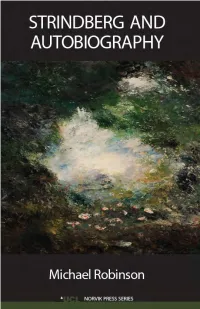
Strindberg and Autobiography
Strindberg and Autobiography Michael Robinson ]u[ Norvik Press ubiquity press London Published by Ubiquity Press Ltd. Gordon House 29 Gordon Square London WC1H 0PP www.ubiquitypress.com and Norvik Press Department of Scandinavian Studies University College London Gower Street London WC1E 6BT www.norvikpress.com Text © Michael Robinson 1986 Original edition published by Norvik Press 1986 This edition published by Ubiquity Press Ltd 2013 Cover illustration: Wonderland (1894) by August Strindberg, Nationalmuseum, Stockholm. Via Wikimedia Commons. Source: Google Art Project. Available at: http:// commons.wikimedia.org/wiki/File%3AAugust_Strindberg_-_Wonderland_-_Google_ Art_Project.jpg Printed in the UK by Lightning Source ISBN (paperback): 978-1-909188-01-3 ISBN (EPUB): 978-1-909188-05-1 ISBN (PDF): 978-1-909188-09-9 DOI: http://dx.doi.org/10.5334/bab This work is licensed under the Creative Commons Attribution 3.0 Unported License. To view a copy of this license, visit http://creativecommons.org/licenses/by/3.0/ or send a letter to Creative Commons, 444 Castro Street, Suite 900, Mountain View, California, 94041, USA. This licence allows for copying any part of the work for personal and commercial use, providing author attribution is clearly stated. Suggested citation: Robinson, M 2013 Strindberg and Autobiography. Norvik Press/Ubiquity Press. DOI: http://dx.doi.org/10.5334/bab To read the online open access version of this book, either visit http://dx.doi.org/10.5334/bab or scan this QR code with your mobile device: Contents Preface i Chapter -
Essentials of Expressionism and August Strindberg's a Dream Play
EUROPEAN ACADEMIC RESEARCH Vol. VIII, Issue 12/ March 2021 Impact Factor: 3.4546 (UIF) ISSN 2286-4822 DRJI Value: 5.9 (B+) www.euacademic.org Essentials of Expressionism and August Strindberg’s A Dream Play: A Theoretical Study in Context Dr. ISHFAQ A. YATOO Assistant Professor (Contractual) Department of English, University of Kashmir Srinagar, J&K, India Abstract This paper attempts to study August Strindberg’s A Dream Play within the perspective of Expressionist theatre. The unconventional features of theatrical expressionism like; dreamlike atmosphere, setting, disjointed plot, typification, rhapsodic and poetic dialogue, etc. are thoroughly studied in context. One of the main objectives is to illustrate Strindberg’s mode of weaving together the form and content in the ‘spirit of a dream’ by employing dreamlike form and strikingly framing the content that itself reflects on dreamlike vanity of human life. This accentuates that the clueless flashes in a dream are tantamount to the otiose human strive in real life. Sigmund Freud’s view of a dream being true to real and ‘an expression of repressed drives’ is applicable on A Dream Play due to its semi-autobiographical merit which, featuring as an element, is itself at the core of expressionist theatre. This theoretical paradigm, thus, is used to argue Strindberg’s way of giving expression to his ‘personal neuroses’ and the appropriation of otherwise intriguing title of this drama. Use of symbols also characterizes expressionist theatre which comes handy in A Dream Play. This paper, therefore, is also an effort to analyse such symbols remarkably significant in both the form as well as in the content of the play under study. -

Mariusz Kalinowski Kopparberg Bjorkberg@Poczta.Fm
Mariusz Kalinowski Kopparberg bjorkberg@poczta.fm Indras Dotter – född ur en rysk dröm1 Om Strindbergs skuld till Tjernysjevskij Sanningen är alltid oförsynt. (A. Strindberg, Mäster Olof, 1872) Tar jag något sceneri och rekvisita, kanske en scen ur en tarvlig, tämligen okänd historisk roman, så är dramat fortfarande mitt, ty romanförfattarens arbete var icke konstnärligt utarbetat. Men tar jag till exempel Ivanhoe och Rebecka utan att nämna Walter Scotts namn, då är jag inne på andras jaktmark. (A. Strindberg, Ur-tjuva, 1910) År 2008 presenterade jag i Gdańsk texten ”Fröken Julie – designed 2 in Russia!” , där jag visar att den centrala scenen i Strindbergs drama (navet i dess omtalade ”�na symmetri”), namnen Julie och Jean samt huvuddragen i fröken Julies gestalt är lånade från den ryske författaren Nikolaj Tjernysjevskijs roman Vad bör göras?. Fröken Julie visar sig ha en rysk förlaga: en demimond från Petersburg. Då jag skrev texten trodde jag mig vara ensam om att ha uppmärksammat Tjernysjevskijs betydelse för Strindbergs dramatik. Nu kan jag modi�era uppfattningen i fråga. År 1975 skrev den ryske forskaren Sjarypkin: Porträtten av ”gamla människor” i romanen Vad bör göras? har i viss mån blivit till litterära prototyper för hjältarna i Strindbergs ”naturalistiska” dramer. Personagerna i Fröken Julie (1888), Julie själv och hennes älskare Jean, har inte bara getts samma namn som ”de gamla människorna” hos Tjernysjevskij – Jean Solovtsov och fransyskan Julie – utan också liknande karaktärsdrag och liknande syn på livet; de har samma intressen 3 och uppvisar samma stereotypa beteenden. Osv. Likheterna, skriver Sjarypkin, är ”knappast slumpartade”. Tjernysjevskijs in�ytande på Strindberg slutar dock inte i och med svenskens ”naturalistiska” period. -
An Interpretation of Strindberg's the Dream Play
EUROPEAN ACADEMIC RESEARCH Vol. II, Issue 6/ September 2014 Impact Factor: 3.1 (UIF) ISSN 2286-4822 DRJI Value: 5.9 (B+) www.euacademic.org Life is such Stuff as Dreams are Made on: An Interpretation of Strindberg’s The Dream Play DR. ZEENATH MOHAMED KUNHI Assistant Professor Centre for Research & Advanced Studies in English Language & Literature Farook College, Calicut India Abstract: The Dream Play, a semi-autobiographical piece by Augustus Strindberg, written during his ‘inferno crisis’ is a metaphor for life itself with its twists and turns and ups and downs. The play structured in a dream mode, takes one through the intricate alleys and by-lanes of man’s inner world of emotions and thoughts and the unpredictability, mystery, conflict and insecurity associated with the world outside. The Dream Play tries to successfully achieve this mastery of dual portrayal, both thematically and structurally. The play is probably the first of its kind in adopting a dream mode as a genre in itself. This kind of a theatrical presentation is made possible by the excessive use of symbols and poetic images which literally float across the text, lending it a haunting, surreal experience. The paper is an attempt to interpret the play with special emphasis on the symbols and images employed by the author. Key words: Dream Play, Strindberg, symbols, syncretism, surrealism The Dream Play, a semi-autobiographical piece by Augustus Strindberg, written during his ‘inferno crisis’ is a metaphor for life itself with its twists and turns and ups and downs. The play structured in a dream mode, takes one through the intricate 7861 Zeenath Mohamed Kunhi- Life is such Stuff as Dreams are Made on: An Interpretation of Strindberg’s The Dream Play alleys and by-lanes of man’s inner world of emotions and thoughts and the unpredictability, mystery, conflict and insecurity associated with the world outside. -

August Strindbergs Arkiv – Från Privatarkiv Till Kulturarv En Studie I Proveniensprincipens Tillämpning Och Nationalistisk Historietolkning
MAGISTERUPPSATS I BIBLIOTEKS- OCH INFORMATIONSVETENSKAP VID BIBLIOTEKS- OCH INFORMATIONSVETENSKAP/BIBLIOTEKSHÖGSKOLAN 2003:9 August Strindbergs arkiv – från privatarkiv till kulturarv En studie i proveniensprincipens tillämpning och nationalistisk historietolkning OLA TÖRJAS © Författaren/Författarna Mångfaldigande och spridande av innehållet i denna uppsats – helt eller delvis – är förbjudet utan medgivande av författaren/författarna. Svensk titel: August Strindbergs arkiv – från privatarkiv till kulturarv: En studie i proveniensprincipens tillämpning och nationalistisk historietolkning. Engelsk titel: The Strindberg Archives – from Private Archives to Cultural Heritage: A Study of the Application of the Principle of Provenance and of a Nationalistic Interpretation of History. Författare: Ola Törjas Färdigställt: 2003 Handledare: Dick Kasperowski, Anders Burius Abstract: In this thesis I examine the events that followed the death of August Strindberg and resulted in his private belongings becoming an important part of Sweden’s cultural heritage. My purpose has been twofold: firstly, to identify which aims were sought to be achieved when dealing with Strindberg's archives and his home and to relate these to a nationalistic interpretation of history, secondly, to relate this work to the then newly introduced archival principle, the Principle of provenance. I identified three different aims: firstly the economic aim must be seen in the light of an increasingly expanding publishing market. I argue that the author gained a new and important role in the general social debate (a nationalistic one), an important point with regard to my following conclusions. Secondly, the aim to store and display the material in a museum is discussed in relation to different views of cultural history and the interpretation of history.