20 Great Hollywood Costume Designers You Should Know About
Total Page:16
File Type:pdf, Size:1020Kb
Load more
Recommended publications
-

The Cartographic Steppe: Mapping Environment and Ethnicity in Japan's Imperial Borderlands
The Cartographic Steppe: Mapping Environment and Ethnicity in Japan's Imperial Borderlands The Harvard community has made this article openly available. Please share how this access benefits you. Your story matters Citation Christmas, Sakura. 2016. The Cartographic Steppe: Mapping Environment and Ethnicity in Japan's Imperial Borderlands. Doctoral dissertation, Harvard University, Graduate School of Arts & Sciences. Citable link http://nrs.harvard.edu/urn-3:HUL.InstRepos:33840708 Terms of Use This article was downloaded from Harvard University’s DASH repository, and is made available under the terms and conditions applicable to Other Posted Material, as set forth at http:// nrs.harvard.edu/urn-3:HUL.InstRepos:dash.current.terms-of- use#LAA The Cartographic Steppe: Mapping Environment and Ethnicity in Japan’s Imperial Borderlands A dissertation presented by Sakura Marcelle Christmas to The Department of History in partial fulfillment of the requirements for the degree of Doctor of Philosophy in the subject of History Harvard University Cambridge, Massachusetts August 2016 © 2016 Sakura Marcelle Christmas All rights reserved. Dissertation Advisor: Ian Jared Miller Sakura Marcelle Christmas The Cartographic Steppe: Mapping Environment and Ethnicity in Japan’s Imperial Borderlands ABSTRACT This dissertation traces one of the origins of the autonomous region system in the People’s Republic of China to the Japanese imperial project by focusing on Inner Mongolia in the 1930s. Here, Japanese technocrats demarcated the borderlands through categories of ethnicity and livelihood. At the center of this endeavor was the perceived problem of nomadic decline: the loss of the region’s deep history of transhumance to Chinese agricultural expansion and capitalist extraction. -

Stanley Kubrick's 18Th Century
Stanley Kubrick’s 18th Century: Painting in Motion and Barry Lyndon as an Enlightenment Gallery Alysse Peery Abstract The only period piece by famed Stanley Kubrick, Barry Lyndon, was a 1975 box office flop, as well as the director’s magnum opus. Perhaps one of the most sumptuous and exquisite examples of cinematography to date, this picaresque film effectively recreates the Age of the Enlightenment not merely through facts or events, but in visual aesthetics. Like exploring the past in a museum exhibit, the film has a painterly quality harkening back to the old masters. The major artistic movements that reigned throughout the setting of the story dominate the manner in which Barry Lyndon tells its tale with Kubrick’s legendary eye for detail. Through visual understanding, the once obscure novel by William Makepeace Thackeray becomes a captivating window into the past in a manner similar to the paintings it emulates. In 1975, the famed and monumental director Stanley Kubrick released his one and only box-office flop. A film described as a “coffee table film”, it was his only period piece, based on an obscure novel by William Makepeace Thackeray (Patterson). Ironically, his most forgotten work is now considered his magnum opus by critics, and a complete masterwork of cinematography (BFI, “Art”). A remarkable example of the historical costume drama, it enchants the viewer in a meticulously crafted vision of the Georgian Era. Stanley Kubrick’s film Barry Lyndon encapsulates the painting, aesthetics, and overall feel of the 18th century in such a manner to transform the film into a sort of gallery of period art and society. -

Puvunestekn 2
1/23/19 Costume designers and Illustrations 1920-1940 Howard Greer (16 April 1896 –April 1974, Los Angeles w as a H ollywood fashion designer and a costume designer in the Golden Age of Amer ic an cinema. Costume design drawing for Marcella Daly by Howard Greer Mitc hell Leis en (October 6, 1898 – October 28, 1972) was an American director, art director, and costume designer. Travis Banton (August 18, 1894 – February 2, 1958) was the chief designer at Paramount Pictures. He is considered one of the most important Hollywood costume designers of the 1930s. Travis Banton may be best r emembered for He held a crucial role in the evolution of the Marlene Dietrich image, designing her costumes in a true for ging the s tyle of s uc h H ollyw ood icons creative collaboration with the actress. as Carole Lombard, Marlene Dietrich, and Mae Wes t. Costume design drawing for The Thief of Bagdad by Mitchell Leisen 1 1/23/19 Travis Banton, Travis Banton, Claudette Colbert, Cleopatra, 1934. Walter Plunkett (June 5, 1902 in Oakland, California – March 8, 1982) was a prolific costume designer who worked on more than 150 projects throughout his career in the Hollywood film industry. Plunk ett's bes t-known work is featured in two films, Gone with the Wind and Singin' in the R ain, in which he lampooned his initial style of the Roaring Twenties. In 1951, Plunk ett s hared an Osc ar with Orr y-Kelly and Ir ene for An Amer ic an in Paris . Adr ian Adolph Greenberg ( 1903 —19 59 ), w i de l y known Edith H ead ( October 28, 1897 – October 24, as Adrian, was an American costume designer whose 1981) was an American costume designer mos t famous costumes were for The Wiz ard of Oz and who won eight Academy Awards, starting with other Metro-Goldwyn-Mayer films of the 1930s and The Heiress (1949) and ending with The Sting 1940s. -
THTR 433A/ '16 CD II/ Syllabus-9.Pages
USCSchool of Costume Design II: THTR 433A Thurs. 2:00-4:50 Dramatic Arts Fall 2016 Location: Light Lab/PDE Instructor: Terry Ann Gordon Office: tagzragz@aol.com/ floating office Office Hours: Thurs. 1:00-2:00: by appt/24 hr notice Contact Info: tagzragz@aol.com, 818-636-2729 Course Description and Overview This course is designed to acquaint students with the requirements, process and expectations for Film/TV Costume Designers, supervisors and crew. Emphasis will be placed on all aspects of the Costume process; Design, Prep: script analysis,“scene breakdown”, continuity, research, and budgeting; Shooting schedules, and wrap. The supporting/ancillary Costume Arts and Crafts will also be discussed. Students will gain an historical overview, researching a variety of designers processes, aesthetics and philosophies. Viewing films and film clips will support critique and class discussion. Projects focused on specific design styles and varied media will further support an overview of techniques and concepts. Current production procedures, vocabulary and technology will be covered. We will highlight those Production departments interacting closely with the Costume Department. Time permitting, extra-curricular programs will include rendering/drawing instruction, select field trips, and visiting TV/Film professionals. Students will be required to design a variety of projects structured to enhance their understanding of Film/TV production, concept, style and technique . Learning Objectives The course goal is for students to become familiar with the fundamentals of costume design for TV/Film. They will gain insight into the protocol and expectations required to succeed in this fast paced industry. We will touch on the multiple variations of production formats: Music Video, Tv: 4 camera vs episodic, Film, Commercials, Styling vs Costume Design. -
Dvds and DVD Extras That Help Teach the Language of Film
DVDs and DVD Extras That Help Teach The Language of Film Copyright 2010, by Frank W. Baker – Media Literacy Clearinghouse This page is not intended to be an exhaustive, all-inclusive list, but rather a list of some DVDs that I am aware of and have watched that I think could be used in classes where “film literacy” and “film fluency” is being taught. There’s nothing like reading a book about film, but viewing, analyzing and deconstructing are best when you have access to films, and extras, that will help your students better understand the languages of film. NOTE: many of these “extras” can now be founded streamed on YouTube. General Film, Form and Culture (CD How to Read A Film: Looking At Movies Rom) Multimedia Edition The Art of Watching Films A Movie Lover’s Guide to Making Movies Make Sense (CD Rom) Film Language American Cinema: 100 Years Moving Images Making Movies, Moguls & Movie Stars: A of Filmmaking Understanding Media History of Hollywood Filmmakers on Film Acting/Casting Matching Identities: Casting Widescreen, The Bourne Supremacy Lemony Snicket’s A Series of Unfortunate Building A Bad Actor (Title 2, Chapter 1) Events A Collaboration of Spirits: Casting and The Color Purple, Two Disc Special Edition Acting Animation Peering Through The Veil Paranorman (Blu-ray DVD) Miniatures in Motion: Bringing Frankenweenie Frankenweenie (2 Disc Combo Pack, Blu- to Life ray-DVD) Tim Burton’s The Corpse Bride, Blu-Ray The Animators: The Breadth of Life Edition Peering Through the Veil: Stop Motion Behind Paranorman, Blu Ray Disc The Scenes Art Direction: Set Design Behind Hogwarts: Dumbledore’s Office- Harry Potter & the Chamber of Secrets Build a Scene (Widescreen Ed. -

The New Hollywood Films
The New Hollywood Films The following is a chronological list of those films that are generally considered to be "New Hollywood" productions. Shadows (1959) d John Cassavetes First independent American Film. Who's Afraid of Virginia Woolf? (1966) d. Mike Nichols Bonnie and Clyde (1967) d. Arthur Penn The Graduate (1967) d. Mike Nichols In Cold Blood (1967) d. Richard Brooks The Dirty Dozen (1967) d. Robert Aldrich Dont Look Back (1967) d. D.A. Pennebaker Point Blank (1967) d. John Boorman Coogan's Bluff (1968) – d. Don Siegel Greetings (1968) d. Brian De Palma 2001: A Space Odyssey (1968) d. Stanley Kubrick Planet of the Apes (1968) d. Franklin J. Schaffner Petulia (1968) d. Richard Lester Rosemary's Baby (1968) – d. Roman Polanski The Producers (1968) d. Mel Brooks Bullitt (1968) d. Peter Yates Night of the Living Dead (1968) – d. George Romero Head (1968) d. Bob Rafelson Alice's Restaurant (1969) d. Arthur Penn Easy Rider (1969) d. Dennis Hopper Medium Cool (1969) d. Haskell Wexler Midnight Cowboy (1969) d. John Schlesinger The Rain People (1969) – d. Francis Ford Coppola Take the Money and Run (1969) d. Woody Allen The Wild Bunch (1969) d. Sam Peckinpah Bob & Carol & Ted & Alice (1969) d. Paul Mazursky Butch Cassidy & the Sundance Kid (1969) d. George Roy Hill They Shoot Horses, Don't They? (1969) – d. Sydney Pollack Alex in Wonderland (1970) d. Paul Mazursky Catch-22 (1970) d. Mike Nichols MASH (1970) d. Robert Altman Love Story (1970) d. Arthur Hiller Airport (1970) d. George Seaton The Strawberry Statement (1970) d. -

Hiff 2018 Announces Alan Alda, First
Embargoed Until 12:00PM ET / 9:00AM PT on Thursday, August 30, 2018 THE HAMPTONS INTERNATIONAL FILM FESTIVAL ANNOUNCES ALAN ALDA AS “THE DICK CAVETT ARTISTIC CHAMPION AWARD” RECIPIENT FIRST MAN announced as Saturday Night Centerpiece Film ROMA to Screen as Spotlight Film Complete Lineup in World Cinema Narrative and World Cinema Documentary Categories Announced Alan Alda, Damien Chazelle and Josh Singer to attend Festival 26th Annual Festival to run October 4 - 8, 2018 East Hampton, NY (August 30, 2018) - The Hamptons International Film Festival (HIFF) announced today that Academy Award®-nominated and Golden Globe®-winning actor Alan Alda will receive The Dick Cavett Artistic Champion Award, celebrating his artistic achievements and contributions to the industry over the years. The festival established the award in 2017, honoring Dick Cavett himself. Seven-time Emmy® Award winner Alan Alda played Hawkeye Pierce and wrote many of the episodes on the classic TV series M*A*S*H, and appeared in continuing roles on ER, The West Wing, 30 Rock, The Blacklist, The Big C, Horace and Pete, and The Good Fight. He was nominated for an Academy Award® for his role in THE AVIATOR. Alda’s films include BRIDGE OF SPIES, TOWER HEIST, WANDERLUST, CRIMES AND MISDEMEANORS, MANHATTAN MURDER MYSTERY, AND THE BAND PLAYED ON, SAME TIME, NEXT YEAR and CALIFORNIA SUITE, as well as THE SEDUCTION OF JOE TYNAN, which he wrote, and THE FOUR SEASONS, SWEET LIBERTY, A NEW LIFE and BETSY’S WEDDING, all of which he wrote and directed. On Broadway, he received Tony nominations for Glengarry Glen Ross, Jake’s Women, and The Apple Tree. -
Final J.Min |O.Phi |T.Cun |Editor |Copy
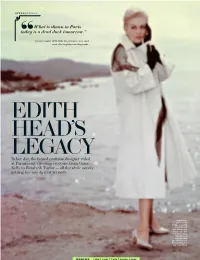
Style SPeCIAl What is shown in Paris today is a dead duck tomorrow.” — Costume designer EDITH HEAD, whose 57-year career owed “ much of its longevity to avoiding trends. C Edith Head’s LEgacy In her day, the famed costume designer ruled at Paramount, dressing everyone from Grace Kelly to Elizabeth Taylor — all the while savvily getting her way By Sam Wasson Kim Novak’s wardrobe for Vertigo, including this white coat with black scarf, was designed to look mysterious. “This girl must look as if she’s just drifted out of the San Francisco fog,” said Head. FINAL J.MIN |O.PHI |T.CUN |EDITOR |COPY Costume designer edith head — whose most unforgettable designs included Grace Kelly’s airy chiffon skirt in Hitchcock’s To Catch a Thief, Gloria Swanson’s darkly elegant dresses in Sunset Boulevard, Dorothy Lamour’s sarongs, and Elizabeth Taylor’s white satin gown in A Place in the Sun — sur- vived 40 years of changing Hollywood styles by skillfully eschewing fads of the moment and, for the most part, gran- Cdeur and ornamentation, too. Boldness, she believed, was a vice. Thirty years after her death, Head is getting a new dose of attention. A gor- geous coffee table book,Edith Head: The Fifty-Year Career of Hollywood’s Greatest Costume Designer, was recently published. And in late March, an A to Z adapta- tion of Head’s seminal 1959 book, The Dress Doctor, is being released as well. ! The sTyle setter of The screen The breezy volume spotlights her trade- Clockwise from above: 1. -

Eiko Ishioka:Blood, Sweat, and Tears—A Life of Design
PRESS RELEASE 2020.6.30 The Tokyo Metropolitan Government and the Tokyo Metropolitan Foundation for History and Culture are carrying out this exhibition as part of the Tokyo Tokyo FESTIVAL. Museum of Contemporary Art Tokyo Eiko Ishioka: Blood, Sweat, and Tears—A Life of Design 14 November 2020 – 14 February 2021 The Museum of Contemporary Art Tokyo (MOT) is pleased to present the world’s first large-scale retrospective exhibition dedicated to Eiko Ishioka (1938-2012), an internationally renowned art director and designer who ignited with her work a new era in various fields including advertising, theater, cinema, and graphic design. The exhibition takes a comprehensive look at Ishioka’s distinctive, incandescent creations, from her groundbreaking ad campaigns from early in her career, to her design work for films, opera, theater, circuses, music videos, and projects for the Olympic Games. Highlights Introducing Eiko Ishioka’s Design Process though Collaborations As described in detail in her autobiography, I DESIGN (Kodansha Ltd., 2005), Eiko Ishioka’s work has also been realized through a series of robust collaborations with great masters in their respective fields, such as Miles Davis, Leni Riefenstahl, Francis Ford Coppola, Björk, and Tarsem Singh. Along with extensive materials regarding her design process, the exhibition introduces and attempts to approach the secrets of “Eiko Ishioka’s Practice” which considers means of exerting individual creativity in the context of group production. Experience the Overwhelming Fervor of Eiko Ishioka’s Design This highly enthusiastic exhibition invites visitors to experience Eiko Ishioka’s works and her ongoing creations, which while harboring the vibrant dynamism of the human body at its core and focuses on “red” as a key color, have a great visual impact and exude emotion. -

'Perfect Fit': Industrial Strategies, Textual Negotiations and Celebrity
‘Perfect Fit’: Industrial Strategies, Textual Negotiations and Celebrity Culture in Fashion Television Helen Warner Submitted for the degree of Doctor of Philosophy (PhD) University of East Anglia School of Film and Television Studies Submitted July 2010 ©This copy of the thesis has been supplied on condition that anyone who consults it is understood to recognise that its copyright rests with the author and that no quotation from the thesis, nor any information derived therefrom, may be published without the author's prior, written consent. Helen Warner P a g e | 2 ABSTRACT According to the head of the American Costume Designers‟ Guild, Deborah Nadoolman Landis, fashion is emphatically „not costume‟. However, if this is the case, how do we approach costume in a television show like Sex and the City (1998-2004), which we know (via press articles and various other extra-textual materials) to be comprised of designer clothes? Once onscreen, are the clothes in Sex and the City to be interpreted as „costume‟, rather than „fashion‟? To be sure, it is important to tease out precise definitions of key terms, but to position fashion as the antithesis of costume is reductive. Landis‟ claim is based on the assumption that the purpose of costume is to tell a story. She thereby neglects to acknowledge that the audience may read certain costumes as fashion - which exists in a framework of discourses that can be located beyond the text. This is particularly relevant with regard to contemporary US television which, according to press reports, has witnessed an emergence of „fashion programming‟ - fictional programming with a narrative focus on fashion. -

English and French-Speaking Legislation Intended to Diminish the Rights Requiring Workers Contribute to Their Own Television Channels Throughout Canada
Join The Stand Up, Fight Back Campaign! IATSE Political Action Committee Voucher for Credit/Debit Card Deductions I hereby authorize the International Alliance of Theatrical Stage Employees, Moving Picture Technicians, Artists and Allied Crafts of the United States Political Action Committee, hereinafter called the IATSE-PAC to initiate a deduction from my credit card. This authorization is to remain in full force and effect until the IATSE-PAC has received written notification from me of its termination in such time and in such manner as to afford the parties a reasonable opportunity to act on it. Check one: President’s Club ($40.00/month) Leader’s Club ($20.00/month) Activist’s Club ($10.00/month) Choose one: Or authorize a monthly contribution of $________ Mastercard Discover Authorize a one-time contribution of $________($10.00 minimum) VISA American Express Card #: _____________________________________ Expiration Date (MM/YY): ____/____ Card Security Code: ______ Employee Signature_______________________________ Date________________ Last 4 Digits of SSN___________ Local Number_____________ ET Print Name_____________________________________Email______________________________________ Phone Number________________________ Home Address_______________________________________ City ____________________________ State/Zip Code _____________________________ Billing Address_________________________ City_________________ State/Zip Code______________ Occupation/Employer_____________________ This Authorization is voluntarily made based on my specific -

Films Winning 4 Or More Awards Without Winning Best Picture
FILMS WINNING 4 OR MORE AWARDS WITHOUT WINNING BEST PICTURE Best Picture winner indicated by brackets Highlighted film titles were not nominated in the Best Picture category [Updated thru 88th Awards (2/16)] 8 AWARDS Cabaret, Allied Artists, 1972. [The Godfather] 7 AWARDS Gravity, Warner Bros., 2013. [12 Years a Slave] 6 AWARDS A Place in the Sun, Paramount, 1951. [An American in Paris] Star Wars, 20th Century-Fox, 1977 (plus 1 Special Achievement Award). [Annie Hall] Mad Max: Fury Road, Warner Bros., 2015 [Spotlight] 5 AWARDS Wilson, 20th Century-Fox, 1944. [Going My Way] The Bad and the Beautiful, Metro-Goldwyn-Mayer, 1952. [The Greatest Show on Earth] The King and I, 20th Century-Fox, 1956. [Around the World in 80 Days] Mary Poppins, Buena Vista Distribution Company, 1964. [My Fair Lady] Doctor Zhivago, Metro-Goldwyn-Mayer, 1965. [The Sound of Music] Who's Afraid of Virginia Woolf?, Warner Bros., 1966. [A Man for All Seasons] Saving Private Ryan, DreamWorks, 1998. [Shakespeare in Love] The Aviator, Miramax, Initial Entertainment Group and Warner Bros., 2004. [Million Dollar Baby] Hugo, Paramount, 2011. [The Artist] 4 AWARDS The Informer, RKO Radio, 1935. [Mutiny on the Bounty] Anthony Adverse, Warner Bros., 1936. [The Great Ziegfeld] The Song of Bernadette, 20th Century-Fox, 1943. [Casablanca] The Heiress, Paramount, 1949. [All the King’s Men] A Streetcar Named Desire, Warner Bros., 1951. [An American in Paris] High Noon, United Artists, 1952. [The Greatest Show on Earth] Sayonara, Warner Bros., 1957. [The Bridge on the River Kwai] Spartacus, Universal-International, 1960. [The Apartment] Cleopatra, 20th Century-Fox, 1963.