U.S. Policy Toward Southern Africa
Total Page:16
File Type:pdf, Size:1020Kb
Load more
Recommended publications
-

Africans: the HISTORY of a CONTINENT, Second Edition
P1: RNK 0521864381pre CUNY780B-African 978 0 521 68297 8 May 15, 2007 19:34 This page intentionally left blank ii P1: RNK 0521864381pre CUNY780B-African 978 0 521 68297 8 May 15, 2007 19:34 africans, second edition Inavast and all-embracing study of Africa, from the origins of mankind to the AIDS epidemic, John Iliffe refocuses its history on the peopling of an environmentally hostilecontinent.Africanshavebeenpioneersstrugglingagainstdiseaseandnature, and their social, economic, and political institutions have been designed to ensure their survival. In the context of medical progress and other twentieth-century innovations, however, the same institutions have bred the most rapid population growth the world has ever seen. The history of the continent is thus a single story binding living Africans to their earliest human ancestors. John Iliffe was Professor of African History at the University of Cambridge and is a Fellow of St. John’s College. He is the author of several books on Africa, including Amodern history of Tanganyika and The African poor: A history,which was awarded the Herskovits Prize of the African Studies Association of the United States. Both books were published by Cambridge University Press. i P1: RNK 0521864381pre CUNY780B-African 978 0 521 68297 8 May 15, 2007 19:34 ii P1: RNK 0521864381pre CUNY780B-African 978 0 521 68297 8 May 15, 2007 19:34 african studies The African Studies Series,founded in 1968 in collaboration with the African Studies Centre of the University of Cambridge, is a prestigious series of monographs and general studies on Africa covering history, anthropology, economics, sociology, and political science. -

Downloaded Cc-By-Nc from License.Brill.Com10/02/2021 05:36:28AM Via Free Access
chapter 2 Group Identifications: African and Global Categories Defining African Ethnicities against a Global Background Discussions about group identifications in sub-Saharan Africa, and elsewhere in the world, are today dominated by a somewhat odd parallelism between different concepts, which are rarely understood as alternatives. This relates to the factors of ethnicity, religion, and the post-colonial nation-building proj- ects: in the case of West Africa, for some regions, like Nigeria, the debate now favours religion almost exclusively as a divisive problem; in Ghana and Sierra Leone, regional and ethnic factors are broadly discussed; for Côte d’Ivoire, scholars seek explanations for what they regard as the failure of nation- building. The different factors, to which we can add family, kinship, and mod- els of political organisation, are rarely brought into a larger panorama. Moreover, they are not really seen as different options for identification for an individual or for a group.1 The current chapter endeavours to give the reader a solid general idea about ethnic sentiment as a conceptual factor in sub-Saharan Africa and in its global dimensions. It addresses key problems in this context: the debate about the nature of ethnicity, with its slowly changing arguments over the last five decades; and the quest for a working definition of ethnic groups. Concerning the former, it is necessary to engage with a basic discussion of whether ethnic identification is a long-lasting ‘traditional’ fact or a construction under condi- tions of colonial rule: that is, would a member of a certain community have automatically been inclined to identify herself or himself as belonging to her or his ethnic group, or was she or he usually led or even manipulated to do so? The second problem is also quite intriguing. -
Annual Research Report 2016
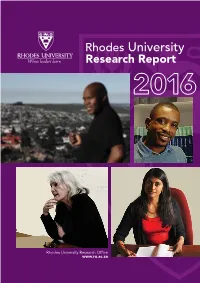
RRR Cover Final 11/9/17 5:23 PM Page 1 C M Y CM MY CY CMY K Composite RRR 2017 | Intro pages 11/10/17 11:59 AM Page 1 C M Y CM MY CY CMY K A publication of the Rhodes University Research Office, compiled and edited by: Tarryn Gillitt, Thumeka Mantolo, Jill Macgregor and Jaine Roberts. Cover: Rhodes University researchers Visiting Professor Research Office Thembela Kepe (top left), Associate Professor Dion Nkomo Director: Jaine Roberts (top right), Professor Sioux McKenna (below left) and j.roberts@ru.ac.za Associate Professor Sam Naidu (below right). Tel: +27 (46) 603 8756/7572 Cover photos: Snow Cindy Harris www.ru.ac.za Composite RRR 2017 | Intro pages 11/10/17 10:10 AM Page 2 C M Y CM MY CY CMY K Rhodes University Research Report | 2016 03 FOREWORD Dr Sizwe Mabizela, Vice-Chancellor 05 INTRODUCTION Dr Peter Clayton, Deputy Vice-Chancellor: Research & Development 07 TOP 30 RESEARCHERS 08 PHD GRADUATES AT THE 2016 GRADUATION CEREMONIES 13 VICE-CHANCELLOR’S DISTINGUISHED SENIOR RESEARCH AWARD Professor Heila Lotz-Sisitka 15 VICE-CHANCELLOR’S DISTINGUISHED RESEARCH AWARD Associate Professor Dion Nkomo 18 VICE-CHANCELLOR’S DISTINGUISHED RESEARCH AWARD Associate Professor Julie Coetzee 20 RESEARCH FOCUS Associate Professor Sam Naidu 22 HUMAN GEOGRAPHY Professor Thembela Kepe 24 THE CENTRE FOR POSTGRADUATE STUDIES Professor Sioux McKenna 26 RETRIEVING & RE-PUBLISHING ISIXHOSA WRITINGS 01 Composite RRR 2017 | Intro pages 11/10/17 10:10 AM Page 3 C M Y CM MY CY CMY K Rhodes University Research Report | 2016 30 Publications from the Vice-Chancellorate -
Plurality of Religion, Plurality of Justice
Plurality of religion, plurality of justice African Studies Centre African Studies Collection, vol. 28 Plurality of religion, plurality of justice Exploring the role of religion in disputing processes in Gorongosa, Central Mozambique Carolien Jacobs African Studies Centre P.O. Box 9555 2300 RB Leiden The Netherlands asc@ascleiden.nl http://www.ascleiden.nl Cover design: Heike Slingerland Photographs: Carolien Jacobs Printed by Ipskamp Drukkers, Enschede ISSN: 1876-018X ISBN: 978-90-5448-099-0 © Carolien Jacobs, 2010 Contents List of tables and figures vii Acknowledgements viii 1. INTRODUCTION: RELIGION AND DISPUTING 1 Central question 2 The concept of religion 4 Approaching religion in the field 9 The context of legal pluralism 14 Disputing 16 Religion in the disputing process 19 Introduction to the field of Mozambique 23 Structure of the book 31 2. A HISTORY OF MOZAMBIQUE, A HISTORY OF GORONGOSA 34 Early history 34 Intensifying colonisation 40 Defending a colony 44 Independence and civil war 55 Post-war reconstruction 63 3. IN SEARCH OF SPIRITUAL SECURITY IN A CHANGING WORLD 70 Changing society, changing beliefs 73 Converting or entangling? 88 Conclusion 94 4. NAVIGATING THROUGH A LANDSCAPE OF POWERS OR GETTING LOST ON MOUNT GORONGOSA 97 Mount Gorongosa: Locating a landscape of powers 100 Conclusion: Getting lost or finding the way? 117 5. CONFLICT MEDIATION BY SPIRIT MEDIUMS AND PASTORS 120 Dispute management by spirit mediums 121 Christian-oriented dispute management 146 Conclusion 155 v 6. SPIRITS AT THE POLICE STATION AND THE DISTRICT COURT 159 The Gorongosa district police station 161 Spirits at the district court 173 Conclusion 180 7. -
WWF World Wide Fund for Nature
WWF World Wide Fund For Nature Centre For Applied Social Sciences CHANGING LAND-USE IN THE EASTERN ZAMBEZI VALLEY: SOCIO-ECONOMIC CONSIDERATIONS By Bill Derman Department of Anthropology & African Studies Centre Michigan State University December 22 1995 Printed October 1996 CASS/WWF Joint Paper Report submitted to: Centre for Applied Social Sciences WWF - World Wide Fund for Nature University of Zimbabwe Programme Office - Zimbabwe P O Box MP 167 P O Box CY 1409 Mount Pleasant Causeway HARARE HARARE Zimbabwe Zimbabwe Members of IUCN - The World Conservation Union The opinions and conclusions of this Joint Paper are not necessarily those of the Centre for Applied Social Sciences, University of Zimbabwe or the WWF - World Wide Fund for Nature. TABLE OF CONTENTS PREFACE ................ ii INTRODUCTION ............... 1 PART 1 The Eastern Zambezi Valley: An Historical Overview . 4 PART 2 Development Interventions in the Eastern Valley . 13 PART 3 Non-Governmental Organisations ...... 19 PART 4 Migration and Migrants ......... 22 PART 5 Local Responses to Change ........ 26 PART 6 New and Planned Development Initiatives .. 32 PART 7 The Organisational Environment ...... 46 PART 8 Policy and Land Use Planning ....... 50 ENDNOTES ............. 52 BIBLIOGRAPHY .............. 57 PREFACE This study by Professor Bill Derman is intended to provide an overview of socio- economic dimensions which have influenced, and often controlled, land use in the eastern Zambezi Valley of Zimbabwe. The study also provides a wider contextual framework to several more detailed studies of the ecological, economic and social components of land use, agriculture, and natural resource use and management being undertaken by CASS and WWF. Much of this work is in support of Zimbabwe's Communal Areas Management Programme for Indigenous Resources - CAMPFIRE, but has wider implications for the development of sustainable land use practices and resource management regimes in the region. -
Ivory and Slaves in East and Central Africa (C
Ivory and slaves in East and Central Africa (c. 1800- 1880) Com- Under Central and East Africa we include most of the land north of the Limpopo and Pari' south of the Equator. The coast of what is often called West Central Africa featured in the chapters on the Atlantic slave trade and West Africa, but the peoples and routes that other supplied the slaves for the coast will be discussed here. There are some similarities ports of between the situation in North and West Africa and that existing in East and Central Africa Africa. In Northeast Africa and in the central Sudan of West Africa we come across warlords such as Zubayr and Rabih. In Central and East Africa we meet up with leaders such as Msiri, Mirambo, Tippu Tip and Mlozi who also built up secondary trading and conquest states that dealt in slaves and ivory. In these other regions we witness some empire building during the period of the jihads by people such as al-Hajj Umar and Samory Toure, by Mohammad Ali in Egypt and Menelik in Ethiopia. In this region too, we have some empire building and state expansion, for example on the island of Madagascar by the Merina, in the area of the Great Lakes by Buganda, and also the growth of the trading empire of the Omani Arabs in East Africa. But large empires were scarce because the geography did not encourage the growth of big polities. It was mainly in the Great Lakes region that we find sizeable states such as Buganda. -

September 2012 Rhodesian Services Association Incorporated
September 2012 A monthly publication for the Rhodesian Services Association Incorporated Registered under the 2005 Charities Act in New Zealand number CC25203 Registered as an Incorporated Society in New Zealand number 2055431 PO Box 13003, Tauranga 3141, New Zealand. Web: www.rhodesianservices.org Secretary’s e-mail thesecretary@rhodesianservices.org Editor’s e-mail theeditor@rhodesianservices.org Phone +64 7 576 9500 Fax +64 7 576 9501 To view all previous publications go to our Archives Greetings, The October RV and AGM are next month over the weekend 19th–21st October. Please see details further on in this newsletter. It is essential for the smooth running of the event that you book and pay for your tickets before the 12th October. Everyone is welcome – come along and have a good time. Anyone connected to Umtali and the 4th Battalion Rhodesia Regiment should make a special effort to attend this year’s RV as we have a special event planned. Unfortunately we cannot publically disclose the details yet, but anyone is welcome to contact me to get a briefing. In view of the upcoming AGM we encourage new blood to come on board the Committee for the purpose of learning the ropes and taking on positions of responsibility. In particular, the Editor and Webmaster positions are open for change. Job descriptions can be supplied on request. It is vital to the continuation of the work done by this Association that the younger generation build on the solid foundations that have been made by this Association. This newsletter is another mammoth effort, so strap in and enjoy the next thirty odd pages. -

The Last Flight out of Uli
One of Jack Malloch’s unmarked DC-7’s that maintained the nightly airlift of arms and ammunition into the shrinking state of Biafra throughout 1969. This is likely the actual aircraft that made the very last flight out of Uli. Picture from Jack Malloch’s private collection. © Greg Malloch. THE LAST FLIGHT OUT OF ULI By the beginning of January 1970 in the break-away state of Biafra, Uli or ‘Airstrip Annabel’ as it was officially known, had become the country’s last remaining beacon of desperate hope in the eye of a swirling hurricane of inevitable death and destruction. Since the beginning of 1969 the little widened section of palm-tree lined roadway had become the very epitome of hell itself. The country was completely surrounded by the encroaching Nigerian forces and Uli was the only place where food and ammunition could be flown in and the starving orphans could be flown out. © Alan Brough Page !1 In early December ’69 the veteran war correspondent Al J. Venter flew into Uli. Describing his experience he said, “None of us will ever forget the heat and the noise that cloaked us like a sauna. Time meant nothing. You were simply too awed, too overwhelmed by what was going on, and the musty, unwashed immediacy of it all. Our senses were constantly sharpened by the stutter of automatic fire along the runway. The priests in their white cassocks, the rattle of war, the roar of aircraft, the babble of voices shouting in strange tongues and the infants hollering all made for a surreal assault on the senses.”1 Three days before Christmas the ‘final assault’ was launched and what remained of Biafra was finally sliced in two. -

FALL 2015 - Volume 62, Number 3
FALL 2015 - Volume 62, Number 3 WWW.AFHISTORICALFOUNDATION.ORG Fall 2015 -Volume 62, Number 3 WWW.AFHISTORICALFOUNDATION.ORG Features A War Too Long: Part II John S. Schlight 6 New Sandys in Town: A–7s and Rescue Operations in Southeast Asia Darrel Whitcomb 34 Ivory and Ebony: Officer Foes and Friends of the Tuskegee Airmen Daniel L. Haulman 42 Dragons on Bird Wings: The Combat History of the 812th Fighter Air Regiment By Vlad Antipov & Igor Utkin Review by Golda Eldridge 50 Richthofen: The Red Baron in Old Photographs By Louis Archard Review by Daniel Simonsen 50 The Ardennes, 1944-1945: Hitler’s Winter Offensive Book Reviews By Christer Bergström Review by Al Mongeon 50 The Medal of Honor: A History of Service Above and Beyond By Boston Publishers, ed. Review by Steven D. Ellis 51 American Military Aircraft 1908-1919 By Robert B. Casari Review by Joseph Romito 51 Believers in the Battlespace: Religion, Ideology and War By Peter H. Denton, ed. Review by R. Ray Ortensie 52 British Airship Bases of the Twentieth Century By Malcolm Fife Review by Carl J. Bobrow 53 The Phantom in Focus: A Navigator’s Eye on Britain’s Cold War Warrior By David Gledhill Review by Mike R. Semrau 53 Lords of the Sky By Dan Hampton Review by Janet Tudal Baltas 54 An American Pilot with the Luftwaffe: A Novella and Stories of World War II By Robert Huddleston Review by Steve Agoratus 54 The Astronaut Wives Club By Lily Koppel Review by Janet Tudal Baltas 55 Malloch’s Spitfire: The Story and Restoration of PK 350 By Nick Meikle Review by Steve Agoratus 56 U.S. -

A Decade of Civil Aviation in Zimbabwe: Towards a History of Air Zimbabwe Corporation 1980 to 1990
The African e-Journals Project has digitized full text of articles of eleven social science and humanities journals. This item is from the digital archive maintained by Michigan State University Library. Find more at: http://digital.lib.msu.edu/projects/africanjournals/ Available through a partnership with Scroll down to read the article. Zambezia (1995), XXII (i). A DECADE OF CIVIL AVIATION IN ZIMBABWE: TOWARDS A HISTORY OF AIR ZIMBABWE CORPORATION 1980 TO 1990 A. S. MLAMBO Department of Economic History, University of Zimbabwe Abstract In 1980 when Air Zimbabwe was established, there was great hope that it would prosper, especially since it was going to operate in a global atmosphere without the restrictions of economic sanctions that had constrained its predecessor, Rhodesia Airways. In the first few years, Air Zimbabwe expanded its services, replaced old aircraft with newer and more hiel-efficient state-of- the-art aeroplanes. By the mid-1980s however, the airline had started to lose money and continued to do so for the rest of the decade, necessitating hefty subsidies from the government. This article traces the development of Air Zimbabwe from 1980 to 1990 and attempts to analyze the reasons behind the airline's disappointing performance. It suggests that the failure of the airline to operate as a viable commercial enterprise was a result of both internal weaknesses of the airline's administration and restrictive government policies, as well as a generally difficult global economic climate. INTRODUCTION Air Zimbabwe Corporation (hereafter called AirZim) was established under the Zimbabwe Corporation Act (Chapter 253) of 1980.1 The new airline took over from Rhodesia Airways which had been established in 1967 and which had operated profitably throughout its existence, with the exception of the 1979 financial year when it registered its first deficit. -

Africans: the HISTORY of a CONTINENT, Second Edition
P1: RNK 0521864381pre CUNY780B-African 978 0 521 68297 8 May 15, 2007 19:34 This page intentionally left blank ii P1: RNK 0521864381pre CUNY780B-African 978 0 521 68297 8 May 15, 2007 19:34 africans, second edition Inavast and all-embracing study of Africa, from the origins of mankind to the AIDS epidemic, John Iliffe refocuses its history on the peopling of an environmentally hostilecontinent.Africanshavebeenpioneersstrugglingagainstdiseaseandnature, and their social, economic, and political institutions have been designed to ensure their survival. In the context of medical progress and other twentieth-century innovations, however, the same institutions have bred the most rapid population growth the world has ever seen. The history of the continent is thus a single story binding living Africans to their earliest human ancestors. John Iliffe was Professor of African History at the University of Cambridge and is a Fellow of St. John’s College. He is the author of several books on Africa, including Amodern history of Tanganyika and The African poor: A history,which was awarded the Herskovits Prize of the African Studies Association of the United States. Both books were published by Cambridge University Press. i P1: RNK 0521864381pre CUNY780B-African 978 0 521 68297 8 May 15, 2007 19:34 ii P1: RNK 0521864381pre CUNY780B-African 978 0 521 68297 8 May 15, 2007 19:34 african studies The African Studies Series,founded in 1968 in collaboration with the African Studies Centre of the University of Cambridge, is a prestigious series of monographs and general studies on Africa covering history, anthropology, economics, sociology, and political science. -

“Honoured More in the Breach Than in the Observance”: Economic Sanctions on Rhodesia1 and International Response, 1965 to 1979
“HONOURED MORE IN THE BREACH THAN IN THE OBSERVANCE”: ECONOMIC SANCTIONS ON RHODESIA1 AND INTERNATIONAL RESPONSE, 1965 TO 1979 A. S. Mlambo Department of Historical and Heritage Studies University of Pretoria Abstract The United Nations Security Council passed a series of resolutions condemning Rhodesia’s unilateral declaration of independence (UDI) in 1965, culminating in Resolution 253 of 1968 imposing comprehensive mandatory international sanctions on Rhodesia. With a few exceptions, notably South Africa and Portugal, most member states supported the resolution and pledged their commitment to uphold and enforce the measures. Yet, most countries, including those at the forefront of imposing sanctions against Rhodesia, broke sanctions or did little to enforce them. An examination of the records of the Security Council Committee Established in Pursuance of Resolution 253 (1968) Concerning the Question of Southern Rhodesia (the Sanctions Committee) shows that sanctions against Rhodesia were honoured more in the breach than in the observance. Keywords: Sanctions, UDI, United Nations, Security Council, Sanctions busting, Ian Smith, Harold Wilson Introduction On November 11, 1965, the Rhodesia Front Government of Prime Minister Ian Douglas Smith unilaterally declared independence (UDI) from Britain in response to the colonial authority’s reluctance to grant independence to the country under white minority rule. Facing mounting pressure to use force to topple the illegal regime in Rhodesia from the Afro-Asian lobby at the United Nations (UN), Britain opted, to impose economic sanctions on Rhodesia, instead. British Prime Minister Harold Wilson confidently predicted at the time 1 The names Rhodesia and Southern Rhodesia are used interchangeably in this paper. While the UDI leaders referred to the country only as ‘Rhodesia’, the United Nations continued to call it ‘Southern Rhodesia’ throughout the UDI period.