Dominating the World China and the Rare Earth Industry
Total Page:16
File Type:pdf, Size:1020Kb
Load more
Recommended publications
-

2019 LCC Brochure.Pdf
Scholarships Facts & Figures Shanghai 2018 Rankings QS World University Rankings 62 Jiao Tong University US News & World Report 156 Times Higher Education (THE) 188 Types of Scholarships Founded in 1896, Shanghai Jiao Tong Students University (SJTU) is the second oldest International degree students 2,401 university in China and is one of the Type Duration Support (RMB) Coverage (RMB) Sponsor Undergraduate students 16,195 most prestigious universities in China. Graduate students 21,093 SJTU is very strong in engineering, Monthly stipend (3,000/Month) which listed top 0.01% in ESI ranking. Tuition (28,900/Year) Faculty With a full range of academic disciplines A: CSC 2-3 Years 80,100/Year Health insurance CSC Academicians 48 in power & energy engineering, Accommodation allowance Chair Professors 148 environmental science and engineering, (1,200/Month) Fellows 160 finance and management related to International Faculties 222 low-carbon technology, SJTU has a solid Monthly stipend (1,700/Month) Professors 891 foundation and extraordinary advantag- Tuition (28,900/Year) es in establishing the China-UK Low B 2-3 Years 64,500/Year SJTU Full-time Faculties 2,835 Health insurance Carbon College. Accommodation allowance (1,200/Month) Tuition (28,900/Year) Health insurance C 2-3 Years 44,100/Year SJTU Accommodation allowance (1,200/Month) Prominent Alumni D 2-3 Years 29,700/Year Tuition (28,900/Year) SJTU Health insurance Jiang Ze Min Former President of China Note: In general, the support duration cannot be extended. All scholarship recipients are obliged to attend the annual China-UK comprehensive scholarship assessment during April and May of each year to confirm their qualification of the scholarship for the next year. -

The Rare Earths II
Redis co very of the Elements The Ra re Earth s–The Con fusing Years I A gallery of rare earth scientists and a timeline of their research I I James L. Marshall, Beta Eta 1971 , and Virginia R. Marshall, Beta Eta 2003 , Department of Chemistry, University of North Texas, Denton, TX 76203-5070, jimm@unt.edu The rare earths after Mosander. In the pre - vi ou s HEXAGON “Rediscovery” article, 1p we were introduced to the 17 rare earths, found in the f-block and the Group III chemical family of Figure 1. Important scientists dealing with rare earths through the nineteenth century. Johan Gadolin the Periodic Table. Because of a common (1760 –1852) 1g —discovered yttrium (1794). Jöns Jacob Berzelius (1779 –1848) and Martin Heinrich valence electron configuration, the rare earths Klaproth (1743 –1817) 1d —discovered cerium (1803). Carl Gustaf Mosander (1787 –1858) 1p —discovered have similar chemical properties, and their lanthanum (1839), didymium (1840), terbium, and erbium (1843). Jean-Charles deGalissard Marignac chemical separation from one another can be (1817 –1894) 1o —discovered ytterbium (1878) and gadolinium (1880). Per Teodor Cleve (1840 –1905) 1n — difficult. From preparations of the first two rare discovered holmium and thulium (1879). Lars Fredrik Nilson (1840 –1899) 1n —discovered scandium earth element s—yttrium and ceriu m—the (1879). Paul-Émile Lecoq de Boisbaudran (1838 –1912) —discovered samarium (1879) and dysprosium Swedish chemist Carl Gustaf Mosander (Figure (1886). 1b Carl Auer von Welsbach (1858 –1929) 1c —discovered praseodymium and neodymium (1885); 1, 2) was able to separate four additional ele - co-discovered lutetium (1907). -
RBRC-32 BNL-6835.4 PARITY ODD BUBBLES in HOT QCD D. KHARZEEV in This ~A~Er We Give a Pedawwicalintroduction~0 Recent Work Of
RBRC-32 BNL-6835.4 PARITY ODD BUBBLES IN HOT QCD D. KHARZEEV RIKEN BNL Research Center, Br$ookhauenNational Laboratory, . Upton, New York 11973-5000, USA R.D. PISARSKI Department of Physics, Brookhaven National Laboratoy, Upton, New York 11973-5000, USA M.H.G. TYTGAT Seruice de Physique Th&orique, (7P 225, Uniuersitc4Libre de Bruzelles, B[ud. du !t%iomphe, 1050 Bruxelles, Belgium We consider the topological susceptibility for an SU(N) gauge theory in the limit of a large number of colors, N + m. At nonzero temperature, the behavior of the topological susceptibility depends upon the order of the reconfining phrrse transition. The meet interesting possibility is if the reconfining transition, at T = Td, is of second order. Then we argue that Witten’s relation implies that the topological suscepti~lfity vanishes in a calculable fdion at Td. Ae noted by Witten, this implies that for sufficiently light quark messes, metaetable etates which act like regions of nonzero O — parity odd bubbles — can arise at temperatures just below Td. Experimentally, parity odd bubbles have dramatic signature% the rI’ meson, and especially the q meson, become light, and are copiously produced. Further, in parity odd bubbles, processes which are normally forbidden, such as q + rr”ro, are allowed. The most direct way to detect parity violation is by measuring a parity odd global seymmetry for charged pions, which we define. 1 Introduction In this .-~a~er we give a Pedawwicalintroduction~0 recent work of ours? We I consider an SU(IV) gau”ge t~e~ry in the limit of a large number of colors, N + co, This is, of course, a familiar limit? We use the large N expansion I to investigate the behavior of the theory at nonzero temperature, especially for the topological susceptibility. -
A Glimpse of Materials Research in China a Report from an Interagency Study Team on Materials Visiting China from June 19, 1995 to June 30, 1995
NATL INST. OF STAND ^JECH Rrf^ I PUBLICATIONS mill nil nil I II A111Q4 7T2m3 United States Department of Commerce Technology Administration National Institute of Standards and Technology NIST Special Publication 893 A Glimpse of Materials Research in China A Report From an Interagency Study Team on Materials Visiting China From June 19, 1995 to June 30, 1995 Stephen M. Hsu and Lyle H. Schwartz^ Editors QC 100 ,U57 NO. 893 1995 Jhe National Institute of Standards and Technology was established in 1988 by Congress to "assist industry in the development of technology . needed to improve product quality, to modernize manufacturing processes, to ensure product reliability . and to facilitate rapid commercialization ... of products based on new scientific discoveries." NIST, originally founded as the National Bureau of Standards in 1901, works to strengthen U.S. industry's competitiveness; advance science and engineering; and improve public health, safety, and the environment. One of the agency's basic functions is to develop, maintain, and retain custody of the national standards of measurement, and provide the means and methods for comparing standards used in science, engineering, manufacturing, commerce, industry, and education with the standards adopted or recognized by the Federal Government. As an agency of the U.S. Commerce Department's Technology Administration, NIST conducts basic and applied research in the physical sciences and engineering, and develops measurement techniques, test methods, standards, and related services. The Institute does generic and precompetitive work on new and advanced technologies. NIST's research facilities are located at Gaithersburg, MD 20899, and at Boulder, CO 80303. Major technical operating units and their principal activities are listed below. -
Completion and Evaluation of NSFC Projects
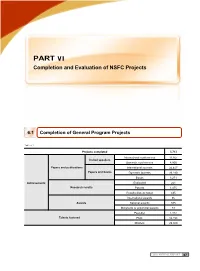
PART Completion and Evaluation of NSFC Projects 6.1 Completion of General Program Projects Table 6-1 Projects completed 5,713 International conferences 11,167 Invited speakers Domestic conferences 8,900 Papers and publications International journals 22,447 Papers and books Domestic journals 36,180 Books 3,271 Achievements Evaluated 241 Research results Patents 1,475 Results disseminated 435 International awards 95 Awards National awards 585 Ministerial or provincial awards 73 Post-doc 1,312 Talents fostered Ph.D. 16,158 Masters 29,040 2008 ANNUAL REPORT 67 6.2 Completion of Young Scientists Fund Projects Table 6-2 Projects completed 1,602 International conferences 2,645 Invited speakers Domestic conferences 1,750 Papers and publications International journals 5,097 Papers and books Domestic journals 7,030 Books 978 Achievements Evaluated 28 Research results Patents 277 Results disseminated 44 International awards 22 Awards National awards 131 Ministerial or provincial awards 31 Post-doc 215 Talents fostered Ph.D. 2,296 Masters 4,723 6.3 Completion of Projects of the Fund for Less Developed Regions Table 6-3 Projects completed 279 International conferences 250 Invited speakers Domestic conferences 309 Papers and publications International journals 644 Papers and books Domestic journals 2,110 Books 184 Achievements Evaluated 18 Research results Patents 33 Results disseminated 5 International awards 0 Awards National awards 34 Ministerial or provincial awards 3 Post-doc 14 Talents fostered Ph.D. 263 Masters 1,725 68 2008 ANNUAL REPORT Completion and Evaluation of NSFC Projects NSFC 6.4 Completion of Key Program Projects Table 6-4 Projects completed 239 International conferences 2,361 Invited speakers Domestic conferences 1,767 Papers and publications International journals 6,936 Papers and books Domestic journals 5,919 Books 324 Achievements Evaluated 21 Research results Patents 376 Results disseminated 59 International awards 34 Awards National awards 119 Ministerial or provincial awards 23 Post-doc 367 Talents fostered Ph.D. -

Other Publications in the CECD Series
Other Publications in the CECD Series Energetics Science and Technology in Central Europe Invited Editor: Ronald W. Armstrong Series Editors: James M. Short, Robert A. Kavetsky, and Davinder K. Anand ISBN 978-0-9846274-3-1 Simulation -Based Innovation and Discovery. Energetics Applications Edited by Davinder K. Anand, Satyandra K. Gupta, and Robert A. Kavetsky ISBN 978-0-9846274-2-4 Energetics Science and Technology in China James M. Short, Robert A. Kavetsky, Michael G. Pecht, and Davinder K. Anand ISBN 978-0-9846274-0-0 Other Publications in the CECD Series From Science to Seapower. A Roadmap for S&T Revitalization. Postscript 2010 Robert A. Kavetsky, Michael L. Marshall, and Davinder K. Anand ISBN 978-0-9846274-1-7 Training in Virtual Environments. A Safe, Cost-Effective, and Engaging Approach to Training Satyandra K. Gupta, Davinder K. Anand, John E. Brough, Maxim Schwartz, and Robert A. Kavetsky ISBN 978-0-9777295-2-4 From Science to Seapower. A Roadmap for S&T Revitalization Robert A. Kavetsky, Michael L. Marshall, and Davinder K. Anand ISBN 978-0-9846274-1-7 Rare Earth Materials Insights and Concerns CENTER FOR ENERGETIC CONCEPTS DEVELOPMENT SERIES Editorial Board Davinder K. Anand, CECD, University of Maryland, College Park, MD James M. Short, CECD, University of Maryland, College Park, MD Don DeVoe, CECD, University of Maryland, College Park, MD Bryan Eichhorn, University of Maryland, College Park, MD Satyandra K. Gupta, CECD, University of Maryland, College Park, MD Michael G. Pecht, CALCE, University of Maryland, College Park, MD Michael R. Zachariah, CECD, University of Maryland, College Park, MD ENERGETICS SCIENCE AND TECHNOLOGY SERIES Editorial Board James M. -

A Historical Geography of Rare Earth Elements: from Discovery to the Atomic Age
The Extractive Industries and Society 2 (2015) 572–580 Contents lists available at ScienceDirect The Extractive Industries and Society journal homepage: www.elsevier.com/locate/exis Review article A historical geography of rare earth elements: From discovery to the atomic age Julie Michelle Klinger* Frederick S. Pardee School of Global Studies, Boston University, United States ARTICLE INFO ABSTRACT Article history: This article presents a historical geography of rare earth elements from their discovery to the atomic age Received 16 January 2015 with a focus on the period between 1880 and 1960 in order to lend greater depth to the growing body of Received in revised form 19 May 2015 scholarship on the relationship between rare earth elements and global political change. Drawing on Available online 7 July 2015 archival and field research undertaken in the United States, China, Brazil, and Germany between 2011 and 2014, this article advances the following argument. Rare earth elements, and the production of geological Keywords: knowledge about them, have entangled with contentious politics since their first industrial applications Rare earth elements in the late 19th century. The historical geography of rare earth exploration and extraction is defined by a Historical geography fundamental tension between the military-industrial necessity of these elements and the hazards Geology fi Politics associated with their production. This tension played a de nitive role in international colonial, Cold War, Cold war and atomic politics. ã 2015 Elsevier Ltd. All rights reserved. Contents 1. Introduction . ................................................................................................... 572 2. Discovery and classification .......................................................................................... 573 3. Geology, territory, and power . ..................................................................................... 573 4. The political life of rare earth elements ............................................................................... -
The Elements.Pdf
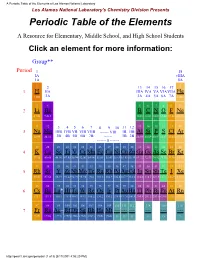
A Periodic Table of the Elements at Los Alamos National Laboratory Los Alamos National Laboratory's Chemistry Division Presents Periodic Table of the Elements A Resource for Elementary, Middle School, and High School Students Click an element for more information: Group** Period 1 18 IA VIIIA 1A 8A 1 2 13 14 15 16 17 2 1 H IIA IIIA IVA VA VIAVIIA He 1.008 2A 3A 4A 5A 6A 7A 4.003 3 4 5 6 7 8 9 10 2 Li Be B C N O F Ne 6.941 9.012 10.81 12.01 14.01 16.00 19.00 20.18 11 12 3 4 5 6 7 8 9 10 11 12 13 14 15 16 17 18 3 Na Mg IIIB IVB VB VIB VIIB ------- VIII IB IIB Al Si P S Cl Ar 22.99 24.31 3B 4B 5B 6B 7B ------- 1B 2B 26.98 28.09 30.97 32.07 35.45 39.95 ------- 8 ------- 19 20 21 22 23 24 25 26 27 28 29 30 31 32 33 34 35 36 4 K Ca Sc Ti V Cr Mn Fe Co Ni Cu Zn Ga Ge As Se Br Kr 39.10 40.08 44.96 47.88 50.94 52.00 54.94 55.85 58.47 58.69 63.55 65.39 69.72 72.59 74.92 78.96 79.90 83.80 37 38 39 40 41 42 43 44 45 46 47 48 49 50 51 52 53 54 5 Rb Sr Y Zr NbMo Tc Ru Rh PdAgCd In Sn Sb Te I Xe 85.47 87.62 88.91 91.22 92.91 95.94 (98) 101.1 102.9 106.4 107.9 112.4 114.8 118.7 121.8 127.6 126.9 131.3 55 56 57 72 73 74 75 76 77 78 79 80 81 82 83 84 85 86 6 Cs Ba La* Hf Ta W Re Os Ir Pt AuHg Tl Pb Bi Po At Rn 132.9 137.3 138.9 178.5 180.9 183.9 186.2 190.2 190.2 195.1 197.0 200.5 204.4 207.2 209.0 (210) (210) (222) 87 88 89 104 105 106 107 108 109 110 111 112 114 116 118 7 Fr Ra Ac~RfDb Sg Bh Hs Mt --- --- --- --- --- --- (223) (226) (227) (257) (260) (263) (262) (265) (266) () () () () () () http://pearl1.lanl.gov/periodic/ (1 of 3) [5/17/2001 4:06:20 PM] A Periodic Table of the Elements at Los Alamos National Laboratory 58 59 60 61 62 63 64 65 66 67 68 69 70 71 Lanthanide Series* Ce Pr NdPmSm Eu Gd TbDyHo Er TmYbLu 140.1 140.9 144.2 (147) 150.4 152.0 157.3 158.9 162.5 164.9 167.3 168.9 173.0 175.0 90 91 92 93 94 95 96 97 98 99 100 101 102 103 Actinide Series~ Th Pa U Np Pu AmCmBk Cf Es FmMdNo Lr 232.0 (231) (238) (237) (242) (243) (247) (247) (249) (254) (253) (256) (254) (257) ** Groups are noted by 3 notation conventions. -
A Brief Overview Including Uses, Worldwide Resources, and Known Occurrences in Alaska
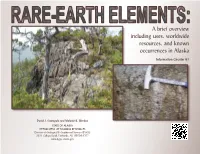
A brief overview including uses, worldwide resources, and known occurrences in Alaska Information Circular 61 David J. Szumigala and Melanie B. Werdon STATE OF ALASKA DEPARTMENT OF NATURAL RESOURCES Division of Geological & Geophysical Surveys (DGGS) 3354 College Road, Fairbanks, AK 99709-3707 www.dggs.alaska.gov COVER PHOTO CAPTIONS: TOP: Sheeted REE-bearing veins, Dotson Trend, Bokan Mountain property, Alaska. Photo from http://www.ucoreraremetals.com/docs/SME_2010_Keyser.pdf BOTTOM: Rare-earth-element-bearing quartz vein exposed in granite, Bokan Mountain, Alaska. Photo from http://www.ucoreraremetals.com/docs/SME_2010_Keyser.pdf RARE-EARTH ELEMENTS: A brief overview including uses, worldwide resources, and known occurrences in Alaska David J. Szumigala and Melanie B. Werdon GGS Minerals Program The Alaska Division of Geological & Geophysical Surveys (DGGS), part of the Department of Natural Resources, is charged by statute with determining the potential of Alaska’s land for production of metals, minerals, fuels, and geothermal resources; the locations and supplies of groundwater and construction Dmaterial; and the potential geologic hazards to buildings, roads, bridges, and other installations and structures. The Mineral Resources Section at DGGS collects, analyzes, and provides information on the geological and geophysical framework of Alaska as it pertains to the state’s mineral resources. The results of these studies include reports and maps, which are used by scientists for various associated studies, by mining company geologists as a basis for their more focused exploration programs, and by state and federal agency personnel in resource and land-use management decisions. This paper provides a brief overview of rare-earth elements, their uses, and current worldwide sources of their production. -

The Importance of Thorium to China
Fuel for Thought: The Importance of Thorium to China by Cindy Hurst February 2015 Institute for the Analysis of Global Security (IAGS) The Institute for the Analysis of Global Security is a Washington based non-profit think tank dedicated to research and public debate on issues related to energy security. IAGS seeks to promote public awareness to the strong impact energy has on the world economy and security and to the myriad of technological and policy solutions that could help nations strengthen their energy security. WWW.IAGS.ORG Cindy Hurst is a government contractor working as an analyst for the U.S. Army's Foreign Military Studies Office, Fort Leavenworth, KS. The views expressed in this report are those of the author and do not necessarily represent the official policy or position of the Department of the Army, Department of Defense, or the U.S. Government. Introduction Over the past few years China has launched efforts to develop the world’s first commercial thorium-fueled reactor based on the use of liquid salt. At one point thorium was widely used in gas mantles. It has also been used in night flares from the Milan weapon system and in magnesium alloy aircraft components, optical lenses, refractory ceramics, and some laboratory compounds. As a magnesium alloy, a small quantity of thorium can be used for its hardening and lightweight properties, making it ideal for the aerospace industry.1 One problem with thorium is its mildly radioactive nature, producing concerns over its safety and potential harmful effects. Therefore, today there is little use for thorium. -
THE MAJOR RARE-EARTH-ELEMENT DEPOSITS of AUSTRALIA: GEOLOGICAL SETTING, EXPLORATION, and RESOURCES Figure 1.1
CHAPTER ONE WHAT ARE RARE- EARTH ELEMENTS? 1.1. INTRODUCTION latter two elements are classified as REE because of their similar physical and chemical properties to the The rare-earth elements (REE) are a group of seventeen lanthanides, and they are commonly associated with speciality metals that form the largest chemically these elements in many ore deposits. Chemically, coherent group in the Periodic Table of the Elements1 yttrium resembles the lanthanide metals more closely (Haxel et al., 2005). The lanthanide series of inner- than its neighbor in the periodic table, scandium, and transition metals with atomic numbers ranging from if its physical properties were plotted against atomic 57 to 71 is located on the second bottom row of the number then it would have an apparent number periodic table (Fig. 1.1). The lanthanide series of of 64.5 to 67.5, placing it between the lanthanides elements are often displayed in an expanded field at gadolinium and erbium. Some investigators who want the base of the table directly above the actinide series to emphasise the lanthanide connection of the REE of elements. In order of increasing atomic number the group, use the prefix ‘lanthanide’ (e.g., lanthanide REE: REE are: lanthanum (La), cerium (Ce), praseodymium see Chapter 2). In some classifications, the second element of the actinide series, thorium (Th: Mernagh (Pr), neodymium (Nd), promethium (Pm), samarium 1 (Sm), europium (Eu), gadolinium (Gd), terbium (Tb), and Miezitis, 2008), is also included in the REE dysprosium (Dy), holmium (Ho), erbium (Er), thulium group, while promethium (Pm), which is a radioactive (Tm), ytterbium (Yb), and lutetium (Lu). -
Towards the Recovery of Rare Earth Elements from End-Of-Life Products: Hydrometallurgical Routes and Mathematical Modelling of Extraction Systems
Chemical Engineering Department PhD Program: Chemical Processes Engineering TOWARDS THE RECOVERY OF RARE EARTH ELEMENTS FROM END-OF-LIFE PRODUCTS: HYDROMETALLURGICAL ROUTES AND MATHEMATICAL MODELLING OF EXTRACTION SYSTEMS Author: Eleonora Obón Estrada Director: Dr. Ana Maria Sastre Requena Codiretor: Dr. Agustín Fortuny Sanromà Escola Tècnica Superior d’Enginyeria Industrial de Barcelona (ETSEIB) Universitat Politècnica de Catalunya, Barcelona, July 2019 Thesis presented to obtain the qualification of Doctor awarded by the Universitat Politècnica de Catalunya II Abstract The rare earth elements (REEs) are essential ingredients for the development of modern industry and the transition to a more sustainable economy model. The unique physicochemical features of these elements, such as their magnetism and optical properties, are greatly expanding their application. They have become key elements for the manufacture of many ordinary consumer goods like hybrid cars, fluorescent lamps or electronic devices like mobile phones or tablets. The growing popularity of the rare earth elements derivatives is leading to an increase in the global demand and the price of these elements. Unfortunately, the current availability of these resources is limited due to three main factors: their heterogeneous geological location, their low concentration in the ores, and the environmental issues related with their mining. All these disadvantages concerning the supply of the rare earth elements have led to the study of new techniques to obtain them, such as the recycling of end- of-life products. Recycling of REEs arises as a new secondary source of supply of REEs, especially in Europe where large amounts of technological waste are generated every year. Currently, the recycling of rare earth elements represents less than 1% of the global supply.