FAM Newsletter – April 2021
Total Page:16
File Type:pdf, Size:1020Kb
Load more
Recommended publications
-

Michael J. Allen North Carolina State University Department of History Box 8108 Raleigh, NC 27695-8108 919.767.1172 Michaelallen@Ncsu.Edu
Michael J. Allen North Carolina State University Department of History Box 8108 Raleigh, NC 27695-8108 919.767.1172 michaelallen@ncsu.edu 1. EMPLOYMENT_________________________________________________ NORTH CAROLINA STATE UNIVERSITY, Raleigh, NC (2003-present) Assistant Professor of U.S. history 2. EDUCATION ______________________________________________ NORTHWESTERN UNIVERSITY, Evanston, IL (1997-2003) Degrees: Ph.D., December 2003; M.A., December 1998 Dissertation: “The War’s Not Over Until the Last Man Comes Home”: Body Recovery And The Vietnam War Dissertation Committee: Michael Sherry (chair), Nancy MacLean, Laura Hein Major Field: U.S. History Minor Field: U.S.-East Asian Relations in the Cold War Master’s Thesis: “Seeketh That Which is Gone Astray”: Finding the Meaning of Prisoner of War Defection Following the Korean War THE UNIVERSITY OF CHICAGO, Chicago, IL (1992-96) Degree: A.B. with honors, June 1996 Concentration: History Honors Thesis: From Normal to Neurotic: Psychoneurotic World War II Veterans and the Roots of Postwar Anxiety Thesis Adviser: George Chauncey 3. HONORS, FELLOWSHIPS AND AWARDS__________________________ PROFESSIONAL CHASS Scholarly Project Award, North Carolina State University (2006) Pride of the Wolfpack Award, North Carolina State University (2004) CHASS Summer Research Grant, North Carolina State University (2004) GRADUATE Dissertation Year Fellowship, Northwestern University (2002-03) Kaplan Center for the Humanities Graduate Teaching Fellow, Northwestern University (2001-02) The Dirksen Congressional Center Research Award (2001) Gerald R. Ford Foundation Research Grant (2000) Graduate Research Grant, Northwestern University (2000) University Fellow, Northwestern University (1997-98) UNDERGRADUATE General Honors in The College, The University of Chicago (1996) Honors in the History Concentration, The University of Chicago (1996) Dean’s List, The University of Chicago (1993-96) Ph.D. -

The Foreign Service Journal, January 2000
DEBT JUBII.EE? ■ BREAKINC WITH THE 20TH CENTURY ■ KISSINGER AND ANGOLA WRESTLEMANIA 2000 Does Foreign Policy Matter in This Campaign? The right vehicle ready for delivery to developing countries At Bukkehave, we always have over 600 automobiles and trucks as well as 800 motorcycles in stock. All makes and models are richly represented: DaimlerChrysler, Ford, Mitsubishi, Toyota, Nissan, Yamaha, Isuzu with right-hand or left- hand drive. We also stock generators and outboard motors. Check out our current inventory at www.bukkehave.com. Our services start with advice at the purchasing stage and include efficient transportation solutions. If you are stationed abroad, we can assist you in finding the right vehicle. Choose from Call us and let us help you find a solution that goes over 600 vehicles the distance - even in in stock terrain where reality is a little tougher than you are accustomed to. Bukkehave Inc. 1800 Eller Drive )>h- P.O. Box 13143, Port Everglades 'IVV< Fort Lauderdale, FL 33316 I USA. Tel. I 800 815 3370 Tel. +1 954 525 9788 Fax +1 954 525 9785 usa@bukkehave.com www.bukkehave.com CLEMENTS & COMPANY Insumncc Worldwide. 1660 L Street, NW, 9th Floor, Washington, DC 20036 TELEPHONE 202-872-0060 or 800-872-0067 FACSIMILE 202-466-9064 E-MAIL info@dements.com WEBSITE wwW.clements.com Attention: U.S. Foreign Service Officers and Specialists Coming To Town For Training? Alexandria Suites Hotel Convenient to: NFATC (5 miles) Washington, D.C. (8 miles) Room & Ride Program: Studio Suite and Intermediate Size Car ® Comfortable within your Per Diem ® Enjoyable ® Affordable Participant in FARA Plus: Housing Program ® Full size, fully equipped kitchens ® Complimentary deluxe breakfast # Free shuttle Van Dorn Metro, NFATC ® On site fitness center ® Pets accepted 420 North Van Dorn Street Alexandria, VA 22304 Phone: (703) 370-1000 Fax: (703) 751-1467 Reservations 1-800-368-3339 www.alexandriasuites.com CONTENTS January 2000 I Vol. -
MKA Club Brochure PDF Version.Pub
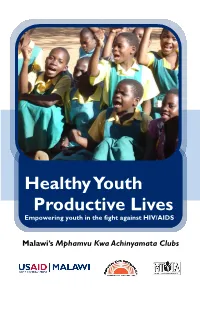
Healthy Youth Productive Lives Empowering youth in the fight against HIV/AIDS Malawi’s Mphamvu Kwa Achinyamata Clubs Youth: A Powerful Resource In 2006, the USAID-funded Malawi Teacher Training Activity (MTTA) created the Mphamvu Kwa Achinyamata (MKA) or “Power to the Youth” clubs, to support USAID efforts at promoting school-based HIV and AIDS prevention education in Malawi. This brochure highlights key aspects of the initiative, and profiles just a few of the many successful club activities underway throughout Malawi. The MKA school-based youth development clubs are built on the history of Malawi’s Edzi-Toto Clubs but provide dynamic invigoration of a school/community extra curricular format (clubs) to prevent and mitigate HIV and AIDS among people of all ages, particularly the youth. Clubs are mandated in their by-laws to include out-of-school youth, orphans and children with HIV and AIDS, stimulating community wide dialogue about youth development and HIV. Teacher, youth and community member training and empowerment for the clubs includes training in club formation, leadership skills and how to elect officers, facilitating club meetings and managing club activities, HIV and AIDS prevention, care and support for orphans and vulnerable children (OVC) and others affected by AIDS. Club members have also received training in intergenerational dialogue techniques, advocacy and lobbying as well as in coordinating and collaborating with other implementing partners operating within their localities. All club activities and projects are selected, -

Government & Politics Corr
1 CONCEPTUAL AND CONTEXTUAL BACKGROUND Augustine Titani Magolowondo INTRODUCTION This book is about Government and politics in Malawi. The diversity of issues that are discussed in the subsequent chapters bears testimony to the complexity of this subject matter. The aim of this first chapter is twofold. First, as you may have probably experienced in our daily discourse, the terms Government and politics are often confused with other key terms such as state and nation. As a starting point, this chapter clarifies these related concepts, which are inherently connected but yet conceptually distinct. Second, the discussion in this chapter aims at providing the context within which politics and Government in Malawi operate. In this regard, I look at both the political history and key socio-economic characteristics of Malawi. Finally, I discuss challenges facing Malawi’s politics and Government today. WHAT IS POLITICS? The concept of politics is as old as Government itself. Aristotle, the Greek philosopher (384–322 BC) argued that ‘man is by nature a political animal’. What was meant is that politics is not only inevitable but also essential to human activity. In other words, wherever there are human beings, politics is unavoidable. However, much as Aristotle’s maxim has become almost indisputable among the students of politics, there is no consensus on what exactly is to be understood by politics. To appreciate the conceptual complexity of politics, let us consider for instance the 2000 constitutional amendment to Section 65 of the Malawi Constitution (popularly called the ‘crossing of the floor’ provision). This amendment was to result in any member of Parliament (MP) losing his/her seat should he/she join 1 GOVERNMENT AND POLITICS IN MALAWI any organisation whose objectives were deemed to be political in nature. -
Independent Evaluation of the ILO's Strategy to Address HIV and AIDS and the World of Work /Carla Henry, Mei Zegers; International Labour Office, Evaluation Unit
Independent evaluation of the ILO’s strategy to address HIV and AIDS and the world of work For more information: International Labour Offi ce (ILO) Tel.: (+ 41 22) 799 6440 Evaluation Unit (EVAL) Fax: (+41 22) 799 6219 OCTOBER 2011 4, route des Morillons E-mail: eval@ilo.org CH-1211 Geneva 22 http://www.ilo.org/evaluation Switzerland EVALUATION UNIT Independent evaluation of the ILO’s strategy to address HIV and AIDS and the world of work International Labour Office September 2011 Copyright © International Labour Organization 2011 First published 2011 Publications of the International Labour Office enjoy copyright under Protocol 2 of the Universal Copyright Convention. Nevertheless, short excerpts from them may be reproduced without authorization, on condition that the source is indicated. For rights of reproduction or translation, application should be made to ILO Publications (Rights and Permissions), International Labour Office, CH-1211 Geneva 22, Switzerland, or by email: pubdroit@ilo.org. The International Labour Office welcomes such applications. Libraries, institutions and other users registered with reproduction rights organizations may make copies in accordance with the licences issued to them for this purpose. Visit www.ifrro.org to find the reproduction rights organization in your country. Henry, Carla; Zegers, Mei Independent evaluation of the ILO's strategy to address HIV and AIDS and the world of work /Carla Henry, Mei Zegers; International Labour Office, Evaluation Unit. - Geneva: ILO, 2011 1 v. ISBN print: 978-92-2-125422-5 -

Losing an Empire, Losing a Role?: the Commonwealth Vision, British Identity, and African Decolonization, 1959-1963
LOSING AN EMPIRE, LOSING A ROLE?: THE COMMONWEALTH VISION, BRITISH IDENTITY, AND AFRICAN DECOLONIZATION, 1959-1963 By Emily Lowrance-Floyd Submitted to the graduate degree program in History and the Graduate Faculty of the University of Kansas in partial fulfillment of the requirements for the degree of Doctor of Philosophy. Chairperson Dr. Victor Bailey . Dr. Katherine Clark . Dr. Dorice Williams Elliott . Dr. Elizabeth MacGonagle . Dr. Leslie Tuttle Date Defended: April 6, 2012 ii The Dissertation Committee for Emily Lowrance-Floyd certifies that this is the approved version of the following dissertation: LOSING AN EMPIRE, LOSING A ROLE?: THE COMMONWEALTH VISION, BRITISH IDENTITY, AND AFRICAN DECOLONIZATION, 1959-1963 . Chairperson Dr. Victor Bailey Date approved: April 6, 2012 iii ABSTRACT Many observers of British national identity assume that decolonization presaged a crisis in the meaning of Britishness. The rise of the new imperial history, which contends Empire was central to Britishness, has only strengthened faith in this assumption, yet few historians have explored the actual connections between end of empire and British national identity. This project examines just this assumption by studying the final moments of decolonization in Africa between 1959 and 1963. Debates in the popular political culture and media demonstrate the extent to which British identity and meanings of Britishness on the world stage intertwined with the process of decolonization. A discursive tradition characterized as the “Whiggish vision,” in the words of historian Wm. Roger Louis, emerged most pronounced in this era. This vision, developed over the centuries of Britain imagining its Empire, posited that the British Empire was a benign, liberalizing force in the world and forecasted a teleology in which Empire would peacefully transform into a free, associative Commonwealth of Nations. -
1. Introduction 1. Malawi: a Multi-Ethnic Nation
From: Dr. Willie Zeze RE: Abstract Submission – 2015 Religious Freedom and Religious Pluralism in Africa: Prospects and Limitations Conference DEMOCRATIC CONSTITUTION AND ETHNIC ORGANIZATIONS IN MALAWI - PRESERVING GOOD TRADITIONAL PRACTICES OR PROMOTING NEPOTISM AND TRIBALISM? Abstract Due to the advent of the 1994 democratic constitution particularly its enactment on Protection of human rights and freedoms: Culture and language, Freedom of association, Religion and beliefs, Freedom of assembly and Political rights, Malawi has witnessed mushrooming of tribal organizations, aiming at preserving the traditional African religious beliefs and African cultural traditions. The Chewa Heritage Foundation (Chefo) and the Muhlakho wa Alhomwe (MWA) among the Chewa and Lhomwe tribes respectively are among well-known ethnic organizations through which the traditional beliefs, cultural traditions and religions are enjoying a significant respect from members of mentioned-tribes. The democratic constitution has cleared a road for the establishment of these ethnic organizations. However, it seems activities of Chefo and MWA are inter alia promoting tribalism and nepotism, in addition to being used as campaign tools for some political parties. This article intends to assess and evaluate the role and the impact of the Chefo and MWA on preservation of good cultural practices and constitutional democracy in Malawi. The hypothesis is, in spite of preserving cultural practices as guaranteed in constitution, the tribal organizations need to be watchful so that they should not promote tribalism, nepotism and being used as campaign tools by Malawian politicians. 1. Introduction In order to appreciate how in their understanding the Democratic Constitution the Chewa Heritage Foundation and Mulhako wa Alhomwe in Malawi, revitalize, preserved and protect customs, values, beliefs and traditional practices it is necessary to understand a social- political history of Malawi. -
Malawi Systematic Country Diagnostic: Breaking the Cycle of Low Growth and Poverty Reduction
Report No. 132785 Public Disclosure Authorized Malawi Systematic Country Diagnostic: Breaking the Cycle of Low Growth and Slow Poverty Reduction December 2018 Public Disclosure Authorized Public Disclosure Authorized Malawi Country Team Africa Region Public Disclosure Authorized i ABBREVIATION AND ACRONYMS ADMARC Agricultural Development and Marketing Corporation ANS Adjusted Net Savings APES Agricultural Production Estimates System BVIS Bwanje Valley Irrigation Scheme CDSSs Community Day Secondary Schools CBCCs community-based child care centers CPI Comparability of Consumer Price Index CCT Conditional cash transfers CEM Country Economic Memorandum DRM Disaster Risk Management ECD Early Childhood Development EASSy East Africa Submarine System IFPRI Food Policy Research Institute FPE Free Primary Education GPI Gender parity indexes GEI Global Entrepreneurship Index GDP Gross Domestic Product GER Gross enrollment rate GNI Gross national income IPPs Independent Power Producers IFMIS Integrated Financial Management Information System IHPS Integrated Household Panel Survey IHS Integrated Household Survey IRR internal rate of return IMP Investment Plan ECD Mainstream Early Childhood Development MACRA Malawi Communications Regulatory Authority MHRC Malawi Human Rights Commission SCTP Malawi’s Social Cash Transfer Program GNS Malawi's gross national savings MOAIWD Ministry of Agriculture, Irrigation and Water Development MPC Monetary Policy Committee MICS Multiple Indicator Cluster Survey NDRM National Disaster Risk Management NES National Export -
Bibliography
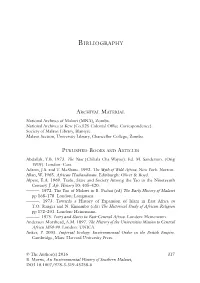
BIBLIOGRapHY ARCHIVaL MaTERIaL National Archives of Malawi (MNA), Zomba. National Archives at Kew (Co.525 Colonial Office Correspondence). Society of Malawi Library, Blantyre. Malawi Section, University Library, Chancellor College, Zomba. PUBLISHED BOOKS aND ARTICLES Abdallah, Y.B. 1973. The Yaos (Chikala Cha Wayao). Ed. M. Sanderson. (Orig 1919). London: Cass. Adams, J.S. and T. McShane. 1992. The Myth of Wild Africa. New York: Norton. Allan, W. 1965. African Husbandman. Edinburgh: Oliver & Boyd. Alpers, E.A. 1969. Trade, State and Society Among the Yao in the Nineteenth Century J. Afr. History 10: 405–420. ———. 1972. The Yao of Malawi in B. Pachai (ed) The Early History of Malawi pp 168–178. London: Longmans. ———. 1973. Towards a History of Expansion of Islam in East Africa in T.O. Ranger and N. Kimambo (eds) The Historical Study of African Religion pp 172–201. London: Heinemann. ———. 1975. Ivory and Slaves in East-Central Africa. London: Heinemann. Anderson-Morshead, A.M. 1897. The History of the Universities Mission to Central Africa 1859-96. London: UNICA. Anker, P. 2001. Imperial Ecology: Environmental Order in the British Empire. Cambridge, Mass: Harvard University Press. © The Author(s) 2016 317 B. Morris, An Environmental History of Southern Malawi, DOI 10.1007/978-3-319-45258-6 318 BiblioGraphy Ansell, W.F.H. and R.J. Dowsett. 1988. Mammals of Malawi: An Annoted Checklist and Atlas. St Ives: Trendrine Press. Antill, R.M. 1945. A History of Native Grown Tobacco Industry in Nyasaland Nyasaland Agric. Quart. J. 8: 49–65. Baker, C.A. 1961. A Note on Nguru Immigration to Nyasaland Nyasaland J. -

Evaluation of Knowledge and Attitudes on Doping by Football Athletes, Coaches and Sponsors in Malawi
EVALUATION OF KNOWLEDGE AND ATTITUDES ON DOPING BY FOOTBALL ATHLETES, COACHES AND SPONSORS IN MALAWI JOHN MPONDOVA CHILIMA KAOCHE (B. ED) H108F/29581/2014 A THESIS SUBMITTED IN PARTIAL FULFILLMENT OF THE REQUIREMENTS FOR THE AWARD OF DEGREE OF MASTER OF SCIENCE (RECREATION AND SPORTS MANAGEMENT) IN THE SCHOOL OF HOSPITALITY, TOURISM AND LEISURE STUDIES OF KENYATTA UNIVERSITY JULY, 2019 ii DECLARATION This thesis is my original work and has not been presented for a degree in any other University or for any other award. Signature ___________________________ Date ______________________________ John Mpondova Chilima Kaoche (H108F/29581/2014) SUPERVISORS We confirm that the work reputed in this thesis was carried out by this candidate under our supervision. Signature: _________________________Date: _________________________ Prof. Elijah Gitonga Rintaugu Department of Recreation Management and Sports Science Kenyatta University Signature: _________________________Date: _________________________ Dr. Janet Wanjira Kamenju Department of Physical Education and Sports University of Nairobi iii DEDICATION I dedicate this work to my late grandfather, Mr. Presvo Swizan Kaoche, for being my academic push. To my beloved children, this work must be a reminder on the need to work hard in life regardless of situations and age. iv ACKNOWLEDGEMENT I would like to acknowledge and extend my humble appreciation to my supervisors, Professor Elija Gitonga Rintaugu and Dr. Janet Wanjira Kamenju, for their tireless guidance, encouragement and support throughout the undertaking of this study. My sincere thanks also go to Mr. Joseph Mwandidya, the Secretary for Ministry of Labour, Youth, Sports and Manpower Development, for facilitating the data collection exercise for the study in Malawi. I would further like to express my sincere gratitude to the Football Association of Malawi and Mr. -

Academic Freedom and Human Rights Abuses in Africa
ACADEMIC FREEDOM AND HUMAN RIGHTS ABUSES IN AFRICA An Africa Watch Report March 1991 ACADEMIC FREEDOM AND HUMAN RIGHTS ABUSES IN AFRICA An Africa Watch Report March 1991 485 Fifth Avenue 1522 K Street, NW Third Floor Suite 910 New York, NY 10017 Washington, DC 20005 (212) 972-8400 (202) 371-6592 90 Borough High Street London SEI ILL United Kingdom (071) 378-8008 Copyright 8 March 1991 by Human Rights Watch All Rights Reserved. Printed in the United States of America ISBN 0-929692-77-2 Library of Congress Catalog Card Number: 90-86085 Cover Design by: AFRICA WATCH Africa Watch was established in May 1988 to monitor and promote respect for internationally recognized human rights in Africa. The Chairman of Africa Watch is William Carmichael. The Executive Director is Rakiya Omaar; Richard Carver is the Research Director; Alex de Waal is Research Consultant; Janet Fleischman and Karen Sorensen are Research Associates; Richard Dicker is an Orville Schell Fellow; and Jo Graham and Ben Penglase are Associates. Africa Watch is part of Human Rights Watch. HUMAN RIGHTS WATCH Human Rights Watch is composed of five Watch Committees: Africa Watch, Americas Watch, Asia Watch, Helsinki Watch and Middle East Watch. Executive Committee: Chairman, Robert L. Bernstein; Vice Chairman, Adrian DeWind; Members: Roland Algrant, Lisa Anderson, Peter Bell, William Carmichael, Dorothy Cullman, Jonathan Fanton, Jack Greenberg, Alice H. Henkin, Stephen Kass, Marina Kaufman, Jeri Laber, Aryeh Neier, Bruce Rabb, Kenneth Roth, Orville Schell, Sophie S. Silverberg, Gary Sick, Nadine Strossen. Staff: Executive Director, Aryeh Neier; Deputy Director, Kenneth Roth; Washington Director, Holly J. -

Archiv Der Playfootballmalawi-Newsmeldungen Vom 25.03.2013 Bis 06.03.2014 Chronologisch Aufsteigend Deutsch / Englisch
Archiv der Playfootballmalawi-Newsmeldungen vom 25.03.2013 bis 06.03.2014 chronologisch aufsteigend Deutsch / Englisch --------------------- Archive of PlayFootballMalawi-News from 25/03/2013 to 03/06/2014 chronologically ascending German / English Play Football Malawi hebt ab Am 28. März erlebt Play Football Malawi den körperlichen Take-off. Von Mailand aus hebt unsere Maschine in Richtung Lilongwe ab, wo wir während drei Wochen die Entwicklung unseres Projekts vorantreiben. Die bisherigen Besuche in Malawi haben uns erste Eindrücke über das Land und die Bedürfnisse der Menschen gegeben. Beim anstehenden Aufenthalt möchten wir die Phase der Konkretisierung betreten. Im Vordergrund steht die Besichtigung von Grundstücken, auf denen unsere Fussballakademie gebaut werden kann. Ebenfalls werden wir mit den malawischen Behörden unsere Positionierung als Non-Profit-Organisation registrieren. Ebenso wichtig sind Treffen mit Mitarbeitern und zukünftigen Partnern. Der Take-off erfolgt in Mailand. Die Reise führt uns über Rom, Addis Abeba (Äthiopien) und Blantyre (Malawi) nach Lilongwe. Lilongwe ist die Hauptstadt von Malawi. Die Stadt hat rund 700’00 Einwohner und liegt auf einer Hochebene am Lilongwe-Fluss (1200 Meter über dem Meeresspiegel). In Lilongwe wird die Fussballakademie von Play Football Malawi gebaut. Wir freuen uns, unseren Gönnern und Freunden schon bald über unsere Erlebnisse und Fortschritte in Malawi berichten zu dürfen 25.03.2013, Play Football Malawi Ankunft in Malawi Nach einer 24-Stunden-Reise sind wir gut in Malawi angekommen. Nun werden wichtige Gespräche mit lokalen Organisationen und Behörden geführt. Das Erledigen organisatorischer Aufgaben erfordert in Malawi viel Zeit und Geduld. Trotzdem konnten wir seit unserer Ankunft am Karfreitag erste Schritte tätigen.