Wholesale Catalog 2018 Northwest Native Plants Dear Friends & Colleagues
Total Page:16
File Type:pdf, Size:1020Kb
Load more
Recommended publications
-

Liliaceae S.L. (Lily Family)
Liliaceae s.l. (Lily family) Photo: Ben Legler Photo: Hannah Marx Photo: Hannah Marx Lilium columbianum Xerophyllum tenax Trillium ovatum Liliaceae s.l. (Lily family) Photo: Yaowu Yuan Fritillaria lanceolata Ref.1 Textbook DVD KRR&DLN Erythronium americanum Allium vineale Liliaceae s.l. (Lily family) Herbs; Ref.2 Stems often modified as underground rhizomes, corms, or bulbs; Flowers actinomorphic; 3 sepals and 3 petals or 6 tepals, 6 stamens, 3 carpels, ovary superior (or inferior). Tulipa gesneriana Liliaceae s.l. (Lily family) “Liliaceae” s.l. (sensu lato: “in the broad sense”) - Lily family; 288 genera/4950 species, including Lilium, Allium, Trillium, Tulipa; This family is treated in a very broad sense in this class, as in the Flora of the Pacific Northwest. The “Liliaceae” s.l. taught in this class is not monophyletic. It is apparent now that the family should be treated in a narrower sense and some of the members should form their own families. Judd et al. recognize 15+ families: Agavaceae, Alliaceae, Amarylidaceae, Asparagaceae, Asphodelaceae, Colchicaceae, Dracaenaceae (Nolinaceae), Hyacinthaceae, Liliaceae, Melanthiaceae, Ruscaceae, Smilacaceae, Themidaceae, Trilliaceae, Uvulariaceae and more!!! (see web reading “Consider the Lilies”) Iridaceae (Iris family) Photo: Hannah Marx Photo: Hannah Marx Iris pseudacorus Iridaceae (Iris family) Photo: Yaowu Yuan Photo: Yaowu Yuan Sisyrinchium douglasii Sisyrinchium sp. Iridaceae (Iris family) Iridaceae - 78 genera/1750 species, Including Iris, Gladiolus, Sisyrinchium. Herbs, aquatic or terrestrial; Underground stems as rhizomes, bulbs, or corms; Leaves alternate, 2-ranked and equitant Ref.3 (oriented edgewise to the stem; Gladiolus italicus Flowers actinomorphic or zygomorphic; 3 sepals and 3 petals or 6 tepals; Stamens 3; Ovary of 3 fused carpels, inferior. -
Plants for Pollinators Calendar & Practices to Support Pollinators
PLANTS FOR POLLINATORS CALENDAR & PRACTICES TO SUPPORT POLLINATORS Jacqueline Cramer, Design Collaborators and Kimberly Leeper, Mariposa Naturescapes GREEN GARDENING WORKSHOP – Oct. 22, 2014 Increase Foraging Habitat – Succession of Flowers through Entire Growing Season – Plant in Clumps/Natural Drifts of Same Species and in Plant Corridors (Hedgerows) Choose nectar and pollen‐rich plants like native wildflowers and old‐fashioned (non‐native) varieties of perennial flowers that are NOT invasive. A corridor of pollinator gardens in neighborhoods, cities, and rural areas around the country could provide enough habitat to restore healthy communities of beneficial insects and pollinators. PLANTS FOR POLLINATORS CALENDAR Be aware that this plant list is a sampling of possible native and non‐native plants available for pollinators. Criteria for selection on this list: well‐behaved; less “messy” than some; easy to find; drought‐tolerant (“right plant, right plant”); multi‐functional (two functions+); and focus on being good for variety of bees. *Bloom times are approximate and will depend upon the weather that season as well as microclimates/site conditions; Observe bloom times of different species you’ve planted and tweak it so you have multiple species blooming over the growing season (Feb. – Oct.). You can find non‐native “versions” of some native plants listed. WINTER – January – February* ‐‐Cornelian Cherry – Cornus mas ‐‐Hardy Cyclamen (or Persian Violet) ‐‐ Cyclamen coum ‐‐BULBS – Narcissus (early varieties), Daffodil, and Crocus ‐‐Hellebore -
Subalpine Meadows of Mount Rainier • an Elevational Zone Just Below Timberline but Above the Reach of More Or Less Continuous Tree Or Shrub Cover
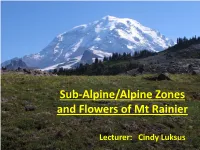
Sub-Alpine/Alpine Zones and Flowers of Mt Rainier Lecturer: Cindy Luksus What We Are Going To Cover • Climate, Forest and Plant Communities of Mt Rainier • Common Flowers, Shrubs and Trees in Sub- Alpine and Alpine Zones by Family 1) Figwort Family 2) Saxifrage Family 3) Rose Family 4) Heath Family 5) Special mentions • Suggested Readings and Concluding Statements Climate of Mt Rainier • The location of the Park is on the west side of the Cascade Divide, but because it is so massive it produces its own rain shadow. • Most moisture is dropped on the south and west sides, while the northeast side can be comparatively dry. • Special microclimates result from unique interactions of landforms and weather patterns. • Knowing the amount of snow/rainfall and how the unique microclimates affect the vegetation will give you an idea of what will thrive in the area you visit. Forest and Plant Communities of Mt Rainier • The zones show regular patterns that result in “associations” of certain shrubs and herbs relating to the dominant, climax tree species. • The nature of the understory vegetation is largely determined by the amount of moisture available and the microclimates that exist. Forest Zones of Mt Rainier • Western Hemlock Zone – below 3,000 ft • Silver Fir Zone – between 2,500 and 4,700 ft • Mountain Hemlock Zone – above 4,000 ft Since most of the field trips will start above 4,000 ft we will only discuss plants found in the Mountain Hemlock Zone and above. This zone includes the Sub-Alpine and Alpine Plant communities. Forest and Plant Communities of Mt Rainier Subalpine Meadows of Mount Rainier • An elevational zone just below timberline but above the reach of more or less continuous tree or shrub cover. -

Dog Mountain
Dog Mt. Columbia River Gorge Skamania County, WA T3N R9E S 19, 20, 29, 30, 31, 32 Updated May 5, 2011 Flora Northwest- http://science.halleyhosting.com List compiled after numerous visits by Paul Slichter, from historical records and from NPSO and WNPS lists. Common Name Scientific Name Family Vine Maple Acer circinatum Aceraceae Big-leaf Maple Acer macrophyllum Aceraceae Poison Oak Toxicodendron diversiloba Anacardiaceae Sharp-tooth Angelica Angelica arguta Apiaceae Bur Chervil Anthriscus caucalis Apiaceae Wild Chervil ? Anthriscus sylvestris ? Apiaceae Queen Anne's Lace Daucus carota Apiaceae Cow Parsnip Heracleum maximum Apiaceae Gray's Lovage Ligusticum grayi Apiaceae Fernleaf Desert Parsley Lomatium dissectum v. dissectum Apiaceae Slender-fruited Desert Parsley? Lomatium leptocarpum ? Apiaceae Martindale's Desert Parsley Lomatium martindalei Apiaceae Bare-stem Desert Parsley Lomatium nudicaule Apiaceae Nine-leaf Desert Parsley Lomatium triternatum (v. anomalum ?) Apiaceae Nine-leaf Desert Parsley Lomatium triternatum v. triternatum Apiaceae Common Sweet Cicely Osmorhiza berteroi Apiaceae Mountain Sweet Cicely Osmorhiza occidentalis Apiaceae Sierra Snake Root Sanicula graveolens Apiaceae Flytrap Dogbane Apocynum androsaemifolium Apocynaceae Common Periwinkle Vinca minor Apocynaceae Devils Club Oploplanax horridum Araliaceae Wild Ginger Asarum caudatum Aristolochaceae Yarrow Achillea millefolium Asteraceae Pathfinder Adenocaulon bicolor Asteraceae Large-flowered Agoseris ? Agoseris grandiflora Asteraceae Annual Agoseris Agoseris heterophylla -

45Th Anniversary Year
VOLUME 45, NO. 1 Spring 2021 Journal of the Douglasia WASHINGTON NATIVE PLANT SOCIETY th To promote the appreciation and 45 conservation of Washington’s native plants Anniversary and their habitats through study, education, Year and advocacy. Spring 2021 • DOUGLASIA Douglasia VOLUME 45, NO. 1 SPRING 2021 journal of the washington native plant society WNPS Arthur R. Kruckberg Fellows* Clay Antieau Lou Messmer** President’s Message: William Barker** Joe Miller** Nelsa Buckingham** Margaret Miller** The View from Here Pamela Camp Mae Morey** Tom Corrigan** Brian O. Mulligan** by Keyna Bugner Melinda Denton** Ruth Peck Ownbey** Lee Ellis Sarah Reichard** Dear WNPS Members, Betty Jo Fitzgerald** Jim Riley** Mary Fries** Gary Smith For those that don’t Amy Jean Gilmartin** Ron Taylor** know me I would like Al Hanners** Richard Tinsley Lynn Hendrix** Ann Weinmann to introduce myself. I Karen Hinman** Fred Weinmann grew up in a small town Marie Hitchman * The WNPS Arthur R. Kruckeberg Fellow Catherine Hovanic in eastern Kansas where is the highest honor given to a member most of my time was Art Kermoade** by our society. This title is given to Don Knoke** those who have made outstanding spent outside explor- Terri Knoke** contributions to the understanding and/ ing tall grass prairie and Arthur R. Kruckeberg** or preservation of Washington’s flora, or woodlands. While I Mike Marsh to the success of WNPS. Joy Mastrogiuseppe ** Deceased love the Midwest, I was ready to venture west Douglasia Staff WNPS Staff for college. I earned Business Manager a Bachelor of Science Acting Editor Walter Fertig Denise Mahnke degree in Wildlife Biol- douglasia_editor@wnps.org 206-527-3319 wnps@wnps.org ogy from Colorado State Layout Editor University, where I really Mark Turner Office and Volunteer Coordinator douglasia_layout@wnps.org Elizabeth Gage got interested in native info@wnps.org plants. -
Mutual Exclusion Between Salmonberry and Douglas-Fir in the Coast Range of Oregon
Portland State University PDXScholar Dissertations and Theses Dissertations and Theses 1972 Mutual exclusion between Salmonberry and Douglas-fir in the Coast Range of Oregon Kenneth Ray Still Portland State University Follow this and additional works at: https://pdxscholar.library.pdx.edu/open_access_etds Part of the Ecology and Evolutionary Biology Commons, Forest Biology Commons, and the Plant Biology Commons Let us know how access to this document benefits ou.y Recommended Citation Still, Kenneth Ray, "Mutual exclusion between Salmonberry and Douglas-fir in the Coast Range of Oregon" (1972). Dissertations and Theses. Paper 963. https://doi.org/10.15760/etd.963 This Thesis is brought to you for free and open access. It has been accepted for inclusion in Dissertations and Theses by an authorized administrator of PDXScholar. Please contact us if we can make this document more accessible: pdxscholar@pdx.edu. I. fl r I'· AN ABSTRACT OF THE THESIS OF Kenneth Ray Still for the Master of Science presented June 12. 1972. Title: Mutual Exclusion between Salmonberry and Douglas-fir in the Coast Range of Oregon. APPROVED BY MEMBERS OF THE THESIS COMMITEE: Richard D. Tocher Clyde • Calvin . One serious problem faced by the forest industry in the Pacific Northwest is poor regeneration of commercial trees ~ land which is har vested and subsequently dominated by brush species. In Coastal Oregon, salmonberry is one of these brush species. Detailed investigations of field sites indicate that light i~tensity in the brush stands was low but sufficient for germination and early growth of Douglas-fir seedlings and soil moisture percentages and nutrient levels were high enough to support early Douglas-fir growth. -

Norsk Botanisk Forenings Tidsskrift Journal of the Norwegian Botanical Society
NORSK BOTANISK FORENINGS TIDSSKRIFT JOURNAL OF THE NORWEGIAN BOTANICAL SOCIETY ÅRGANG 77 BLYTTIA ISSN 0006-5269 1/2019 http://www.nhm.uio.no/botanisk/nbf/blyttia/ I DETTE NUMMER: BLYTTIANORSK BOTANISK Nytt år, ny vår, nytt Blyttia. Et forhåpentligvis vel- FORENINGS balansert blad har funnet veien til dine hender. Som TIDSSKRIFT vanlig har vi en blanding av nyheter fra Norsk Botanisk Forenings arbeid og aktiviteter, inspirerende små biter «skoleringsstoff» og fire klassiske artikler i «Norges Redaktør: Jan Wesenberg. I redaksjonen: Leif Galten, Botaniske Annaler». Hanne Hegre, Klaus Høiland, Mats G Nettelbladt, Kristin Vigander. Denne gangen markerer vi professor Rolf Y. Berg, Postadresse: Blyttia, Naturhistorisk museum, postboks som døde i fjor, med en in- 1172 Blindern, NO-0318 Oslo. teressant artikkel om Bergs Telefon: 90888683 (redaktøren). forskning i grenselandet sys- Faks: Bromus s.lat. spp. tematikk/spredningsbiologi/ E-mail: blyttia@nhm.uio.no. anatomi. Se artikkel av Inger Hjemmeside: http://www.nhm.uio.no/botanisk/nbf/blyttia/. Nordal m.fl. på s. 35. Blyttia er grunnlagt i 1943, og har sitt navn etter to sentrale norske botanikere på 1800-tallet, Mathias Numsen Blytt (1789–1862) og Axel Blytt (1843–1898). En gjennomgang av situa- © Norsk Botanisk Forening. ISSN 0006-5269. sjonen med fremmedarter Sats: Blyttia-redaksjonen. i kystkommeunen Selje får Trykk og ferdiggjøring: ETN Porsgrunn. vi av Ingvild Austad og Leif Utsending: GREP Grenland AS. Hauge på s. 49. Både proble- Ettertrykk fra Blyttia er tillatt såfremt kilde oppgis. Ved marter kjent over mye av lan- ettertrykk av enkeltbilder og tegninger må det innhentes det og relative nykomlinger, tillatelse fra fotograf/tegner på forhånd. -

OSU Gardening with Oregon Native Plants
GARDENING WITH OREGON NATIVE PLANTS WEST OF THE CASCADES EC 1577 • Reprinted March 2008 CONTENTS Benefi ts of growing native plants .......................................................................................................................1 Plant selection ....................................................................................................................................................2 Establishment and care ......................................................................................................................................3 Plant combinations ............................................................................................................................................5 Resources ............................................................................................................................................................5 Recommended native plants for home gardens in western Oregon .................................................................8 Trees ...........................................................................................................................................................9 Shrubs ......................................................................................................................................................12 Groundcovers ...........................................................................................................................................19 Herbaceous perennials and ferns ............................................................................................................21 -
Checklist of the Vascular Plants of Redwood National Park
Humboldt State University Digital Commons @ Humboldt State University Botanical Studies Open Educational Resources and Data 9-17-2018 Checklist of the Vascular Plants of Redwood National Park James P. Smith Jr Humboldt State University, james.smith@humboldt.edu Follow this and additional works at: https://digitalcommons.humboldt.edu/botany_jps Part of the Botany Commons Recommended Citation Smith, James P. Jr, "Checklist of the Vascular Plants of Redwood National Park" (2018). Botanical Studies. 85. https://digitalcommons.humboldt.edu/botany_jps/85 This Flora of Northwest California-Checklists of Local Sites is brought to you for free and open access by the Open Educational Resources and Data at Digital Commons @ Humboldt State University. It has been accepted for inclusion in Botanical Studies by an authorized administrator of Digital Commons @ Humboldt State University. For more information, please contact kyle.morgan@humboldt.edu. A CHECKLIST OF THE VASCULAR PLANTS OF THE REDWOOD NATIONAL & STATE PARKS James P. Smith, Jr. Professor Emeritus of Botany Department of Biological Sciences Humboldt State Univerity Arcata, California 14 September 2018 The Redwood National and State Parks are located in Del Norte and Humboldt counties in coastal northwestern California. The national park was F E R N S established in 1968. In 1994, a cooperative agreement with the California Department of Parks and Recreation added Del Norte Coast, Prairie Creek, Athyriaceae – Lady Fern Family and Jedediah Smith Redwoods state parks to form a single administrative Athyrium filix-femina var. cyclosporum • northwestern lady fern unit. Together they comprise about 133,000 acres (540 km2), including 37 miles of coast line. Almost half of the remaining old growth redwood forests Blechnaceae – Deer Fern Family are protected in these four parks. -

Jan. 1, 1974 M. OWNBEY Plant Pat. 3,419 DICENTRA PLANT Filed Aug
Jan. 1, 1974 M. OWNBEY Plant Pat. 3,419 DICENTRA PLANT Filed Aug. 23, 1971 Plant Pat. 3,419 United States Patent Office Patented Jan. 1, 1974 1. 2 PREFERRED CONDITIONS OF GROWTH DICENiRAPLANT3.419 The plant thrives best, both as to growth and flower Marion Ownbey, Pullman, Wash., assignor to The ing, in the full sun, but it tolerates medium to dense Wayside Gardens Company, Mentor, Ohio shade. The particular exposure is not critical, but a Well Filed Aug. 23, 1971, Ser. No. 174,066 5 drained, fertile, sand or sandy loam soil is preferred for Int, Cl, A01 h 5/00 best growth and bloom. U.S. C. Plt-68 1. Claim This application is directed to a new and distinct THE PARTS OF THE EXPOSED PLANT variety of Dicentra plant. The flower stalks are generally upright and curving, The present new variety was first developed by me in O and drooping at their ends. They are slightly branched. Pullman, Wash., and there asexually reproduced by me Generally they are adequate to support the foliage and by root division. blooms well. The color of both the old and new foliage is blue The new variety was developed by an intentional cross green, comparable to Chrysocolla green, RHS 56/3. It is pollination made by the transfer of pollen from the 5 . staminate parent Dicentra peregrina, a wild species from generally uniform both on the old and new growth. Japan, to the seed or pistillate parent Dicentra "Para The length of the flower stalks is from about fifteen mount,” U.S. -

Dicentra Formosa
Plant Propagation Protocol for [Dicentra formosa] ESRM 412 – Native Plant Production Spring 2015 Protocol URL: https://courses.washington.edu/esrm412/protocols/DIFO.pdf Adding information from: http://depts.washington.edu/propplnt/Plants/bleeding_heart.htm North America Distribution Washington State Distribution From the USDA Plants Database6 TAXONOMY Plant Family Scientific Name Fumariaceae Common Name Fumitory Species Scientific Name Scientific Name Dicentra formosa (Haw.) Walp. Varieties Dicentra formosa (Haw.) Walp. var. brevifolia L.F. Hend. Dicentra formosa (Haw.) Walp. var. brevipes L.F. Hend. Sub-species Dicentra formosa (Haw.) Walp. ssp. formosa Dicentra formosa (Haw.) Walp. ssp. oregona (Eastw.) Munz Dicentra formosa (Haw.) Walp. ssp. nevadensis (Eastw.) Munz Cultivar Common Synonym(s) Common Name(s) Bleeding heart, Pacific bleeding heart, Oregon bleeding heart, Sierra bleeding heart Species Code (as per DIFO6 USDA Plants database) GENERAL INFORMATION Geographical range Southern British Colombia to Central California, mid-elevation Cascades and below7; See maps above for North American and Washington State distribution6. Ecological distribution Moist woody to dry open areas, shade preferred7. Climate and elevation Low-middle elevations, mild climate7. range Local habitat and Pseduotsuga menziesii, Tusga heterophylla; typically found in abundance coniferous forests11. Plant strategy type / Late successional plant7. successional stage Plant characteristics Perennial forb growing from a rhizome, pink-purple heart-shaped flowers on leafless stems12. Leaves are divided and fern-like4. PROPAGATION DETAILS Ecotype Propagation Goal Plants Propagation Method Seed5 Product Type Seeds and containers Stock Type Seeds or container plants Propagation Method Vegetative5 Product Type Bareroot and cuttings Stock Type Bareroot Propagule Collection After parent plant has finished blooming and is preparing for Instructions winter, collect seeds for storage; plant seeds in late fall. -

Salal Chapter Spring 2021 Plant List
Salal Chapter Spring 2021 Plant Sale Online sales start April 16 Species Name Common Name Category on website Price Acer circinatum Vine Maple Trees and Shrubs $9 Acer macrophyllum Big-leaf Maple Trees and Shrubs $7 Amelanchier alnifolia Serviceberry Trees and Shrubs $8 Arbutus menziesii Pacific Madrona Trees and Shrubs $10 Arctostaphylos uva-ursi Kinnikinnick Trees and Shrubs $5 - $8 Betula papyrifera Paper Birch Trees and Shrubs $7 Cornus nuttallii Western Flowering Dogwood Trees and Shrubs $5 - $6 Cornus stolonifera Red-Osier Dogwood Trees and Shrubs $8 - $10 Corylus cornuta Beaked Hazelnut Trees and Shrubs $8 Frangula purshiana Cascara Trees and Shrubs $7 Fraxinus latifolia Oregon Ash Trees and Shrubs $6 - $7 Gaultheria shallon Salal Trees and Shrubs $5 - $8 Holodiscus discolor Oceanspray Trees and Shrubs $7 Juniperus communis Common Juniper Trees and Shrubs $7 - $10 Lonicera involucrata Black Twinberry Trees and Shrubs $5 - $8 Mahonia aquifolium Tall Oregongrape Trees and Shrubs $8 - $9 Mahonia nervosa Dull Oregongrape Trees and Shrubs $8 Malus fusca Pacific Crabapple Trees and Shrubs $7 - $9 Oemleria cerasiformis Indian Plum Trees and Shrubs $6 - $8 Oplopanax horridus Devil's Club Trees and Shrubs $7 Philidelphus lewisii Lewis' Mock Orange Trees and Shrubs $7 - $9 Physocarpus capitatus Pacific Ninebark Trees and Shrubs $8 Pinus contorta Shore Pine Trees and Shrubs $8 Prunus emarginata Bitter Cherry Trees and Shrubs $8 Quercus garryana Garry Oak Trees and Shrubs $7 - $9 Ribes sanguineum Red-flowering Currant Trees and Shrubs $8 -