The Sephardi Diaspora in Cochin, India
Total Page:16
File Type:pdf, Size:1020Kb
Load more
Recommended publications
-
477 Appendix 3B, I. NAMES Supplemental Listing ABIAH
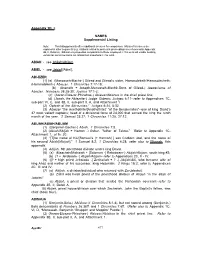
Appendix 3B, I. NAMES Supplemental Listing Note: This listing primarily offers additional avenues for comparison. Many of its names are explored in other segments (e.g. citations related to post-exilic proceedings are referenced in Appendix 3B, II, Detail A). Biblical encyclopedias comparable to those employed in this work will enable locating verses for some few items not referenced elsewhere in this work. ABIAH - see Abijah/Abijam. ABIEL - see Jehiel[/Abiel]. ABI-EZER (1) (a) (Manasseh-Machir-) Gilead and Gilead’s sister, Hammoleketh/Hammolecheth; (Hammoleketh-) Abiezer. 1 Chronicles 7:17-18; (b) (Asenath + Joseph-Manasseh-Machir-Sons of Gilead-) Jeezer/sons of Abiezer. Numbers 26:28-30; Joshua 17:1-2; (c) (Aaron-Eleazar-Phinehas-) Abiezer/Abishua in the chief priest line; (d) (Joash, the Abiezrite-) Judge Gideon; Judges 6:11--refer to Appendices 1C, sub-part VI, C, and 3B, II, sub-part II, A, and Attachment 1. (2) Ophrah of the Abi-ezrites.” Judges 6:24, 8:32. (3) Abiezer “the Anethothite/[Anathothite]” “of the Benjaminites”--one of king David’s 37 most valiant captains; head of a divisional force of 24,000 that served the king the ninth month of the year. 2 Samuel 23:27; 1 Chronicles 11:28, 27:12. ABIJAH/ABIAH/ABIJAM (1) (Benjamin-Becher-) Abiah. 1 Chronicles 7:8. (2) (Abiah/Abijah + Hezron -) Ashur, “father of Tekoa.” Refer to Appendix 1C, Attachment 1, at fn. 20. (3) “[T]he name of his/[Samuel’s (+ Hannah) ] son firstborn Joel, and the name of his second Abiah[/Abijah].” 1 Samuel 8:2; 1 Chronicles 6:28; refer also to Elkanah, this appendix. -

Priesthood, Cult, and Temple in the Aramaic Scrolls from Qumran
PRIESTHOOD, CULT, AND TEMPLE IN THE ARAMAIC SCROLLS PRIESTHOOD, CULT, AND TEMPLE IN THE ARAMAIC SCROLLS FROM QUMRAN By ROBERT E. JONES III, B.A., M.Div. A Thesis Submitted to the School of Graduate Studies in Partial Fulfillment of the Requirements for the Degree Doctor of Philosophy McMaster University © Copyright by Robert E. Jones III, June 2020 McMaster University DOCTOR OF PHILOSOPHY (2020) Hamilton, Ontario (Religious Studies) TITLE: Priesthood, Cult, and Temple in the Aramaic Scrolls from Qumran AUTHOR: Robert E. Jones III, B.A. (Eastern University), M.Div. (Pittsburgh Theological Seminary) SUPERVISOR: Dr. Daniel A. Machiela NUMBER OF PAGES: xiv + 321 ii ABSTRACT My dissertation analyzes the passages related to the priesthood, cult, and temple in the Aramaic Scrolls from Qumran. The Aramaic Scrolls comprise roughly 15% of the manuscripts found in the Qumran caves, and testify to the presence of a flourishing Jewish Aramaic literary tradition dating to the early Hellenistic period (ca. late fourth to early second century BCE). Scholarship since the mid-2000s has increasingly understood these writings as a corpus of related literature on both literary and socio-historical grounds, and has emphasized their shared features, genres, and theological outlook. Roughly half of the Aramaic Scrolls display a strong interest in Israel’s priestly institutions: the priesthood, cult, and temple. That many of these compositions display such an interest has not gone unnoticed. To date, however, few scholars have analyzed the priestly passages in any given composition in light of the broader corpus, and no scholars have undertaken a comprehensive treatment of the priestly passages in the Aramaic Scrolls. -

Fisher, Memories of The
Memories of the Ark: Texts, Objects, and the Construction of the Biblical Past By Daniel Shalom Fisher A dissertation submitted in partial satisfaction of the requirements for the degree of Doctor of Philosophy in Near Eastern Studies in the Graduate Division of the University of California, Berkeley Committee in charge: Professor Ronald Hendel, Chair Professor Robert Alter Professor Benjamin Porter Professor Daniel Boyarin Professor Ann Swidler Summer 2018 Copyright © 2018 by Daniel Shalom Fisher, All Rights Reserved. 1 Abstract Memories of the Ark: Texts, Objects, and the Construction of the Biblical Past by Daniel Shalom Fisher Doctor of Philosophy in Near Eastern Studies University of California, Berkeley Professor Ronald Hendel, Chair This dissertation constructs a cultural biography of the Ark of the Covenant, exploring through it the close, but often complicated, relationships that have existed between objects and collective memory in Biblical and ancient Jewish societies. The project considers the different ways in which Biblical writers and interpreters have remembered the Ark as a “real thing,” forming it, mobilizing it, and making meaning with it—largely in its absence after its likely loss in the 6th century BCE. From Exodus to Chronicles and in works of biblical interpretation through the Mishnah, this project explores how these writers reimagine the Ark to craft visions for their people’s future through their people’s past. The project is structured around five interrelated case studies from the Ark’s mnemohistory, considering different dimensions of cultural memory’s entanglement in material culture. Each case study draws upon and enriches text-, source-, and redaction-critical approaches, investigating the growth and reshaping of biblical writings as creative memory work. -

Saint Zechariah
Saint Zechariah Priest, Prophet, Martyr Zechariah was a priest in the division of Abijah, After Elizabeth had given birth to their son, she one of the twenty-four priestly divisions formed during named him John as the Angel Gabriel had commanded. the reign of King David to minister at the Temple in At the time it was customary to name children after a Jerusalem. Each of the orders was responsible for member of the family, but no one in their family was ministering during a different week and Sabbath. Each named John so they went to ask Zechariah what he wished division would begin their service at midday during the to name the child. When he wrote on a tablet that John Sabbath before the time when they would perform the was his name, Zechariah’s muteness was cured and he morning sacrifice. From then on, they would serve in the named their child John. Zechariah then began to prophesy temple, offering the daily sacrifices and administering the about the messiah and his son in a prayer which became Priestly Blessings to the people, with their service ending known as the Benedictus. at midday on the following Sabbath after they had Less than a year after the birth of their son, King performed the morning sacrifice. Herod ordered a census be taken at the command of the As a member of the priestly line of Israel, Emperor of the Roman Empire, Augustus Caesar. Zechariah was well respected along with his wife Zechariah and Elizabeth remained where they lived while Elizabeth who was also from one of the priestly lines of many others around them had to travel to their hometown Israel. -

Jews Synagogues in Kerala. Most of Their Synagogues Still Exist in Kerala, Whereas a Few Were Sold Or Adapted for Other Uses
Social Impact Assessment Study of Black Jewish Synagogue Mattancherry (Ancient Monument Renovation & Protection Project) (0.0351Hectares) Draft Report (Date : 04/06/2019) Notification : C.8-65887/16 dated 19/3/2019 Requisition Authority Archeological Department By KERALA VOLUNTARY HEALTH SERVICES COLLECTORATE P.O. MULLANKUZHY KOTTAYAM – 686002 E-mail : keralavhs@yahoo.co.in Web : www.keralavhs.co.in Social Impact Assessment Study of Black Jewish Synagogue Mattancherry (Ancient Monument Renovation & Protection Project) (0.0351 Hectares) Draft Report Requisition Authority Archeological Department By KERALA VOLUNTARY HEALTH SERVICES COLLECTORATE P.O. MULLANKUZHY KOTTAYAM – 686002 E-mail : keralavhs@yahoo.co.in Web : www.keralavhs.co.in Abbreviations APL Above Poverty Line BPL Below Poverty Line PWD Public Works Department DLPC District Level Purchasing Committee LA Land Acquisition NGO Non - Governmental Organisation NTH Non - Title Holder MSW Master of Social Work PAP Project Affected Person PAF Project Affected Family TH Title Holder SIA Social Impact Assessment SIMP Social Impact Management Plan RTFCTLARR Act The Right to Fair Compensation and Transparency in Land Acquisition, Rehabilitation and Resettlement Act CONTENTS 1.1. Introduction - Project and Public Purpose 1.2. Location 1.3. Size and Attributes of Land Acquisition 1.4. Alternatives Considered 1.5. Social Impact 1.6. Mitigation Measures 1.7. Assessment of Social Impacts at different Phases of Project Introduction Cochin Jewish Community. The oldest of the Indian Jewish communities was in the erstwhile Cochin Kingdom. The traditional account is that traders of Judea arrived at Cranganore, an ancient port near Cochin in 562 BCE, and that more Jews came as exiles from Israel in the year 70 CE, after the destruction of the Second Temple. -

13. BIBLICAL EPIC: 1 Chronicles Notes
13. BIBLICAL EPIC: 1 Chronicles Notes rown 1 Chron 1-9: 1 Adam, Seth, Noah, Shem, Eber, Abraham; Abraham's sons were Isaac and Ishmael; Isaac's sons were Esau and Israel. Kings ruled in Edom. 2 Judah's line led to Obed, Jesse and David. Caleb was son of Hezron; Jerahmeel was firstborn of Hezron. Caleb's line were the Kenites. 3 David had 6 sons at Hebron, 4 by Bathshua and 9 others. Solomon's line led to Jeconiah, and then to Elioenai. 4 Reaiah's sons were the Zorathites; God blessed Jabez; Shelah's sons worked for the king. Simeon's line went to Gedor to seek pasture. 5 Reuben lost his birthright; his sons lived in Gilead. The sons of Gad and Manasseh lived in Bashan until the captivity. 6 Levi's sons were Gershon, Kohath and Merari. The musicians were Heman and Asaph. Aaron's sons made offerings and were given cities. 7 Issachar's sons were 87,000. Benjamin's sons were Bela, Beker and Jediael. Ephraim's line led to Joshua. Asher's sons were 26,000. 8 Benjamin fathered Bela, Ashbel, Aharah, Nohah and Rapha; Ner's line was Kish, Saul, Jonathan; Ulam’s sons were mighty men. 9 Jerusalem was resettled by Judah, Benjamin, Ephraim and Manasseh; there were priests and Levite gatekeepers. Kish fathered Saul. While anonymous, Jewish tradition assigns 1-2 Chronicles to Ezra in the 5th century BC. It was written after a remnant of Israel had returned from exile in Babylon. Although they had hoped to enter a time of blessing in anticipation of the Messiah, they were quickly disappointed. -

Jews: an Historical Exploration Through the Shores of Kerala History
IOSR Journal Of Humanities And Social Science (IOSR-JHSS) Volume 20, Issue 9, Ver. VI (Sep. 2015) PP 43-45 e-ISSN: 2279-0837, p-ISSN: 2279-0845. www.iosrjournals.org Jews: an Historical Exploration through the shores of Kerala History Dr. Sumi Mary Thomas Assistant Professor, Dept. of History, CMS College, Kottayam, Kerala, 686001 Kerala, also known as Gods own Country, is a state in the South West region of India. The state was formed on November 1956 by combining various Malayalam speaking regions. From the early days Kerala is famous for trade, particularly for spices which attracted traders from different parts of the world. As per Sumerian records Kerala is referred as the ‘Garden of spices’ or ‘The spice garden of India’. The state has attracted Babylonians, Assyrians, Egyptians, Arabs, Greeks and Romans. Merchants from West Asia and Southern Europe established coastal ports and settlements in Kerala. Jewish connection with Kerala was started in the tenth Century B C. The Jews are an ethnic group who settled first in Muziris, the earliest seaport in Kerala which was known as ‘Little Jerusalem’. They came to Kerala during the period of King Solomon. It is believed that King Solomon had visited Kerala for trade purposes. From the very early days the country Kerala was known to the ancient Jews. In the 6th century BC the Jews came to Kodungaloor in order to escape from the Babylonian captivity of Nebuchednezzar. In 580 B C the Babylonian Empire conquered Yehudah (Judah), the Southern region of ancient Israel. After 50 years later, the Persian Empire (ancient Iran) conquered the Babylonian Empire and allowed the Jews to return home to the land of Israel. -

Ernakulam-Sessions-Court-Jisha-Murder-Case.Pdf
Bar & Bench (www.barandbench.com) 1 IN THE COURT OF SESSION/SPECIAL JUDGE FOR SCHEDULED CASTES AND SCHEDULED TRIBES (PREVENTION OF ATTROCITIES) ACT, 1989 AS AMENDED BY ACT 1 OF 2016, ERNAKULAM DIVISION Present :- Sri. N. Anilkumar, Sessions Judge/Special Judge Tuesday, the 12th day of December, 2017/ 21st Agrahayana, 1939 SESSIONS CASE NO.662/2016 (Crime No.909/2016 of Kuruppampady Police Station) Complainant State of Kerala, represented by the Superintendent of Police SB CID, Kozhikode Range By Special Public Prosecutor Sri. N.K. Unnikrishnan and Sri P. Radhakrishnan. Accused Muhammed Ameer-ul Islam, aged 22 years, S/o Nizamudheen, Rampursathra Panchayath, Ward No.8, Near Baithur Muharam Juma Masjid, Doldagramam, Nagaon District, Assam State. By Adv. Sri Biju Antony Aloor, Sri Togi K.I. and Sri Satheesh Mohanan Offences: Under Sections 449, 342, 376, 376(A), 302 and 201 of IPC and u/s 3(1)(a), 3(1)(w)(i) & (ii) and 3(2)(v) of the Scheduled Castes and Scheduled Tribes (Prevention of Atrocities) Act, 1989 as amended by Act (1) of 2016. Bar & Bench (www.barandbench.com) 2 Plea of the Accused: Not guilty Finding: Guilty Sentence/Order: The convict is sentenced to- 1. (i) rigorous imprisonment for 7 (seven) years and also to pay a fine of Rs.15,000/- (Rupees fifteen thousand only) and in default, to undergo rigorous imprisonment for 6 (six) months more for the offence under section 449 of IPC; (ii) rigorous imprisonment for 1 (one) year and also to pay a fine of Rs.1000/- (Rupees one thousand only) and in default, to undergo rigorous imprisonment -

Divine Manifestations in the Slavonic Pseudepigrapha Orientalia Judaica Christiana
Divine Manifestations in the Slavonic Pseudepigrapha Orientalia Judaica Christiana 2 Orientalia Judaica Christiana, the Christian Orient and its Jewish Heritage, is dedicated, first of all, to the afterlife of the Jewish Second Temple traditions within the traditions of the Christian East. A second area of exploration is some priestly (non-Talmudic) Jewish traditions that survived in the Christian environment Divine Manifestations in the Slavonic Pseudepigrapha Andrei Orlov govg'ms press 2009 For law and June Fair ... Then the old man stood up and stretched his hands to wards heaven. His fingers became like ten lamps of fire and he said to him, "If you will, you can become all flame/5 Apophthegmata Patrum, Joseph of Panephysis, 7. Abba Bessarion, at the point of death, said, "The monk ought to be as the Cherubim and the Seraphim: all eye." Apophthegmata Patrum, Bessarion, 11. TABLE OF CONTENTS Preface xv Locations of the Original Publications xvii List of Abbreviations xix INTRODUCTION. The Kavod and Shem Paradigms and Divine Manifestations in the Slavonic Pseudepigrapha 1 Silvanus and Anthony. 3 Moses and Elijah 8 Enoch and Abraham 12 PART I: THE DIVINE BODY TRADITIONS 19 "Without Measure and Without Analogy": The Tradition of the Divine Body in 2 (Slavonic) Enoch 21 Introduction 21 Adamic Tradition of 2 Enoch 23 The Corporeality of the Protoplast 26 From the Four Corners of the World 29 The Measure of the Divine Body. 34 Bodily Ascent 37 Adam and Enoch: "Two Powers" in Heaven 38 Two Bodies Created According to the Likeness of the Third One 43 The Pillar of the World: The Eschatological Role of the Seventh Antediluvian Hero in 2 (Slavonic) Enoch 49 Introduction 49 I. -

On Diversity and Identity Among Indian Jews by Prof. Shalva Weil
A course under MHRD scheme on Global Initiative on Academic Network (GIAN) On Diversity and Identity among Indian Jews by Prof. Shalva Weil Course Venue: Date: 23-31 January 2017 Time: 4:00-7:00 PM Overview The Jews of India represent a miniscule minority residing in harmony among Hindus, Muslims and Christians for generations. India is the only place in the world where Jews never suffered antisemitism, except during the Portuguese colonial period, as will be demonstrated in the course. The three major Jewish communities – the Bene Israel, the Cochin Jews, and the ‘Baghdadi’ Jews – retained their faith in monotheism in a polytheistic environment, whilst at the same time, being influenced by caste and religion in their daily practices. In the final analysis, Indian nationalism and global politics decided their fate. Today, most Indian Jews live in the state of Israel. However, their impact on Indian society was great, whether in the field of the arts, the military, commerce or in the free professions. The course throws new light on the diversity of India’s Jewish communities, spinning the unique narratives of each community. It includes in the discussion the temporary sojourn of 1 European Jews, who fled the Holocaust to India. In addition, it touches upon an increasing global phenomenon of weaving “Israelite” myths whereby the Shinlung of north-east India, today designated the “Bnei Menashe”, are migrating to Israel, and new Judaizing groups are emerging in India, such as the “Bene Ephraim” of Andhra Pradesh. The course provides a critical analysis of the position of the Jews in India both synchronically and diachronically. -

2018040471-1.Pdf
ABSTRACT OF THE AGENDA FOR THE SITTING OF REGIONAL TRANSPORT AUTHORITY ERNAKULAM PROPOSED TO BE HELD ON 16/11/2016 AT 11.00 AM AT PLANNING OFFICE CONFERENCE HALL ,GROUND FLOOR, CIVIL STATION, KAKKANAD Item No:01 G/7967/2016/E Agenda:-To consider the application for the grant of fresh regular permit in respect of a suitable stage carriage not less than 5 years with seating capacity not less than 28 in all to operate on the route Perumbavoor-Trippunithura- Kakkanad via Pattimattam- Pazhamthottam-Puthencruz- Vandippetta- Eruveli- Chottanikkara and Puthiyakavu as Ordinary Moffusil Service. Applicant:Mr.Bobas.P.K, Plamoottil House, Pazhamthottam.P.O Proposed timings Perumbavr Pattimattam Kizhak Pazhm Puthe Chotta Tripnthra Kakkanad mblm thtam ncruz nikra A D A D P P A D A D 6.56 7.11 7.31 7.51 7.55 8.25 9.35 8.55 9.05 8.45 8.25 9.51 10.21 10.31 10.46 11.06 11.26 11.40 12.1 0 1.35 1.05 1.55 2.25 4.00 3.30 4.25 5.05 6.35 6.05 5.45A 5.20 5.55D 6.50 7.20 7.30 7.45H Last Trip-Pallikkara Pass at 7.35pm Item No:02 C1/95291/2016/E Agenda: To consider the application for variation of regular permit in respect of stage carriage KL 06 D 366 operating on the route ADIVARAM-ALUVA (Via) Kadapara, Malayattoor, Neeleswaram, Kottamam, Kalady, Mattur College Jn, Nayathode, Air port road, Thuruthissery, Lakshamveedu colony, Devi Kshethram, Nedumbassery M A H S Jn ,Athani, Kunnumpuram, Desam,and Paravurkavala as ordinary Moffusil service on the strength of regular permit No.7/ 761/2008 valid upto 02/03/2018. -

DNA, Race, and Gene Talk in Judaism and Messianic Judaism
View metadata, citation and similar papers at core.ac.uk brought to you by CORE provided by IUScholarWorks Lineage Matters: DNA, Race, and Gene Talk in Judaism and Messianic Judaism Sarah Imhoff and Hillary Kaell In July 2012, Jewish Voice host Jonathan Bernis began his week- ly television program by telling the audience: “One of the questions I’m asked by Christians who love Jewish people and Israel is ‘How can I find out if I am Jewish? I just feel so Jewish. Is there any way to know?’” Then he introduced his guest: “My guest today says yes you can. He claims your history is actually written into your cells. He is a DNA expert who helps people discover their ancestry through DNA testing, and he is the world’s foremost authority on DNA testing as it relates to Jewish lineage. Please help me welcome to Jewish Voice DNA expert Bennett Greenspan.”1 At first, Bernis and Greenspan may seem like odd bedfellows. Bernis is a Messianic Jew and his target audience is evangelical and Pentecostal Christians with connections to Messianic Judaism, a loose movement of congregations, missionary associations, and online min- istries that incorporate aspects of Jewish culture and ritual into Chris- tianity. Messianic Jews believe that Judaism is a heritable “genetic” lineage and that Jews, therefore, remain Jewish even after they are “completed” through belief in the messiahship of Jesus. Although this idea is the fundamental basis for the movement, today upwards of 70 percent of congregants are actually what insiders call Gentile Believers (GBs), a fact that few scholars have addressed in depth likely because “ethnic” Jews like Bernis comprise Messianic Judaism’s public face.2 By contrast, Greenspan, CEO of the largest personal DNA test- ing company in the world, is Jewish, not Messianic.