Picabia: the Forgotten Artist in America
Total Page:16
File Type:pdf, Size:1020Kb
Load more
Recommended publications
-

Dada Bros Man Ray & Picabia
MAN RAY & PICABIA DADA BROS MAN RAY & PICABIA The Avant-Garde Masters at Vito Schnabel Gallery By Ines Valencia April 26, 2021 Man Ray, The Tortoise, 1944. Oil on canvas, 20 x 24 inches (50.8 x 61 cm) © Man Ray 2015 Trust / Artists Rights Society (ARS), NY / ADAGP, Paris 2021. Vito Schnabel Gallery, in New York, is hosting the historical different media types (including painting, photography, exhibition Man Ray & Picabia. This show brings together collage, and sculpture,) although he considered himself a two of the most legendary artists of the avant-garde and painter. In Paris, he joined the Dadaist group and became essential contributors to the Dada movement. It runs well known for his photography (his subjects included through May 15, 2021. some of the biggest names in the art world, including Pablo Picasso, Salvador Dalí, Peggy Guggenheim, Gertrude Stein, Man Ray & Picabia focuses on nine carefully selected and Jean Cocteau). However, he abandoned the medium for paintings produced between the late 1920s and mid-1950s painting in 1937. (some of which have not been on display to the public for decades.) Both artists did meet briefly in 1915 (Marcel Francis Picabia (1879-1953) was a French artist specializing Duchamp introduced them). Still, the dialogue presented in in painting, poetry, and typography. Like Man Ray, he was the exhibition is an imaginary one between the two, one one of the central figures in the Dada movement. Having that uses juxtaposition to bring their similarities to light. moved on from Impressionism, Pointillism, and Cubism, Both were prominent figures in the Dada and Surrealist Picabia identified with the provocative spirit of Dada and movements, and breaking rules played significant roles was active in both Paris and Zürich but renounced his ties in redefining what can be considered art and what it can to the movement in 1921, the same year Man Ray arrived in contain and do. -

Recording of Marcel Duchamp’S Armory Show
Recording of Marcel Duchamp’s Armory Show Lecture, 1963 [The following is the transcript of the talk Marcel Duchamp (Fig. 1A, 1B)gave on February 17th, 1963, on the occasion of the opening ceremonies of the 50th anniversary retrospective of the 1913 Armory Show (Munson-Williams-Procter Institute, Utica, NY, February 17th – March 31st; Armory of the 69th Regiment, NY, April 6th – 28th) Mr. Richard N. Miller was in attendance that day taping the Utica lecture. Its total length is 48:08. The following transcription by Taylor M. Stapleton of this previously unknown recording is published inTout-Fait for the first time.] click to enlarge Figure 1A Marcel Duchamp in Utica at the opening of “The Armory Show-50th Anniversary Exhibition, 2/17/1963″ Figure 1B Marcel Duchamp at the entrance of the th50 anniversary exhibition of the Armory Show, NY, April 1963, Photo: Michel Sanouillet Announcer: I present to you Marcel Duchamp. (Applause) Marcel Duchamp: (aside) It’s OK now, is it? Is it done? Can you hear me? Can you hear me now? Yes, I think so. I’ll have to put my glasses on. As you all know (feedback noise). My God. (laughter.)As you all know, the Armory Show was opened on February 17th, 1913, fifty years ago, to the day (Fig. 2A, 2B). As a result of this event, it is rewarding to realize that, in these last fifty years, the United States has collected, in its private collections and its museums, probably the greatest examples of modern art in the world today. It would be interesting, like in all revivals, to compare the reactions of the two different audiences, fifty years apart. -

The Founders of the Woodstock Artists Association a Portfolio
The Founders of the Woodstock Artists Association A Portfolio Woodstock Artists Association Gallery, c. 1920s. Courtesy W.A.A. Archives. Photo: Stowall Studio. Carl Eric Lindin (1869-1942), In the Ojai, 1916. Oil on Board, 73/4 x 93/4. From the Collection of the Woodstock Library Association, gift of Judy Lund and Theodore Wassmer. Photo: Benson Caswell. Henry Lee McFee (1886- 1953), Glass Jar with Summer Squash, 1919. Oil on Canvas, 24 x 20. Woodstock Artists Association Permanent Collection, gift of Susan Braun. Photo: John Kleinhans. Andrew Dasburg (1827-1979), Adobe Village, c. 1926. Oil on Canvas, 19 ~ x 23 ~ . Private Collection. Photo: Benson Caswell. John F. Carlson (1875-1945), Autumn in the Hills, 1927. Oil on Canvas, 30 x 60. 'Geenwich Art Gallery, Greenwich, Connecticut. Photo: John Kleinhans. Frank Swift Chase (1886-1958), Catskills at Woodstock, c. 1928. Oil on Canvas, 22 ~ x 28. Morgan Anderson Consulting, N.Y.C. Photo: Benson Caswell. The Founders of the Woodstock Artists Association Tom Wolf The Woodstock Artists Association has been showing the work of artists from the Woodstock area for eighty years. At its inception, many people helped in the work involved: creating a corporation, erecting a building, and develop ing an exhibition program. But traditionally five painters are given credit for the actual founding of the organization: John Carlson, Frank Swift Chase, Andrew Dasburg, Carl Eric Lindin, and Henry Lee McFee. The practice of singling out these five from all who participated reflects their extensive activity on behalf of the project, and it descends from the writer Richard Le Gallienne. -

The Influence of Gertrude Stein on Marsden Hartley’S Approach to the Object Portrait Genre Christal Hensley
One Portrait of One Woman: The Influence of Gertrude Stein on Marsden Hartley’s Approach to the Object Portrait Genre Christal Hensley Marsden Hartley’s 1916 painting One Portrait of One Woman Hartley’s circle that assembled abstract and/or symbolic forms is an object portrait of the American abstractionist poet and in works called “portraits.”4 writer Gertrude Stein (Figure 1). Object portraits are based on Although several monographs address Stein’s impact on an object or a collage of objects, which through their associa- Hartley’s object portraits, none explores the formal aspects of tion evoke the image of the subject in the title. In this portrait, this relationship.5 This paper first argues that Hartley’s initial the centrally located cup is set upon an abstraction of a checker- approach to the object portrait genre developed independently board table, placed before a half-mandorla of alternating bands of that of other artists in his circle. Secondly, this discussion of yellow and white, and positioned behind the French word posits that Hartley’s debt to Stein was not limited to her liter- moi. Rising from the half-mandorla is a red, white and blue ary word portraits of Picasso and Matisse but extended to her pattern that Gail Scott reads as an abstraction of the Ameri- collection of “portraits” of objects entitled Tender Buttons: can and French flags.1 On the right and left sides of the can- Objects, Food, Rooms, published in book form in 1914. And vas are fragments of candles and four unidentified forms that finally, this paper concludes that Hartley’s One Portrait of echo the shape of the half-mandorla. -

The Artwork Caught by the Tail*
The Artwork Caught by the Tail* GEORGE BAKER If it were married to logic, art would be living in incest, engulfing, swallowing its own tail. —Tristan Tzara, Manifeste Dada 1918 The only word that is not ephemeral is the word death. To death, to death, to death. The only thing that doesn’t die is money, it just leaves on trips. —Francis Picabia, Manifeste Cannibale Dada, 1920 Je m’appelle Dada He is staring at us, smiling, his face emerging like an exclamation point from the gap separating his first from his last name. “Francis Picabia,” he writes, and the letters are blunt and childish, projecting gaudily off the canvas with the stiff pride of an advertisement, or the incontinence of a finger painting. (The shriek of the commodity and the babble of the infant: Dada always heard these sounds as one and the same.) And so here is Picabia. He is staring at us, smiling, a face with- out a body, or rather, a face that has lost its body, a portrait of the artist under the knife. Decimated. Decapitated. But not quite acephalic, to use a Bataillean term: rather the reverse. Here we don’t have the body without a head, but heads without bodies, for there is more than one. Picabia may be the only face that meets our gaze, but there is also Metzinger, at the top and to the right. And there, just below * This essay was written in the fall of 1999 to serve as a catalog essay for the exhibition Worthless (Invaluable): The Concept of Value in Contemporary Art, curated by Carlos Basualdo at the Moderna Galerija Ljubljana, Slovenia. -

Responses to the Armory Show Reconsidered
"One Term is as Fatuous as Another": Responses to the Armory Show Reconsidered J. M. MANCINI University College Cork If the picture, the Nude Descending the Staircase, had not had that title, it would never have attractedany attentionat all. It was the title. At that moment in history, art and politics came together.... Everythingone wanted stood together at the end of a single perspective and everything one hated stood together in the opposite direction.2 Perhaps because of its familiarity to students of American culture, the 1913 InternationalExhibition of Modem Art is an event whose meaning has remained peculiarly impervious to serious reevaluation. The exhibition, better known as the Armory Show, was the first large- scale exhibition of modernistart in the United States. It was arranged under the auspices of the American Association of Painters and Sculptors, a loosely organized group of artists who had decided by 1911 that there were too few exhibition opportunitiesin the United States, and mastermindedby ArthurB. Davies, Walt Kuhn, and Walter Pach, who negotiated the display of approximately1300 works, more than a third of them European,in order to show Americans what was new and exciting in the world of art. The show was a success in terms of sales and attendance;nearly $45,000 worth of art-including works by the likes of Picasso, Matisse, and Gauguin-changed hands, and approximately275,000 people came to see it during its two months in J. M. Mancini is a lecturer in history at University College Cork and Post-Doctoral Fellow for 1999-2000 at the National Museum of American Art, Smithsonian Institution. -

Société Anonyme
Société Anonyme Research Question: Modern art of the early 20th century: To what extent did the Société Anonyme contribute to the change of appreciation and perception of art? Visual Arts Extended Essay Word Count: 3,015 1 Table of Contents Title Page……………………………………………………………………….….page 1 Introduction…………………………………………………………………….. page 3 Representation………………………………………………………………..…page 5 Beginning of Modern Art …………………………………………………...page 6 Artistic Styles before the Société……………………………………....…page 7 Impact of Société Anonyme…………………………………………...……page 10 Conclusion…………………………………………………………………………page 11 References………………………………………………………………………....page 12 Images…………………………………………………………………………….…page 14 2 Introduction The Société Anonyme was an organization created by pioneering artists Marcel Duchamp, Man Ray, and Katherine Dreier in 1920. The goal of the society was to normalize modern art in America that was already popular in Europe and introduce American avant-garde artists, by sponsoring lectures, exhibitions, concerts, and publications. The organization collected over a thousand pieces of art, and held 80 exhibitions between 1920 and 1940. The founding members were disappointed by the lack of appreciation for modern art in America by critics and citizens and “believed it was important that the history of art be chronicled not by the historians or academics but by the artists.” (Gross) They felt responsible to give credit to all pieces and artists. This society has had a lasting effect since it first began, donating over a thousand pieces to the Yale art gallery. Marcel Duchamp, a French-American painter born in 1887, was well known for his works of cubism and Dadaism. Cubism is an early 20th century art movement where objects are portrayed in blocky, abstract ways that shows multiple viewpoints and lacks movement. -
Linking Local Resources to World History
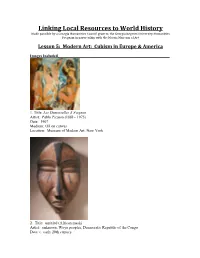
Linking Local Resources to World History Made possible by a Georgia Humanities Council grant to the Georgia Regents University Humanities Program in partnership with the Morris Museum of Art Lesson 5: Modern Art: Cubism in Europe & America Images Included_________________________________________________________ 1. Title: Les Demoiselles d’Avignon Artist: Pablo Picasso (1881– 1973) Date: 1907 Medium: Oil on canvas Location: Museum of Modern Art, New York 2. Title: untitled (African mask) Artist: unknown, Woyo peoples, Democratic Republic of the Congo Date: c. early 20th century Medium: Wood and pigment Size: 24.5 X 13.5 X 6 inches Location: Los Angeles County Museum of Art 3. Title: untitled (African mask) Artist: Unknown, Fang Tribe, Gabon Date: c. early 20th century Medium: Wood and pigment Size: 24 inches tall Location: Private collection 4. Title: Abstraction Artist: Paul Ninas (1903–1964 Date: 1885 Medium: Oil on canvas Size: 47.5 x 61 inches Location: Morris Museum of Art 5. Title: Houses at l’Estaque Artist: Georges Braque (1882–1963) Date: 1908 Medium: Oil on Canvas Size: 28.75 x 23.75 inches Location: Museum of Fine Arts Berne Title: Two Characters Artist: Pablo Picasso (1881– 1973) Date: 1934 Medium: Oil on canvas Location: Museum of Modern Art in Rovereto Historical Background____________________________________________________ Experts debate start and end dates for “modern art,” but they all agree modernism deserves attention as a distinct era in which something identifiably new and important was under way. Most art historians peg modernism to Europe in the mid- to late- nineteenth century, with particularly important developments in France, so we’ll look at that time in Paris and then see how modernist influences affect artworks here in the American South. -

Joan of Arc and Francis Picabia's La Sainte-Vierge." Dada/ Surrealism 22 (2018): N
View metadata, citation and similar papers at core.ac.uk brought to you by CORE provided by Iowa Research Online Dada/Surrealism ISSN 0084-9537 No. 22 DOI: 10.17077/0084-9537.1321 Dada, War and Peace Article 5 The Blood of France: Joan of Arc and Francis Picabia's La Sainte- Vierge Simon Marginson University of York accessible Copyright © 2018 Simon Marginson Recommended Citation Marginson, Simon. "The Blood of France: Joan of Arc and Francis Picabia's La Sainte-Vierge." Dada/ Surrealism 22 (2018): n. pag. Web. Available at: https://doi.org/10.17077/0084-9537.1321 Hosted by Iowa Research Online This Theme Essay is brought to you for free and open access by Iowa Research Online. It has been accepted for inclusion in Dada/Surrealism by an authorized administrator of Iowa Research Online. For more information, please contact lib-ir@uiowa.edu. The Blood of France: Joan of Arc and Francis Picabia’s La Sainte-Vierge Simon Marginson Francis Picabia’s blasphemously titled drawing La Sainte-Vierge first appeared in the twelfth issue of his journal 391 (fig. 1). Originally published in May 1920, Picabia’s iconoclastic gesture is now canonical. An icon in its own right, La Sainte-Vierge continues to serve as the ubiquitous visual shorthand for Dada’s nihilistic, anti-art tendencies within general accounts of modernism, despite the existence of a large body of specialist literature that expands the significance of the drawing well beyond these persistent clichés. Indeed, La Sainte-Vierge has been subject to such wide- ranging interpretations that George Baker has complained that it is in danger of becoming the Rorschach blot of art history (38). -
JAN MATULKA the Unknown Modernist
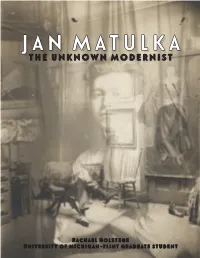
JAN MATULKA the unknown modernist Rachael Holstege University of michigan-flint graduate stUdent This online catalogue is published in conjunction with exhibition Jan Matulka: The Unknown Modernist presented at the Flint Institute of Arts, Flint, Michigan. Jan Matulka loans courtesy of McCormick Gallery, Chicago. Copyright © 2020 Rachael Holstege. All right reserved. No part of this publication may be reproduced, transmitted, or utilized in any form or in any means, electronic or mechanical, including photocopying, recording, or information storage or retrieval systems, without the prior written consent of the author. Rights and reproductions: © 2020 Estate of Pablo Picasso / Artists Rights Society (ARS), New York (page 10) © Georgia O’Keeffe Museum / Artists Rights Society (ARS), New York (page 12) © Estate of Stuart Davis / Licensed by VAGA at Artists Rights Society (ARS), New York (page 17) Cover: Double-exposed portrait of Jan Matulka, c. 1920. Jan Matulka papers, 1923-1960. Archives of American Art, Smithsonian Institution. contents PREFACE ix INTRODUCTION 5 THE YOUNG ARTIST 6 LE TYPE TRANSATLANTIQUE 8 THE NEW SPIRIT 11 LASTING LEGACY 13 ABSTRACTED CONCLUSION 16 CATALOGUE 20 BIBLIOGRAPHY 22 III PREFACE I first read the name Jan Matulka while nature of art history, Matulka is continually looking through the Flint Institute of Arts forgotten. This exhibition looks to reinforce database of the nearly 9,000 artworks in his role in the pivotal decades of the their collection. Eager to find a compelling development of modern art and reinforce artist or subject to base my research on, his importance in the oeuvre of art history. I was continually drawn to two works in the collection by Czech-American artist This catalogue and accompanying exhibition Jan Matulka. -

Dada and Surrealist Journals in the Mary Reynolds Collection
Documents of Dada and Surrealism: Dada and Surrealist Journals in the Mary Reynolds Collection... Page 1 of 26 Documents of Dada and Surrealism: Dada and Surrealist Journals in the Mary Reynolds Collection IRENE E. HOFMANN Ryerson and Burnham Libraries, The Art Institute of Chicago Dada 6 (Bulletin The Mary Reynolds Collection, which entered The Art Institute of Dada), Chicago in 1951, contains, in addition to a rich array of books, art, and ed. Tristan Tzara ESSAYS (Paris, February her own extraordinary bindings, a remarkable group of periodicals and 1920), cover. journals. As a member of so many of the artistic and literary circles View Works of Art Book Bindings by publishing periodicals, Reynolds was in a position to receive many Mary Reynolds journals during her life in Paris. The collection in the Art Institute Finding Aid/ includes over four hundred issues, with many complete runs of journals Search Collection represented. From architectural journals to radical literary reviews, this Related Websites selection of periodicals constitutes a revealing document of European Art Institute of artistic and literary life in the years spanning the two world wars. Chicago Home In the early part of the twentieth century, literary and artistic reviews were the primary means by which the creative community exchanged ideas and remained in communication. The journal was a vehicle for promoting emerging styles, establishing new theories, and creating a context for understanding new visual forms. These reviews played a pivotal role in forming the spirit and identity of movements such as Dada and Surrealism and served to spread their messages throughout Europe and the United States. -

1. Tristan Tzara, 'The Gas Heart'
Notes Dates of reviews in newspapers are given in brackets as in note 5, chapter 3 (11.11.46). PART 1: DADA, SURREALISM AND THE THEATRE OF CRUELTY 1. Andre Breton, Manifeste du Surrealisme, p. 51. 2. Ibid., p. 11. 3. Louis Aragon, 'Une vague de reves', Commerce, automne, 1924. 4. From Nadeau, Surrealisme, p. 45. 1. Tristan Tzara, 'The Gas Heart' 1. J. H. Matthews, Theatre in Dada and Surrealism, p. 18. 2. Michel Corvin, Revue d'Histoire du Theatre, 1971-73. Le Theatre existe-t-il?', p. 21. 3. Elmer Peterson, Tristan Tzara, p. 43. 4. Ibid., p. 35. 5. Micheline Tison-Braun, Tristran Tzara inventeur de l'homme nouveau, p. 7. 6. Corvin, p. 228. 171 French Theatre 1918-1939 7. Matthews, pp. 19-22. 8. Ibid., pp. 22-30. 9. Corvin, p. 255. 10. Ibid., p. 260. 11. Matthews, pp. 3(}..38. Quotes Henri Behar, Etude sur le Theatre Dada et Surrealiste, p. 159. 12. Ibid., p. 32. 13. Matthews, pp. 3(}..35. 14. Ibid., p. 20. 2. Andre Breton 1. Andre Breton,Manifeste du Surrealisme, p. 37. 2. Ibid., p. 34. 3. Andre Breton, Les Pas perdus, p. 9. 4. J. H. Matthews, Theatre in Dada and Surrealism, p. 88. 5. Ibid., p. 90. 6. Ibid., pp. 97-100. 3. Roger Vitrac, 'Victor' 1. Henri Behar, Roger Vitrac, p. 18; 42-47. 2. Antonin Artaud, Oeuvres completes, II, p. 14. 3. Ibid., II, p. 12. 4. Ibid., II, p. 267. 5. See J. H. Matthews, Theatre in Dada and Surrealism, pp. 109-32. From Le Figaro litteraire (11.11.46).