List of Books Available in the Library
Total Page:16
File Type:pdf, Size:1020Kb
Load more
Recommended publications
-
Advancing Workers' Rights Under Sdgs
Research Paper IX Advancing Workers’ Rights under SDGs Policy and Situational Analysis of Decent Work in Nepal The Centre for the Study of Labour and Mobility is a research centre within Social Science Baha, Kathmandu, set up with the primary objective of contributing to broader theories and understandings on labour and mobility. It conducts interdisciplinary, policy-relevant research on critical issues affecting working people; serves as a forum to foster academic, policy and public debates; and provides new insights on the impact of labour and migration. Jeevan Baniya with 9 789937934916 Sunita Basnet, Himalaya Kharel and Rajita Dhungana Research Paper IX Advancing Workers’ Rights under SDGs Policy and Situational Analysis of Decent Work in Nepal Jeevan Baniya with Sunita Basnet, Himalaya Kharel and Rajita Dhungana This publication was made possible through the financial support of the Solidarity Center, Washington DC. The authors would like to thank Krishma Sharma of the Solidarity Center for administrative and logistical support during the study. The authors are grateful to Saloman Rajbanshi, Senior Programme Officer and Dr Biswo Poudel, Economic Advisor, from ILO Country Office Nepal, for reviewing the report and providing their valuable feedback. The authors would also like to thank Khem Shreesh at Social Science Baha for his feedback while finalising this publication. © Solidarity Center, 2019 ISBN: 978 9937 9349 1 6 Centre for the Study of Labour and Mobility Social Science Baha 345 Ramchandra Marg, Battisputali, Kathmandu – 9, Nepal Tel: +977-1-4472807, 4480091 • Fax: +977-1-4475215 info@ceslam.org • www.ceslam.org Printed in Nepal CONTENTS Acronyms v Executive Summary vii 1. -

Himalayan Studies and Interdisciplinarity Workshop
HIMALAYA, the Journal of the Association for Nepal and Himalayan Studies Volume 39 Number 1 Article 24 July 2019 Himalayan Studies and Interdisciplinarity Workshop Priyanka Chatterjee Sikkim University Follow this and additional works at: https://digitalcommons.macalester.edu/himalaya Recommended Citation Chatterjee, Priyanka. 2019. Himalayan Studies and Interdisciplinarity Workshop. HIMALAYA 39(1). Available at: https://digitalcommons.macalester.edu/himalaya/vol39/iss1/24 This work is licensed under a Creative Commons Attribution-Noncommercial-No Derivative Works 4.0 License. This Conference Report is brought to you for free and open access by the DigitalCommons@Macalester College at DigitalCommons@Macalester College. It has been accepted for inclusion in HIMALAYA, the Journal of the Association for Nepal and Himalayan Studies by an authorized administrator of DigitalCommons@Macalester College. For more information, please contact scholarpub@macalester.edu. length, also engaged with meaningful presentations and interactions. In her inaugural speech, Maitreyee Choudhury (Director, CHS) stressed the need for interdiscipliarity to continue within Himalayan studies. The chief guest Sanchari Roy Mukherjee (Dean, Faculty Arts Commerce & Law, NBU) emphasized the growing importance of science and technological studies in the Himalayas and the consequential Himalayan Studies and politics of knowledge involved in Interdisciplinarity Workshop such developments in the context of the Himalayas. Anup K Dutta Centre for Himalayan Studies (CHS) (NBU) emphatically put forth the University of North Bengal (NBU), India need for conceiving the Himalayas December 11-12, 2018 as a multi-state formation and for defamiliarizing social science The World Mountain Day was research practices from the received uniquely observed at the Centre notions of borders and boundaries if for Himalayan Studies (CHS) at the Himalayan studies is to be continued University of North Bengal (NBU), in a persuasive manner. -
Page 20 Backup Bulletin Format on Going
gkfnL] nfsjftf] { tyf ;:s+ lt[ ;dfh Nepali Folklore Society Nepali Folklore Society Vol.1 December 2005 The NFS Newsletter In the first week of July 2005, the research Exploring the Gandharva group surveyed the necessary reference materials related to the Gandharvas and got the background Folklore and Folklife: At a information about this community. Besides, the project office conducted an orientation programme for the field Glance researchers before their departure to the field area. In Introduction the orientation, they were provided with the necessary technical skills for handling the equipments (like digital Under the Folklore and Folklife Study Project, we camera, video camera and the sound recording device). have completed the first 7 months of the first year. During They were also given the necessary guidelines regarding this period, intensive research works have been conducted the data collection methods and procedures. on two folk groups of Nepal: Gandharvas and Gopalis. In this connection, a brief report is presented here regarding the Field Work progress we have made as well as the achievements gained The field researchers worked for data collection in from the project in the attempt of exploring the folklore and and around Batulechaur village from the 2nd week of July folklife of the Gandharva community. The progress in the to the 1st week of October 2005 (3 months altogether). study of Gopalis will be disseminated in the next issue of The research team comprises 4 members: Prof. C.M. Newsletter. Bandhu (Team Coordinator, linguist), Mr. Kusumakar The topics that follow will highlight the progress and Neupane (folklorist), Ms. -

Read: Literary Journey: a Rushdie-Esque Take on Nepali Travel Writing
Upclose with Rabindra Mishra | Pitamber Sharma on books March-May 2007|Issue-02 What Kathmandu is reading NIBl bene_ In itssoci.1 rttjIOnSibIlily. WM !hIIln mind NIBl hllstarted I ~-- uniquo, firsl of ~I kind lithe .... whlclo Ihl'" wllh _lily I IIttlo III whal k ..... ,chl.vu. Th. S""I,I OepolH. Accllunl pennita any INGOINGO Iccount ------- hoIdH to d.lm 11har>i In !hi ptofllS of IhI account Tht Soclll Deposit Aecount Is NIBl's conlrlbUlllln te help Ichl",e . belle< NEPAL INVESTMENT BANK LTD. Nepal. WIll NIBl Invit.In such ~niza~en. to Join hinds with us In this ncbIoClUH. 'fru[y a :Nepafi (/Jan/t www.melamchiwater.org Melamchi Water Supply Project: At a Glance A view of Sindhu Adit Access Raod Intake Point of Melamchi Water The main objective of the Melamchi Water supply Project is to solve the chronic water supply shortage in the Kathman- du Valley. The objective will be achieved by the diversion of 170 MLD water from the Melamchi River via 26.5 km long tunnel system to a water system to a water treatment plant and distribution facilities to be constructed in the Kathmandu Valley. The project consists of the following four major components; namely; Infrastructure Development, Social and Environment Support, Institutional Reforms and Implementation. These major components are supplemented by management, social institutional activities including the Social Uplift Program (SUP) for the MDS works, Resettlement Action Plan (RAP), Environmental Management and Monitoring for all the components, and related support activities. The current activity of the Project are mainly concentrated on construction of the access roads, main access road in the Melamchi Valley, and the preparations for the procurement of the Management contractor (MC), in place of the previ- ously proposed Private Operator of the distribution system. -
Nepal Side, We Must Mention Prof
The Journal of Newar Studies Swayambhv, Ifliihichaitya Number - 2 NS 1119 (TheJournal Of Newar Studies) NUmkL2 U19fi99&99 It has ken a great pleasure bringing out the second issue of EdltLlo the journal d Newar Studies lijiiiina'. We would like to thank Daya R Sha a Gauriehankar Marw&~r Ph.D all the members an bers for their encouraging comments and financial support. ivc csp~iilly:-l*-. urank Prof. Uma Shrestha, Western Prof.- Todd ttwria Oregon Univers~ty,who gave life to this journd while it was still in its embryonic stage. From the Nepal side, we must mention Prof. Tej Shta Sudip Sbakya Ratna Kanskar, Mr. Ram Shakya and Mr. Labha Ram Tuladhar who helped us in so many ways. Due to our wish to publish the first issue of the journal on the Sd Fl~ternatioaalNepal Rh&a levi occasion of New Nepal Samht Year day {Mhapujii), we mhed at the (INBSS) Pdand. Orcgon USA last minute and spent less time in careful editing. Our computer Nepfh %P Puch3h Amaica Orcgon Branch software caused us muble in converting the files fm various subrmttd formats into a unified format. We learn while we work. Constructive are welcome we try Daya R Shakya comments and will to incorporate - suggestions as much as we can. Atedew We have received an enormous st mount of comments, Uma Shrcdha P$.D.Gaurisbankar Manandhar PIID .-m -C-.. Lhwakar Mabajan, Jagadish B Mathema suggestions, appreciations and so forth, (pia IcleI to page 94) Puma Babndur Ranjht including some ~riousconcern abut whether or not this journal Rt&ld Rqmmtatieca should include languages other than English. -
PDF Generated By
OUP UNCORRECTED PROOF – FIRSTPROOFS, Mon Dec 07 2015, NEWGEN 3 Vajrayāna Traditions in Nepal Todd Lewis and Naresh Man Bajracarya Introduction The existence of tantric traditions in the Kathmandu Valley dates back at least a thousand years and has been integral to the Hindu– Buddhist civi- lization of the Newars, its indigenous people, until the present day. This chapter introduces what is known about the history of the tantric Buddhist tradition there, then presents an analysis of its development in the pre- modern era during the Malla period (1200–1768 ce), and then charts changes under Shah rule (1769–2007). We then sketch Newar Vajrayāna Buddhism’s current characteristics, its leading tantric masters,1 and efforts in recent decades to revitalize it among Newar practitioners. This portrait,2 especially its history of Newar Buddhism, cannot yet be more than tentative in many places, since scholarship has not even adequately documented the textual and epigraphic sources, much less analyzed them systematically.3 The epigraphic record includes over a thousand inscrip- tions, the earliest dating back to 464 ce, tens of thousands of manuscripts, the earliest dating back to 998 ce, as well as the myriad cultural traditions related to them, from art and architecture, to music and ritual. The religious traditions still practiced by the Newars of the Kathmandu Valley represent a unique, continuing survival of Indic religions, including Mahāyāna- Vajrayāna forms of Buddhism (Lienhard 1984; Gellner 1992). Rivaling in historical importance the Sanskrit texts in Nepal’s libraries that informed the Western “discovery” of Buddhism in the nineteenth century (Hodgson 1868; Levi 1905– 1908; Locke 1980, 1985), Newar Vajrayāna acprof-9780199763689.indd 872C28B.1F1 Master Template has been finalized on 19- 02- 2015 12/7/2015 6:28:54 PM OUP UNCORRECTED PROOF – FIRSTPROOFS, Mon Dec 07 2015, NEWGEN 88 TanTric TradiTions in Transmission and TranslaTion tradition in the Kathmandu Valley preserves a rich legacy of vernacular texts, rituals, and institutions. -

The Kamaiya System of Bonded Labour in Nepal
Nepal Case Study on Bonded Labour Final1 1 THE KAMAIYA SYSTEM OF BONDED LABOUR IN NEPAL INTRODUCTION The origin of the kamaiya system of bonded labour can be traced back to a kind of forced labour system that existed during the rule of the Lichhabi dynasty between 100 and 880 AD (Karki 2001:65). The system was re-enforced later during the reign of King Jayasthiti Malla of Kathmandu (1380–1395 AD), the person who legitimated the caste system in Nepali society (BLLF 1989:17; Bista 1991:38-39), when labourers used to be forcibly engaged in work relating to trade with Tibet and other neighbouring countries. In the 18th and 19th centuries, the Gorkhali and Rana rulers introduced and institutionalised new forms of forced labour systems such as Jhara,1 Hulak2, Beth3 and Begar4 (Regmi, 1972 reprint 1999:102, cited in Karki, 2001). The later two forms, which centred on agricultural works, soon evolved into such labour relationships where the workers became tied to the landlords being mortgaged in the same manner as land and other property. These workers overtimes became permanently bonded to the masters. The kamaiya system was first noticed by anthropologists in the 1960s (Robertson and Mishra, 1997), but it came to wider public attention only after the change of polity in 1990 due in major part to the work of a few non-government organisations. The 1990s can be credited as the decade of the freedom movement of kamaiyas. Full-scale involvement of NGOs, national as well as local, with some level of support by some political parties, in launching education classes for kamaiyas and organising them into their groups culminated in a kind of national movement in 2000. -
Editorial in the NAME of Bikasø
Editorial IN THE NAME OF BIKAS¯ Mary Des Chene In desperate times people do the best they can. It seems that in Nepal’s bik¯as world it is always desperate times. Overwhelming needs, impending crises and unachieved goals dominate the agenda. Thus academic critiques of bik¯as projects that point to methodological or theoretical weaknesses can be deflected with the counter charge of a lack of realism. Academics can appear to development practitioners to be impractical, either mired in ground-level description or lost in clouds of theoretical reflection. In either case they can seem to be uninterested in, or incapable of producing clear guidelines for social transformation. Academic analyses of bik¯as can seem useless at best, parasitical at worst, feeding off of activities meant to meet urgent needs without contributing to those efforts. Development practitioners, in turn, can appear to academics to be mercenary, carrying out rapid superficial surveys on the basis of which major social interventions will be made. Such research and the resulting social programs can appear to be vastly uninformed about the realities they seek to assess and then change. Bik¯as studies and projects can seem poorly designed at best, immoral at worst, feeding off poverty and need without effectively alleviating them. When the infamous “real world” meets the equally infamous “ivory tower” of academia the result is too often an unproductive, even uncomprehending standoff. Both academics and development practitioners can easily believe that the other inhabits a fictional world, while they themselves best know the real condition of “the people”. This special issue of Studies in Nepali History and Society reflects on the real world of bik¯as in its Nepali avatars. -

Research Brief
Research No. Brief, 29 No. 29, January 2020 January‘WRITING AS2020 AN ACTIVISM’: BAREFOOT RESEARCHRESEARCH INITIATIVE IN NEPAL BRIEF ‘Writing as an Activism’: Barefoot Research Initiative in Nepal Introduction This research brief is a report on the experience of managing/executing a “barefoot research” initiative in three districts—Kapilvastu, Nawalparasi and Rupandehi—of Nepal’s Western Tarai from November 2017 to June 2019. An assessment of the intellectual landscapes of rights-based advocacy research in the Western Tarai, from which this work follows, was described earlier in Martin Chautari (2019).1 The barefoot research (hereafter BR) initiative is different from academic, participatory or action research. BR initiative argues for the inclusion of those who have been directly or indirectly denied the opportunities to do social science research and to disseminate knowledge from below. BR initiative is an attempt to explore the ways in which grassroots-based individuals may be able to claim their “right to research”2 and advocate their causes for “democratic citizenship.”3 The possibilities of BR initiative emerge out of asymmetrical arrangements. Nepal’s socio-political transitions from the Panchayat system through multi- party democracy and the civil war up until the promulgation of the new constitution in 2015 have witnessed evolving academia, civil society and public intellectuals.4 The current challenge faced in the Nepali intellectual landscape is its inability to harness and articulate grassroots-based voices that are necessary for a devolved democracy. Such disconnect is due to a peripheral blindness 1 Martin Chautari. 2019. Institutional Assessment of Rights-based Advocacy in the Western Tarai. -

Climate Change in Nepal/Himalaya: a Bibliography
CLIMATE CHANGE IN NEPAL/HIMALAYA: A BIBLIOGRAPHY Sharad Ghimire Martin Chautari Climate change discussion formally entered in Nepal in 1992, when Nepal became a party of the United National Framework Convention of Climate Change (UNFCCC) at the Rio Convention, 1992. However, Nepal and the Himalayan region were already in the academic radar of the emerging debate of climate change. For example, based on entries in this bibliography, Nakajima talked about the climate change in South Asia in 1976. In the late 1980s, when human induced climate change was getting academic recognition globally, Nepal and Himalayan region also got some attention, as shown here by Shah (1985–1986) and Gleick (1989), who, however, focused mainly on security and conflict aspects of GHGs effect and climate change. These were the initial academic concerns of climate change in the region. Climate change in the region got proper attention from scholars only in the late 1990s, for instance, see Huq (1992), Chalise (1994), Yogacharya (1996), Mirza and Dixit (1997), Nakawo et al. (1997), Shrestha et al (1999), Kalshian (1999). Their focus were on measuring greenhouse gases, identifying general impacts as well as specific impacts on water and snow /glaciers, calculation of the temperature rise and also on communication aspects of climate change. Only after 2000, particularly after 2007, climate change became one of major concerns in academia in Nepal from diverse perspectives, e.g., in the form of natural and social science research, development programs and policy making. The trend is increasing more rapidly in recent days and has generated a substantial number of literatures. -
Federalism Is Debated in Nepal More As an ‘Ism’ Than a System
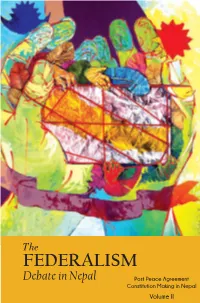
The FEDERALISM Debate in Nepal Post Peace Agreement Constitution Making in Nepal Volume II Post Peace Agreement Constitution Making in Nepal Volume II The FEDERALISM Debate in Nepal Edited by Budhi Karki Rohan Edrisinha Published by United Nations Development Programme (UNDP) Support to Participatory Constitution Building in Nepal (SPCBN) 2014 United Nations Development Programme (UNDP) Support to Participatory Constitution Building in Nepal (SPCBN) UNDP is the UN’s global development network, advocating for change and connecting countries to knowledge, experience and resources to help people build a better life. United Nations Development Programme UN House, Pulchowk, GPO Box: 107 Kathmandu, Nepal Phone: +977 1 5523200 Fax: +977 1 5523991, 5523986 ISBN : 978 9937 8942 1 0 © UNDP, Nepal 2014 Book Cover: The painting on the cover page art is taken from ‘A Federal Life’, a joint publication of UNDP/ SPCBN and Kathmandu University, School of Art. The publication was the culmination of an initiative in which 22 artists came together for a workshop on the concept of and debate on federalism in Nepal and then were invited to depict their perspective on the subject through art. The painting on the cover art titled ‘’Emblem” is created by Supriya Manandhar. DISCLAIMER: The views expressed in the book are those of the authors and do not necessarily represent the views of UNDP/ SPCBN. PREFACE A new Constitution for a new Nepal drafted and adopted by an elected and inclusive Constituent Assembly (CA) is a key element of the Comprehensive Peace Agreement (CPA) of November 2006 that ended a decade long Maoist insurgency. -

The Institute of Chartered Accountants of Nepal CA Member List from 2074-04-01 to 2075-03-21 Sno
The Institute of Chartered Accountants of Nepal CA Member List From 2074-04-01 to 2075-03-21 SNo. M.No. Name Address Phone Email 1 1 KOMAL BAHADUR CHITRACAR P.O.Box: 2043, Lalitpur SMPC, Ward No. 1, K.B. 01 5528671 komal@kbc-ca.com.np Chitrakar & Co., Jwagal, Lalitpur. 2 2 TIRTHA RAJ UPADHYAYA 124 Lal Colony Margh Lal Durbar, Kathmandu 01 4470964,4410927 trunco@ntc.net.np 3 3 KAUSHALENDRA KUMAR SINGH 158\18 kha shreeram marga Battisputali kathmandu 01 4472463 4 4 GOPAL PRASAD RAJBAHAK battisputali-9 surya bikram marga kathmandu. 4470612 rajbahak11@hotmail.com 5 5 SUNDAR MAN SHRESTHA P.O.Box 3102, Sundarman & Co., Pulchowk, Lalitpur, 01 5521804 sundarmans@gmail,com House No. 20/8, Kathmandu. 6 6 KISHOR BANSKOTA 46, New Plaza Road, Putalisadak, Kathmandu. 01 5250354 kishorbanskota@gmail.com 7 7 DR. GOVINDA RAM AGRAWAL KMPC-33, Gyaneshwor, Shruti Marg, House No: 52, 01 4413117 Ktm. 8 8 SHASHI SATYAL 58 Amal Margh Gairidhara, Kathamandu 01 4444084 ssatyal@trunco.com.np 9 9 PRADEEP KUMAR SHRESTHA Pradeep & Co., Sanepa, Lalitpur, P.O.Box 12143, Ktm. 01 5551126 pradeep.stha@gmail.com 10 10 PRATAP PRASAD PRADHAN Sanepa, Lalitpur, 01 5551126 pratap.pradhan@pppradhan.com 11 11 MADAN KRISHNA SHARMA CSC & Co, 175 Gairidhara Marga, Gairadhara, Ktm 014004580 madan.sharma@cscnepal.com 12 14 JITENDRA BAHADUR RAJBHANDARY POB No. 23725, Sherpa Mall 2nd Floor, Durbar Marga 01 4228352, 4247177 jitendra@jbrdibins.com.np Kathmandu. 13 16 DHRUBA NARAYAN KARMACHARYA Kathmandu MPC, Ward No. 32, Saraswati Marga, 01 4602357 dnkarmacharya.com.np@gmail.com Koteshwor, House No.